

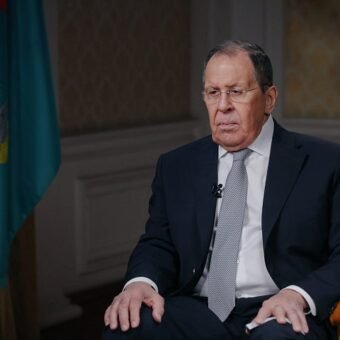
Foreign Minister Sergey Lavrov’s interview with the RBC television channel, Moscow, August 28, 2026

(Comment – Amarynth: This transcript is now completed. The most major comment by Mr Lavrov is:
“I would point to our national character and to the proverbs that reflect our faith in people right to the very end.
But the end has already come.”
This confirms and cements the very structural change that Russia is taking in terms of the collective West, because they are not honest and reliable brokers. Mr Lavrov is telling the collective West to go and pound sand forever. )
—
Question: Mr Lavrov, thank you very much for agreeing to speak with us. The first question is, one might say, conceptual – concerning the world order. Previously, we discussed the existence of a bipolar world. Subsequently, following the collapse of the USSR, we spoke of a unipolar world. How would you characterise the present state of the world? What is its nature?
Sergey Lavrov:
The world currently stands at a stage of transformation and profound change. These changes will, in all likelihood, span an entire era, such that the generation currently residing on Earth may not witness the final configuration – if, of course, it does ultimately materialise, and if it proves possible to bring it about.
It is true that, after the dissolution of the Soviet Union, unipolarity was proclaimed almost openly. Francis Fukuyama captured the aspirations, dreams, and prevailing sentiment of Western society and its elites when he declared that the “end of history” had arrived and that henceforth only the Western liberal model, in economics, politics, and human rights, would constitute the sole, dominant paradigm on the planet. At the time, this was received in various ways, but I do not recall our Chinese counterparts commenting on it with any great frequency.
Domestically, it was remarked upon with a certain enthusiasm, with many claiming that finally, we had cast off the “shackles” of the communist system. “God bless America!” – as the then President of the Russian Federation, Boris Yeltsin, exclaimed in the US Congress. Western experts flooded into all our governmental institutions, took part in reforms, contributed to the preparation of privatisation – and a great deal else was occurring at that time.
Many raised the alarm regarding the dangers inherent in this course. In my view, the events of the 2000 election reflected the desire of the nation and its people to reclaim its historical essence, its destiny, and its national pride. At the end of December 1999, when Boris Yeltsin publicly transferred power to Vladimir Putin, followed by elections being called, a new epoch dawned. I do not believe that the proponents of the unipolar theory anticipated that Russia would be as compliant as it had been under Boris Yeltsin’s administration. One must give the West its due – it began not only by “patting us on the shoulder,” but also by creating a certain atmosphere.
In 2001, President Vladimir Putin paid his first visit to the United States. A year later, US President George W. Bush visited our country. A declaration was signed – you may not believe this (and indeed, few now recall it) – concerning new strategic relations between the Russian Federation and the United States.
The Russian President responded in kind. Even before George W. Bush assumed office, he had interacted with Bill Clinton. Not long ago, Vladimir Putin recalled how, at their first meeting, he proposed to Bill Clinton that if they were no longer adversaries, if the Soviet Union had ceased to exist, if the Warsaw Pact was no more, if ideological differences were a thing of the past, and if they did not wish to dissolve NATO – then they might admit Russia to the alliance and collaborate. Bill Clinton hemmed and hawed, to put it in colloquial terms. This occurred at a G20 summit. In the evening, at a reception, Bill Clinton responded that his advisers had told him it “would not work.”
The intention was always to keep us close, but not as an equal partner. Even when we triumphantly joined the G8, which later became the G7, it was not full-fledged membership.
Question: Seven plus one, was it not?
Sergey Lavrov: No, it was the Group of Eight whenever political issues were on the agenda, whenever the West sought to impose certain political assessments – for example, with regard to Iran or the DPRK. Moreover, they imposed assessments that exceeded the parameters of existing UN Security Council resolutions.
We participated in meetings of finance ministers, but the most sensitive matters concerning the governance of the international monetary, financial, and trade system were discussed by the G7. Only afterwards was the head of our Ministry of Finance invited and, by and large, simply informed of what had already been agreed upon in those areas.
The watershed moment in the evolution of our position, in our final understanding and the crystallisation of the conviction that the West would not engage with us on equal terms, was President Vladimir Putin’s Munich speech in 2007. Everyone is familiar with it. Everything said on that occasion was grounded in facts. And beyond the facts – dry, compelling, irrefutable – there was also an emotional dimension. If one watches the recording of that address, one can see how, in citing examples of the West deceiving us at every turn, whether regarding NATO or numerous other specific crises, Vladimir Putin quite literally asked, as they say, with palpable emotion: “Why are you doing this? Why not conduct our affairs as was promised, as is set out in so many documents?”
At present, the emergence of a multipolar world is an established reality. China is the world’s largest economy by purchasing power parity, a fact recognised by virtually all, and the pace of its economic development is highly impressive. At the same time, there is now talk of a possible crisis of overproduction: owing to what the West has done to its own economies, there may be nowhere to sell everything China produces. But that is a practical matter, and it will be resolved.
In geopolitical and geoeconomic terms, giants such as China, India, and Brazil are asserting themselves and rapidly strengthening their economic positions, claiming their rightful place in world economic affairs.
Fundamental transformations are underway in Africa, as the continent begins to distance itself from the neo-colonial model whereby raw materials were extracted there and value was added in Europe.
Question: Did Africans also realise they had been deceived?
Sergey Lavrov: Of course. They were happy, enjoying political freedom and political decolonisation. But economic deprivation remains.
Question: A follow-up question that concerns many segments of our population. You mentioned how, in 2007, President Vladimir Putin said the West always deceives. But we still hear reactions from our country like, “Look, they’ve deceived us again.” And everyone asks: why do we still expect fair play? How much longer are we going to fall for this?
Sergey Lavrov: After all, we are a God-fearing nation. Our multi-ethnic people have many proverbs about their great patience: “God endured, and so must we,” “Measure twice, cut once,” “Don’t hold your breath for promises.” This reveals something about our psychology – not naivety ingrained by centuries of historical experience, but rather the enduring hope that a scoundrel cannot be a complete scoundrel, to put it simply. [Our epic hero] Ilya Muromets lay idle on the stove for 33 years, waiting for the moment his services would be called upon for his homeland.
Deception lies in the foundation of Western diplomacy. And it still does. We can recall 1999, when the OSCE summit in Istanbul stated that NATO would not expand. Its declaration said so, in different words: no one shall strengthen their security at the expense of others, and no country or organisation in the Euro-Atlantic space shall claim dominance. The North Atlantic Alliance did exactly the opposite.
There are memoirs by Yevgeny Primakov, who headed the Russian Ministry of Foreign Affairs in the mid-1990s. Incidentally, Jack Matlock, the former US ambassador to our country, has published a memoir in which he clearly and unconditionally confirmed what was firmly promised: NATO would not expand if Germany reunified. But the alliance did expand, not just to eastern Germany but to other countries as well.
When we asked how this was possible if we had been promised and given a firm assurance, we were told: “But it was verbal.” Then, in Istanbul in 1999, it was formalised in writing. But the expansion continued. We asked again: “This time it wasn’t verbal, but written, at the highest level.” They answered us without batting an eyelid: “But that’s a political declaration; it’s not legally binding.” Our penultimate attempt was in 2008, when we said: “Okay, since you’re citing the declaration’s non-binding political nature, here’s a legally binding agreement that translates into legal language the same principles enshrined in the OSCE and signed by your leaders.” They “went under the rug,” not even discussing it. The same was true of our last effort to prevent the Ukrainian crisis. In December 2021, we proposed to NATO and the United States that we conclude treaties on European security in this part of our Eurasian continent. Sadly, such examples abound.
Let’s turn to Ukrainian affairs, since we’ve mentioned them. On February 21, 2014, Germany, France and Poland guaranteed, with their ministerial signatures, an agreement between Viktor Yanukovych and the opposition on early elections and the formation of a government of national unity before the elections. The next morning, February 22, the opposition seized government buildings, took to the Maidan and declared: “Congratulations – we’ve created a ‘government of victors!’” And on those same dates, February 22–24, 2014 (read it up, it’s all online) François Hollande, then President of France, Frank-Walter Steinmeier, then German Foreign Minister, Angela Merkel, then Chancellor of Germany, and, of course, William Hague, then British Foreign Secretary, all declared that the people had finally taken power into their own hands. They claimed Viktor Yanukovych had left, and no one knew where he was. But Viktor Yanukovych was at his party congress in Kharkov. That he wasn’t exactly welcomed there is another matter. But he hadn’t fled; he was still in the country.
Question: And after everything that has happened, do we still believe them?
Sergey Lavrov:
I would point to our national character and to the proverbs that reflect our faith in people right to the very end. But the end has already come.
After the special military operation began, the West, having overcome its initial confusion, firmly set out on a course of supplying the Nazi Kiev regime with ever more advanced and increasingly deadly offensive weapons. In one of his speeches in the year the special military operation began, President Vladimir Putin, answering questions about the West’s position, its treachery and duplicity, said that we would always be ready to talk, but that we had learned our lessons and that our relations with the West would never again be what they had been before February 2022.
Question: Since we’re on the subject, the head of Vatican diplomacy, Archbishop Paul Richard Gallagher, and CIA Director John Ratcliffe are both in Moscow this week, on the same day. What is going on?
Sergey Lavrov: The head of Vatican diplomacy and the CIA Director are visiting.
Question: What is behind these visits? What did you discuss?
Sergey Lavrov: In both cases, the visitors came because they wanted to talk.
I spoke with the head of Vatican diplomacy, the Secretary for Relations with States and International Organisations of the Holy See, Archbishop Paul Richard Gallagher. There were no secrets between us. We covered virtually everything later at the news conference.
Of course, they expressed an interest in bringing the Ukrainian conflict to an end as quickly as possible. In particular, they once again confirmed their readiness to assist in resolving humanitarian matters.
Cardinal Matteo Zuppi, whom Pope Leo XIV tasked with facilitating contacts on humanitarian issues, prisoner exchanges and the exchange of bodies between Russia and Ukraine, has visited us several times.
As you know, our Human Rights Commissioner Yana Lantratova is in contact with her Ukrainian counterpart. They use practical, depoliticised language. This approach helps resolve issues, and we support it.
The Vatican has expressed its readiness to assist with these efforts, just as Melania Trump has helped resolve a number of issues brought to her through public organisations.
Naturally, given Mr Gallagher’s interest in achieving a swift settlement – something he has emphasised repeatedly – I provided him with all the examples that we are discussing with you now.
Question: What was his response?
Sergey Lavrov: I pointed out that we had never been short of goodwill, and that back in 2014 we had supported the agreement that had been reached, only to see it trampled upon the very next morning, to the applause of those who had guaranteed its inviolability. A year later, there were the Minsk agreements, in which Russia acted as a guarantor alongside Europeans – Angela Merkel and François Hollande. They were sabotaged in their entirety, despite the fact that in 2019 Emmanuel Macron, who had by then become President of France, gathered the so-called Normandy Four, together with Vladimir Putin, Angela Merkel and Vladimir Zelensky, and we adopted yet another document. It reaffirmed the need to honour the Minsk agreements, especially since they had been endorsed by the UN Security Council.
More recently, Angela Merkel, François Hollande and Pyotr Poroshenko all said that they had never intended to implement any of this. They needed to buy time to arm themselves. And then, of course, there were the manoeuvres of the then British Prime Minister Boris Johnson in April 2022, when he did not let the Ukrainians sign the document which they themselves had drafted and initialled during the Istanbul talks. This was especially pertinent as my interlocutor, Paul Richard Gallagher, is also from the British Isles.
Question: And what did the Vatican’s envoy say?
Sergey Lavrov: I think he understood everything. I can say that he did not bring forward any counterarguments, apart from the general refrain that “we need to bring this to an end as soon as possible.”
Here is what I told him. What the West is currently pushing for is stopping along the line of contact, with a ceasefire but no lasting peace. At the same time, it has been declared for everyone to hear that, once hostilities have been suspended or stopped in this way, neither Ukraine nor the West, at least as far as Europe is concerned, will recognise the territories under Russia’s control as part of the Russian Federation, including under the Russian Constitution. They even proudly say that there must first be a ceasefire, followed by efforts to restore the 1991 borders by peaceful means. Then “stabilisation forces” would be deployed in the territory remaining under Vladimir Zelensky’s control, with the UK and France at the forefront of this, should we say, unhinged initiative.
And these “stabilisation forces” would, in effect, preserve, entrench and protect the neo-Nazi regime – the only regime in the world to have banned an entire language and an entire canonical denomination at the legislative level. Moreover, these bans were introduced long before the special military operation began.
Question: What was the Vatican’s reaction to this?
Sergey Lavrov: I asked the Vatican’s representative to what extent they take these human rights, including religious rights, seriously. He said that this was not right. Let me be frank – and I hope I am not giving away any secrets – in response to my request, he promised to send an appropriate signal in his subsequent contacts with the Ukrainians.
He had visited Kiev one month before coming to Moscow, so I asked him whether they had raised these issues, because the Vatican follows all the developments in the global religious sphere, across all the world’s religions. They could not have been unaware of what was going on. He admitted that he had not had enough time.
However, I have been saying that this state of affairs is unacceptable for several years now. I have been referring to the UN Charter, which states that everyone must respect and ensure human rights irrespective of race, sex, language or religion. In other words, this applies directly to the Kiev regime. And no one, anywhere, in any of the proposals put forward by those seeking to bring the conflict to an end through such a “just settlement” – whether those voices are coming from Europe or from other regions of the world – mentions language, religion or human rights.
At one event, after I had spoken and raised this issue once again, one of my Western colleagues – I will not name him or his country – came up to me over a cup of coffee and said that, if negotiations began, this would be part of them. I replied that this cannot be part of a negotiating package. It is an obligation that Ukraine must fulfil unconditionally. And those who lead and run Ukraine bear direct responsibility for this.
Question: Today, The Wall Street Journal published an article about CIA Director John Ratcliffe’s visit to Moscow. According to the article, he came to warn against a potential Russian attack on a NATO country, most likely one of the Baltic states. US President Donald Trump said it was a “routine” visit. There is another version, namely that on August 14 we asked the Americans to explain how they were helping the Ukrainians carry out strikes against our economic infrastructure. In your view, which of these versions is closer to the truth? What actually happened?
Sergey Lavrov: I wasn’t there. Like the rest of the world, we have procedures governing contacts between intelligence agencies. There is nothing unusual about that. Nor is there anything unusual about them conducting their work quietly.
We also conduct much of our diplomatic work quietly, but diplomats are traditionally expected, by the very nature of their profession, to say something publicly. Of course, we do not disclose details that are particularly sensitive or are still being worked on, when it is important not to jeopardise potential compromises or a possible consensus.
As for August 14, yes, we published something…
Question: It was reported that on August 14 we asked the Americans how they were helping the Ukrainians carry out strikes against our territory, and that we practically issued an ultimatum.
Sergey Lavrov: No, there was no ultimatum on our part.
We did raise the question because reports periodically appear in the Western media about how, specifically, the administration of Donald Trump, which has described the Ukrainian crisis as “Joe Biden’s war,” is helping Ukraine with new financial allocations, weapons, intelligence information and so on. There have been three or four such instances over the past couple of months. When such information appears, we calmly send it to the US State Department through diplomatic channels and ask them to confirm whether it is true.
Question: What was the response?
Sergey Lavrov: We have not received a response even once.
In principle, when it comes to the Americans, Russia appreciates the fact that US President Donald Trump has pursued a policy from the outset that differs from that of the Europeans and former US President Joe Biden. Whatever reservations we may have in making this assessment, he has nevertheless focused on the root causes. Long before his current initiatives, when he was on the campaign trail, he repeatedly said, in effect, forget about NATO [membership for Ukraine]: the Russians had made their position on the alliance clear to us long before President Vladimir Putin. It was unrealistic, he said, and should not even be discussed. Donald Trump said this repeatedly, both before and after Anchorage.
In Anchorage, we discussed a proposal that, as President Vladimir Putin has explained, US Special Envoy to the Middle East Steve Witkoff had brought to us a week before the meeting. It contained certain elements of compromise, but was based on the realities that had emerged on the ground. And when I say “on the ground,” I also include the referendums that had been held there. The proposal was based on these realities, with some limited compromises.
After the NATO summit in June this year, my colleague, US Secretary of State Marco Rubio – I subsequently spoke with him and asked him about this – said that the United States could not be a mediator because it was unequivocally on Ukraine’s side. Apparently, according to him, nothing had happened in Anchorage. What was discussed there was their proposal, which the Ukrainians subsequently rejected.
But this brings us to the question of how Russians negotiate and how negotiations are conducted in the West.
Question: I just wanted to ask: does it often happen that presidents meet simply to talk, without any prior agreements?
Sergey Lavrov: You can certainly meet just to talk, and it is still useful to exchange views even when there is no document. But there is a tradition that goes back centuries: merchants would “shake hands” on a deal – they reached an understanding. That was it. No one signed any papers. It was a matter of honour. It was the same with NATO: they gave us their word, and then later started saying, “Well, those were just words.”
In Anchorage, the United States put forward a proposal. President Vladimir Putin began by reading it out point by point and asking Steve Witkoff, who was present, whether he had set it out correctly. Witkoff nodded and confirmed everything. Once Steve Witkoff had confirmed that everything President Putin had read out accurately reflected the position of US President Donald Trump, President Putin said that there were some nuances, but that he accepted the proposal in full. We were ready to proceed. If that is not agreement, if that is not an understanding, then I don’t know what is.
Immediately following the Anchorage summit, the Europeans, together with Vladimir Zelensky, rushed to court Donald Trump. As a result of their lobbying, which continued for almost the entire year, President of France Emmanuel Macron proudly announced at the G7 summit in Evian in June this year that they had “buried” Anchorage and that Donald Trump was now on their side. I don’t know how that was viewed in the White House, but there was no response to those remarks.
Question: Does that mean that we failed to follow through, that we didn’t court Donald Trump and failed to explain our position to him?
Sergey Lavrov: That’s not our style. We are used to doing things, you might say, “like gentlemen,” or you could put it more colloquially, “like real men.” Essentially, it’s the same thing. We shook hands on the deal.
Question: We stand by our word.
Sergey Lavrov: Exactly. Here is the proposal. We say that we accept it without changes. Just as we essentially accepted the Ukrainian proposal without changes in April 2022 in Istanbul.
Admittedly, after Secretary of State Marco Rubio said that the United States could not act as a mediator, we met with him in Manila on the sidelines of the ASEAN events. Then, about a month ago, he said that they were interested in resolving the Ukrainian crisis, but that new approaches needed to be explored. Russia is ready to hear out any new approaches. In the meantime, we continue our efforts on the ground.
President Vladimir Putin has repeatedly recalled what happened in early April 2022, when we had practically reached an agreement in Istanbul and had initialled the documents, only for the then British Prime Minister Boris Johnson to tell them they could not go ahead. At that time, President of France Emmanuel Macron called Vladimir Putin and asked him, in order to create the best possible atmosphere for signing the document, to make a “gesture of goodwill” and withdraw from Kiev. We withdrew from Kiev. Then, just two days later, when we were no longer there, the BBC arrived and began filming bodies neatly laid out along the roadside in the residential community of Bucha. Even then, President Vladimir Putin said that from that point on we would always remain ready for negotiations, but that we would not declare any ceasefires for the duration of the talks. The fighting will stop only when a comprehensive, long-term settlement has been reached.
And finally, regarding the Americans. At Anchorage itself, during the press conference with President Vladimir Putin, US President Donald Trump spoke in highly positive terms about the results. He said that, essentially, only one difficult issue remained. I am referring to what everyone knows by now – the part of the Donetsk People’s Republic that is still under the control of the Ukrainian armed forces. In his statements in August 2025, Donald Trump stressed in particular that we were not pursuing some kind of ceasefire that would inevitably collapse a year or two later, but were instead working towards establishing lasting and sustainable foundations for a stable settlement. All our main points were fully confirmed.
Question: But if Donald Trump was fully in favour of signing these agreements, and yet nothing came of it, the question arises: is Donald Trump really in charge, and is he as powerful as he wishes to appear?
Sergey Lavrov: I have spoken with US President Donald Trump several times, both during his first term and now. But I have never played golf with him, so I cannot judge the power of his swing. Those who know the sport have told me, however, that he is a very good player.
I will not speculate on how well-coordinated relations within the Western camp are today, or whether they are structured in such a way that it is possible to understand who is doing what and who depends on whom. But the United States is clearly concerned that its once seemingly unlimited power is becoming a thing of the past. You can see this even from the statistics on its share of the global economy. They lead only in terms of military spending. Even there, however, they have now forced Europe to catch up, bringing its combined military spending to almost 1.5 trillion euros. That is the kind of military budget the United States would like to have for itself.
We were absolutely sincere when disaster struck the Americans. On September 11, 2001, President Vladimir Putin was the first to call then US President George W. Bush, the first to offer assistance and the first to express solidarity. Just a few days later, the UN Security Council adopted a resolution that became the basis for the operation launched by the Americans in Afghanistan, with the stated aim, proclaimed to the whole world and enshrined in the Security Council resolution, of eliminating terrorism and helping the Afghan people return to normal life.
As a result, an international coalition was formed under that resolution. We were sincerely prepared to cooperate in various forms. But in the end, instead of eliminating terrorism, the Americans simply decided to stay in Afghanistan. And they remained there until the latest events.
Russia expressed its solidarity primarily because, at that time, we knew and understood better than most what international terrorism was, having seen it actively sponsored in the Caucasus by the British and some other Western countries.
Question: It is good that you mentioned the British. My next question was about them.
In 2022, then British Prime Minister Boris Johnson flew to Kiev, and the signing of the Istanbul agreements was derailed. This week, the new Prime Minister, Andy Burnham, visited Ukraine – the British travel to Ukraine quite frequently. What is Britain’s role in this entire conflict? In your view, are the British currently managing to outmanoeuvre the Americans?
Sergey Lavrov: Britain’s role is highly negative, as it has been for centuries. As far as Russia is concerned, certainly. But the same applies to most others as well – I would not call them partners, but Britain’s “fellow travellers,” because Britain has never had permanent allies. The United States is no exception. They have always looked somewhat down their noses at those Anglo-Saxons who established their own state across the Atlantic.
Since the time of Ivan the Terrible – and there is ample contemporary evidence of this – the British have constantly sought to cause trouble for our country. One need only recall the Crimean War in the late 19th century. During the Revolution, British diplomats actively incited the State Duma and betrayed their own monarchs’ relatives, as Nicholas II and his family were. King George V refused to grant Nicholas II’s direct request for asylum. That was in the spring of 1917. We all know what happened next.
Yes, there was the period of the Second World War. Indeed, they were our allies – both the United States and Britain. Lend-Lease and the Arctic convoys were of great assistance. Many historians write that they played an almost decisive role in enabling us to hold out during the first year, up to the Battle of Moscow.
Then a kind of diplomatic manoeuvring began: the second front, and so on. It gave the impression that they were watching the situation at the front and waiting to see which way it would go. They were thinking about which side to choose.
Question: Then there was the Fulton speech by the then British Prime Minister Winston Churchill. That much is clear.
Sergey Lavrov: Before the Fulton speech, there was also something that our intelligence services did not disclose until recently, because they wanted, after all, to preserve the memory of our alliance. There was Operation Unthinkable, which the British began planning together with the Americans before the end of the Second World War. It envisaged a massive attack on the Soviet Union.
Even so, we do not forget the period of our alliance. But if this was a situational alliance on the part of our partners, our brothers-in-arms during the Second World War, it disappeared very quickly.
Question: I was asking about something else. Their attitude towards us is clear. Do you not think that the British are now outmanoeuvring the Americans on the Ukrainian front?
Sergey Lavrov: Vladimir Zelensky is outmanoeuvring everyone there as well. You do not even need politicians as sophisticated as the British for that. Look at it: Vladimir Zelensky is calling the shots for everyone. That is simply his style.
Apart from the fact that huge amounts of money are disappearing in Ukraine, much of it being stolen, and corruption is flourishing, he is not carrying out the “instructions” of those same Americans regarding cooperation with the National Agency on Corruption Prevention. They also have some kind of special administrative chamber there. They simply ignore these instructions and try to keep these agencies under their control.
But beyond all that, beyond this growing irritation, there is also “irritation with Ukrainians” who have gone to Europe and behave as though they own the place, creating problems for the employment of local citizens in Poland, for example.
There are also problems with grain exports. They have now started transporting grain overland to Poland. The conditions created there for Ukrainian grain are such that Polish farmers are already on the verge of going on strike.
Apart from all these objective facts, Vladimir Zelensky’s behaviour when he travels around the world is such that everyone is expected to listen to him and carry out his orders.
Question: But everyone does listen.
Sergey Lavrov: The irritation is building. But I would not rely on the idea that this irritation will keep growing and that, at some point, they will simply tell him, as it were, “Enough. Surrender.”
No, we must not give in to such sentiments and, of course, we must not give in to the attempts by Vladimir Zelensky, actively provoked with the support of the Europeans, to destabilise our society through terrorist attacks on oil refineries, online marketplaces and civilian infrastructure, designed to sow fear.
Schools, children’s centres, beaches, passenger buses – a huge number of targets that have nothing whatsoever to do with military potential. And the West shamefully remains silent. Sadly, UN Secretary-General António Guterres and High Commissioner for Human Rights Volker Türk are also shamefully silent. They have unequivocally and firmly taken the side of the Ukrainian regime.
Since we have touched upon these terrorist methods, which have been intensifying, and what they have started doing in the Black Sea, for which they have received a much stronger response from us: I know that there are people among us who say, “How could everything have been fine, and then suddenly this…” People comment on it in different ways. Few say that we started it. Almost everyone who grumbles about what is happening in everyday life understands that it was the West that started it. But they keep asking, increasingly often, when we are going to end this and why we cannot do it sooner. After all, they say, we are more powerful.
We have never experienced anything like this in our history. During the Second World War, we did have the United States and Britain on our side. Then, as we advanced victoriously, particularly across Europe, other countries joined our ranks – countries that were already pulling their troops out from under Hitler’s command and sending them over to our side.
This time, many people call it a world war. But the only people in the trenches alongside us were North Korean servicemen. Everyone else is on the other side. As US Secretary of State Marco Rubio said – perhaps it simply slipped out – the United States is not a mediator; it is on Ukraine’s side. That makes the collective West’s front against us a universal one.
Question: You mentioned North Korea. Essentially, we now have two allies – North Korea and Iran. Everyone is asking how we got to this point, how we ended up in such company.
Sergey Lavrov: What’s wrong with such company?
Question: Countries that were once regarded around the world as pariah states have become Russia’s main allies. Many people are asking how this came about.
Sergey Lavrov: They were regarded as pariahs by those who imagined themselves the victors of the Cold War and proclaimed the “end of history” for all time – which is where we began our conversation.
I worked in New York from 1994. At the time, Boris Yeltsin was President of the Russian Federation and Andrey Kozyrev was Foreign Minister. I attended a G8 meeting after the Russian Federation had become part of the group.
I remember feeling uncomfortable because I categorically refused to sign off on unacceptable wording, but they looked at me as though I were a pariah. I said, “Listen, why are you bringing G8 issues here that are on the agenda of the UN Security Council? That’s simply unethical.” I even told them point-blank that I understood what they were trying to do: to extract some kind of agreement from the Russian representative on some wording that they could then promote in the UN Security Council and point the finger at us.
The West has boorish manners. That’s just the way they are. Although, at the time, they were still polishing them a little, given that, as I said, documents proclaiming a strategic partnership with the United States had been adopted.
North Korea. What did it do? It was declared an enemy from the very beginning, the main problem. They drew the conclusion – and it proved to be the right one – that in today’s world, the only guarantee is nuclear weapons. Especially when you have South Korea, US military bases and Japan right next door. No one is threatening them now.
US President Donald Trump recently spoke of North Korea not as a pariah, but of its leader, Kim Jong-un, as a good friend of his, saying that the two of them get along well.
In Iran, completely out of the blue, in June 2025, the United States and Israel bombed the country in the midst of negotiations. The talks were under way; they finished in the evening and agreed to meet again in the morning – and in between, they bombed them. The war lasted 12 days. Then there were the strikes on February 28 this year. Now the Americans say they are demanding that Iran open the Strait of Hormuz. The Islamic Republic of Iran says that, in return, the sanctions must be eased or lifted. And they will keep pressing for that.
But the most interesting thing is that the Strait of Hormuz was completely open until February 28. Following this aggression, Iran demonstrated that it, too, has its own national interests, national pride and traditions. The history of Persia goes back more than a thousand years.
Now, if the Strait of Hormuz is to be reopened, they are discussing a fee for passage. There was no such fee until the United States and Israel launched this reckless attack. Incidentally, we do not want a fee to be introduced either, but that is a matter for further discussions.
One of the consequences of the aggression against Iran is that the position of those in the Iranian leadership who had warned that, without nuclear weapons, Iran would be constantly pressured has been greatly strengthened. These views were marginal under Ayatollah Ali Khamenei and Ali Larijani, Secretary of Iran’s Supreme National Security Council, both of whom were killed.
Now US President Donald Trump says they want to talk to the Iranians, but there is no one there to talk to; he doesn’t know anyone. They killed everyone there. What is that supposed to mean?
Question: Let me ask you an unusual question. Perhaps no one has ever asked you this before. As a diplomat, do you see artificial intelligence as a threat to diplomacy? Two blocs have already emerged. One American bloc is called Pax Silica, and the second, Chinese one is called WAICO.
Sergey Lavrov: “Silica” comes from silicone, as I understand it.
Question: Indeed, countries have started forming separate groups depending on what type of artificial intelligence they use.
Sergey Lavrov: I would say that the idea of creating this kind of division did not come from the countries themselves. They were subjected to these divisive practices. The United States views China as its main competitor. There are trustworthy professional assessments claiming that China is advancing more rapidly and effectively in this domain, given certain national characteristics, including discipline, the readiness to sacrifice free time and to fully invest in one’s work.
It is true that the Americans were the ones who created Pax Silica. They do not want China to be part of it. This coalition was established and presented as an initiative to promote cooperation and control the circulation of semiconductors and other components which are involved in developing and using artificial intelligence in one way or another. Specifically, its purpose is to gather as many countries as possible under this umbrella and set forth rules governing the use of AI, including in terms of its commercial use and possible dual-use, including for military purposes, but in a way that suits the United States, while preventing those who are part of Pax Silica from switching over to China. This is just to give you a rough idea without going into too much detail.
In July 2026, China held the first World Artificial Intelligence Conference, during which it announced the establishment of the World Artificial Intelligence Cooperation Organisation. Russia took part in this conference as a full-fledged founding member – or should I say mother? We are now at a crucial stage of fine-tuning this concept and addressing organisational matters, including the governing bodies, subsidiary institutions, the research council, who would head the organisation and how many vice presidents it will have, etc. There were 29 countries, including Russia, which signed the agreement to establish the World Artificial Intelligence Cooperation Organisation, while the United States has a comparable number of participants. This is a serious matter. In principle, we would like to have a global conversation on this issue without splitting everyone apart in terms of national, ideological, or class-driven affiliations.
China offers an inclusive project which is open to everyone, while Pax Silica is more of a closed cooperation framework.
Question: Is this about selling technology?
Sergey Lavrov: Yes, imposing technology in the long run, as they say. This will not be an easy matter.
By the way, Paul Richard Gallagher, who heads the Vatican’s diplomacy, has recently visited Russia. They share our concern about the fact that there has been a growing number of researchers voicing their misgivings regarding the possibility of controlling AI’s military applications.
Question: We learned that former President of Armenia Robert Kocharyan and his son were both arrested for two months. We saw Armenian law enforcement officers at all the family’s businesses. What is the Foreign Ministry’s position?
Sergey Lavrov: There is another former President of Armenia, Armen Sarkissian, who served as Defence Minister when Robert Kocharyan was President, and went on to become President himself. He is also facing an investigation.
As far as the Foreign Ministry is concerned, we focus on the interests of the people of Armenia. We can see that for many centuries their interests were intertwined with the interests of our nation. We have always been together and demonstrated solidarity towards one another during long stretches of history. Russia was there to help out the Armenian nation and its leaders many times when they found themselves in dire straits. Of course, these interests must dominate the agenda. This is not what today’s leaders in Yerevan are after. They declared the goal to focus on the European Union and adopted a law launching the EU accession process. But when countries of the Eurasian Economic Union issued a statement following their meeting in May 2026 at a summit calling on the Armenian leadership to hold a referendum in order to decide whether they want to be in the EU or stay within the EAEU – I think that this request was completely justified. The norms of one organisation are incompatible with the norms of the other organisation, as has been said many times already. But Prime Minister of Armenia Nikol Pashinyan said that he would make up his mind when the time comes. What does this mean if you have already adopted a law launching Armenia’s accession to the European Union?
Just the other day, I read a news article about Nikol Pashinyan’s statement that they could talk about a referendum once they apply for EU membership, receive a response and once there is a roadmap for this accession. This is when the referendum can happen, he said.
I think that this demonstrates that he does not trust the Armenian voters and the people of Armenia all that much. He should have offered them an honest choice by explaining what they are choosing and what fuels the Armenian economy today. Annual trade exceeded $6 billion over the past three years, and reached $12 billion in one of these years. This is to say that the EAEU fuelled much of Armenia’s development.
Question: Do the processes which are currently unfolding in Armenia remind you in any way of what happened in Ukraine in 2013 when affiliation with two incompatible unions was also on the agenda?
Sergey Lavrov: Viktor Yanukovych’s request to postpone the association agreement rather than cancel it served as a formal pretext for launching the bloody Maidan. It was quite obvious at that time that by becoming an associated member of the European Union, Ukraine would benefit from close to zero tariffs across the board. But they also had zero tariffs within the CIS free trade area. There were no customs borders between us. All we did was tell them that if they opened their border with Europe, we would have to close our border. After all, Russia spent 18 years insisting on having protective tariffs regarding Europe as part of the process to join the WTO. And we got these protections. If you open up your markets, everything will flow there.
Question: Russia has navigated this path in its relations with Ukraine. How can we now avoid repeating the same mistakes with Armenia and refrain from severing relations or breaking ties?
Sergey Lavrov: From our side, everything has been done. All our positions, as well as the advantages that Armenia derives from its participation in the Eurasian Economic Union – including the receipt of energy resources from us at prices three to four times lower than those prevailing in the European Union – remain in place.
I proceed from the assumption that there are good economists in Armenia. Regular contacts are maintained between our respective deputy prime ministers. Any issue of interest to our Armenian counterparts may be raised for discussion, including the situation regarding the South Caucasus Railway, which is operated by Russian Railways under a concession agreement. We are surprised to hear such questions… If they have indeed arisen, one should explain to one’s partner how one sees the matter. Instead, public pronouncements are issued, asserting that the railway is entirely “theirs” and that we, purportedly, owe them two billion dollars. I understand that such statements provoke, in addition to assessments based on economic analysis, an emotional response among our citizens. I am no exception.
One might also recall the situation in Moldova, where the elections were conducted with such intense involvement on the part of the European Union. Even this was insufficient to secure a majority of votes from Moldovans residing in Moldova itself. Only 48 percent supported moving towards the European Union and the election of Maia Sandu as president. The result was determined by the polling stations established across Europe – more than two hundred in total – whereas in Russia, where the largest Moldovan diaspora resides, a mere two polling stations were opened. In effect, 100,000 votes were simply crossed out; people were denied the opportunity to vote.
Incidentally, the European Union presently has a mission there. A similar mission was engaged in “combating hybrid threats” during the parliamentary elections held in Armenia on June 7 this year. That is regrettable.
This is all the more deplorable given that – once again, both in the case of Moldova and in the case of Armenia – the European Union is directly interfering in electoral processes and seeking to exert influence. Admittedly, not as brazenly as was the case in Romania in 2024, when no amount of campaigning proved effective, and the frontrunner was removed from the race after the first round without any explanation.
There are, perhaps, analysts in Armenia and other countries that are courting the European Union. I have not the slightest doubt on that score. Intelligent, perceptive individuals – they must, at long last, understand what the European Union truly represents and what benefit they hope to derive.
Question: After the collapse of the Soviet Union, the concept of the “post-Soviet space” appeared. In 2026, in your opinion, has this concept not yet passed into history? Is it still relevant?
Sergey Lavrov: I believe that it entered the annals of history long ago, as did many other groupings that were formerly empires.
The Soviet Union was, in all probability, an empire, as was the Russian Empire. In some respects, our territorial boundaries were even more extensive. Yet “post” always denotes something that is past. History must be remembered. However, when it comes to contemporary political science, to use the notion that “there was a time, and we must somehow not forget about it”… That is properly the domain of historians and the task of educating young people in schools and universities, in order to preserve our traditions and spiritual values, which have been nurtured across the centuries from one generation to the next. As far as modern politics is concerned, the appropriate term is the one we used in the latest version of the Foreign Policy Concept dated March 31, 2023 – the “Near Abroad.”
The Near Abroad is a neutral designation: neither Soviet, nor imperial, nor democratic. And then there is the “far abroad.” Here live people who – each nation – have the right to choose how to organise their lives and their state, and to determine their own destiny. We have never imposed anything upon anyone.
If one examines the root causes of every crisis, it becomes evident that all the problems arising around us were imported from outside. This includes Britain and the Europeans. Constantly – Europe.
As early as 2004, we witnessed the first Maidan in Ukraine. At that time, Ukraine’s Constitutional Court was compelled to hand down an unconstitutional ruling and conduct a third round of elections, because Viktor Yanukovych, not Viktor Yushchenko, had prevailed in the second round. By decision of Ukraine’s Constitutional Court, a third round was held, even though there was no provision for it in the Constitution. At that time, we worked with both Viktor Yushchenko and Yulia Timoshenko. We respected the will of the Ukrainian people – even that choice, which was arrived at through the fraudulent methods employed by the Europeans. We have nothing for which to reproach ourselves. Perhaps we are criticised for the fact that our “soft power” is too soft, and that it ought to be more assertive.
Question: Yes, I heard in Armenia in May this year that Russia does not know how to wield soft power and that it does not succeed in this regard.
Sergey Lavrov: Yes, perhaps. After all, soft power has now unequivocally degenerated into direct methods of interference in internal affairs. Of course, during both the pre-war period and the war itself, we had – and continue to have – experience in sabotage operations. Our intelligence officers have operated in various countries and have heroically defended our interests. But that, first and foremost, concerns the collection of information. As for orchestrating coups, we never learned how to do that.
Related Posts
-
Foreign Minister Sergey Lavrov’s interview with RT India, Moscow, May 13, 2026
May 13, 2026 -
FM Sergey Lavrov’s interview: Al Arabiya television channel, Moscow, February 18, 2026
February 18, 2026 -
I’m just a Pilgrim
June 12, 2025 -

Caption This
June 8, 2025 -

Crocus Terror: USUK points back at itself!
April 1, 2024 -

Terror in Moscow: what went down
March 28, 2024 -

Fallout from Moscow’s Crocus City Hall
March 25, 2024 -
It’s War: The Real Meat Grinder Starts Now
March 23, 2024 -

A Travelogue of Electoral Donbass
March 20, 2024 -

The Global Majority Mixes in Multipolar Moscow
March 1, 2024