

Transcript : Michael Hudson & Radhika Desai – The ‘Financial D-Day’ Sanctions Are Killing The Dollar, Not Iran
Michael Hudson: The ‘Financial D-Day’ Sanctions Are Killing The Dollar, Not Iran
August 26, 2026. https://www.youtube.com/watch?v=hMbzVHX2VYw&t=7s
Radhika Desai:
Hello and welcome to another Geopolitical Economy Hour, the socialist and anti-imperialist conversation that illuminates the fast-changing political economy and geopolitical economy of our times. You’re watching Geopolitical Economy Hour, and I’m Radhika Desai, geopolitical economist. Today’s show is one of my fortnightly conversations with Professor Michael Hudson, who you see here. Welcome, Michael.
Michael Hudson:
Good to be back.
Radhika Desai:
Michael, today we want to discuss all things dollar and dollar system. This is, in a way, a sort of practice session for us, because we are both speaking at the Eastern Economic Forum next week, which will be held in Vladivostok, and we’ll be on the same panel. I’ll be there in person, you’ll be there by Zoom. Our panel is to be about the payment and settlement infrastructure now being built outside the Western financial system. And clearly you and I have been pressing the need for it, in good part by emphasizing the problems with the dollar system and the need to think about alternatives along the lines laid down by Keynes’s ideas and rationale for an international clearing union and Bretton Woods.
Now this panel couldn’t be happening at a more apt time. There are so many signs of trouble in the dollar system that have been accumulating over the past several months. A very incomplete list would include the following points. There was the Treasury’s recent intervention to save the yen, which failed. There were then promises for further actions which promised to be equally ineffective. There was Bessent’s announcement of a new program for buying long-term bonds, that is, ten-year to thirty-year US Treasuries, which was widely judged to be too puny to be effective in terms of essentially lowering the yield on long-term bonds, which have been going up rather alarmingly, and worse, betraying desperation about the rising cost of US debt just when demand for Treasuries is declining and issuance, that is, supply, is increasing, thanks to Trump’s tax cuts, his increased military spending, and a whole host of other things.
On top of all these things, there have also been hollow threats of an economic D-Day for Iran. Trump also made some equally hyperbolic noises about that. Scott Bessent called it an economic D-Day, and he wrote an editorial in the Financial Times justifying it. But of course all that this action reveals is that the United States has lost its military war in the Middle East. It is now shifting gears to pursuing an economic war, which is moreover also unlikely to be effective in terms of influencing Iran in any way. What it is more likely going to do is divert more Persian Gulf funds away from the dollar system, which, putting pressure on these trading partners of Iran, would, according to Scott Bessent himself, amount to blowing up the global financial system, by which of course he means the dollar-denominated financial system. And finally, there is pressure on the Federal Reserve to tighten rates. But of course doing this in any significant manner will only jeopardize the historic, unprecedented everything bubble, which has relied on easy monetary policy. So, Michael, there is clearly trouble ahead for the dollar and the dollar system. What’s your take on all this?
Michael Hudson:
Well, you’ve just run through a menu of all of the different dimensions that are in play all at once, but the big picture is, as you just said, the dollar system. What Bessent is trying to do is to save the dollar’s exchange rate and its dominant role in the world financial system, along with keeping interest rates low here, because if interest rates go up, that’s going to stop investors from being able to borrow to buy stocks hoping that they’ll go up. It’ll stop the stock market from going up. And there’s been a huge foreign financial inflow into the stock market. So, altogether, connecting the stock market and the war in Iran, you can see how on earth we’re going to keep the dollar’s exchange rate as remarkably stable as it’s been for the last few years.
Well, I think the key is what Bessent said in the sentence that ended the press conference, about all the sanctions that were going to bomb Iran back into the financial stone age. I wish we had a clip, but I’ll read you that amazing statement: “Everyone should know that we are serious. Secondary sanctions are a very powerful tool. If people do not want to meet our expectations,” in other words, stop having any financial transactions with Iran, don’t pay it for any of the oil you get, “if they don’t meet our expectations, they should expect that they will leave the dollar system.”
Well, this is amazing. In order for the United States to maintain its exchange rate the way it is, in order for it to attract foreign financing of its stock market and bond market, countries have to be part of this system. So what’s the system that Bessent was trying to close? Well, it’s basically the SWIFT messaging system. When you write a check to a bank, whether your own bank or to somebody in the United States, or if you’re writing a check that’s supposed to end up with Iran for oil, the idea, certainly in the past, is that the computer sends a note through the bank SWIFT clearing system saying here’s a claim by one bank to another bank. So SWIFT doesn’t actually transfer any funds at all. It’s just a messaging system. But if countries aren’t able to send a message saying here’s how to send money from my account into your account, then how on earth is Iran going to be paid for its oil?
Well, he thinks that somehow doing what the United States has threatened, ever since the Biden administration and even before, that Trump just says we won’t let you use the SWIFT system, how are you ever going to tell the banks to transfer payments for the Iranian oil or anything else? Well, China’s made an end run around this. America has threatened for so many years to cut Russia off from the system, China off from the system, Iran off the system. But hardly by surprise, China’s created its own system, the Cross-Border Interbank Payment System. So China has already moved away from having to use the dollarized US financial system at all, and other countries wanting to deal with it, Russia, Iran, or any country that the United States may threaten with a sanction, are going to have to use the China system. What Bessent has said, well, if we find any country or any company, for instance, paying a Chinese bank to pay for the Chinese small private refineries, for instance, we’re going to sanction that bank and lock it out of the system. What Bessent is doing is saying if you’re a country that needs to buy oil, don’t use the dollar anymore. If you’re a country that doesn’t give in to what Donald Trump insists you have to give back for cutting tariffs, and don’t follow our military and Cold War policy, don’t use the dollar. He’s driving countries away from the dollar.
Well, you can just imagine what foreign investors are thinking. The newspaper coverage says, well, what’s all this worry about the yen and the long-term interest rates? Well, as we discussed last time on our show, the US Treasury doesn’t want Japan to begin selling off its very heavy holdings of US Treasury bonds to buy dollars to support the currency, because then the Federal Reserve will simply have to monetize all of this debt itself. So the problem is how do you avoid all this? Well, you mentioned Bessent’s former boss writing a very interesting op-ed in the Wall Street Journal yesterday, saying how can the Federal Reserve succeed in keeping the long-term interest rates down in the face of the whole market? There’s no way the Fed, as strong as it is, can overcome the fact that private investors want to sell their long-term Treasuries. And the mythology is, well, they’re selling the Treasuries because they’re worried about inflation, and if, in twenty-five, in thirty years, how much will a dollar buy compared to what it is now, that means bond holders will have less in dollars. Well, that’s not really what they’re worried about at all. What they’re worried about isn’t that the bonds will be worth less than US dollars. It’s that the US dollar itself is going to be going down and down against foreign currencies as Trump succeeds in isolating the rest of the world from using the dollar.
Bessent and Trump are saying don’t use the dollar, because we’re pirates. We’re going to grab your money if you do something we don’t like. If you’re Venezuela or Iran or Russia or China, or if you’re a bank that deals with Iran or Russia or China, we can just grab your money like that. Well, why would anybody remain in the system and take that risk? Trump and Bessent have declared financial war on the rest of the world, and what do you do if somebody declares war on you? Well, the first thing you do is try to avoid a war. Let’s just not have anything to withdraw. We don’t have to fight in the arena of the US dollar. What do we really need? The world right now is moving into an oil crisis, and it’s moving into a food crisis. We need to buy oil and food. Who do we need to buy it from? We need grain from Russia, we need oil from Russia and Iran. And we can deal with them very simply through the China system of bank settlement, which is the equivalent of America’s CHIPS system, the Clearing House Interbank Payments System. Well, China has its own China Interbank Clearing System, and it’s in Chinese currency, and people think, well, given China’s balance of payments surplus of about six hundred billion dollars a year, and given its enormous holdings of gold and foreign exchange, I think that’s a more stable currency than the US dollar. This is a seemingly obvious fact to me, and I hope to you too. It explains why there’s all this pressure to sell bonds, especially long-term bonds, in view of where the dollar is going internationally as a result of the geopolitics that we’ve been discussing.
Radhika Desai:
Sure, Michael. I think several points arise in my mind as you were saying these things. In a certain sense, what you’ve been doing is restating the weaponization-of-the-dollar-system argument, that this is the main reason why the dollar system is in crisis. But of course there’s another aspect to this, it’s bigger than the weaponization of the dollar system, because the dollar system has never functioned properly for the world, and that’s one aspect I want to emphasize. But let me proceed in turn.
So the first thing I’d like to do is share this graph of the dollar’s value, because I think there are a couple of things we should note. Obviously the dollar’s value can no longer be seen, certainly not since the 2008 financial crisis, the North Atlantic financial crisis, and possibly not even since basically this century, or maybe even going back to the period of Alan Greenspan at the Federal Reserve. That is to say, there has always been an element of manipulation in the value of the dollar. But even so, if you look at this chart, what you see is that from the beginning of 2025, which is Trump’s term, about there, this is the peak. The dollar has been declining, this is the declining trend. And since the beginning of the war in Iran, you would think there would be a safe-haven effect, that the whole world’s money would come rushing back into the dollar, strengthening it. That has not been happening, and that’s a very important thing that people should bear in mind. Having said that, you also see that at some level you’re right, that there seems to be a certain stability in the dollar’s value, but remember that this stability, this peak, for example, is the result of easy monetary policy and then subsequently of rising interest rates, because you push different buttons.
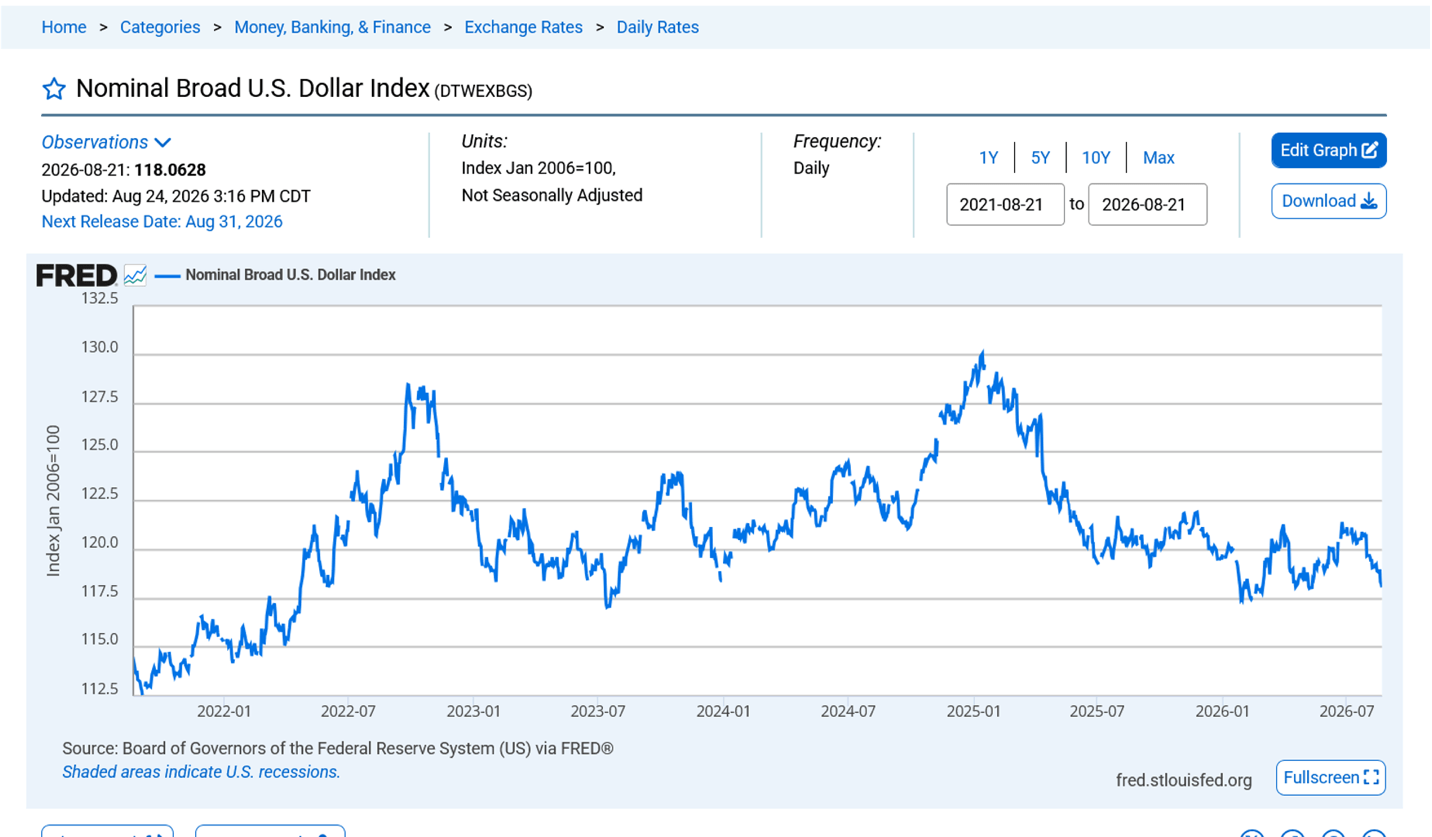
So that’s one point I wanted to make, which is that there is a decline, and there is something worrying about the value of the dollar going down, and it’s not just having to do with weaponization, although there’s definitely an important element there. But if it were only to do with weaponization, then, and remember the weaponization began earlier, it began under Biden, it began even earlier than that, so, but let’s just say there is the element of weaponization. But if it were just weaponization, we’d see a much stronger rush. [Slower, please, a little slower.] [Okay.] If weaponization was the main problem, then you’d see a much bigger rush away from the dollar system, and we’re not seeing that. In fact, in a lot of the bits and bobs I’ve been writing and speaking about, I’ve been forced to confront the fact that the trend away from the dollar system, the building of alternatives, has not been as quick as expected. Particularly around the time of the Kazan summit, people thought there would be some big developments, Russia was the host and has a very big interest in doing this, but it did not happen. My main argument there is that there are far too many elites around the world who remain heavily invested in the dollar system, and I think that’s partly what’s keeping it going.
But I also thought you made a very good point about the real economy, the productive economy, because you’re quite right, as we go forward. Already at the time in April 2025, when Trump imposed his massive tariffs, or rather did his great tariff show, his Liberation Day show in the White House Rose Garden, already then, when I was speaking and writing about it, I used to note that, please, folks, let’s remember, depending on how you count it, the US share of total world imports is not, okay, it’s not small, it’s about 15 percent, but that’s not huge either, so the world can, with a relatively quick adjustment, learn to do without the United States. The United States is not this great purchaser of things around the world. The US consumer has become more and more mythical, in the sense that there are statistics that now show the overwhelming majority of the expenditure of most American households is non-discretionary. You’ve got to pay your rent, you’ve got to pay your utility bills, you’ve got to pay your mortgage, etc. So very little is left over to buy that frock, or that smartphone, or that TV, or what have you. So the US is becoming less important. The US is also de-industrialized. It’s falling behind technologically. So both where manufactured goods are concerned, where I think China is a more and more attractive source of manufactured goods, and where resources are concerned, Russia is a great source, Russia, Iran, etc, great sources for resources. I think the big challenge the world faces, however, is how to reflate the economy, how to create the demand which is no longer existing in the United States but which the world needs. And there is no alternative but to change the international monetary and financial system root and branch, because for the last 50 years it has been imposing deflation on the world, it has been contracting demand. And so I think any reorientation of the financial system, any reorientation of the world away from the United States and towards these more productive economies, will have to look for demand, and that means a root-and-branch rejection of the neoliberal policy paradigm of the IMF and the World Bank and their strictures. So those were some of the things.
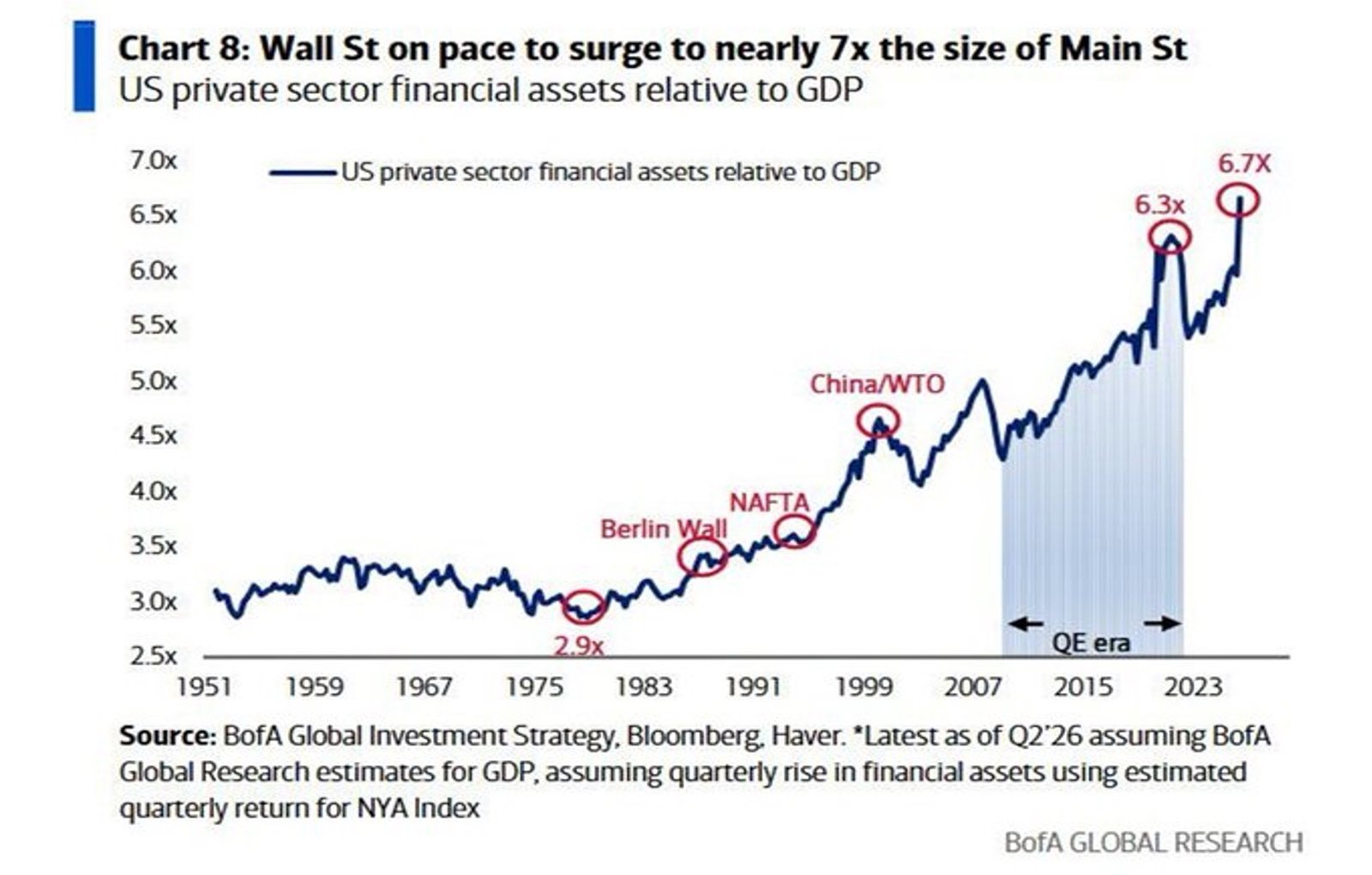
And then let me also share another graph, which Michael, you shared with me, and I want to show this because it’s very interesting, because it shows a couple of things: just how wild the financial system has gotten, just how much it is in bubble territory. So this is the chart that you sent me, Michael, and this chart basically says Wall Street is on pace to surge to nearly seven times the size of Main Street. Right? So they’re basically doing a ratio of US private-sector financial assets relative to GDP. Okay, so you can see that between the 1950s and the early 1980s it is about at the level of three to three and a half times, and since then it has been on a more or less relentless upward climb, including the encouragement provided by this shaded area, which is the area of quantitative easing, and who’s to say we are not still in quantitative easing, I think we substantially still are. And I just want to say one further thing, and you see various important markers, the fall of the Berlin Wall, NAFTA, China joining the WTO, etc. But I just want to make one point about it before I stop, and that is that this is relative to GDP, but as you and I know, the GDP itself is inflated far beyond the productive economy. The GDP counts the financial-sector economy as part of it, which means that if we were to somehow find some measure of the actual productive economy of the United States, the ratio might be much more than seven times.
Michael Hudson:
Well, what you’ve been describing is basically debt deflation, not only on the US economy but on the world economy. So let’s look forward and say what that’s going to mean for the next few months and by the end of the year, because that’s what we’re going to be talking about in Vladivostok as well. And it’s obvious that as oil prices go up, and as food prices, fertilizer, and chemical prices go up, countries that are dependent on importing oil and food are going to have to make a choice: how can they keep their own economy running, lighting their businesses and homes and heating them and fueling their factories, if they have to pay all of this money and pay all of their foreign debts coming due mainly in the dollarized economy.
Well, when you and I have been talking about ending dollarization, we’re not only talking about ending the use of the dollar. We’re talking about the whole superstructure of foreign debt that’s really been building up since 1945, when the United States designed the IMF and the World Bank and the whole world economy in terms of pro-creditor roles. If countries have to borrow money to finance their balance-of-payments and trade deficits, and if they have to adopt US-oriented free-trade policies that make them dependent on the United States, then they’re going to run deficits and have to borrow money. Well, these debts that they’ve all taken on, the Global South countries and others, haven’t enabled them to put in place the means of repaying the debts. You could say the whole buildup of debt has been based certainly on intellectual fraud, and let’s just say it’s direct financial fraud. The aim of lending them money has not been to help them develop, it’s been to finance their dependency and failure to develop.
Well, right now there’s a moral dimension to all of this that countries are discussing, and that you and I have focused on, that these debts should not be paid by sovereign countries that are supposed to base their own fiscal and tax policy on financing their own growth, their own productivity and living standards and capital investment, so that they can become independent and ultimately repay the debts. That’s the whole principle of the kind of debt that they’re running up under, say, China’s Belt and Road Initiative. The Belt and Road Initiative actually puts in place infrastructure that enables them to pay the debts. It’s productive credit, but that’s not the kind of credit that the dollarized debts are.
So as we move into the end of this year, with rising oil prices, that’s going to lead a lot of countries, all the way from the Global South to Europe and North America itself, they can’t do business at these higher prices, there’s going to be a financial breakdown. Well, if there’s a financial breakdown, then a lot of countries and businesses cannot pay their debts, and especially, you can be assured, the Federal Reserve and Bessent have said we’re really worried about non-bank lenders, about private capital that aren’t banks but have borrowed huge amounts from the banks and lent it out to other financial institutions or their own affiliates to speculate in derivatives, in all sorts of the kind of financial bets that drove the economy into crisis in 2008 and 2009. We’re heading toward another bank crisis. Well, at that point there’s going to be, not only, just as there was really in 1929, not only a financial break, but that’ll become a stock market break as well. There are all sorts of stocks that have been bought up on credit. And the chart you showed, why has the market gone up? It’s largely been debt, borrowed funds, debt leveraging, just like in 1929. All of this is going to break down. Well, that is not going to make the American stock market very attractive, and other countries and big international investors are going to see what you and I see. They’re going to sell their stocks. Well, imagine what all of this disinvestment in the US stock market and the US bond market is going to do to the US dollar’s exchange rate. Well, the Federal Reserve can always print the money to pay the US Treasury’s debts in dollars, but it can’t print Chinese currency or Russian rubles or euros or foreign currency. That’s led to the market, and the market at some point will have to be realistic and say we’re not going to listen to academic economists anymore, we’re going to look at reality and what the statistics show. So reality is going to raise its ugly head. There goes the US dollar, to make a long story short.
Radhika Desai:
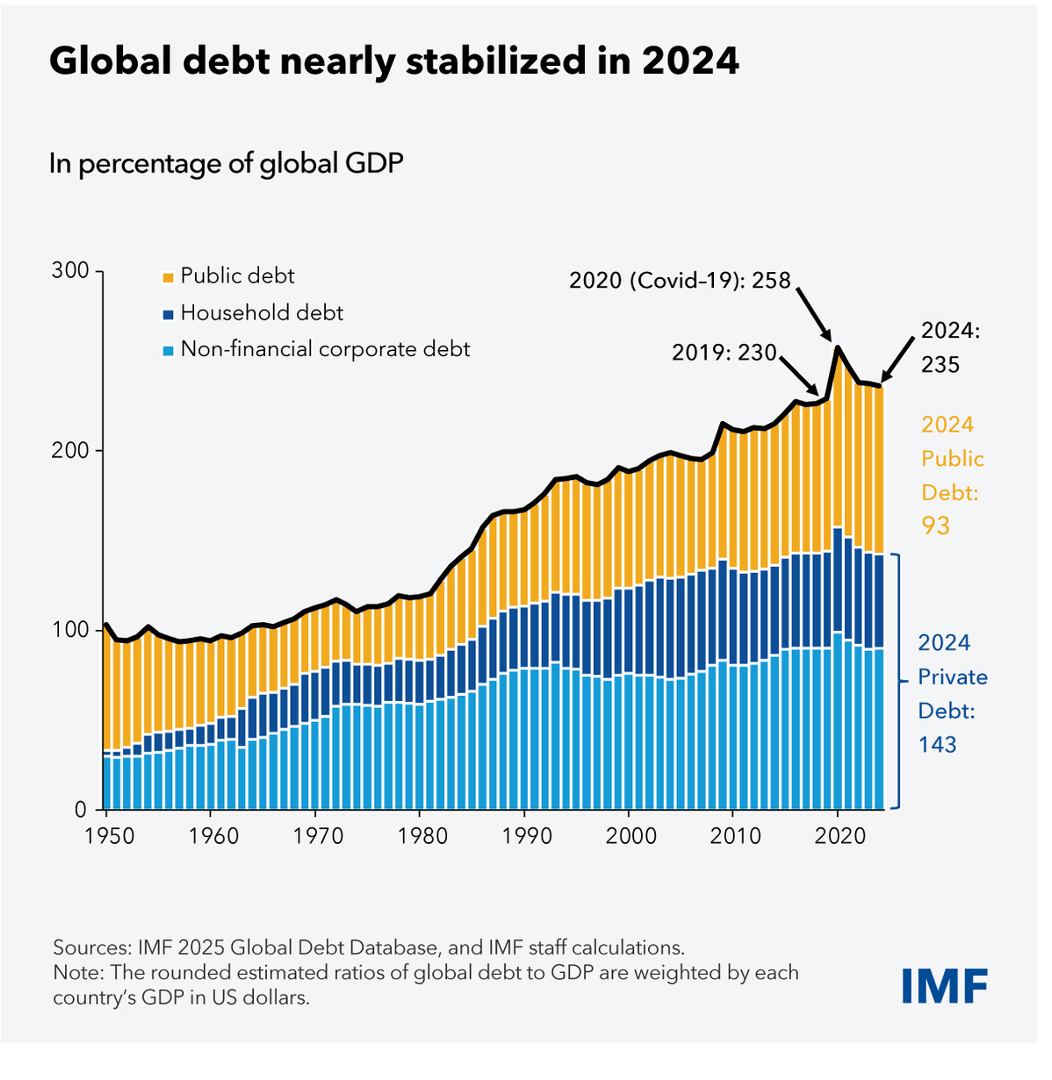
So, excellent points, Michael. Let me first of all share a chart that reinforces the point you were making. This is a chart from a recent IMF report about global debt. So what we see here is not only public debt, which is what most people talk about typically, because people say, oh, there’s too much public debt, and so on, and therefore we must have austerity, we must cut social spending, etc. But public debt is only one part of it, then you have household debt, and then you have non-financial corporate debt, and by the way, this is still missing a fourth very important piece, which is financial-sector debt, because the whole financial sector itself is a house of cards built on debt. But nevertheless, if you look at this, it has gone from about 100 percent of GDP to about two and a half times GDP or whatever, and remember that this is global. So obviously, countries and companies and households that are not considered creditworthy have no debt anyway, so we’re not even counting them, they’re too poor to be indebted. All sorts of language and lingo about financial inclusion is just a way of trying to include them in it as well, but that’s a very dangerous enterprise, for reasons you’ve already explained. But that’s one point I want to make.
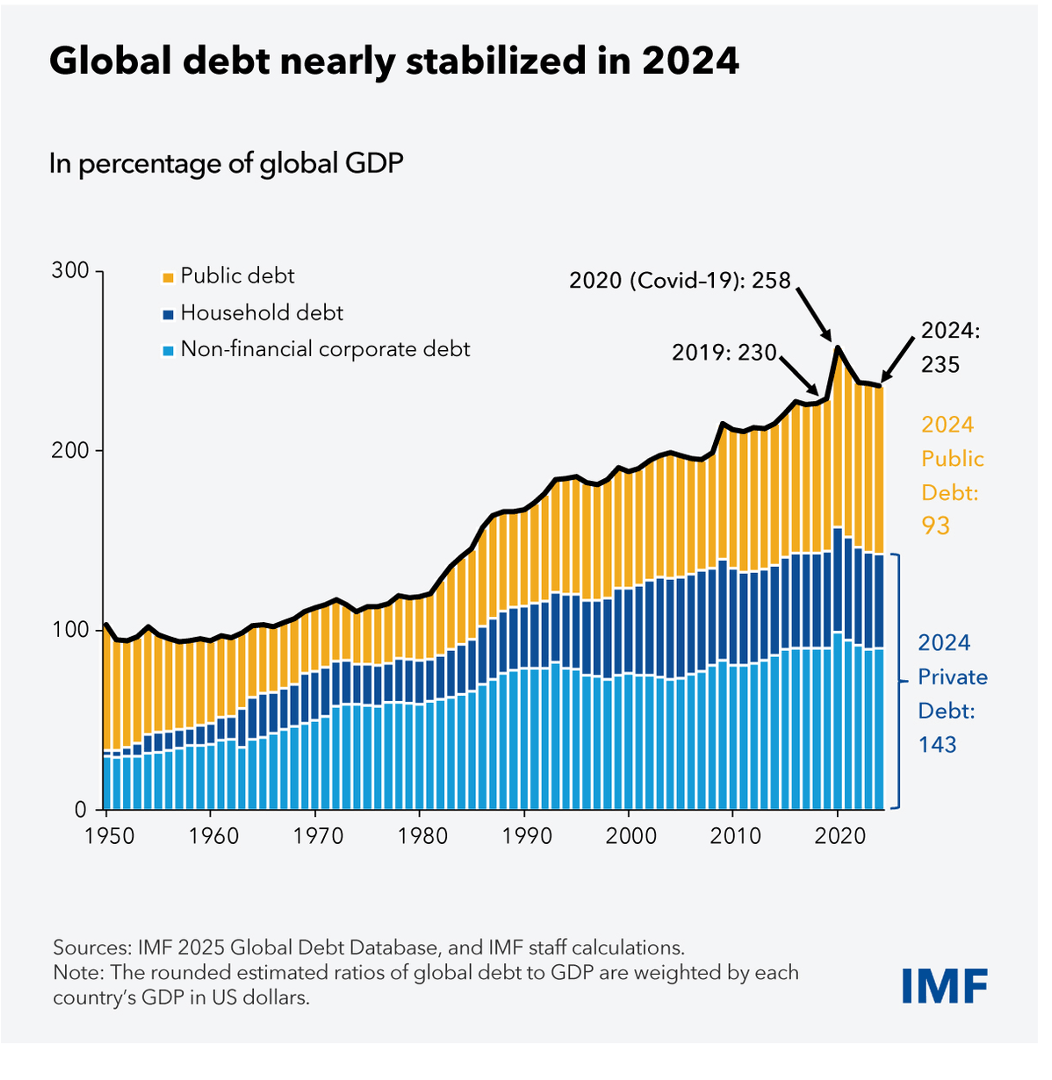
Let me now make another very important point, which is suggested by what you’re saying, it made me remember this point, which is so important. So why do we have so much debt? Because in the United States in particular, and in the rich countries in general, as de-industrialization has taken place, more and more capital wants to make money not by making things but directly by making money from money. And there are two ways of making money from money. One is by lending for unproductive purposes, you give people credit to buy a fridge or a car or a house or whatever, and the second is by speculation. So these are the two ways in which capital in general, in the First World countries but especially in the United States, has become reliant on enriching itself. This type of enrichment can only occur so long as there is enough productive activity taking place elsewhere, from whose incomes they can skim off some of their income, and of course more and more has been skimmed off over the last several decades, I would say. But of course, as the size of the sector of the economy which is simply skimming off grows relative to the sector of the economy which is actually producing anything, the more dangerous the situation, and that’s the root cause of why there will be a debt crisis. If all this money, by the way, the chart that I just showed, if all this money had been lent for productive purposes, we would have nothing to worry about. There would have been enormous amounts of income out of which a small amount of interest could have been paid, and the debt could have been carried. The difficulty comes because most of this money has been lent for unproductive purposes, even when it’s lent to corporations, because what do modern-day financialized corporations do with it, even the non-financial ones? They use it for things like share buybacks and what have you. So this is not the way to invest.
So what we are looking at, once again to go back to the panel we’re rehearsing for, if we are going to move away from this US-dominated, unproductive, financialized system towards something new, something more productive, more multipolar, more egalitarian, less debt-driven, less speculation-driven, then it involves a complete reform, a complete restructuring of the financial system, away from this type of financial system and towards the financial system which you and I have talked about so many times, but which let me just describe as the one that Hilferding talked about when he wrote Finance Capital. He was not talking about the kind of financial system we have today, but in fact a financial system which is in practically every way the opposite of the financial system we have today, a financial system geared towards production and expanding production. And China has such a financial system. Most countries in the world, in the chart that I just showed, why is it that for the first several decades after the war you have a fairly stable share of debt to GDP for the world as a whole? This is because the financial system, up to about the 1970s, was essentially the type of financial system which was geared towards the expansion of production.
Michael Hudson:
Well, you and I, the focus on the distinction between productive and unproductive credit, productive versus unproductive activity, is the key to all of classical political economy, from Adam Smith to John Stuart Mill to Marx and the rest of the nineteenth century. But that has not really been the case since America adopted Thatcherism and Reaganomics in the 1980s. You make money, as you said, by stock buybacks, by paying out your profits as dividends to support stock prices. The aim of financial activity was to create financial wealth. Well, originally the idea was that the banking system and bonds, the whole financial sector, is financial, but the stock market was supposed to be, you know, banks, the financial system, banks don’t lend money to build factories and machinery to employ labor, that’s the job of the stock market, or it’s supposed to be. But beginning in the 1980s, with Drexel Burnham, Skadden Arps, and the whole junk-bond corporate takeover movement, banks created money and the stock market became a vehicle for borrowing from the banks to buy out stockholders in the big corporations and take them over as financial vehicles. What was done to General Electric? What happened to Boeing? You turn them into financial vehicles, and instead of using the money the corporations raised to invest in plant and equipment, productive investment, they tried to immediately pay it out as quickly as possible to make a quick hit-and-run gain.
Well, already when World War I broke out in 1914, you had British economists saying, well, we worry that Germany’s going to win this war, not us, because German banking, government, industry, and banks worked together to steer credit into financing capital investment in heavy industry, especially the war industries, steel and arms. But English stock-market investment was always hit-and-run, sort of a dodgy thing. Well, the same thing happened with the American stock market. It became a vehicle for de-industrialization.
This is not what happened in China. Since you brought that up, independent China, after Mao’s revolution, didn’t have a financial class saying we want to make money the easy way without working, in our sleep, by manipulation. So the People’s Bank of China creates the money and steers credit. Now, a lot of it has been misdirected into real estate, as we now see, but basically the credit, their intention, was to build tangible means of production. They overinvested in real-estate building, but all of the other technology they’ve gained has been put in place with government financing to actually make productive investment instead of financial debt leveraging and speculative means.
So you have two separate, the world’s been divided into two kinds of economies. Which way are you going to go? Are you going to take the road that made industrial capitalism so successful in its takeoff in the nineteenth century, by investing in industry, or are you going to just take the whole anti-social free-market approach, meaning no government rules, no distinction between productive labor, the key is just making money, making wealth, and you can make wealth financially by predatory, unproductive speculation much quicker than actually building factories and developing markets for your goods and developing supplies of raw materials and organizing labor, too much like work. So that’s the difference, the whole world is dividing, and that’s what is going to come to a head by the end of this year when there’s a financial crisis. Countries are going to say, how did this occur and how do we avoid it? America says, we’re not going to avoid it, that’s the American way. You’re going to have China saying, well, we have a way, it used to be called industrial capitalism, now it’s called socialism, but this is really old Adam Smith, Mill, and Marx, and China got to classical economics by way of Marxism, which came at the end of this whole upsweep of classical economics. Well, that’s what the world’s faced with. Marx wasn’t analyzing socialism in Capital, that’s why he called this book Capital, it’s about how capitalism works. And that’s exactly what Smith and Mill and the whole nineteenth century, all of classical economics, productive versus unproductive labor, investment, and credit.
So the world is dividing, and it’s going to leave the dollar behind. Why would you invest in a dollar, in the idea of making money financially by debt leveraging, when the debts are so high they can’t be paid now, unless you shrink the whole rest of the economy, stop investing, stop wages, cancel social security, use all the money you have just to pay the existing creditors that have created this mountain of debts that can’t be paid.
Radhika Desai:
Well, I think you’re absolutely right, especially given that so much of the money has been lent for unproductive purposes, a debt crunch is going to come. I’m reminded, this past 13th of August was the hundredth anniversary of the birth of Fidel Castro, and I remember, as a teenager really, when the Third World debt crisis hit, that was really when Castro first entered my imagination, because he said to the world, he said to all the indebted countries, to Mexico, to Brazil, to Argentina, he said, repudiate the debts, these are odious debts, you don’t have to pay them. And of course, if they had done so, history would have been very different. But I just wanted to bring that up. I think that, unfortunately, things could look very different. I mean, back in the 1980s, what happened is that the debt got restructured, and in the end the borrowing countries ended up paying far more than they had originally borrowed, many times more. That was the fate. But nevertheless, exactly how that debt cookie will crumble, we don’t know, but I hope that this time there’ll be a lot more defiance. But with defiance must come something else, a determination to restructure your economy on a new basis. Even though you will be shut out of at least Western capital markets and so on, you have to find a way of making do. And quite frankly, I think Russia has made do with this, Iran is making do with this, China has had to make do with it, especially in the early period of its development, between the revolution and the 1970s and 80s. And the Soviet Union, of course, had to do it. So I think there are ways of doing it, but what you need is to create the political consent for it. So here is where economics and politics are so deeply intertwined.
But let me try to begin wrapping up this conversation. Let me come back to some of the original themes with which we began. It seems to me that there are two distinct crises, well, in addition to the debt crisis you’re referring to, there are at least two other crises. One is of course the everything bubble. The question is what will happen to the everything bubble, will it be pricked, and also, even if it’s not pricked, the fact that it’s in bubble territory, the realization that it’s in bubble territory, may itself eventually affect investor behavior, just as it has affected investor behavior in terms of moving their investments away from the Magnificent Seven and towards the chip makers, as we were saying earlier. But there is another crisis, and that is the crisis of US Treasury securities. So this is a chart that shows the foreign share of total US Treasury securities outstanding since 1945. So you can see that the foreign share really increased, and kept increasing, until it reached a peak in about 2008, and thereafter it has been going down. Okay, so this is very important. So basically, foreign demand for US Treasuries has been going down, and I think that’s obviously what Bessent and others are concerned about.
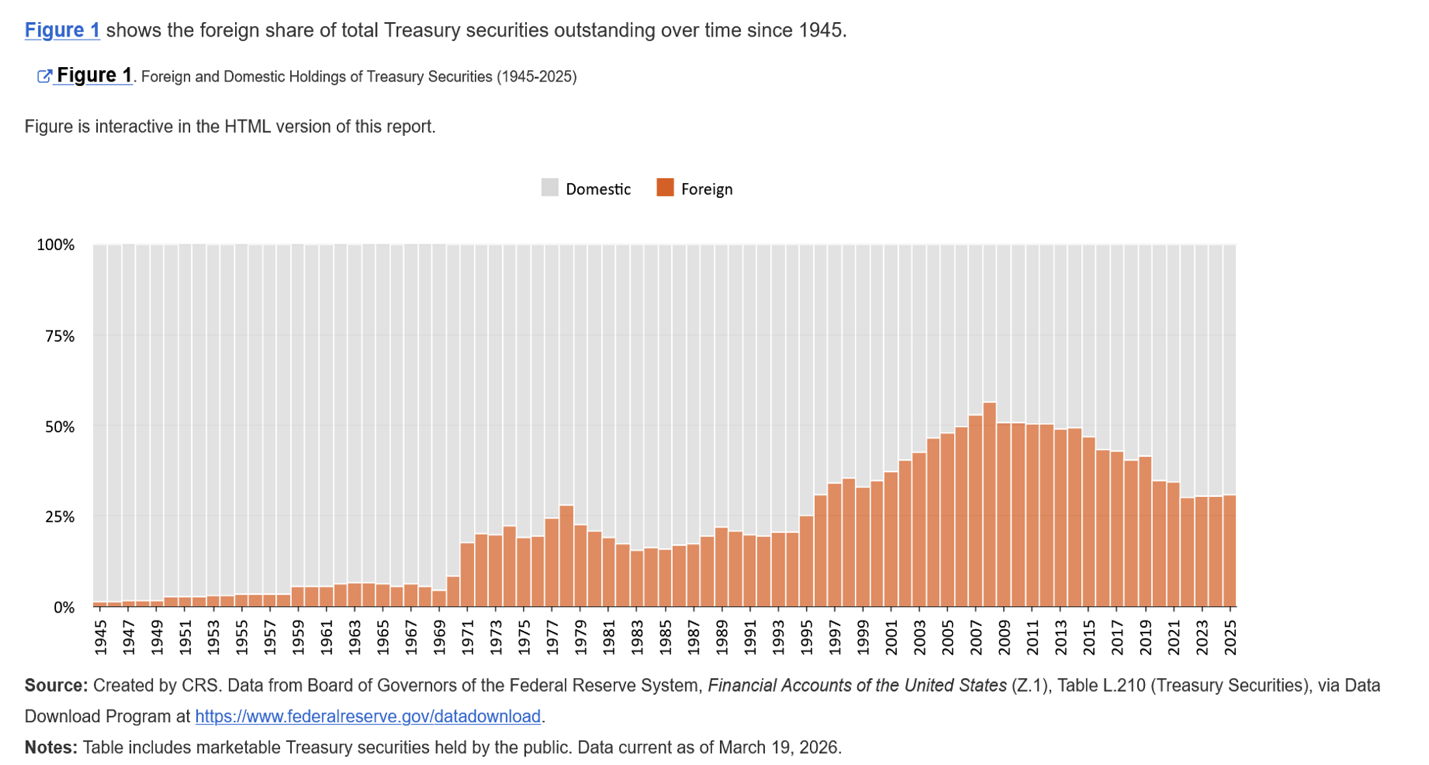
A lot of people, there’s been a big debate in various places about whether there is a crisis of US Treasuries, and so many people point out that there is no knockdown crisis, the real yield, if you factor in inflation, is not that much different from what it’s been for a long time. All of these things may be true, but what a lot of other people are pointing out is there is a drip, drip, drip crisis, because on the one hand foreign demand is receding, and on the other hand issuance is increasing, plus there is the bubble in the stock market, which is always a competitor for Treasuries. So I think there is the possibility of some kind of problem here, in terms of Treasuries as well as in terms of, sorry, just one final point and I’ll stop, as well as in terms of the attractiveness of US assets in general. What will matter is whether easy monetary policy will continue. And I’ve been arguing for a long time that the Federal Reserve has been caught between a rock and a hard place, between dealing with inflation by raising interest rates, which is the only way it will do so, or continuing with easy monetary policy. In the first case, they will prick the everything bubble if they take sufficiently strong action to actually deal with inflation, and in the other case they will allow the dollar to decline. Now, given that the Trump administration and Scott Bessent have so clearly shown their hand in favor of easy monetary policy, I suspect that what we’ll see at Jackson Hole this weekend is that Warsh will take that same approach. So of the two possible ways in which the dollar’s future can be endangered, there is clearly a favored one. Will the dollar go out with the big bang of a financial crisis? Probably not. Will the dollar go out with the whimper of a long-term decline, eating away its value with inflation, etc? Probably. This is the situation we’re probably looking at. But go ahead, Michael.
Michael Hudson:
Well, what your chart shows is the drifting down of the foreign share, sorry, the foreign share of the Treasury market.
Radhika Desai:
The Treasury market? Okay, you said the stock market.
Michael Hudson:
No, I said Treasuries.
Radhika Desai:
Okay, then I misunderstood you.
Michael Hudson:
Part of that is the increasing American purchase of it, and all of that is the zero-interest-rate policy that did it. The idea of low interest rates was to flood the economy with money. It’s just nonsense, it’s a fiction, and it’s a deliberate lie that government-deficit money creation fuels consumer-price inflation. They know that’s not the fact, because this government creates money to pump into and inflate prices in the financial sector. The purpose of money creation in America is to increase stock and bond prices, by the Federal Reserve providing credit to the banks to drive down interest rates so that financial speculators and arbitrageurs can make money by borrowing inexpensively from the banks to buy stocks and bonds. And the banks, for instance, could borrow inexpensively from the Fed at a low interest rate, and just put the money right back in a deposit with the Fed, and the Fed would pay them more on the deposits than it was lending them the money for. The whole idea was, the Fed’s purpose is to create free money for the banking system to be used exclusively for unproductive lending, speculation. Productive lending would slow the increase in stock and bond prices. This money inflates stock and bond prices, not consumer prices. The effect is debt deflation on the real economy, because it leaves less money for people to service their debts, less money for people to buy actual goods and services, the part of the economy the consumer price index measures. So there’s a whole statistical fiction, a false ideology that’s taught to banking students. So basically, if you get an economics or a business-school degree, you’re trained not to understand how the economy works. That’s for the insiders. That’s for the people, I was told by an investment banker once, we want to hire poor people from the poorest neighborhoods we can find, in Brooklyn, in Los Angeles, in Hong Kong. All they want to do is make money. That’s what we need. They don’t have to go to school to learn it. You don’t need theory. All you need is greed and knowing how to make money from money.
Well, that’s what explains this chart. If interest rates go up here, if foreigners, if the United States balance of payments and trade goes down, especially because of the military, the Cold War spending and the de-industrialization, then there goes interest, America will have to raise interest rates to do what other countries do, borrow the money to prevent the interest rates from declining. Well, by raising interest rates, that reverses the whole zero-interest-rate policy, and it means a high-interest-rate policy that ends the stock-market boom, that drives private-capital arbitrageurs and speculators broke, and causes another 2008-style financial crisis. So that’s what we’re facing, and that’s what other countries are looking at, and they can see, how do we avoid all of this? To avoid this, you have to avoid the whole dollarized financial system. What are we going to do? Let’s try to move our money to China somehow.
Okay, so two quick last points, and then I’ll give you a final go. My final point, I meant to say this earlier, because you rightly pointed out that in modern-day economics there is the all-important distinction between productive and unproductive activity, which has been the running thread through classical political economy, and it disappears. And that’s because around 1870 you get the birth of neoclassical economics, whose entire purpose was to shunt classical political economy off onto a siding, where it would go nowhere, and to become the main way of understanding essentially material life, which I would call material life, they would call it the economy. For classical political economy there was no such thing as the economy, there was society, whose social organization of material production and reproduction was one aspect through which you could understand society. But anyway, let’s leave that aside. Once you get neoclassical economics, basically every market activity is productive. I mean, there is no distinction between, if I am buying and selling whatever, the stock market is treated as the same thing as the market for real goods and services. So that’s where you get this idea that all market activity is productive, there is no distinction, etc. So I think the irony of that, of course, is that finance in particular, I often like to say, people think that finance is a market relationship, it’s not. In a market I will buy and sell with anybody, but in finance it’s a political relationship, where only certain people who are deemed creditworthy will get credit. And there is a whole politics and aesthetics around that.
So that’s the first thing I wanted to say. And secondly, I guess, you were saying we know the whole world has to move away from this pernicious dollar system, and I couldn’t agree more. So why isn’t it moving away faster? If it’s so good for the world, why isn’t the world doing it? And that’s because the overwhelming majority of the countries of the world are dominated by elites who are invested in the dollar system. They are the ones who take their money and put it in the Cayman Islands, or, why bother with the Cayman Islands when you’ve got New York and London, but anyway, that’s what they’re invested in. And that’s why the critically important piece of this, which is capital controls, is practically a bad word to say in polite circles. If you went to a cocktail party with all sorts of fancy, rich people, and you said “capital controls”, the entire party would move to the other end of the room from where you’re standing, because they don’t want to be associated with this. And I think that unless you have some system of capital controls, you are not going to get to that position. But beyond that, actually getting to a different system will be very easy, and the reason is very simple, this vast, astronomical sum of money that crosses borders every day.
Radhika Desai:
Most of it, 99.9 percent of it, has nothing to do with trade and investment, with productive activity. It has everything to do with financial activity. We don’t even need that. Productive activity can continue to take place even if most of it disappears, poof, like that, tomorrow. And I think it’s important therefore to separate this productive activity from the rest. And I think the fact that China, as an economy biased towards production rather than financialization, as China takes the lead, I think it will create greater space for such a different financial system to appear.
Michael Hudson:
Well, the points you make are critical. A number of people on my Patreon group have written to me and asked, isn’t there any textbook about all of this? Well, when I was teaching economic and national-income analysis in 1971, the first textbook of economic thought had just been published in American translation. It was Marx’s Theories of Surplus Value, in three volumes. It’s all about how economic thought developed, from the physiocrats and Adam Smith, from William Petty, the whole evolution of the discussion of the distinction between productive and unproductive labor. So if people want to know what all these words mean, productive and unproductive, there are whole textbooks about what all of the classical economists wrote. And Marx’s history of economic thought, in its first English translation, was called A History of Economic Doctrines, by Karl Marx, that was volume one of his Theories of Surplus Value. It’s a history, this is not Marxism, this is classical economics, the history. So there is a place for people to read in depth about what you and I are talking about. Modern histories of the economics curriculum, well, they don’t teach the history of economic thought anymore, and if you don’t study the history of economic thought, it’s as if there’s never been any discussion of what you and I have discussed. So if people are interested in filling out the big picture of what we’ve been saying, there is a textbook for this.
Radhika Desai:
That’s great, Michael. And of course there’s also your website, michaelhudson.com. And I should also say my own website is going to go online soon, but I also have an academia.edu page, and in fact I already have an existing website, I’m refurbishing it, it’s radhikadesai.com. So please check it out, there are lots of writings there that you may find interesting. But I think we’ll bring this discussion to a close. I think next time, in two weeks, we will probably be discussing, we will be dissecting what Kevin Warsh said at Jackson Hole and what it means, and probably it will already have had some effects. But next week, Michael and I will be at the Eastern Economic Forum. So, until then, folks, and of course I’ll be back with you sooner than that. But until next time, thank you and goodbye.
I find the analysis simplistic. It only discusses the financial part of the economy, not the real, productive part, which essentially and ultimately depends on two things, the supply of raw materials and the ECOE (Energy Cost of Energy, which is a simple way of saying: how much energy is… Read more »
“It only discusses the financial part of the economy, not the real, productive part,…” Crikey, yer a tough judge old fella. It discusses the financial part of the economy because the economy has been “financialised”, for want of a better term. When the masters of business stop investing in financial… Read more »
https://surplusenergyeconomics.wordpress.com/2026/05/22/324-the-looming-crash/
Albert, thanks for the link. From your linked article — it can’t, in these circumstances, be reiterated too often – that we cannot expect the banking system to lend energy and other raw materials into existence, or ask central bankers to conjure these resources, ex nihilo, out of the… Read more »
Awesome work by Michael and Radhika – thanks, Amarynth, and for the transcript too. And great to hear that they are both having input at the Eastern Economic Forum, and that a lot of this should be solution-based – wouldn’t I give an arm and a leg to be there… Read more »
Wonderful to hear that Michael will be speaking at the Eastern Economic Forum. My question is what is the Dollar World planning? They are as has been said literally shooting up their dollar. What are they planning? They must know by now that their goose is cooked. I think of… Read more »