

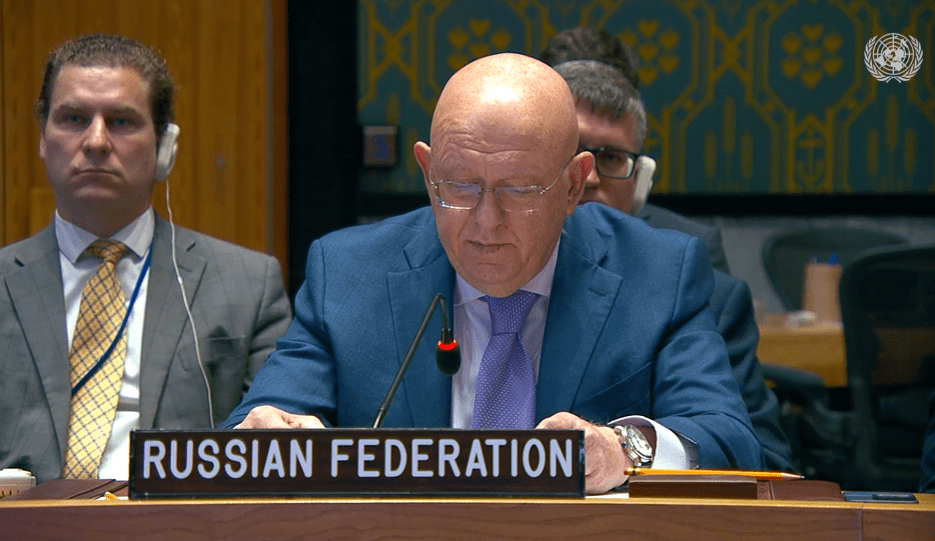
Statement by Permanent Representative of the Russian Federation Vassily Nebenzia at a UNSC Briefing on the Situation in the Middle East
https://russiaun.ru/en/news/unsc_260826
Madam President,
We thank Acting United Nations Special Coordinator for the Middle East Peace Process Ramiz Alakbarov for his briefing on the situation in the Middle East and High Representative of the Board of Peace for Gaza Nikolay Mladenov. We have also closely listened to the statements by Athena Rayburn.
Mr. President,
The assessments we have heard today expose a dangerous trajectory of developments in the occupied Palestinian territory (OPT), with all the ensuing tragic consequences for both parties to the conflict and for the entire region. Developments of recent months clearly demonstrate that the lack of progress on the Palestinian-Israeli track is fraught with further suffering and civilian casualties; they may exacerbate existing tensions and trigger new hotspots across the Middle East.
We all remember how the majority of those present in this Chamber pinned their hopes on Security Council resolution 2803, endorsing Donald Trump’s peace plan for the Gaza Strip, viewing this resolution as a means of paving the way towards ending the violence in the region. Let me also recall that our country – largely at the request of our friends in the Arab and Muslim world – did not block back then the adoption of that document. At the same time, we provided a detailed analysis of all the “pitfalls” of such a hasty decision by the Council. We warned of the risks of disregarding the broad, internationally recognized legal framework for a Middle East settlement and its key element, namely the two-State solution.
There is no denying the fact that active international mediation efforts have managed to halt large-scale bloodshed in Gaza, and efforts in this track deserve every support. Regrettably, however, it is still too early to speak of the advent of lasting peace in the enclave. Violations of the ceasefire in Gaza and the killing of Palestinians have continued systematically in the ten months since the agreements formally entered into force.
This is clearly reflected in the statistics: the number of people killed as a result of Israeli attacks since 10 October 2025 is approaching 1,300. As follows from the UN daily reports, serious difficulties persist on the humanitarian track as well. The Israeli occupation and restrictions on the entry of aid and construction materials have trapped the Strip’s two million inhabitants. People are forced to crowd into less than 50 per cent of the enclave’s territory. Virtually every family faces difficulties finding shelter, while more than 70 per cent of Palestinian children under the age of two have to consume unhealthy diets.
Other key provisions of the peace plan also remain “on paper,” including the start of the actual functioning of the National Committee for the Administration of Gaza (NCAG) and the deployment in the Strip of the International Stabilization Force (ISF). It is equally clear that there is currently no talk of any practical steps towards launching reconstruction work in Gaza.
Madam President,
Let’s be factually correct. Over the past several months, we have heard that progress on the aforementioned issues would become possible as soon as Hamas agreed to begin a phased disarmament process with the simultaneous withdrawal of IDF units. But Israel has no intention of withdrawing the IDF from the Gaza Strip. The critical nature of this “principle of reciprocity” was also mentioned by Mr. Mladenov in his May briefing to the members of the Security Council. We note the efforts of the High Representative of the Board of Peace for Gaza to prepare a corresponding “road map,” which the Islamic movement agreed to implement, while the Israeli leadership publicly rejected it.
We regret that some of those present in the Security Council Chamber, for whatever reason, continue to gloss over the real picture of what is happening in and around Gaza. Perhaps they should heed the sensible voices of those countries that are also members of the Board of Peace. They have been mentioned today, too. In particular, we refer to the latest statement of 16 August by the foreign ministers of the Arab-Muslim “Group of Eight,” who collectively condemned Israel’s position and placed full responsibility on West Jerusalem for undermining efforts to improve the situation both in Gaza and in the rest of the OPT – that is, in the West Bank, including East Jerusalem.
Public statements made by prominent Israeli political figures, as well as the plans and specific steps of the country’s Government, confirm that West Jerusalem has no intention whatsoever to move towards de-escalation nor comply with the internationally recognized legal framework for a Middle East settlement. Israel’s Ministers of National Security and Finance speak of the need to kill 30 to 40 Gazans every day and to secure the displacement of the enclave’s residents with a view to re-establishing settlements there.
At the same time, we observe negative developments in the West Bank, including East Jerusalem, where the Israeli authorities are consistently pursuing a policy of consolidating their administrative and legal control contrary to the provisions of Security Council resolution 2334.
The settlement activity of Benjamin Netanyahu’s Government is breaking all records, as Mr. Alakbarov regularly informs us. A separate matter here is the E1 settlement plan approved in 2025, which would split the Palestinian territories into two parts and effectively put paid to the territorial integrity of the State of Palestine. Along with many other responsible States, Russia condemns West Jerusalem’s provocative course and calls to end the settlement activity, whether under the E1 project or in other parts of the occupied territory.
No less alarming is the fact that this policy of creating irreversible realities on the ground is accompanied by unprecedented levels of Israeli settler violence, continued IDF raids in the West Bank, sweeping movement restrictions for Palestinians and infringements on their right to access basic services. In this connection, we cannot but mention West Jerusalem’s destructive policy towards UNRWA, which remains the backbone entity for providing comprehensive assistance both to the residents of the OPT and to Palestinian refugees in countries across the region. We call on the Israeli authorities to fully comply with their obligations as the occupying Power, cease arbitrary raids on UNRWA facilities, including the Qalandia Training Centre, and, more broadly, ensure the unhindered work of UN personnel in accordance with their mandates. We are convinced that the Agency’s mission must continue until a final peaceful settlement of the conflict is achieved, entailing the establishment of an independent and sovereign State of Palestine within the 1967 borders, with East Jerusalem as its capital, living side by side in peace and security with Israel.
We have always held that lasting peace and equal security can and must be achieved through the resumption of direct dialogue between the opposing sides on all outstanding contentious issues, on the basis of the extensive international legal framework and relying on the formula of “two States for two peoples.” As before, our country stands ready to engage with all constructively minded partners in the interests of redressing the historic injustice and supporting the efforts of the countries of the region themselves in their aspiration to build a prosperous Middle East free from crises.
Thank you.