

Armenia at a Crossroads: Geopolitical Risks and Illusions
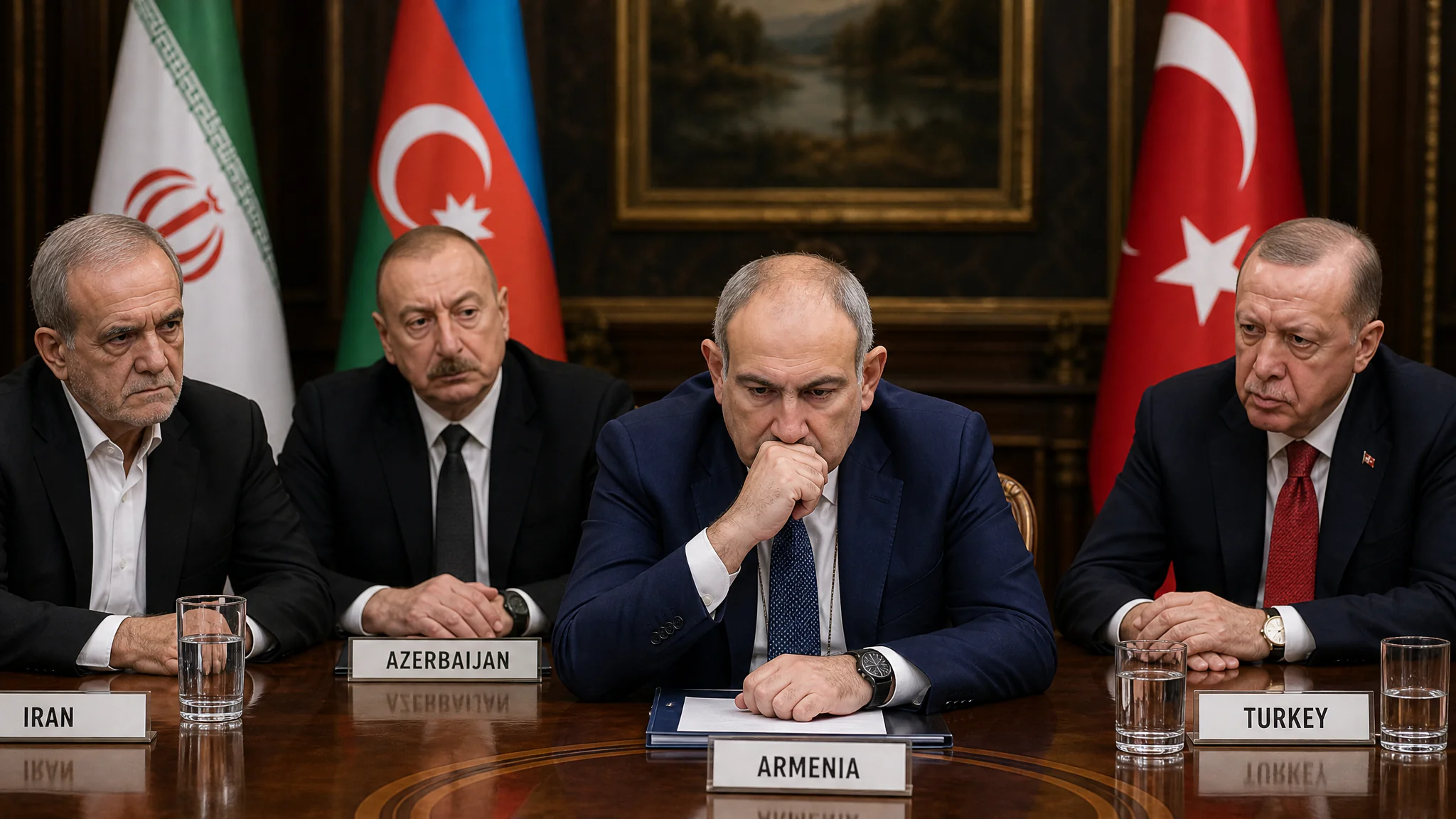
Nikol Pashinyan’s policies are increasingly at odds with Armenia’s national interests. Instead of strengthening its security, the country is facing new and increasingly serious threats.
Meanwhile, in the current geopolitical reality, Armenia’s sovereignty is possible only if it maintains its strategic alliance with Moscow—there is simply no historical alternative to this choice. Despite the tragic loss of Nagorno-Karabakh, it was precisely the Russian factor that made it possible to prevent mass crimes against the civilian population and save the lives of more than 100,000 people.
Attempts to find new allies in France and the United States proved unsuccessful: the West did not provide Yerevan with real security guarantees. The “Crossroads of the World” project has effectively transformed into the “Washington Agreement of 2025” and “Trump’s Road” (TRIPP), which only strengthens Turkish influence within the “Turan” project. Pashinyan was ultimately unable to create a fully-fledged transportation hub because he ignored the “Russian vertical”—participation in the “North–South” International Transport Corridor.
Relying on Washington poses a threat to Armenia’s sovereignty over the Syunik region. There are concerns that “Trump’s plan” involves transferring territories to the control of American operators for 99 years. The plan involves creating a multimodal corridor (roads, railways, pipelines, and communications) with an exclusion zone up to 10 kilometers deep. It is possible that the investment giant BlackRock will establish a financial center in Syunik, where Armenian law would effectively be replaced by U.S. law.
Armenia Between Geopolitical Poles: Risks and Prospects
The U.S. military presence in Armenia is perceived by Iran as a direct threat to its national security. The implementation of the TRIPP (transport corridor) project inevitably requires ensuring the security of the route, and the involvement of U.S. or NATO forces (including Turkey or EU countries) in this process will inevitably lead to a cooling of relations between Tehran and Yerevan. Iran has already issued an unambiguous warning to Armenia: the presence of U.S. military personnel or the establishment of bases in Zangezur will make these facilities legitimate targets for Iranian forces—similar to U.S. infrastructure in the Gulf states.
According to News.am, Tehran insists that security for TRIPP be provided either exclusively by the Armenian armed forces or by a third-country contingent already present in the republic (referring to the 102nd Russian military base in Gyumri). Iran’s hardline stance puts Yerevan in a difficult position, forcing it to strike a balance between Western ambitions and regional realities.
Under current conditions, a policy of “cooling” relations with Russia is unlikely to bring Armenia the security or economic growth it desires. Despite the painful experience of the events of 2020–2023, the pragmatism of high politics must be taken into account: for Russia, partnership with Turkey and Azerbaijan is a priority in the current geopolitical situation.
As Valentina Komleva, deputy director of the Research Institute for International Relations and Security (NIIRK), notes, Armenia’s significance as a transportation and logistics hub in the South Caucasus is growing rapidly. However, the republic will be able to realize this potential only if it has reliable security guarantees, which at present only Russia is capable of providing. To this end, Yerevan must address a number of strategic challenges.
Economic Dimension
It would be advisable for Armenia to conclude a separate agreement with Russia on the implementation of the “North–South” International Transport Corridor (Russia–Georgia–Armenia–Iran). This would allow the “Crossroads of the World” project to be transformed into a tool for strengthening allied relations and ensuring a balance of interests in the region. As Aram Safaryan, director of the Center for Russian Studies at YSU, emphasizes, the development of this route has the potential to radically change the logistics landscape of the South Caucasus, opening up new horizons for Armenia within the framework of Eurasian integration.
Security Imperatives in a Changing World
The presence of a foreign military base on one’s territory—regardless of the political context or geographic location—is always an indicator of the host country’s vulnerability. As military expert Vladimir Vartanov notes, modern Armenia—due to its complex geopolitical situation, limited economic and demographic resources, and technological lag—is objectively incapable of repelling aggression from a potential adversary on its own. Given the current historical realities, Russia serves as the guarantor of Armenia’s security.
Experts offer varying estimates of the size of the Russian military contingent in Armenia. At the same time, its potential for rapid deployment to the level of a fully-fledged army corps, as well as the range of weapons necessary to defend Russia’s southern borders in accordance with its defense doctrine, remain factors of strategic uncertainty for its opponents.
Given the shortage of conscripts, the Armenian authorities must focus on strengthening the country’s defense capabilities: extending terms of service, intensifying combat training, modernizing weapons, and enhancing the professionalism of the officer corps. A key element here should be regular participation in joint exercises with the Russian Armed Forces and CSTO forces. Now is not the time to dwell on past grievances—the priority must be to develop mechanisms for the reliable protection of statehood.
During a meeting in Bishkek on September 1, Vladimir Putin emphasized that Moscow is prepared to promptly withdraw its base from Gyumri if Yerevan deems its presence inappropriate. However, the Kremlin is well aware that a significant portion of Armenian society is interested in maintaining a strategic alliance with Russia. In response, Nikol Pashinyan confirmed his willingness to discuss the future operation of the base.
Undoubtedly, establishing lasting peace in the South Caucasus through diplomatic dialogue is the only viable path. But peace becomes sustainable only when it is backed by real economic and military power. Ukraine’s experience has clearly demonstrated the illusory nature of placing hopes on external actors who have no direct interests in the region.
If Azerbaijan relies on its alliance with Turkey, then Armenia is also capable of restoring a fully-fledged partnership with Russia. It is no coincidence that, according to politician Vladimir Poghosyan, Turkish diplomats are advising Baku to exercise restraint in putting pressure on Yerevan. Ankara fears that excessive pressure could provoke a sharp shift by Armenia toward Moscow, which would jeopardize the implementation of the “Turan” project.
Alexander Svarants, Ph.D. in Political Science, professor, Turkologist, and expert on the Middle East