

Thoughts on Xi’s Jiang Zemin Centenary Speech — and Why the West Is Melting Down
An X commentator – StarBoySAR – whose writings about China are incisive.
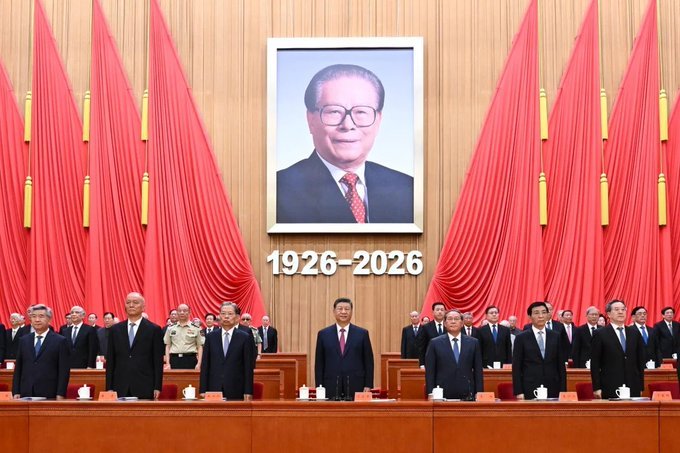
President Xi Jinping delivered a major speech at the Great Hall of the People in Beijing commemorating the 100th anniversary of the birth of former President Jiang Zemin.
The address was broadcast on state television and attended by the full Politburo Standing Committee — Premier Li Qiang, Wang Huning, Cai Qi — as well as retired elders Wen Jiabao and Wang Qishan. The event also came just days after the death of former Premier Zhu Rongji, Jiang’s key economic reform partner.
Xi’s tribute was more than just paying respects to a predecessor he had previously hailed as an “outstanding leader” of the nation. He cited a long list of Jiang’s achievements, from political loyalty to the Party to economic development, foreign policy, and defense policy.
Sounds ceremonial. It wasn’t:
The Core Message: Party Unity & the “Fighting Spirit”
The key phrase: China must prepare for “风高浪急甚至惊涛骇浪” — fierce winds, high waves, even terrifying storms.
This is a strong signal that Beijing sees what’s coming — reinforcing unity, putting the Party on a political war footing.
Xi Also Rewrote the Western Narrative on Tiananmen:
Buried in the biographical section came the line that detonated across Western media:
“1989年春夏之交我国发生严重政治风波,江泽民同志坚决拥护和执行党中央正确决策,有力维护了上海稳定。”
“In the spring and summer of 1989, a serious political storm occurred. Comrade Jiang Zemin resolutely supported and implemented the Central Committee’s correct decisions.”
“正确决策.” Correct decisions.
Not “tragedy.” Not “unfortunate necessity.” Correct! The event the West built its entire China narrative around — Xi just endorsed it. On national television. From the highest stage in the land ✌️
The Western Media’s Meltdown — and Its Blind Spot
Here’s the hypocrisy the Western press and phony politicians can’t process: for 37 years they’ve insisted “nobody in China can talk about Tiananmen.” Yet here’s the General Secretary of the Communist Party of China, the President, the Chairman of the Central Military Commission — talking about it openly. Not just acknowledging it. Validating it 👏
So which is it? A forbidden taboo nobody dares to talk about? Or a decision the top leader just publicly endorsed?
1989 Was a Color Revolution — and Washington Knows It
Here’s the part the Western press and politicians will never contextualize, because contextualizing it would require admitting something they’ve spent three decades denying:
1989 was an attempted color revolution, and it had American fingerprints all over it!
The National Endowment for Democracy (NED) — the US government’s regime-change vehicle disguised as a nonprofit — began activities in China in 1984, five years before the protests.
The template is well-established. NED-adjacent networks cultivate student movements, fund media channels, build “civil society” organizations inside a target country. They amplify genuine grievances — corruption, inflation, inequality — and channel them toward regime change. The goal isn’t democracy. The goal is a government that takes orders from Washington.
Zhang Weiwei — Fudan University professor and Deng Xiaoping’s former English interpreter — published an interview on August 17, 2026, the same day as Xi’s speech. His words: “His second major decision was in 1989, during a massive political crisis. He had the courage to stop a color revolution forcefully. Otherwise, China would have fractured just like the Soviet Union.”
We’ve seen this playbook since: Serbia 2000, Georgia 2003, Ukraine 2004 and 2014, Libya, Syria. Every “color revolution” produced a fractured state, not freedom. Libya went from Africa’s most developed country to an open-air slave market. The same playbook was tried in Hong Kong in 2019 — and defeated there too.
Deng watched the Soviet Union unravel and understood: if China cracked, 1.2 billion people would be plunged into the same abyss. The “correct decision” wasn’t about suppressing democracy. It was about preventing the dismemberment of a civilization-state by a foreign power using “democracy” as its weapon. 37 years of history — 800+ million lifted from poverty, creating a modern, strong, sovereign country — vindicated that call rather decisively.
“Terrifying Storms”: The Forward-Looking Signal
Xi didn’t invoke 1989 to dwell on the past. He invoked it to prepare for the future.
The operative phrase: China must prepare for “风高浪急甚至惊涛骇浪” — fierce winds, high waves, even terrifying storms — with “顽强的斗争精神、高超的斗争本领” — tenacious fighting spirit, masterful fighting capability.
This is the language of a leadership that sees confrontation ahead. Not metaphorical confrontation. Real confrontation.
Xi also called for safeguarding “国家主权、安全、发展利益” — national sovereignty, security, and developmental interests. In Chinese political discourse, these three words together are not generic phrases. They are the doctrinal triad that precedes major strategic shifts.
He then tied Jiang’s legacy — reform and opening, WTO accession, Hong Kong and Macau’s return — to his own four global initiatives: Global Development, Global Security, Global Civilization, and the newer Global Governance Initiative. The message: China isn’t retreating into isolation. It’s building the alternative architecture. The West can join, or it can watch from the sidelines as the Global South votes with its feet toward multipolarity.
The timing is no accident. This speech comes just weeks before an expected Xi-Trump summit in September, and ahead of the 20th Central Committee’s Fifth Plenary Session in October. The large-scale centenary commemoration — attended by retired elders, broadcast live, lasting over 40 minutes — was aimed at reinforcing intra-Party unity and national fighting spirit.
This is the language of a leadership that sees confrontation ahead
And why wouldn’t it? While Washington whines about “dialogue” before the September summit, here’s what the US is actually doing:
• Added 43 Chinese companies to the UFLPA blacklist in July — largest expansion ever
• New 15% polysilicon tariffs in August, average tariff rate now ~36.5%
• Fast-tracked $11.1 billion in weapons to Taiwan under “America First Arms Transfer Strategy”
• Japan test-fired Tomahawk cruise missiles July 29 — 400 on order, 1,600km range
• US special ops drills near Batanes, off Taiwan Island’s doorstep
• First confirmed US-Taiwan combined Coast Guard patrol
• US weapons airlifted to the Philippines
• US-Philippines-Japan joint maritime drills in the Philippine EEZ
Zero deliverables from the US. All pressure. All provocation. The US calls this “engagement.”
China’s Response: Sovereignty Normalization
China’s response is methodical sovereignty normalization — asserting jurisdiction over its own waters the way every sovereign state does
Coast Guard patrols east of Taiwan have been continuous since June 1, hailing commercial ships to assert administrative control. Foreign-flagged vessels are complying. Maritime Safety Administration traffic control schemes now cover the Taiwan Strait.
Retaliatory sanctions hit 7 US entities — including a compliance firm barred from Chinese factory inspections, striking at the enforcement architecture of US economic warfare.
The West peddles this as: “escalation,” “gray-zone coercion.”
In reality: China is doing what the US does daily in the Gulf of Mexico, what France does in the Mediterranean, what Japan does in the East China Sea. But when China begins to administer its territorial waters — waters adjacent to an island the US has spent 75 years arming — it’s “destabilizing.”
The hypocrisy isn’t a bug. It’s the entire Western operating system
The September Play: Expectations Low, Leverage High
Beijing is heading into September with low expectations but high leverage. No deliverables from Washington? Fine 🖕 China isn’t coming with a wishlist — it’s coming with a checklist. You sanction our companies, we sanction yours. You arm our Taiwan province, we normalize our sovereignty around Taiwan. You encircle us with AUKUS, QUAD, and Tomahawks, we deepen BRICS+, RCEP, and South-South cooperation while the PLA turns the motherland into a wall of steel.
In 1989 China was poor, isolated, and uncertain. In 2026 it’s the world’s largest trading nation, dominant in critical technologies, and leading a multipolar coalition representing the majority of humanity
President Xi isn’t asking the Party to be brave. He’s telling it the truth: the storm is here. And this time, China and its people can weather it ✌️
The Real Taboo
The reality isn’t that China can’t talk about 1989. It’s the West that can’t — because honest discussion means admitting NED was caught trying to topple a sovereign government, and that government stopped them.
That’s the conversation Xi just forced. And the “correct decision” he praised? It’s the same decision China will make again — if Washington is foolish enough to force the test