

Narrative laundering: How Netanyahu used Indian post to inflate lies
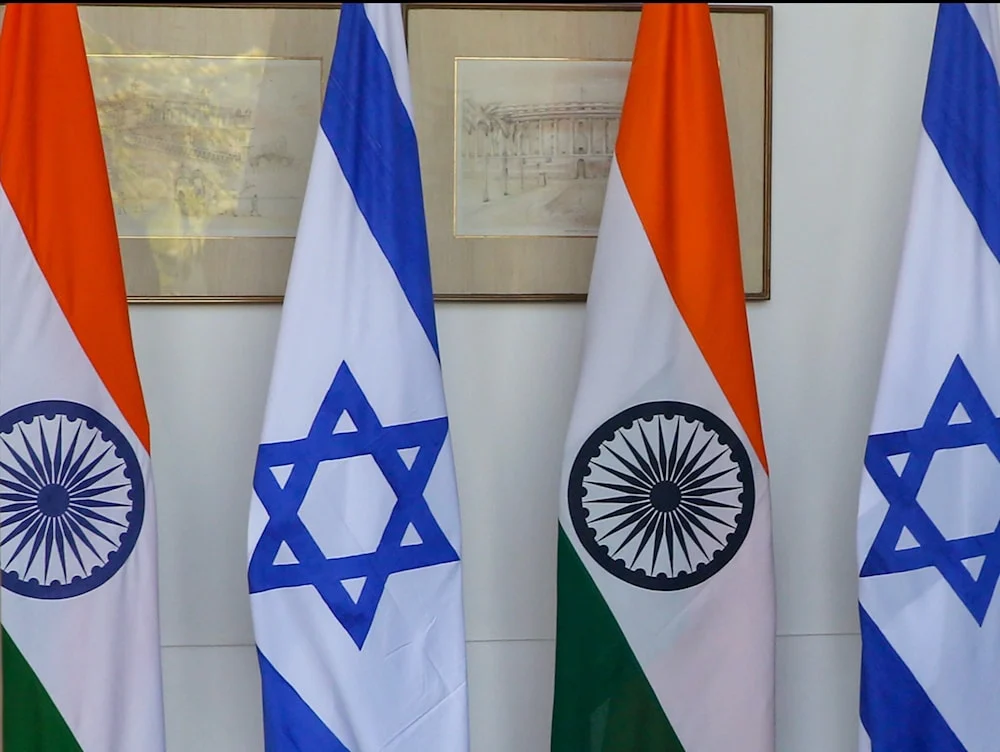
Indian and Israeli flags displayed side-by-side in New Delhi, India, Monday, Jan.15, 2018 (AP)
A fabricated Iran nuclear “admission” originating from Indian nationalist accounts briefly entered Israeli and US political discourse, raising the risk of dangerous wartime escalation before being exposed as false.
A fabricated statement falsely portraying Iran’s senior military leadership as openly committed to acquiring nuclear weapons briefly created a potentially dangerous escalation scenario after traveling from Indian nationalist social media accounts into Israeli media, Israeli Prime Minister Benjamin Netanyahu’s public remarks, and political discourse in Washington.
The false claim was eventually exposed, substantially reducing the immediate danger surrounding the episode. Its rapid rise nevertheless showed how an invented Iranian nuclear “admission” could enter the information environment of countries already waging war against Tehran and potentially influence perceptions of how far that confrontation should escalate.
An investigation published by The New York Times traced the quotation to social media accounts in India before following its movement through pro-Israeli accounts, Israeli television, Netanyahu, and US political figures.
The statement was falsely attributed to Islamic Revolution Guard Corps commander Brigadier General Ahmad Vahidi and claimed that Iran would never abandon its nuclear weapon ambitions while the United States and “Israel” possessed nuclear arsenals.
No evidence of claim identified
There is no evidence Vahidi made the remarks, and no speech, interview, recording, or Iranian publication containing such a declaration has been identified.
Yet within hours, Netanyahu was citing the supposed statement publicly.
“We heard today the commander of the I.R.G.C., Vahidi, explicitly declaring Iran’s intention to keep developing nuclear weapons,” Netanyahu said during a speech at “Mount Herzl” in occupied al-Quds.
The danger was particularly acute because the fabrication concerned the very issue Washington and “Israel” have repeatedly placed at the center of their justification for military action against Iran.
An apparent admission of nuclear-weapons intent from the IRGC commander could have weakened diplomacy, inflated assessments of the threat posed by Tehran, and strengthened arguments that existing military measures were insufficient.
Suspicious timing?
The timing increased the potential consequences.
The false quotation appeared on August 5, only three days after US President Donald Trump indicated that Washington would hold off on another attack against Iran if an agreement could rapidly be reached.
At such a moment, an apparent declaration from the IRGC commander that Iran intended to acquire nuclear weapons could have severely damaged the case for negotiations.
If treated as authentic, opponents of diplomacy could argue that Tehran was negotiating merely to buy time and that no agreement could prevent Iran from eventually obtaining a bomb.
Specifically designed to interfere with negotiation process
Darren L. Linvill of Clemson University’s Media Forensics Hub said the quotation appeared specifically designed to interfere with that process.
“This quote was clearly crafted to drive a wedge into peace negotiations,” Linvill said.
The wording was crucial. Rather than fabricating a general threat against Washington or “Israel”, whoever produced the statement placed an explicit declaration of nuclear-weapons intent in the mouth of one of Iran’s most senior military commanders.
That made the claim politically far more consequential.
The investigation has not established who ultimately manufactured the quotation or whether its creators were acting on behalf of any government.
Its usefulness to opponents of diplomacy, however, was immediately apparent.
Repeated falsehoods emerge from Indian accounts
The earliest known appearance of the August 5 statement came from an anonymous X account in India with around 175,000 followers.
The account had previously faced criticism from fact-checkers and Pakistani authorities over false and Islamophobic material.
Its post displayed Vahidi alongside an AI-generated mushroom cloud and presented the supposed statement without identifying any Iranian source.
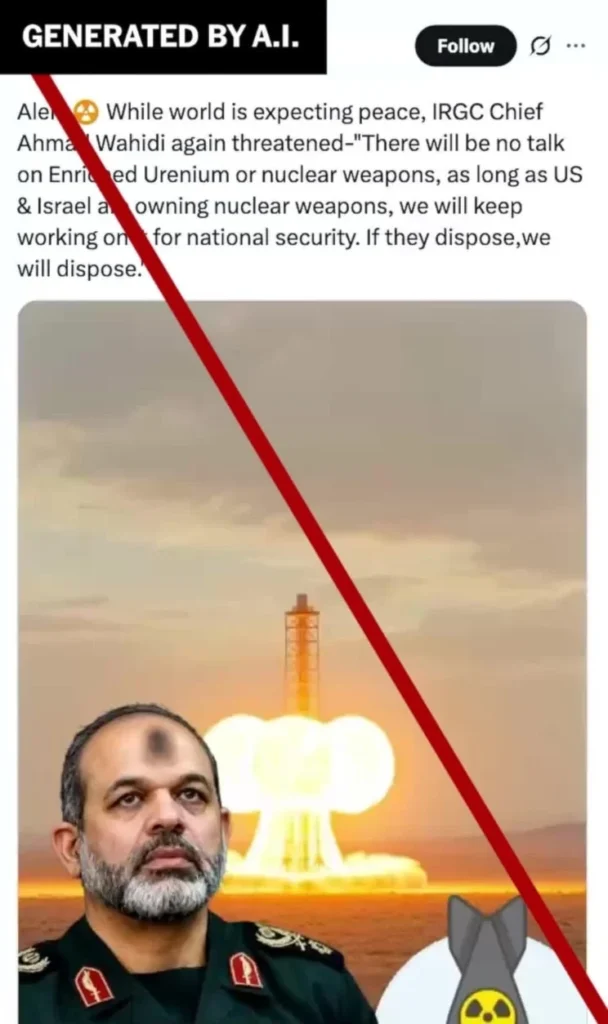 The first known appearance of the quotation was accompanied by a picture of Brig. Gen. Ahmad Vahidi and an animated mushroom cloud (NYT)
Around two hours later, another Indian account circulated the quotation in Hindi.
According to the Israeli fact-checking organization the Bodkim Project, that account had already published another fabricated quotation attributed to Vahidi approximately one week earlier.
That earlier falsehood similarly portrayed the IRGC commander as acknowledging Iranian nuclear-weapons ambitions.
The appearance of two similar fabricated statements in such a short period raises questions over whether the August claim was simply an isolated misunderstanding or mistranslation.
No evidence has nevertheless established coordination between the accounts or linked India’s government to the fabrication.
What can be traced more clearly is what happened once the claim left the Indian information sphere.
From India to Netanyahu
The quotation gained significantly greater exposure after Mossad Commentary, a prominent pro-Israeli social media account, circulated it.
The account immediately drew a conclusion hostile to negotiations.
“The regime is not preparing to abandon its nuclear ambitions. It is buying time. There will be no deal,” it wrote.
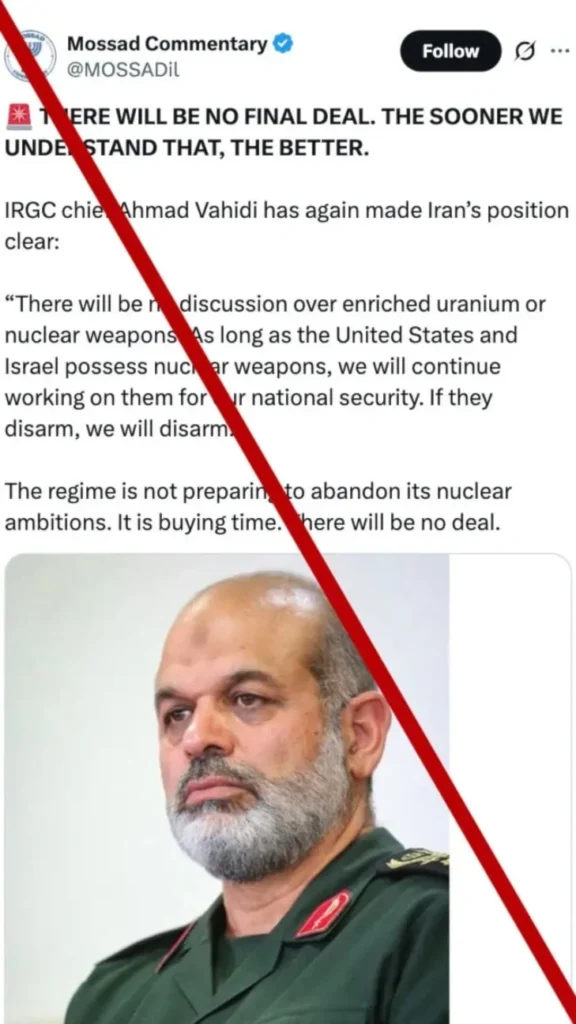 The narrative took off globally after a post by a prominent Israeli account (NYT)
Its operator, entrepreneur Gedaliah Blum, later said he believed the statement had originated from a radio interview with Vahidi but could not identify the interview.
Blum acknowledged uncertainty over “whether those exact words were spoken,” while saying he nevertheless believed Iran sought nuclear weapons.
Channel 14 amplifies the claim
Roughly half an hour later, “Israel’s” Channel 14 amplified the allegation and presented it as the first time Iran had publicly admitted that it intended to acquire a nuclear bomb.
The post reached hundreds of thousands of viewers.
Yair Netanyahu, the Israeli prime minister’s son, subsequently engaged with the reports.
Less than three hours later, Benjamin Netanyahu repeated the fabricated allegation in his speech.
A claim that had begun with no identifiable Iranian source had therefore acquired the authority of an official statement from the Israeli prime minister within the space of several hours.
A spokesperson for Netanyahu did not explain how the false quotation entered his remarks, instead defending Netanyahu’s wider claims concerning Iran’s nuclear program.
On Azriel, a co-founder of the Bodkim Project, said the fabrication “gained credibility every time an outlet or a politician repeated it.”
Falsehood reaches Washington before corrections emerge
Once Netanyahu repeated the fabricated Vahidi statement, the claim quickly entered US political discourse, gaining further credibility as it moved farther from its anonymous Indian origins.
US Ambassador to the United Nations Mike Waltz reposted the allegation, saying Iran was “finally admitting what’s been obvious for years.”
Republican Senator Rick Scott of Florida also circulated it, while Fox News anchor Bill Hemmer cited the quotation during an interview with former US Central Command chief General Joseph Votel.
“That’s as close to an admission as I have heard, and we’ve been watching this story for years,” Hemmer said.
Original source disappears
By that point, the original source had largely disappeared from view. What began as an unsupported post from an Indian account was now being repeated by senior US political figures and a major television network as apparent evidence of Iranian nuclear intent.
Researchers describe this process as narrative laundering, in which repeated amplification by increasingly prominent sources gives an otherwise dubious claim greater legitimacy.
Scrutiny eventually caught up with the fabrication.
Waltz removed his post without explanation, while Fox News later acknowledged that the quotation could not be verified. Hemmer subsequently told viewers that the network had learned the statement was “unverified and inaccurate.”
Those corrections sharply weakened the claim’s credibility, although they did not erase its earlier spread. Scott’s post remained online, as did the original fabrications and numerous social media responses continuing to treat the statement as genuine.
Linvill described the episode as a simple but effective example of narrative laundering.
“It is a simple campaign,” he said, “but simple campaigns can still be very effective, and this seems to have certainly had bang for the buck.”
A brief but dangerous escalation scenario
The significance of the incident becomes clearer in the context of an ongoing war.
Iran has consistently denied seeking nuclear weapons, and Vahidi had previously said Tehran’s position on the issue “has been stated with complete clarity in the past,” while warning that Iran would “do things it has not done previously” if required for its defense.
The fabricated quotation effectively reversed that position, briefly making it appear that Iran’s senior military leadership had openly declared an intention to acquire nuclear weapons.
That could have shifted the debate from Iran’s existing nuclear capabilities to the perception that Tehran had made an explicit decision to obtain a bomb, potentially strengthening arguments that more severe military measures were required.
Inflating perceptions of ‘Iranian threat’
The danger was not that the fabricated quote automatically constituted a pretext for nuclear use. Rather, the falsehood risked inflating perceptions of the Iranian threat during an already volatile conflict.
Because “Israel” is widely assessed to possess nuclear weapons, falsely suggesting that Iran had crossed a new nuclear threshold carried an additional danger of strategic miscalculation, potentially influencing arguments over more destructive strikes, attacks on nuclear infrastructure or intensified nuclear signaling.
The episode therefore showed how fabricated information could briefly become relevant to decisions over war and escalation before verification caught up.
Iran says nuclear lies have served aggression
Iranian Foreign Ministry spokesperson Esmaeil Baghaei placed the fabrication within what Tehran considers a much broader campaign surrounding its nuclear program.
He described it as “an example of the flood of lies against the Islamic Republic.”
“The allegations of a link to a nuclear bomb are based on the same thing, a lie they have been feeding the international community for 20 years to justify military aggression,” Baghaei said.
His remarks reflected Tehran’s longstanding argument that allegations concerning an Iranian bomb have been used to legitimize coercion and military action.
In that context, a fabricated “admission” from the IRGC commander was particularly consequential because it appeared to validate the nuclear-threat narrative at the same moment diplomacy was being reconsidered.
Indian origin gains significance amid ties with ‘Israel’
The Indian origin of the claim also attracts scrutiny against the backdrop of deepening political, military, and ideological ties between India and “Israel”.
Indian Prime Minister Narendra Modi visited “Israel” only days before the current war began.
Addressing the Knesset on February 25, Modi declared, “India stands with Israel, firmly, with full conviction, in this moment, and beyond.”
New Delhi and Tel Aviv have expanded defense and security cooperation, including military-industrial partnerships.
India’s relationship with the Israeli security sector has also faced scrutiny during the war on Gaza.
India complicit too, with weapons shipments
An Amnesty International investigation published in July identified 2,596 shipments of weapons, ammunition, components and other military-related material from India to “Israel” since October 7, 2023, including suppliers owned or controlled by the Indian state.
At the same time, studies of India’s online political environment have documented strongly pro-Israeli narratives, anti-Muslim rhetoric, and misinformation circulating within sections of the Hindu nationalist digital ecosystem.
That wider context does not establish that the Modi government had any role in producing or disseminating the false Vahidi quotation.
There is likewise no evidence demonstrating that Israeli or US government agencies manufactured it.
The background nevertheless makes the Indian origin of repeated fabricated claims regarding Iran’s nuclear intentions noteworthy, particularly given how readily the latest one moved from Indian nationalist accounts into pro-Israeli networks.
Exposure blunted threat, but episode leaves warning
The immediate escalation risk declined once the quotation was exposed, but the episode left a broader warning.
Within hours, an unsupported claim originating from an Indian nationalist account had passed through pro-Israeli networks and entered the public discourse of officials in states already at war with Iran.
For a brief period, the fabrication appeared to manufacture evidence that Tehran had adopted a substantially more dangerous nuclear position.
Had the claim remained unchallenged, that perception could have increased pressure for escalation at precisely the moment diplomacy remained possible.
The lasting danger, therefore, lies in how close an invented Iranian nuclear “admission” came to being normalized as fact before verification caught up with it.