

Sanctions against Iran: Curse or Blessing?
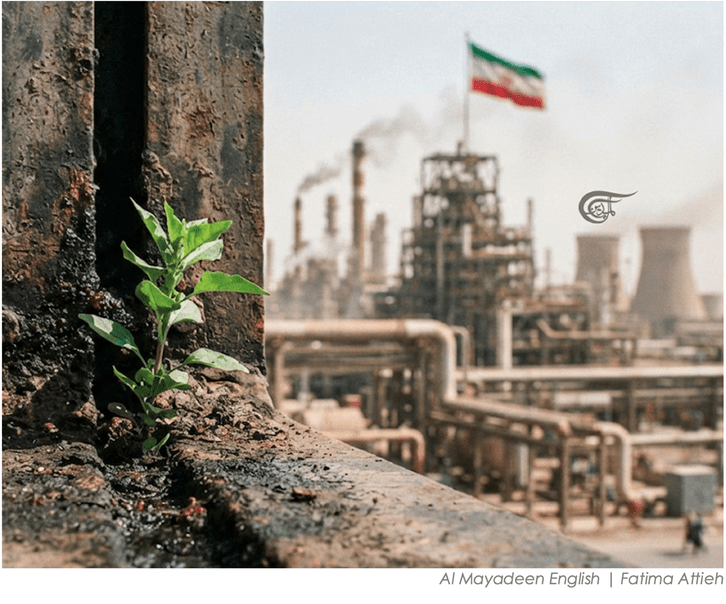
by Tariq Marzbaan | Al Mayadeen English
The Imperial Logic of Containment
“The most effective way to destroy a fleet is to not allow it to be built in the first place.”
This saying, often attributed to British naval officers of the First World War, reveals the perennial logic of colonialism. If we translate “fleet” into national sovereignty – economic, military, and technological strength – the essence of imperial strategy becomes clear: to subjugate, occupy, and plunder a nation, one must first ensure that it never develops the capacity to resist. To this end, colonial powers devised overt and covert methods to hinder advancement. When these methods fail, the bombs and armies follow.
After World War II, the United States refined these colonial practices through a web of multilateral institutions: the United Nations, Bretton Woods, the World Bank, the IMF, the WEF, NGOs, the ICJ, and even cultural vehicles like Hollywood. These became the new instruments of hegemonic control – promoting neoliberal ideology under the guise of “development” and “reform.”
Historical Context – Iran and the Global Financial Order
Following the Islamic Revolution of 1979 and the subsequent hostage crisis – during which it emerged that many of the US diplomats involved had close links to the intelligence services – the United States imposed comprehensive sanctions on Iran. These measures have steadily intensified over the decades, causing immense harm to Iran’s economy and inflicting widespread suffering on its population.
Prior to 1979, Iran was an active partner of Western financial institutions. As a founding member of the World Bank and the IMF (since 1944), Iran received approximately $1.2 billion in combined loans from 1975 to 1979 for infrastructure projects. However, the revolution fundamentally altered this relationship. Throughout the 1980s, World Bank loans were suspended, and the IMF effectively withdrew its activities in Iran. It was only in 1991, under President Rafsanjani’s reconstruction programme, that loans slowly and partially resumed.
Notably, institutional ties were never entirely severed. Iranian representatives continued to attend the annual meetings of the World Bank and IMF – most famously in 1987. For Iran, these meetings offered little direct financial benefit but served as a diplomatic platform to push for sanctions relief. For the West, however, they provided a channel to cultivate pro-Western financial elites within Iran – figures who would later become known as “reformists,” implicitly carrying the torch of neoliberal ideology.
These activities led to the JCPOA in 2015–2018 and, as a result, to the partial lifting of sanctions, which in turn led to a reduction in the production of domestic goods. Following Trump’s withdrawal from the JCPOA, Iran was thrust into a state of agitation. Iranian negotiators such as Foreign Minister Javad Zarif and President Hassan Rouhani were humiliated and lost credibility, even though it was Trump who had withdrawn from the JCPOA. Their critics felt vindicated. In February 2025, Ayatollah Seyyed Khamenei criticised the JCPOA, stating that the Iranian team had been too generous and that the US had failed to honour its commitments and had ultimately withdrawn from the agreement. This temporary return to dependence actually proved his point: sanctions forced innovation; relief measures fostered dependence.
Social Fractures – Class, Ideology, and the Revolutionary Ethos
The sanctions did not affect all Iranians equally, and this created a profound social divide.
Many wealthy Iranians – members of the oligarchic upper class, alongside significant segments of the Western-leaning middle class – blamed their own government for the sanctions. They argued that the Islamic Republic’s anti-Western rhetoric had provoked US hostility and prevented the lifting of economic pressure. Their mindset remained trapped within the neoliberal framework: they longed for privatisation, deregulation, and integration into “free markets,” viewing the clerical leadership as the primary obstacle to their personal prosperity.
The middle class, in particular, inherited this pro-Western orientation from the Shah era, consciously or unconsciously embracing neoliberal values out of pure self-interest.
Yet both classes were largely blind to the deeper reality: the enmity of the United States toward the Islamic Republic was never merely about nuclear enrichment or human rights. It was, and remains, a neo-colonial agenda – an insistence that Iran submit to US-dictated economic and political norms. The West would accept no outcome short of a compliant, neoliberal client state.
The Revolutionary Compass – Justice over Submission
What the upper and middle classes failed to comprehend was Ayatollah Khomeini’s foundational concept of justice – the protection of the mustazafin (the downtrodden) and solidarity with Palestine. This principle, later pursued with equal vigour by Ayatollah Khamenei, represented a complete rejection of Western hegemony.
Left-leaning political groups within Iran often focused narrowly on economic redistribution but overlooked this anti-colonial vigilance. Ayatollahs Khomeini and Khamenei understood that any leadership yielding to external pressure would, like so many post-Soviet states, eventually open its doors to neoliberal predation, allowing the global financial and technological oligarchy to dismantle national sovereignty from within. The Iranian leadership chose a different path.
The Paradox of Pressure – Deprivation as a Catalyst
The sanctions have undoubtedly caused horrific inflation, massive currency devaluation, crippling unemployment (with 39% of university graduates unable to find work, and shortages of critical medications. Daily life has become a relentless struggle.
And yet – this is the paradox – sanctions have made Iran stronger, more self-sufficient, and more resilient. They have forced the state to innovate, strengthened domestic capacities, and, contrary to Western expectations, inspired a profound sense of national unity. As scholars have noted, external pressure often “inadvertently produce[s] resistance economies by strengthening domestic potentials and inspiring national unity”.
The “Resistance Economy” – Institutionalising Self-Sufficiency
Iran institutionalised this response through the doctrine of the “Resistance Economy” – a strategy first articulated after the 1979 Revolution. Its core principle is to rely on domestic resources, reduce dependence on external systems, and maximise internal capacities. This has translated into a policy of import substitution, evolving into what analysts now call a “sophisticated survival mechanism” that has outlasted all international predictions.
The sectors that have flourished under this doctrine are not marginal; they are strategically vital:
- Pharmaceuticals & Medical Biotech: Iran has achieved 97–99% self-sufficiency in pharmaceutical production. Because radiopharmaceuticals have half-lives of mere hours or days, importation was impossible – so Iran mastered their production domestically. Today, it produces over 70 types of radiopharmaceuticals, with 56 countries applying to purchase its nuclear medical equipment. Iranian medicines cost one-fifth to one-tenth of global prices.
- Military & Defence: Sanctions and wartime pressures accelerated defence R&D. Iran now produces advanced missiles, UAVs (drones), and naval assets entirely indigenously. Its drone capabilities have drawn global attention, and production of short-range missiles is fully self-sufficient.
- Science, Technology, Engineering, and Mathematics (STEM) & Nanotechnology: Iran ranks top 10 globally in stem cell research and first in the Middle East in nanotechnology. It ranks first among Islamic nations in cognitive sciences and stands among the top global producers of scientific publications in advanced materials and AI.
- Space Technology: Iran is now one of only nine nations worldwide capable of independently manufacturing and launching satellites – a clear demonstration of technological sovereignty.
- Agriculture & Food Security: Iran has achieved 85% self-sufficiency in food and approximately 96% in essential staples. Wheat production rose from 4 million to 13 million tons; poultry meat from 165,000 to nearly 3 million tonnes.
- Energy Independence: By investing in domestic refineries, Iran eliminated its reliance on imported fuel – a critical vulnerability that had been a point of external pressure.
- Industrial Manufacturing: Petrochemicals, automotive parts, and even the wood/paper industry have undergone localisation and reverse-engineering, with several sectors doubling production since the 1990s.
The Unifying Force of Collective Hardship
Perhaps the most remarkable benefit lies in the social and psychological realm. When sanctions are perceived as collective punishment of an entire nation – rather than targeted measures against officials – deprivation becomes a shared national experience. The state repositions itself as the protector against external hostility.
Empirical research bears this out. A study analysing nearly 2 million tweets from over 1,000 Iranian influencers during the Trump administration’s “maximum pressure” campaign found that sweeping sanctions generally improved public sentiment toward the Iranian government – even among moderate opposition figures. The “Rally-Around-the-Flag” effect, observed during periods of intensified sanctions (2005–2020), showed heightened nationalist sentiment and increased solidarity behind non-civilian state institutions.
The daily struggle to survive – queueing for subsidised goods, navigating currency collapses, finding black-market medicines – has, paradoxically, forged a collective identity. Alongside other positive developments, external pressure has led to better-organised state institutions and a governing structure that has proved remarkably durable.
The Hubris of the Hegemon and the Triumph of Sovereignty
The human cost of sanctions cannot be dismissed. Inflation, unemployment, and shortages have broken countless lives. However, when weighed against the historical arc of national sovereignty, the qualitative gains are undeniable.
The recent wars waged by the United States and its regional allies against Iran have demonstrated the ultimate failure of the sanctions strategy. Iran did not buckle. It deployed superior strategy, superior indigenous technology, and a population whose resilience had been forged in decades of hardship. It has shown that a nation fighting for its dignity – armed with principles of justice and anti-colonial solidarity – can outlast a superpower trapped in its own hubris.
The sanctions were an expression of US pathological self-importance: the illusory conviction that the world cannot function without American approval. Iran has proven the contrary. It has become a role model for the Global Majority – nations seeking not just sovereignty, but deserved dignity. The curse of sanctions, through sheer Iranian ingenuity and collective will, has transmuted into a paradoxical blessing: a self-reliant, technologically capable, and ideologically steadfast nation that no external power can bend.
Perfect but very sad. It is just too sad that we have to even consider that hardship somehow has a correlation with human performance and the ability of humans to transmute and to develop. Hard to put that into words. But I wonder what it is. Hardship to me (I don’t mean hardship vs… Read more »
Yes dear Amarynth: It does break the heart, and it is truly a struggle to put it into words. All we can do, it seems, is open to and embrace this “full catastrophe” and if we can find within ourselves the strength to not turn away, to trust and stay… Read more »