

Foreign Minister Sergey Lavrov’s interview with VGTRK broadcasting company, Moscow, August 14, 2026
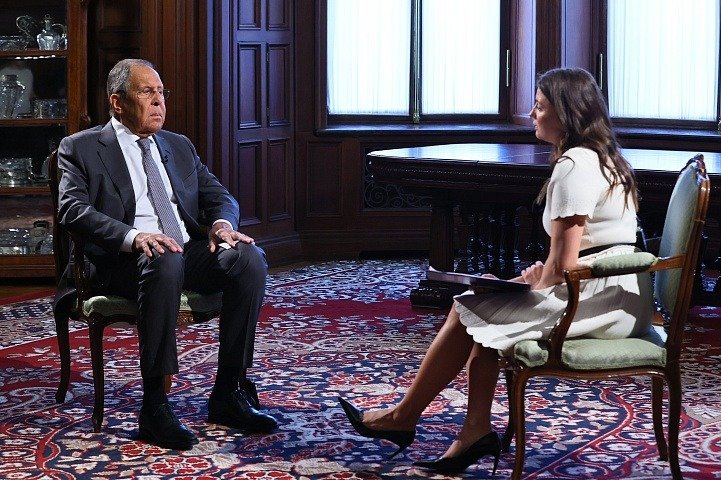
Question: In its military doctrine, Japan has designated Russia as its main threat. What would be your comment on this matter, and could this have happened under Shinzo Abe’s government?
Sergey Lavrov: Shinzo Abe had a lot of tact as a politician, and he understood that working with the Russian Federation was essential for asserting Japan’s national interests. But those who came after him believe that to ensure their national interests, they need to work with the United States by embarking on an effort to militarise Japan.
At the ASEAN events which took place in the Philippines with our partners, the Japanese minister said in a statement after the gathering that he had met with Sergey Lavrov to discuss bilateral affairs and regional developments. This came as quite a surprise to me because it happened during an official reception – there was this long table and all the ministers were seated around it. All of a sudden, someone touched me on my shoulder. I turned my head and there he was, our Japanese colleague, saying that he was delighted to see me and all the good things… I did not even have enough time to get to my feet. I shook his hand, and he walked off to be seated. This was, it turns out, what he meant when he said that we discussed bilateral and regional matters.
According to recent reports, a delegation of Japanese business executives visited Russia not long ago. They told us outright that their country’s leadership firmly instructed them to refrain from discussing any projects with us.
Question: The European Union announced its intention to inspect Russian commercial ships and referred to them as the so-called shadow fleet. What is this all about? What does this mean? What is behind these inspections?
Sergey Lavrov: The European Union came up with this term quite some time ago. You will not find it in any documents. The European Union decided to enforce its own would-be laws, if you can use the word “law” to describe the illegal decisions Brussels takes, by restricting Russia’s ability to earn revenue on the global markets.
They de facto enacted a ban on Russia’s ability to sell energy resources, while designating all ships which are not obeying the European Union, no matter the flag these ships sail under, as being part of the so-called shadow fleet. This is an extremely dangerous path since they claim that their decisions prevail over international law.
They authorised themselves not just to stop and inspect vessels, but even to confiscate their cargo and sell it to generate revenue. This way, these funds can be transferred to Ukraine so that it can continue consolidating its Nazi regime.
President Vladimir Putin was very clear when he tactfully said that Russia will respond in kind to this robbery. We will choose the targets as we deem fit by focusing on the ships serving countries which have made pillaging and piracy their official policy.
Question: How can we win if the other side is so crooked? After all, the values we adhere to are totally different. Even in ancient times, our princes treated their adversaries with respect when heading into war. The values we share are completely at odds and are far removed from these terrorist attacks.
Sergey Lavrov: Moreover, after every terrorist attack of this kind, the regime’s representatives use social media and other resources to boast about striking a beach, a dormitory for young women aspiring to become teachers, and other civilian sites.
Question: How should we fight these adversaries? After all, descending to the level of their dishonest methods is not an option for us.
Sergey Lavrov:
We will not sink to their level. Instead, we will adopt much harsher methods to destroy everything that enables the West to fuel Kiev’s war machine. We are already doing this, and they are already moaning.
It is no coincidence that there have been more voices across our shared space calling for an immediate cessation [of hostilities]. But this is not the way things work. You need a lasting, reliable and sustainable settlement to stop.
If we were to suddenly stop at the line of contact, this would effectively betray the feats of our forefathers who defeated Nazism. This option is not on the table. We are talking about something that goes beyond ensuring that people can live in comfort today. People are suffering, and people are dying in these terrorist attacks. This is a matter of our responsible attitude towards the millennia-long history of the Russian state.
Question: During a news conference by President of Serbia Aleksandar Vucic and Vladimir Zelensky, a German journalist openly tells Zelensky how they, the Germans, can help Ukrainians kill Russians. What an unthinkable thing to say. What has happened to Western diplomacy?
Sergey Lavrov: It goes without saying that this person does not deserve to work in any position in the media, let alone hold any official government functions.
Nazism has been metastasising and becoming increasingly apparent in German society under Chancellor Friedrich Merz, who has openly spoken about the need to once again make Germany Europe’s main military force. Does he even understand what the word “again” means in this context? I am not sure about that.
By the way, regarding this question during the news conference by Vladimir Zelensky and Aleksandar Vucic, I saw that this statement really struck the President of Serbia. Of course, we would like our Serbian friends to respond in one way or another, considering their major contribution to defeating Nazism.
Question: President of Serbia Aleksandar Vucic signed a document offering military support to Ukraine. However, people remember the bombing of Yugoslavia. Does this mean that Serbia has sided with the West? What would be your comment in this regard?
Sergey Lavrov: President of Serbia Aleksandar Vucic is facing a challenging situation. He is a very seasoned politician, who is committed to pursuing European integration.
At this stage, the European Union is bullying him by engaging in outright blackmail. Their position is as follows: Serbia may have been on the waiting list for joining the EU for quite some time now, but we will fast-track talks only after you fulfil two main requirements. The first is recognising Kosovo’s independence, and the second is joining everything the EU does and resolves regarding Russia.
He has been courageous in sustaining this pressure for several years now. We have been selling natural gas to Serbia at a very beneficial price and have never asked Serbia for anything in exchange, apart from saying that it would be unacceptable if our Serbian brothers were to take part in arming the Kiev regime. President Aleksandar Vucic issued a dedicated resolution to prohibit any initiatives of this kind.
Perhaps, by agreeing to Vladimir Zelensky’s insistent requests for a meeting, Aleksandar Vucic wanted to ease the pressure he has been facing from the European Union. This kind of pressure is unacceptable and totally obnoxious.
They are acting as if they had already established the Fourth Reich.
Question: The Bulgarian leader decided to move in the opposite direction by announcing his desire to withdraw from the coalition of the willing and saying that everything must be resolved by diplomatic means. In your opinion, will the European Union succeed in forcing him to change his mind?
Sergey Lavrov: I know Prime Minister of Bulgaria Rumen Radev very well. He ran his election campaign by focusing on national interests instead of submitting to EU’s bureaucracy. There have been quite a few examples of people stating similar intentions but acting differently once in power. Some succeed in remaining true to their principles and beliefs as set forth during their election campaigns, while others give in to pressure.
They will have to figure this out on their own.
Question: With regard to Steve Witkoff and Jared Kushner, who appear to be unable to get here yet again. You have personally engaged with both of them. In your estimation as an experienced diplomat, can either of them exert any influence on US President Donald Trump?
Sergey Lavrov: I proceed from the premise that, if such trust is indeed placed in them, they do have influence on the President of the United States. He places his confidence in them.
We do not refuse to engage in dialogue with them. Should they choose to visit, they are fully aware that President Vladimir Putin stands ready to receive them once again. The pivotal question is what they will bring to the table. When Steve Witkoff visited just over a year ago – it must have been August 5 or 6 – he conveyed proposals from President Donald Trump. President Vladimir Putin took these into consideration and, upon his arrival in Alaska, stated: “Donald, you sent us proposals; I have reflected on them. There are matters that require compromise. But your proposals, as you have formulated them, I accept.”
Then there was a pause. This was followed by the imposition of sanctions against Lukoil and Rosneft. Simultaneously, leaders of the European Union and NATO, joined by Vladimir Zelensky, hastened to Washington, clinging to President Donald Trump with the primary aim of dissuading him from pursuing any further initiatives.
Subsequently, US Secretary of State Marco Rubio, when responding to a journalist’s question regarding Anchorage, remarked that, upon reflection, they were likely unable to serve as mediators because they support Ukraine. Yet, a fortnight later, he asserted quite the opposite: that, in any case, only President Donald Trump is capable of bringing Ukraine and Russia to the negotiating table and forging a settlement. Thus, in other words, they support Ukraine and supply such weapons and intelligence data.
Question: This is precisely the reason why the Ukrainians strike our oil refineries with such accuracy, inflicting damage upon small businesses and civilians. Why might we not, before engaging with them at the negotiating table – with Steve Witkoff and Jared Kushner – first issue an ultimatum demanding that they cease such actions?
Sergey Lavrov: We do not present ultimatums. We have submitted a number of questions to the Department of State, requesting comments on, among other matters, the intelligence data and the fact that the United States is far more deeply involved in orchestrating and executing strikes deep into the territory of the Russian Federation against civilian targets. We will await their response.
Question: Turkish Foreign Minister Hakan Fidan visited Russia, travelled to Kazan, and held meetings with you as well as with President Vladimir Putin. Naturally, the conversation – as you have already confirmed – addressed the possibility of Türkiye once again serving as a mediator in negotiations. Concurrently, however, President Recep Tayyip Erdogan, during the NATO summit, signed documents concerning the restoration of the territorial integrity of the Kiev regime. Can we, or indeed should we, place our reliance upon such mediators?
Sergey Lavrov: Türkiye aspires to be both a NATO member with the largest army in the bloc and to maintain relations with the European Union, though it is acutely aware that it will never be admitted to the EU. It also seeks to foster strong relations with Russia, given our many joint economic projects and shared history: the Caucasus and the Black Sea. Türkiye is genuinely committed to ensuring that the Black Sea remains stable.
Currently, our Turkish colleagues are once again proposing that some form of agreement be reached so that shipping is not subjected to attacks. Yet it was not us who initiated these hostilities. When an AFU drone strikes a Turkish bulk carrier, a tanker, or a civilian vessel, when those same drones repeatedly attack the infrastructure of the Caspian Pipeline Consortium in the Caspian Sea, directly targeting vessels associated with American companies Chevron and ExxonMobil, neither Türkiye nor the United States publicly declares that such actions by Ukrainian terrorists are unacceptable.
When we enquired as to whether they would acquiesce to this, they responded in the negative, stating that they had sent a signal. Evidently, with regard to the Caspian Pipeline Consortium, US Vice President JD Vance conveyed some form of message to Vladimir Zelensky. Our Turkish counterparts informed us that they too had told the Ukrainians not to target it. Yet in the public domain, silence prevails. This, too, is highly revealing. Notably, in response to these admonitions, the Zelensky regime – as far as one can judge from available information – did not undertake to halt the strikes. It undertook merely to cease strikes on vessels unaffiliated with the Russian Federation. Evidently, that explanation was deemed acceptable.
We maintain a substantial agenda with Türkiye. I believe that the “trails” that persist as a consequence of its NATO membership and various engagements with the European Union are, indeed, unavoidable.
Question: A slightly more personal question, if I may. What would you say is the quality that has shaped you most?
Sergey Lavrov: I’ve never been one for self-promotion. I think the main thing is that I’ve always taken whatever I did very seriously – I never wanted to let down the people who trusted me with a post, whether that was in Sri Lanka, at the Central Office, in New York, or back here in Moscow.
Question: And is there any quality that gets in the way of being a diplomat?
Sergey Lavrov: Honestly? Nothing gets in the way. A diplomat needs a sense of humour and a certain lightness – once the job is done properly and signed off.
Question: The diplomat William Burns wrote in his book that you’re impossible to embarrass. Would you agree with that?
Sergey Lavrov: You can embarrass me, alright – you just might not notice it.
Question: You were very close to your grandparents. Which of them – or perhaps someone else in the family – do you think had the biggest influence on you and your character?
Sergey Lavrov: My mother, my grandfather and my grandmother all had an influence, mainly because they didn’t just allow me to be independent with my friends – they encouraged it. I’d come home from school, get my homework out of the way, and then it was out into the street, into the courtyard, into all the usual childhood scraps. Someone would say something to someone else, it would cause offence, and then they’d sort it out, talk each other round. And interestingly, that’s where the principle of “shake on it and move on” really took root.
I’m very grateful they never forced me to come back inside. You know the sort of thing – just as you’re getting going…
Question: But only after school, right?
Sergey Lavrov: After school, of course. I did skip a lesson occasionally – but who didn’t? It depended.
Question: Which subjects did you skip?
Sergey Lavrov: I can’t really remember now. I do remember I once got a “satisfactory” on my conduct report, though.
Question: These are quite difficult times for the country. People want to hear strong messages – including from you. What would you like to say today?
Sergey Lavrov: We hear strong messages on a regular basis. President Putin has been very clear: all the objectives of the special military operation will be achieved.
I’ve been watching the reports from the front. Those are impressive men – steady, clear-eyed, proud of their country. When you hear them after taking another town, saying “The enemy will be defeated, victory will be ours, our cause is just” – that’s a very powerful message.
What more can I add to that? Sometimes I’m tempted to add a word, but I’m afraid you’d have to bleep it out.
Ivan’s not foolin’ Lavrov’s words bode defeat for the nazis…and their “alliance”, and ruin for the nazi base in y’all know where… Our Cause Is Just – Vyacheslav M. Molotov 1941 Context: Citizens of the Soviet Union: The Soviet Government and its head, Comrade Stalin, have authorized me to make… Read more »