

Enemies at the Gate
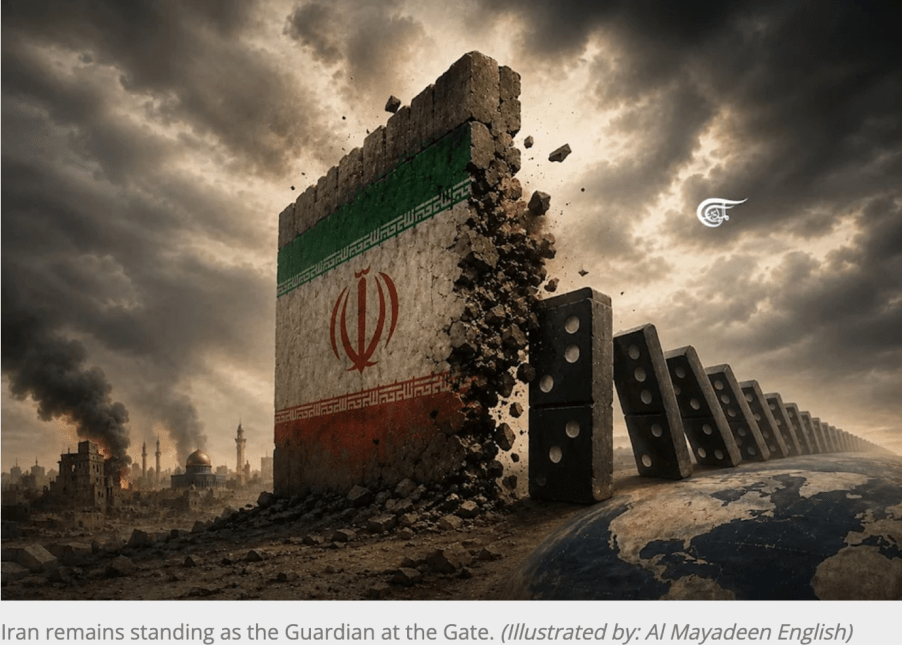
– Tariq Marzbaan and Nora Hoppe – Al Mayadeen English
Since the publication of our essay “Iran: Guardian at the Gate of Sovereign Nations” by Al Mayadeen English on 7 February 2026, events have surpassed even the darkest predictions. On 28 February, the United States and “Israel” launched a coordinated war against Iran, assassinating the people’s beloved Supreme Leader Ayatollah Seyyed Ali Khamenei and members of his family in their home. The assault did not spare other innocents: a triple-tap bombing at the Minab Elementary School, a double missile strike on the Lamerd Sports Hall, and systematic attacks on homes, hospitals, bridges, streets, fishing boats, and workplaces have killed thousands.
An impracticable MoU was signed on 17 June… and, predictably, broken repeatedly by the United States. (The Iranian mission to the UN has documented 42 significant US violations.) On 8 July, American military attacks resumed, slaughtering 50 people and wounding over 500, including women and children, in just days. The attacks not only targeted military objectives but have systematically struck hospitals, schools, transportation infrastructure, and even an environmental station with the family of a ranger on duty. On 16 July the bombing of the Shahid Baghaei Medical Centre in Ahvaz forced 211 children undergoing chemotherapy to evacuate. These are not acts of war under any civilised code (i.e. under so-called “international law” of the so-called “United Nations”) – they are war crimes.
The People’s Response: A Unity Beyond Comprehension
The assassination produced a response that shattered Western assumptions. Approximately 43 million people attended the week-long funeral ceremonies for Ayatollah Khamenei and his family. The sea of red flags, raised fists, and banners declaring “We must rise” were not mere grief – they were a testament to an unbreakable national will. External aggression does not fracture a nation with a civilisational soul; it forges it.
The late Supreme Leader’s political testament: “Someone like me does not pledge allegiance to Yazid” – invoking Imam Hussein’s refusal to submit to the tyrant Yazid – has become the roadmap for the Islamic Republic’s future. The message to the West is unequivocal: Iran’s civilisational will cannot be broken by military force.
The Gate, the Trigger and the Domino Effect
Iran is not merely defending itself. It stands as the Guardian at the Gate of Sovereign Nations – a bulwark against imperial homogenisation. Iran has made good on its threat to control the Strait of Hormuz and block alternative routes. The US has reimposed a naval blockade of Iranian ports and sunk an oil tanker en route to Kharg Island – the first use of force against a civilian vessel since the blockade began. Oil prices have surpassed $86 per barrel. The Ansar Allah movement in Yemen stands ready to close the Bab el-Mandeb Strait in coordination with Iran, a move that could send oil prices to $200 and trigger global economic collapse.
Yet even if the straits remain open, the fall of Iran would be devastating. The Hegemon would plunder Iran’s resources, seize control of the entire Axis of Resistance – Lebanon, Syria, Yemen, Palestine – and secure the straits. Emboldened, it would proceed to appropriate further territories and resources. This is a domino game leading to the domination of much of the world.
Major General Mohsen Rezaei, the Supreme Leader’s top military adviser, has warned that if US attacks continue, Iran will shift from defence to an “offensive and full annihilation phase,” striking US bases both within and beyond the conflict zone. Iran has thus far exercised restraint to prevent wider war, but the US has miscalculated this. Rezaei has called on the peoples of regional countries – Kuwait, Jordan, the UAE, Qatar – to help prevent further escalation. The US is not merely waging war on Iran; it is pulling the trigger on a global firestorm. The domino effect is no longer a metaphor: if Iran falls, we all fall.
The Paralysis of the Global Majority
And yet the world watches. The Global Majority – nations and peoples who would be the next dominoes – remain frozen in diplomatic paralysis. The UN and other international organisations are moribund; no effort has been made to create new bodies to uphold international law or justice. China and Russia have provided valuable but undisclosed assistance to Iran. Most governments, even those not aligned with the Western “Axis of Barbarism,” are stuck in their functions, speaking, if at all, through a defunct UN.
Their peoples are either ignorant, indifferent, or deliberately ignoring the crisis. They feel no responsibility for their governments. Silence is no longer paralysis – it is active complicity in a war that is expanding into a world war. Major General Rezaei’s call must be heard worldwide.
The Obstacle: The System
The great obstacle to action is the System – neoliberal and financialized capitalism, which holds the world hostage and paralysed. This is not a superficial observation. The crises converging upon us – economic, social, political, ecological – are not new. They are the chronic symptoms of a global system that has been poisoning the Global South for decades. This polycrisis is the organic crisis of neoliberalism itself – and of the imperial modernity that gave it life. What we are witnessing is not a crisis within the system that can be overcome; it is the system itself in its terminal phase.
Neoliberalism, with its emphasis on privatisation, liberalisation, and deregulation, has atomised societies, stripping away communal bonds, denigrating reciprocity, and reducing citizens to passive consumers. In the West, this has bred complacency; globally, it has bred poverty and despair. and fatalism. And in certain parts of the Global South, a sense of fatalism prevails amongst the masses, rendering people incapable of resistance and prone to resignation. This fatalism is rooted in religion, worldview, philosophy and other ancient traditions and cultural characteristics, and intensifies significantly in times of crisis. The élites, even those not aligned with the Hegemon, preserve their positions and wealth within the system that sustains them (their conduct is determined by class affiliation). The masses, deprived of class consciousness and historical memory, are either indifferent or crushed by a sense of powerlessness. All seem comatose, watching the herculean efforts of one heavily sanctioned nation – Iran and the Axis of Resistance – stand alone against the System.
What Can We Learn from Iran?
The sea of red flags at the funeral procession for Ayatollah Seyyed Ali Khamenei teaches a vital lesson: a heterogeneous people, subjected to decades of sanctions and war, can transcend internal divisions when united by a common destiny. Each individual, in that collective, sensed a scope larger than themselves; each life acquired profound meaning. What unites the Axis of Resistance is not a homogenising creed but a converging quest – analysis of oppression, identification of the oppressor, a course of resistance, and the goal of sovereignty and dignity. This template is not limited to Iran; it is available to any people seeking to reclaim their agency.
What Is to Be Done – Now
Iran does not need our material help. It has always fended for itself. But our world needs collective action before we all go down together. Solidarity with Iran as the Gatekeeper must be fought for within our own countries. The first step is to see reality clearly: to name the enemy – the neoliberal-capitalist system – and understand its harms. Then we must begin dismantling it through concrete action: cultivating class consciousness, rebuilding communities, and acting collectively.
The Iranian people have shown that the people are more powerful than they think. The question is whether the rest of the world will learn this lesson before it is too late.
The time for diplomatic appeals is over. The time for practical action is now.
1. Sound the alarm – not as a request, but as a siren. World War III is no longer “on the brink”; it has begun. The question is not whether it will come, but how far it will spread before the world awakens.
2. Force governments to take a stand – every neutral silence is a vote for the aggressor. The UN is incapacitated. We need new, alternative institutions of justice and international law – immediately.
3. Mobilise people worldwide – the 43 million at the funeral ceremonies were not just mourning; they were a demonstration of power. This power must be organised globally.
Iran remains standing as the Guardian at the Gate. The Gate will not fall – not as long as the peoples of the world understand that this Gate is their own.
The Gate is under siege. The abyss is before us. There is no one else to save us.
We are the ones we have been waiting for.