

From Hormuz to Bab al-Mandab: Yemen Strikes Saudi Arabia and Joins Iran Against Trump
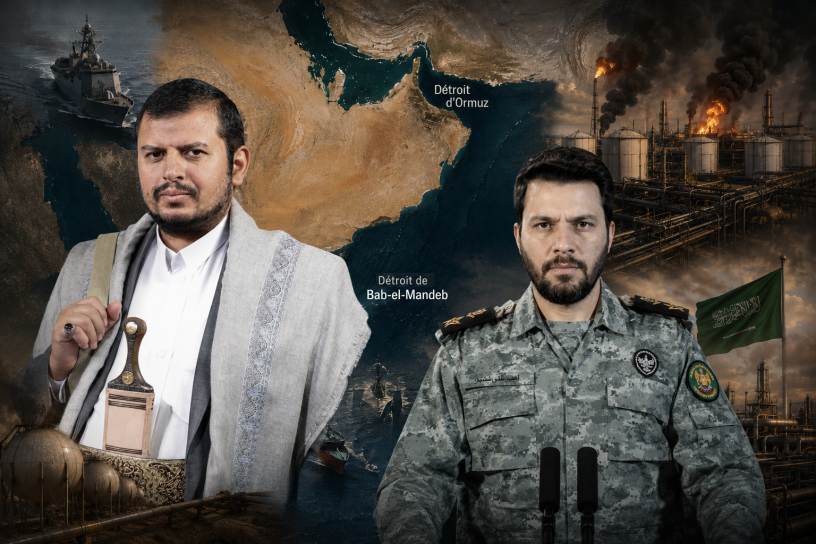
- Statement by Yahya Saree, spokesman for the Yemeni armed forces, following the retaliation against Saudi Arabia
- Interview with Muhammad Al-Bukhaiti, member of the Political Bureau of the Ansar Allah movement, and Brigadier General Bahaa Hallal, expert in military affairs and international relations, a few hours before the Yemeni retaliation.
Summary
The Saudi siege of Yemen dates back more than 11 years, having been imposed with the launch of the military operation “Decisive Storm” in March 2015, led by an Arab coalition under Saudi command (officially including the UAE, Bahrain, Kuwait, Qatar, Jordan, Morocco, Sudan, Egypt, and unofficially the United States, the United Kingdom, France, and Israel). This air, sea, and land siege has considerably restricted the entry of food, fuel, and medicine into the country, causing one of the worst humanitarian crises in the world. In 2023, Yemen was on the verge of resuming the conflict, frozen by a 2022 agreement which Saudi Arabia did not honor, but the Al-Aqsa Flood pushed Yemen to prioritize the fight against Israel, in solidarity with the Palestinian people, going as far as directly confronting the United States, which was defeated and humiliated. Iran broke the Saudi blockade in July 2026, transporting wounded people and a Yemeni delegation on the occasion of the funeral of Sayyid Ali Khamenei. The Saud regime tried to prevent this plane’s return, striking Sanaa airport (without having the courage to claim the attack, leaving this task to the puppet Yemeni government even though it has no air force), and Yemen struck Saudi Arabia back, determined to break the siege once and for all by imposing an air blockade on the whole of Saudi Arabia, to liberate the whole of Yemen, and to defeat the imperialist and expansionist projects of Trump and Netanyahu: will both the Bab al-Mandab Strait and the Strait of Hormuz end up closed?
Statement by Yahya Saree, spokesman for the Yemeni armed forces, following the retaliation against Saudi Arabia
July 13, 2026
In the name of God, the Most Gracious, the Most Merciful.
The Almighty says: {Whoever has assaulted you, then assault him in the same way that he has assaulted you. And fear God and know that God is with those who fear Him.} God Almighty has spoken the truth.
Insisting on continuing its unjust siege on the Yemeni people, and at exactly 1:54 PM on this Monday, the Saudi enemy committed an open aggression via its warplanes on Sana’a International Airport, by targeting it with a number of raids with the aim of closing it to humanitarian flights carrying patients and those stranded to and from Sana’a International Airport. The armed forces engaged with the aggression aircraft to counter this treacherous and cowardly attack.
In response to this criminal Saudi aggression, the Yemeni Armed Forces carried out a military operation that targeted Abha International Airport with a number of ballistic missiles and drones. The operation achieved its objectives successfully, by the grace of God.
The Saudi enemy, with its reckless decision to launch an unjust attack on Sana’a International Airport, bears full responsibility and the dire consequences for this brutal aggression that serves the “israeli”-American enemy, and for the repercussions that result from it.
The Yemeni Armed Forces affirm that they are determined in their just position to repel the aggression and lift the unjust siege on our country. In this context, they warn all airlines against crossing the airspace of the Saudi Kingdom, and they must take our warnings seriously until the siege on Sana’a International Airport is lifted.
We extend our deep gratitude to the Islamic Republic of Iran for its assistance to the Republic of Yemen in lifting the unjust siege on Sana’a International Airport and for facilitating humanitarian flights to and from Sana’a Airport.
Greetings to our great people who have come out and continue to come out in massive mass marches in the capital, Sana’a, and in the governorates, districts, villages, and sub-districts. Greetings and all greetings to our loyal and proud tribes for their massive rallies and their authentic faith-based jihadist positions.
Our great people will not accept the continuation of the aggression and the siege, and their armed forces, with the help of Almighty God, are in full readiness to take the necessary steps and measures to deter the aggression and lift the siege.
And God is sufficient for us, and He is the best Disposer of affairs, the best Protector and the best Helper. May Yemen live free, dignified, and independent. And victory to Yemen and to all the free people of the nation.
Sana’a, 28 Muharram 1448 AH
Corresponding to July 13, 2026 AD
Issued by the Yemeni Armed Forces
Interview with Muhammad Al-Bukhaiti, member of the Political Bureau of the Ansar Allah movement, and Brigadier General Bahaa Hallal, expert in military affairs and international relations – a few hours before the Yemeni retaliation.
Source: Al-Mayadeen, July 13, 2026
Translation: Resistance News
JOURNALIST: Welcome, dear viewers, at this critical moment when the Gulf has been set ablaze by the fires of a renewed and growing American aggression, along with the Saudi targeting of Sanaa International Airport. A front that was, until yesterday, calm, even though the embers were smoldering beneath the ashes. In the news: Saudi strikes targeting Sanaa International Airport, with the aim of confirming the siege imposed by Riyadh on Yemen. The method: preventing any plane from landing at Sanaa airport. The Iranian plane therefore diverted its route to Hodeidah, and with it, it seems that the trajectory of the truce in effect since 2022 is coming to an end. The spokesman for the Yemeni armed forces, Brigadier General Yahya Saree, confirms that the Saudi aggression against Sanaa airport will not go without response or punishment: it puts an end to the de-escalation phase, and Riyadh will have to bear the consequences. Ali Al-Qahoum, member of the Political Bureau of the Ansar Allah movement, warns that the retaliation will not be long in coming and will be powerful and devastating, the blockade will be broken, the strangulation and economic war will not get the better of Yemen, and its people will not kneel.
In the Gulf, the American president announces the renewal of the blockade against Iran, threatening to widen the confrontation and affirming his will to take control of the Strait of Hormuz in order to collect passage fees. Faced with this American escalation, the Khatam al-Anbiya headquarters [central command of the Iranian armed forces & IRGC] states: “We will never allow America to interfere in the management of the Strait of Hormuz,” and warns that “the flames of war will touch all the countries of the region if its scope expands,” and that “any cooperation with America or any support for Israel by the countries of the region will be treated as a war against the sovereignty and national security of Iran.”
It seems that the fuse of war has been relit, and that the door to confrontations and escalation has been thrown wide open, on land and at sea, which could affect maritime navigation throughout the region. This situation heralds a major geographic confrontation extending beyond Yemen and the Gulf, with repercussions that international economic organizations have long warned about, and which could deal the world a fatal blow to its energy resources and financial balances.
Welcome, dear viewers, to this hour of coverage that we are devoting to this conflagration, whether concerning Iran or the Yemeni front. We are joined by Muhammad Al-Bukhaiti, member of the Political Bureau of the Ansar Allah movement, from Sanaa, and Brigadier General Bahaa Hallal, expert in military affairs and international relations, from Beirut. Sayed Muhammad [Bukhaiti], I begin with you to go over everything that has happened, namely the facts, their timing, and their implications.
AL-BUKHAITI: Peace be upon you, and upon all the brother viewers. It should have been up to the Saudi leadership to take the initiative itself to end the aggression and lift the siege on Yemen after the failure of all the objectives of this aggression and the collapse of all its pretexts and narratives. It is now established for everyone that Yemen represents no security threat to any Arab or Islamic country whatsoever; on the contrary, it is a support for them, especially since Yemen has waged a fierce war against America, Britain, and the Zionist entity to defend our brothers in Gaza, defend their rights, and put an end to the crimes of genocide in Gaza. We have also repeatedly affirmed that Yemen will stand alongside any Arab or Islamic country exposed to an American-Israeli aggression, even if it were Saudi Arabia or the Emirates. There is therefore no longer any justification for continuing the aggression against Yemen, especially since this aggression was launched under the pretext of “bringing Yemen back into the Arab fold” and that Ansar Allah supposedly represented a threat to Saudi Arabia and the Gulf countries. This pretext has collapsed.
On top of this, if the Saudi leadership does not reason according to moral logic, let it at least reason according to the logic of self-interest, because it has been proven, through the latest confrontation between Yemen and America, the Zionist entity, and Britain, that Yemen is now capable of confronting the most powerful countries in the world and emerging victorious from it. The Saudi and Emirati regimes were counting on American-British-Israeli protection; yet, if these countries, along with the Zionist entity, are incapable of protecting themselves, how could they protect the Saudi regime? The Saudi leadership should have reasoned, at the very least, according to the logic of self-interest, and that would have been enough to end the aggression and lift the siege on Yemen.
JOURNALIST: I turn to you, Brigadier General Bahaa Hallal, why has Saudi Arabia decided to do what it has done now?
HALLAL: My greetings to you, to your distinguished guest, and to the dear viewers. In truth, the Bab al-Mandab Strait is fundamentally a strait that transcends geography: it constitutes one of the most important maritime passages in the world, and consequently influences not only the region, but also, from a military point of view, supply chains and markets.
Concretely, what is the significance of what Saudi Arabia is doing today? Saudi Arabia wanted to prevent Yemen from breaking the siege it has imposed for more than eleven years. Saudi Arabia is putting pressure on this strait. We saw, about a week ago, that an Iranian plane was attempting to land at Sanaa airport, Saudi aviation tried to prevent it, and there was an air-to-ground confrontation between Yemeni air defense and these planes. The landing operation succeeded. That plane was carrying sick people and Yemenis returning from medical treatment in Iran. Today, the same thing happened again, and Sanaa airport was likewise bombed. The bombing of Sanaa airport cannot be read in isolation from the conflict over the breaking of the air blockade. The messages exchanged indicate that each side is seeking to establish new rules: Saudi Arabia is trying to prevent the establishment of air supply lines that could be interpreted as a change to the status quo, while the Yemenis, for their part, proclaim that the continued operation of the airport represents part of a new political and security reality, and that any targeting of it constitutes an escalation calling for a response. When the military command in Sanaa announces the end of the de-escalation phase, this carries, in my view, an operational significance that goes beyond political discourse: it means that the previous constraints, which lasted more than eleven years, have opened the way to retaliatory options liable to expand and encompass more sensitive targets, notably economic infrastructure, ports, refineries, or shipping lanes. What is most dangerous in this development is not the raid itself, but the shift from a policy of containment to a policy of imposing facts by force, which increases the likelihood of a slide into a new cycle of escalation that is difficult to control.
JOURNALIST: On this precise point, I return to you, Muhammad Al-Bukhaiti, the imposition of facts by force. Why does Sanaa consider that this siege must be broken now, and that this move must also take place now? Especially since we have heard Yemeni voices say that Bab al-Mandab would be linked to the Strait of Hormuz in a plan going beyond the simple breaking of the blockade? Why is this timing opportune, and why does Sanaa insist on taking these measures and on ending this siege now?
AL-BUKHAITI: In 2022, an agreement had been concluded between Yemen and Saudi Arabia, stipulating the Saudi withdrawal from Yemeni territory, the end of the aggression and the lifting of the siege, as well as the payment of Yemeni civil servants’ salaries by the Saudi National Bank, with oil and gas revenues being paid into that bank. Unfortunately, Saudi Arabia did not honor or implement this agreement, and kept stalling for more than a year. While we were preparing, in 2023, to break this siege and put an end to this aggression by force, the Al-Aqsa Flood operation took place and the crimes of genocide in Gaza began. We therefore judged that priority demanded putting an end to the crimes of genocide in Gaza. We thus froze the confrontation with Saudi Arabia and the countries of the aggression in order to devote ourselves to the Zionist entity, as well as to America and Britain who stood alongside it.
Then, we tried to get Saudi Arabia to take the initiative itself to end the aggression and lift the siege, especially since it is now established for everyone that Yemen represents no threat but is rather a support for any Arab or Islamic country. On top of this is the collapse of the narrative used by America to stir up discord and conflict in the region, according to which the Axis of Resistance would represent the Persians against the Arabs and the Shiites against the Sunnis, since the Axis of Resistance today stands alongside Arab Palestine, not Persian Palestine, Sunni Palestine, not Shiite Palestine. This means that the Axis of Resistance acts on the basis of religious conviction, of an Islamic national cause, of ethics and humanism. These realities should have changed Saudi Arabia’s behavior. Moreover, Yemen is now capable of imposing a siege on the aggressor countries, just as they impose one on it.
But the Saudis did not learn the lesson, and when we attempted to break this siege by establishing flights to and from Tehran, Iran being the only country to have shown this willingness — we welcome, moreover, any flight to and from Yemen from any country in the region —, Saudi Arabia committed an act of aggression against Yemen by targeting Sanaa airport in order to maintain the siege. This cannot go unanswered.
And we say without hesitation that Yemen had the right to strike Saudi Arabia even before this latest Saudi aggression, since it is Yemen’s right and the Yemeni government’s duty to seek to break the siege and end the aggression by force of arms. But it was Saudi Arabia that took the initiative for war and opened the battle, thereby completing its own condemnation.
We will therefore retaliate, and the response will be very powerful. We will target objectives that are important and vital to the Saudi regime, and these strikes will be painful. And it is Saudi Arabia that took the initiative for the aggression. Our positions are just and logical, our demands are clear: end the aggression, lift the siege, withdraw all foreign forces from Yemen, and have Saudi Arabia withdraw its hand from Yemen. These demands are just, and they are today those of the entire Yemeni people, after it has realized that Saudi Arabia targets everyone. Everyone knows that the Saudi air force targeted its own mercenaries at the start of the aggression in the Al-Abr region, killing more than 300 mercenary soldiers. The Emirates also bombed mercenary forces in the Al-Alam region, killing more than 300 officers, commanders, and soldiers. Saudi forces also targeted the forces of the [Southern] Transitional Council and killed hundreds of them, simply because they were located in Hadramawt and Al-Mahra. Saudi Arabia considered that their presence in these regions constituted a violation of its sovereignty and a threat to its internal security. Look: when they said that the presence of Ansar Allah in any Yemeni province, particularly Sanaa, represented a threat to Saudi Arabia’s security, they also considered that the presence of the forces of the Transitional Council — which was nonetheless a party to the conflict and was fighting against us — in these regions or provinces, constituted a threat to Saudi Arabia’s internal security. Thus, today, the Yemeni people realize that all the pretexts for the aggression against Yemen have collapsed, and that the narratives used to inflame conflicts and discord in the region are American and Zionist narratives with no basis in truth whatsoever. The countries of the aggression target everyone.
We must also be aware of an important reality: Yemen has suffered greatly because of this aggression and this siege, and the only way to put an end to this suffering is to end the aggression and lift the siege. That is why the Yemeni people have, for several months now, begun preparing to wage the battle for the liberation of Yemen from Saada [governorate in northwestern Yemen, on the border with Saudi Arabia] to Al-Mahra [governorate in the far east of Yemen, bordering the Sultanate of Oman]. But today, we are not the ones taking the initiative for combat; it is Saudi Arabia that has taken it, and thus its condemnation is completed, and the Saudi leadership will come to regret what it has done.
JOURNALIST: I will come back to you to learn more, Mr. Muhammad Al-Bukhaiti. I turn to you, Brigadier General Bahaa Hallal: why must Saudi Arabia keep Yemen under siege? Who is putting pressure on Saudi Arabia? Why is it determined to continue this siege by all means? How does this siege serve other parties who are also putting pressure on Saudi Arabia to maintain it? How is it being used to contain Yemen at this stage?
HALLAL: In truth, the American calculations between freedom of navigation and total war constitute the situation that is today pressing Saudi Arabia and pushing it toward pressure, bombardment, aggression, or maintaining the siege on Yemen. Concretely, America knows what it is doing today in the Strait of Hormuz, that is to say, after the Memorandum of Understanding, and after having violated that Memorandum of Understanding and relaunched the war against Iran, it considers that the unity of the theater of operations [doctrine of coordination of the Axis of Resistance across all fronts] is a fact, as Iran has repeatedly threatened. It knows that Bab al-Mandab is not merely a maritime corridor, but a space of strategic deterrence. In military science, the value of maritime straits is not measured by their geographic surface area, but by their capacity to influence the strategic decisions of states. From this point of view, Bab al-Mandab is not a simple passage connecting the Red Sea to the Gulf of Aden: it is turning into one of the most important maritime chokepoints capable of influencing the movement of global trade. This reality, Iran has understood, and Saudi Arabia now understands it too. That is why it attempted, in my view, to wage a preventive battle, in line with the American vision, knowing that this subject was bound to come as a result of all this pressure exerted by the United States on Iran. The new strategic equation can be called “deterrence through the straits”: if the Strait of Hormuz represents Iran’s pressure card in the Arab Gulf, Bab al-Mandab constitutes the southern extension of this equation, allowing Tehran to widen its perimeter of deterrence toward the Red Sea.
This is where we see the change in the rules of engagement following the targeting of Sanaa airport: in light of today’s statements from the Ansar Allah leadership, one can deduce that the concept of de-escalation is no longer considered a valid framework. And there is a fundamental answer on this subject: Saudi national security is facing the equation of a composite threat. Saudi Arabia is today confronted with a challenge consisting of multiple simultaneous sources of threat: it is today threatened by the United States of America, which demands that it be capable of fulfilling the role the United States decrees for it. The threats are therefore no longer limited to its southern borders, but extend into the maritime and economic domains. That is what it wanted to do. From a military planning point of view, the Saudi leadership is today trying to anticipate what could happen, and thus it is the American calculations that pushed Saudi Arabia to do what it did today. I believe it gave, with its own hand, through a flawed operational assessment, the pretext to Yemen to proceed with its military retaliation operations.
All these military and political indicators show that this latest escalation should not, in my opinion, be perceived as an event isolated from what is happening in the Middle East: it is a link in a process of recomposing the rules of engagement in the south of the Arabian Peninsula and in the Red Sea. The main actors are not necessarily seeking total war, but to improve their negotiating positions. Let us not forget that Marco Rubio [United States Secretary of State] traveled to the Gulf and met with the Arab Gulf countries, compelling them to get Oman to back down on the question of the Strait of Hormuz in its partnership with Iran, and the Gulf countries then declared that they did not want and would not accept Iran managing the Strait of Hormuz.
All these warning signs fall within this general framework: improving negotiating positions and imposing new equations of deterrence before any regional settlement and before a return to the Memorandum of Understanding. America, which has considered itself strategically the loser in this equation, wants to withdraw or modify the cards of strength to which Iran has clung, notably the Strait of Hormuz. And today, we add to this the Bab al-Mandab Strait, following this mistake by Saudi Arabia and America. The de-escalation phase is therefore over.
In turn, what will the Kingdom of Saudi Arabia do? Will it try to prevent any change to the reality on the ground while avoiding being dragged into a major war? It will not be able to do so, because the Yemeni retaliation is inevitable. I believe that this time, the region has been dragged, and Saudi Arabia has been dragged, into a new battle in the Red Sea and in the Bab al-Mandab Strait, a battle that falls within the framework of the American war.
JOURNALIST: Continuing along these lines, I come back to you, Sayyid Muhammad Al-Bukhaiti. Based on the high level of Yemeni preparations against Saudi Arabia, when Sanaa chooses today to break this siege, it is saying, in one way or another, that it is now ready, knowing that a Saudi aggression aimed at preventing this breaking of the siege was foreseeable. What kind of Yemen will we now be facing, in terms of preparation and also in terms of coordination with its allies?
AL-BUKHAITI: Today, Saudi Arabia, and behind it America, Britain, and the Zionist entity, will find themselves facing a united Yemen. Incidentally, for the information of Arab viewers: any foreign or covetous country wishing to impose its will on Yemen or to occupy it knows that Yemen, from Saada to Al-Mahra, is a people of resistance, and that this resistance is concentrated notably in the highlands region and in the region of the Triangle, that is to say Yafa’, Al-Dhale’, and Radfan. That is why Saudi Arabia, since its founding, has worked to dismember Yemen and to create conflicts and divergences between the highlands region and the Triangle region. In the aggression against Yemen, Saudi Arabia attempted to draw the Triangle region, notably the [Southern] Transitional Council, toward secession so that they would fight against their own compatriots in the interest of Saudi Arabia and the Emirates. We warned them from the very beginning, confirming to them that the ambitions of the countries of the aggression, notably Saudi Arabia and the Emirates, are concentrated in the southern provinces, especially those with low population density, such as Shabwa, Hadramawt, and Al-Mahra, and that the target of the countries of the aggression in the southern provinces is precisely the Triangle region, because resistance is traditionally concentrated there for historical, geographic, and demographic-density reasons. But they did not heed this advice. Yet as soon as the forces of the Transitional Council reached Hadramawt and Al-Mahra, Saudi Arabia considered this presence a violation of its sovereignty. This is what the defense minister of the “hotel government” [pejorative expression designating the internationally recognized Yemeni government-in-exile, a puppet of the Saud family] expressed when he affirmed that no country had the right to intervene in Yemen without Saudi authorization: that is to say, that if a country wishes to intervene in Yemen, it must obtain Saudi Arabia’s authorization, whereas Saudi Arabia itself has the right to intervene in Yemen. And he said that this was in accordance with the law. And when he was asked what law he was referring to, the defense minister of the hotel government replied that by “law” he meant the will of the countries of what he calls the International Quartet: America, Britain, Saudi Arabia, and the Emirates, which he explicitly named. Thus, whatever they decree concerning Yemen should have the force of law for Yemenis. He added that Yemen falls under Saudi national security. That is how they think.
But today, the people have reached a high level of awareness, notably after Saudi forces bombed the forces of the Transitional Council in various Yemeni provinces. Today, the picture has become clear for the children of the Yemeni people from Saada to Al-Mahra, and in the highlands region as in the Triangle region. Saudi Arabia will therefore today find itself facing a united people. Certainly, there remain a few mercenaries, who belong to only two categories: either Wahhabis influenced by Wahhabi thought, or paid mercenaries who depend on Saudi funds or others. They will therefore find themselves facing a united Yemen, a conscious Yemen, a Yemen armed with all kinds of weapons. And the most important weapon of the Yemenis here…
JOURNALIST: If I may, please explain this to me in detail. You spoke of an armed Yemen: armed with what? We are talking about several parties in conflict within Yemen. How are you armed? And I had asked you what the role of coordination with allies was. Today, this siege was broken by the arrival of an Iranian plane at the airport.
AL-BUKHAITI: Yes, Yemen is armed with all kinds of weapons, and the most important of them is Yemen’s just cause, the injustice suffered by the Yemeni people, because this aggression has caused immense suffering to the children of the Yemeni people. And also the arrogance and pride of the countries of the aggression, first and foremost the Saudis. This arrogance and pride were on display when the Saudi air force targeted Sanaa airport to prevent the landing of a civilian plane carrying some 300 Yemeni citizens, including women and children, putting their lives in danger. Under what pretext? Under the pretext of preventing a violation of Yemen’s sovereignty! Yet at the same time, it fought in the same trench as America and the Zionist entity to shoot down our missiles and drones that were striking deep into the Zionist entity and targeting the American navy in the Red Sea. And Saudi Arabia did not consider that the Israeli-American aggression against Yemen constituted a violation of Yemen’s sovereignty. But an Iranian civilian plane, it considered a violation and targeted it.
We, the Yemenis, are armed with our faith, with our trust in Almighty God to grant us victory, armed with our just cause and the immense injustice done to us, armed against the arrogance and pride of the Saudi entity. And above all, Yemen today possesses ballistic and aerial capabilities: we are now capable of striking deep into Saudi territory and targeting the most important Saudi interests, first and foremost the oil and gas fields, as well as the airports and ports.
But we say that the ball is still in Saudi Arabia’s court. If Saudi Arabia announces today the end of the aggression against Yemen, the end of what they call “Decisive Storm,” and the lifting of the siege on Yemen, that is the only way to avoid the Yemeni strike that is coming. I warned years ago and advised the Saudi regime, I told them: be reasonable, so that you do not one day wake up in a state from which you can no longer escape until the Day of Judgment. They must therefore be reasonable; they still have a chance, perhaps a few hours. The Saudi leadership must hurry, otherwise, we will make the right decision to defend our country and our people.
JOURNALIST: A few hours, you say, Sayyid Muhammad Al-Bukhaiti?
AL-BUKHAITI: A few hours, yes, a few hours. But I say this as advice to the Saudi regime, because the retaliation could come soon, perhaps this evening, or tomorrow. The retaliation is inevitable. They therefore have little time left: they must hurry and take the initiative of announcing the end of the aggression and the lifting of the siege on Yemen.
JOURNALIST: Stay with us, Sayyid Muhammad Al-Bukhaiti. Saudi strikes targeted Sanaa International Airport. The Yemeni state and armed forces confirm that this aggression will not go without retaliation or punishment, and hold the Saudi regime fully responsible for the consequences of its escalation. […] In Iran, the spokesman for the Khatam al-Anbiya central headquarters has warned that continued American interference in the management of the Strait of Hormuz threatens the security of the region and international trade, confirming that Iran will respond firmly to any American move outside the limits it sets. He also warned the countries of the region against the consequences of cooperating with Washington in this area.
Statement by the spokesman of the Joint Command of The Iranian Forces
Continuing our previous warnings, we will never allow America to interfere in the management of the Strait of Hormuz, and we will not let that happen. The armed forces of the Islamic Republic of Iran will respond with all the necessary firmness to any disturbance or destabilization of security affecting the passage and transit of commercial vessels and oil tankers by the aggressive and piratical American military, outside the route determined by Iran and without authorization from its armed forces. The determined measures taken by the Revolutionary Guards and the army of the Islamic Republic of Iran over the past few days bear witness to this affirmation. We warn the leaders of the countries of the region that any cooperation with America and any logistical support for the army of this aggressor country will be considered a war against Iran’s sovereignty and national security. And in the event of a widening of the perimeter of the war in the region, the flames of war will touch all the countries of the region. Responsibility for all forms of destabilization and widening of the perimeter of the war in the region falls upon America and the countries cooperating with the army of this criminal country.
JOURNALIST: To learn more, we welcome Mojtaba Heydari, Al-Mayadeen analyst for Iranian affairs, from Tehran. Mojtaba, all our greetings. Even more escalation in Iran, Trump’s announcement on the closure of the Strait of Hormuz and his willingness to take control of it, even more positions in Iran and escalation in Iran, over to you.
HEYDARI: My greetings to you and to the viewers. In truth, at this stage, Iran continues to affirm its full sovereignty over the Strait of Hormuz; it says and affirms that it rejects any external interference and any parallel route in the Strait of Hormuz. The United States, through its latest attacks, is seeking to open a corridor in the Strait of Hormuz, which Tehran has rejected in its entirety. The nature of the American attacks, notably against the surveillance infrastructure linked to the Strait of Hormuz, shows us that the United States continues to seek to open the Strait of Hormuz. There are also attempts to target Kharg Island. For its part, Iran has announced the closure of the Strait of Hormuz, and now Donald Trump is announcing the imposition of a naval blockade.
I anticipate, based on Iranian statements, that we will witness a greater and wider escalation on the Iranian side. Iran affirms that it will continue to maintain the closure of the strait and that it is the master of it. There is also an important question: it is expected that we will witness broader operations on the Iranian side to break the American naval blockade. At this stage, Iran affirms that the United States has violated the clauses of the memorandum of understanding.
JOURNALIST: Do you have more information on this point?
HEYDARI: On the subject of the Strait of Hormuz, yes: more than one official stated, and there is such an assessment at the media level in Iran, that the United States wants to impose a naval blockade, and Iran will work to break it. There are also sources confirming that Iran will expand, in the next phase, its retaliation, and there is no such thing as an Iranian concession. Iran has set out an equation: commitment for commitment. But when there is an escalation from the other side, Iran will also escalate further.
Just now, there was a remarkable statement from the spokesman of the Revolutionary Guards who said: “We exercise sovereignty over the Strait of Hormuz with all our strength and determination.” Iran therefore affirms its sovereignty and rejects any interference in the Strait of Hormuz. There is also an Iranian warning to the countries of the region: Iran says that any country that deals or cooperates with the Zionist entity or the United States will, from Iran’s point of view, be considered a partner in hostile military operations against Iran. With this statement and this Iranian escalation, one can say that Iran is ready to defend itself. It is clear that Iran knows that the United States wants a greater escalation: this does not mean operations in Tehran, nor that the United States wants to target the Iranian capital, nor that there will be a total war. But the United States, at this stage, wants to subdue Iran and push it toward concessions on the nuclear file and on the Strait of Hormuz. Iran refuses: it cannot accept diktats. And certainly, Iran will continue to maintain the closure of the Strait of Hormuz and will respond to any American escalation.
JOURNALIST: Thank you, Mojtaba Heydari, Al-Mayadeen analyst for Iranian affairs, you were with us from Tehran. I come back to you, Brigadier General Bahaa Hallal: who guarantees that things will not slide once again into total war? A war which seems to have a new actor: the Yemeni side, with its short-term threats to Saudi Arabia demanding that it back down, failing which the interior of Saudi territory will be bombed with weapons capabilities superior to what we have known from Yemen?
HALLAL: There is no guarantee on this subject. The Strait of Hormuz is no longer even a simple maritime corridor for the transport of oil: it has become one of the most important theaters of geopolitical competition between the United States and Iran. If the escalation reaches the point of the United States announcing a genuine naval blockade, as your correspondent in Iran said, or the exercise of broad operational control over shipping movement, the conflict will move from the level of political deterrence to the level of direct competition for maritime control.
In this context, Washington does not consider the Strait of Hormuz to be an Iranian passage; and conversely, Iran considers this passage to be its own passage. America wants to maintain the freedom of navigation guaranteed by international law because of its importance to the global economy. Concretely, Iran’s geographic position gives it a geopolitical and strategic influence that cannot be circumvented. The presence of foreign forces imposing rules of conduct in its territorial waters represents a direct threat to its national security.
America’s strategic objectives are clear:
- depriving Iran of the use of the strait as a tool of deterrence, since the strait was at the heart of the Memorandum of Understanding and constitutes the first card of strength in that Memorandum, which the Democratic Party today boasts about in the face of the Republican Party, considering it inferior to any Obama-era deal that Trump had boasted of wanting to positively surpass for America.
- Trump claims to want to protect global energy export flows, to exhaust Iranian naval capabilities, and to reinforce the credibility of American deterrence, which collapsed during the 40-day war.
From the Iranian point of view, losing the capacity to exert influence over the Strait of Hormuz does not mean, in my view, merely losing a maritime passage, but means the retreat of one of the most important strategic deterrence cards that Tehran has built over decades. Accepting American domination or American participation in the domination of the strait alongside Iran could be interpreted, both domestically and in the region, as a retreat of Iran’s capabilities. It became apparent during Imam Khamenei’s funeral, and with the flags of vengeance, that the assembled crowds did not want this agreement.
Concretely, it is unlikely that Iran will engage in a conventional naval battle, because it knows that the balance of forces between it and America tips in America’s favor — I am speaking here in terms of conventional military forces. But concretely, Iran is banking on asymmetry in warfare: it is adopting an asymmetric style of warfare, as I mentioned, through fast boats to disperse the large naval units, coastal anti-ship missiles, drones that handle targeting, reconnaissance, and attack, and naval mines to slow down navigation and thereby close the strait. The goal of all these messages is to exert pressure and raise the cost of losses on the American side.
And the essential point is the fundamental question: will the conflict turn into total war? There are several factors that could, in my view, push both sides to contain the escalation:
- the global economic cost of any prolonged blockage of the strait, since Iran has always said “we have closed the strait” while at the same time seeking to let certain oil tankers through in coordination with the authority managing the strait.
- the likelihood of other international powers becoming involved to protect navigation, which would make the confrontation global.
- the will of each side to achieve its objectives without sliding into open war — this does not lead to an operation, this brings the United States back to reason and Trump back to reason, in order to return to the Memorandum of Understanding.
I believe that in recent decades, deterrence in the Gulf has largely been based on the threat of closing the strait. If Iran manages to demonstrate its ability to disrupt naval operations, I believe that, in coordination with the closure of Bab al-Mandab, I see a new strategy, and thus new tools of deterrence that will change the rules of engagement in the strait.
JOURNALIST: Perhaps we will better understand the game, or the Bab al-Mandab card, with you, Sayyid Muhammad Al-Bukhaiti, since you have now decided to break this siege. You told me earlier that you postponed this matter when the Al-Aqsa Flood began, but today, the whole planet is on fire, and you have taken this decision to go and break this siege, with all its meanings and its messages. If this total war occurs, what will Yemen’s role be? Because it will naturally not be separate, and there will be alignments. What will Yemen’s role be in this total war, and is there coordination for this total war? Is there information you have received, or is there any hope that Saudi Arabia will back down on continuing this siege and on breaking it?
AL-BUKHAITI: We hold cards against Saudi Arabia even more painful than Bab al-Mandab: setting the Saudi oil fields ablaze, as well as destroying its ports and airports, is a more powerful and more effective card in Yemen’s hands. As for Bab al-Mandab, it is likewise a card in Yemen’s hands and a card of international pressure, not only against Saudi Arabia. There is currently no understanding whatsoever between us and Saudi Arabia. Our position is as clear as the sun: Saudi Arabia has no choice but to end the aggression, lift the siege, and withdraw its hand from Yemen.
On the question of alignments, an important point must be stressed: the war in the region, which America manages, either directly or through its instruments, this war is against all the countries of the Axis of Resistance. America and Britain offered Yemen and Iran the option of abandoning the Palestinian cause. So what is pushing America to wage war on us is that we stand alongside the Palestinian cause and that we refused to abandon it. And here we are today, as a country of the Axis of Resistance, at war against America and its British and Israeli allies. Saudi moves therefore serve America and the Zionist entity, and Saudi Arabia has transformed, unfortunately, into the front line of defense for this Zionist entity. And this reality has become clear to all Arab and Islamic peoples. That is why, as I said earlier, Yemen is today armed with its just cause, with the injustice done to it, with Saudi arrogance, with the awareness of the Yemeni people, and also with the development of its military capabilities.
To this must be added the awareness of the children of the Land of the Two Holy Places (Saudi Arabia). The Saudi regime succeeded in deceiving the children of the Land of the Two Holy Places by making them believe it was waging a battle against the Shiites to defend the Sunnis, and against the Persians to defend the Arabs. But it has become apparent today, it has become apparent today, that this Saudi entity is the front line of defense of the Zionist entity. And this is not surprising, because it was Britain that created the Zionist entity, and it was likewise Britain that created the Saudi entity, as a first preparatory step toward the creation of the Zionist entity on the land of Palestine. This reality has thus become clear to all peoples, including the children of the Land of the Two Holy Places. And I would add an important point: the vast majority of the tribes of Saudi Arabia are Yemeni tribes: Qahtan, Yam, Shammar, Zahran. And these will not abandon their cousins in Yemen. We are all moving together, as Arabs of the Arabian Peninsula, to break the devil’s horn represented by the Saudi regime.
JOURNALIST: All my thanks to Muhammad Al-Bukhaiti, member of the Political Bureau of the Ansar Allah movement, and my thanks also go to Brigadier General Bahaa Hallal, expert in military affairs and international relations. And, as always, the greatest thanks go to you, dear viewers, for your loyal following. See you soon.
Statement by Muhammad Al-Bukhaiti, member of the political bureau of the AnsarAllah movement in Yemen, during the funeral of Sayed Ali Khamenei in Tehran.
Q. In your view, what is the most important legacy of the martyred Mujahid, Imam Sayyid Ali Khamenei, for the Resistance and the Islamic Ummah?
A. In short, Sayyid Ali Khamenei achieved victory through his blood. His martyrdom, under such circumstances, revived the spirit of the Revolution, for Iran and for all the countries of the Axis of Resistance. Through his blood, he also fulfilled the divine proof for the children of the Islamic Ummah. This echoes the battle of Karbala, which Imam Hussein waged and won through his blood. Just as the blood of Imam Hussein (peace be upon him) revived the Ummah, the blood of Sayyid Ali Khamenei has revived the peoples of the Axis of Resistance.
Q. What is the message of the Yemeni people, who are taking part in these ceremonies alongside the Iranian people and other free nations?
A. Sayyid Ali Khamenei holds a very special place in the heart of the Yemeni people. All those who came to the martyrs’ funeral are grateful to be here. Had more Yemenis been able to be present, whether due to the availability of means of travel or a shorter distance, tens of thousands, even hundreds of thousands, would have come to the funeral of Sayyid Ali Khamenei. This is the least we can offer this martyr.
Interview with Muhammad Al-Bukhaiti, member of the Political Bureau of the Ansar Allah movement in Yemen.
Source: Al-Araby, July 13, 2026
Translation: Resistance News
JOURNALIST: I am joined by Muhammad Al-Bukhaiti, member of the political bureau of the Ansar Allah movement, the Houthis. My greetings, Sayyid Bukhaiti. You are with us from Sanaa.
AL-BUKHAITI: I am with you now from Hodeidah, because the plane landed at Hodeidah airport due to the bombing of Sanaa airport.
JOURNALIST: And you were on board?
AL-BUKHAITI: Yes, absolutely.
JOURNALIST: I see. Tell us what happened before we get into the substantive questions.
AL-BUKHAITI: Nothing happened to us as passengers on the plane, but just before landing, an announcement was made indicating that the landing would take place at Hodeidah airport instead of Sanaa International Airport, which had been bombed by Saudi Arabia. We are still in Hodeidah for the moment.
JOURNALIST: I see. Sayyid Muhammad Al-Bukhaiti, this escalation, that is to say the end of the state of de-escalation as announced by the Houthi movement and its commitment to retaliate, is Yemen entering a new phase? Some correspondents use the expression “back to square one” regarding the internal Yemeni situation. What do you think?
AL-BUKHAITI: No. This will be a Yemeni-Saudi war. It would have been up to the Saudi leadership to take the initiative itself to end the aggression against Yemen and lift the siege, especially after all the pretexts put forward by Saudi Arabia to justify this aggression have collapsed. For example, the pretext of restoring legitimacy: Saudi Arabia itself placed (Abd Rabbuh Mansour Hadi, the former internationally recognized Yemeni president) under forced guardianship and appointed Rashad Al-Alimi in his place. On top of this is the fact that it is now established for everyone that Yemen constitutes a threat to no Arab or Islamic country: on the contrary, it is a support, after Yemen stood alongside our brothers in Palestine. It is now established for everyone that Yemen is the cradle of the Arabs, the cradle of Islam, especially since we have affirmed on numerous occasions that we will stand alongside any Arab or Islamic country exposed to an American or Israeli aggression, as we did for Palestine, including if it were Saudi Arabia or the Emirates. Consequently, the pretext that Yemen represents a threat to the security of Saudi Arabia or of any Arab country is now obsolete.
JOURNALIST: Sayyid Muhammad Al-Bukhaiti, a few moments ago, an advisor to the Ministry of Defense of the Ansar Allah movement directly threatened Saudi Arabia and declared that the deployment would take place from the Red Sea, from Mokha to the approaches of Bab al-Mandab. He mentioned the port of Yanbu, he named Aramco specifically, referring to a previous Houthi attack against Aramco. Is this a threat?
AL-BUKHAITI: Absolutely, because there is an unjustified Saudi aggression. As I said, it should have been up to Saudi Arabia to take the initiative itself to end the aggression, lift the siege on Yemen, and put an end to the suffering of the Yemenis, through the peaceful path, rather than resuming the aggression. In Yemen, we had every pretext to strike deep into Saudi territory, but we refrained and sought to avoid this confrontation, until Saudi Arabia took the initiative to once again commit aggression against Yemen. On top of this is the fact that, as I say, all the pretexts for the aggression and the siege against Yemen have collapsed. And chief among them was the narrative claiming that the Axis of Resistance would represent the Persians against the Arabs, or the Shiites against the Sunnis, but this narrative collapsed after the countries of the Axis of Resistance stood alongside our brothers in Palestine. We remain, as the Axis of Resistance, in a state of war against America and the Zionist entity. There was therefore no pretext justifying Saudi Arabia committing this act of stupidity. And so the Yemeni people will today embark on the battle for the liberation of Yemen.
JOURNALIST: Allow me to interrupt you, Sayyid Bukhaiti. Regarding the plane: Rashad Al-Alimi, according to the media, claims that there had been numerous attempts at coordination with you, going as far as offering a plane to transport the Houthi delegation that was to attend the funeral of the former Iranian Supreme Leader Ali Khamenei, but that you refused and insisted on using the Iranian plane. Reports relayed by Rashad Al-Alimi suggest that this plane was carrying not only the Houthi delegation, but also elements of the [Iranian] Revolutionary Guards, along with technology and military equipment, which is raising concerns.
AL-BUKHAITI: Dear sister, the legitimacy of any government in any country must draw its source from within that country itself. One cannot accept the legitimacy of Rashad Al-Alimi, who was appointed by Mohammed bin Salman. And neither Al-Alimi nor anyone from the “hotel government” can claim to speak on behalf of Yemen.
JOURNALIST: Sayyid Bukhaiti, let us not go back to the past: if a legitimate government existed, the government of Abd Rabbuh Mansour Hadi as well as a Yemeni consensus, it was indeed the Houthi movement that rose up against the intra-Yemeni agreement.
AL-BUKHAITI: Dear sister, we are still living with the aftermath of the aggression against Yemen that began in 2015. I said at the start of the interview that it should have been up to the Saudi leadership, and that it was incumbent upon it, to take the initiative to end the aggression and lift the siege, because it failed to achieve its objectives and because all the pretexts for this aggression have also collapsed. We have been suffering the consequences of the aggression since 2015. A month ago, the defense minister of the hotel government stated, word for word, that no country had the right to intervene in Yemen without the authorization of Ibn Saud (Mohammed bin Salman). That is to say, any country can now intervene in Yemen, provided it asks Saudi Arabia’s permission, on the grounds that Yemen constitutes Saudi national security. This hotel government, my sister, no longer represents Yemen in any way whatsoever. And also, Yemen has the right to determine who enters and leaves its territory, which flights arrive in or depart from Yemen. There are currently flights between America, Britain, and the Zionist entity on one hand, and certain Saudi Gulf countries on the other — with Saudi Arabia foremost among them — and we have not protested, even though we have the right to protest against any Saudi relationship with the Zionist entity.
JOURNALIST: Sayyid Bukhaiti, you are focusing on Saudi Arabia, but conversely, there is relevance to the idea that Iran stands behind all this, notably from a timing point of view. Now that the Memorandum of Understanding agreement between the United States and Iran is in crisis, as stated by the spokesman for Iranian foreign affairs, while pressure on the Strait of Hormuz is about to intensify or generate friction, according to certain readings of the situation on the Iranian side, the moment may have come to play the Bab al-Mandab Strait card, and thus to mobilize the Houthi movement to support Iran in its confrontation with the United States. Does all this have nothing to do with the escalation in Yemen, but rather fall within the Iranian agenda?
AL-BUKHAITI: What you are saying is only partly accurate, because the subject is linked to Palestine and the Palestinian cause. What is being demanded of Yemen and Iran by the Americans, the Israelis, and the British? What is being demanded is that we abandon the Palestinian cause and that we allow the Zionist entity to impose the equation whereby it would be permitted to attack any Arab or Islamic country, while Arab and Islamic countries would be forbidden the right to retaliate, and that they commit crimes of genocide in Gaza, in Palestine, in Lebanon, and that we remain silent. That is what is being demanded. Certainly, the question is not limited to Yemen alone: what is at stake is that Yemen is in solidarity with the causes of the Arab and Islamic Ummah. The question is: why does Saudi Arabia today find itself in the same trench as America and the Zionist entity? That is the real question. As for Yemen’s position and Iran’s position, they are just and legitimate.
JOURNALIST: This debate is a long one, Sayyid Bukhaiti, perhaps we will discuss it in more detail on another occasion. Sayyid Muhammad Bukhaiti…
AL-BUKHAITI: One last point: the Arab and Islamic countries must break the siege imposed on Yemen and allow flights to Yemen despite America, Israel, Saudi Arabia, or any American instrument in the region. That is what should have been done. Iran is the only one to have done it, and that is why we extend our thanks to the Islamic Republic of Iran for its support of Yemen, and we will stand alongside it and alongside any Arab or Islamic country. We will never abandon the Palestinian cause.
JOURNALIST: Thank you, Muhammad Al-Bukhaiti, member of the political bureau of the Houthi movement.