

Richard Wolff & Michael Hudson: Iran Humiliates Trump: The Defeat He Can’t Escape
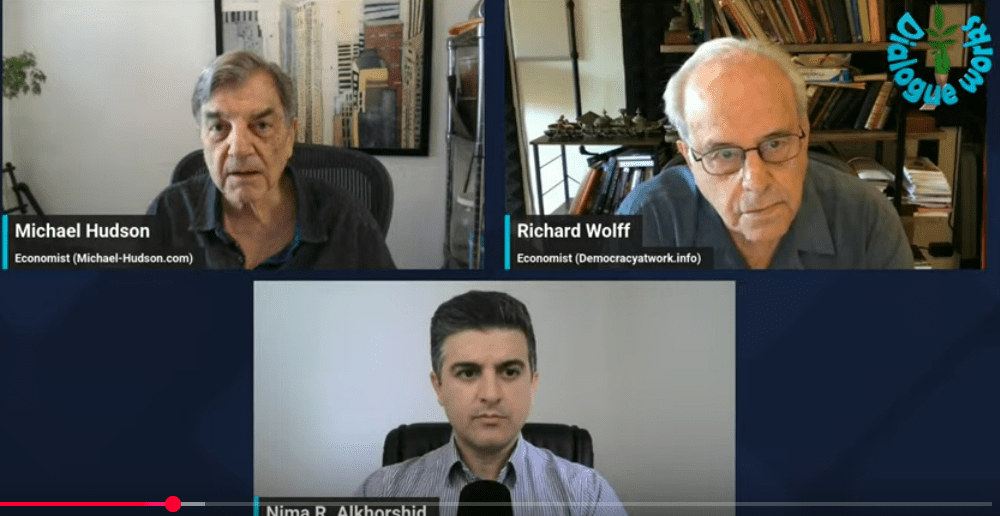
With Nima Alkorshid : Dialogue Works (with transcript)
Nima Alkhorshid: Hi, everybody. Today is Thursday, June 11th, 2026, and our dear friends, Richard Wolff and Michael Hudson, are here with us. Welcome back, Richard. Mike.
Michael Hudson: Good to be here right now. And what an important time.
Nima Alkhorshid: Yeah, exactly. What has happened last night was a confrontation between the United States and Iran. The United States decides to attack Iran. The attacks were basically in some two islands: Sirri Island and Qeshm Island, in the Persian Gulf, close to the Strait of Hormuz. And then we had the attack in one of the cities close to the capital of Iran, Karaj, two strikes in that city.
And the other part, one of the important outcomes of this, the highlights of the attack, American attack, was they were trying to hit a petrochemical plant in the city of Assaluyeh, which is one of the major petrochemical plants in Iran. Then the cruise missile that they used, it was intercepted two times. And then CENTCOM said that it didn’t happen. Then Iranian response came in and they hit the targets in Kuwait, Bahrain, and Jordan. From what we’ve seen so far, they were targets in Kuwait that were hit. The radar in Kuwait was hit. And the Muwaffaq Salti, something like that, an airbase in Jordan. Yeah, Muwaffaq Salti in Jordan was hit by Iranian missiles.
And there are footages out there to confirm that. And Iranians said they hit the fighter jets there. This is what has happened so far. What we had before this attack coming, we had an attack on Iranian, you know, Sirri Island. And that attack destroyed two water tanks, which were significant on that island. And that was a new move. And many people were somehow speculating if Iran would attack, would it would destroy the desalination plants in the GCC countries or in Israel. That didn’t happen. So we are in right now, and Donald Trump, the objective of the attack on Iran, Donald Trump, what Donald Trump said, he wants to force Iranian to accept his terms.
He wants to force Iran into a new position to make a deal with Donald Trump. And today he reiterated that. He said that tonight we’re going to attack Iran. We may capture the Kharg Island. He said that today he tweeted. And here is what he said. And we had Scott Bessent here. And Scott Bessent, moments ago, tweeted that the Iranian regime will lose the zero-sum game it is playing. Any damage it inflicts on our allies in the Gulf will be paid with funds extracted from the Iranian accounts. Any tolls paid to the Persian Gulf Strait Authority will be offset by funds extracted from their accounts. Every attack Iran launches will only deepen the economic and financial consequences it faces. This is Scott Bessent. And moments ago, we had Donald Trump saying this on Fox News.
Donald Trump (clip): Still, in history, they could wave the white flag of surrender. They could say, we surrender, we surrender, we’re finished, we’ve had it. And they could do all of this. Praise be to Allah. They could say it loud and clear, and the fake news would say it was a great victory for Iran. I mean, it’s the craziest thing I’ve ever seen.
Nima Alkhorshid: Richard, let’s start with you. What do you see? How do you see the situation right now with Donald Trump’s new attitude, this tit for tat and this sort of strikes, which he knows that is Iran going to respond? And I don’t see any sort of sign that anybody would care about these attacks in terms of the way that he tries to put pressure to change Iranian position. I don’t see that happening at all. And they’re hardening their position right now. Your understanding of that?
Richard Wolff: Yeah, I think you’re basically right. I don’t have any reason to look at it any other way. Mr. Trump has been saying for the entire three plus months that this war has been going on, that he was negotiating when it became clear that he wasn’t, that there was no negotiation going on. He then said he was very close to an agreement. I mean, that’s been going on for at least two months. There is no close to an agreement.
Mr. Trump doesn’t tell the truth. Or let’s put it differently. He has a very unique and personal relationship to the truth. And it’s not amicable. So the bottom line is there’s no reason to believe any of this. If it is true, I have no way of verifying, of course, but if it is true that the United States sent several missiles and that those were intercepted and shot down and didn’t reach their target, with the exception of two water tanks, well, that’s a wonderful metaphor for the fact that America can’t function. What are you doing knocking out two water tanks? Besides that being stupid, it doesn’t materially affect anything.
Meanwhile, if it is also true that the Iranians retaliated with missiles that did, in fact, hit their targets, and that their targets were military facilities, well, then you have it. Then you have Iran is winning this war. Even in the military tit-for-tat, it’s winning the war. Had you told me that they bombed residential centers in Isfahan and in Tehran and so on, then I would have a different attitude. It would be horrible. But it’s a different situation. This is again more bluffery.
Now let’s turn to Scott Bessent. Scott Bessent, I’m going to be as polite as I can. Scott Bessent is not the sharpest knife in the drawer. He never was and he isn’t now. And what he says is usually pale afterthoughts to support Mr. Trump, toward whom he behaves in a way that no self-respecting intellectual would ever, even if they were slavish in that manner, they wouldn’t want to act it out. This man either doesn’t know how he looks or doesn’t care. So let’s respond to him. Iran is already incurring enormous costs in its closing of the Strait of Hormuz. Iran is a major user of the Strait of Hormuz.
That is costing them money. The bombing is going to have to be repaired. That’s costing money. The fact that Mr. Bessent says, I’ve got some other ways that I’m going to cost you money. For example, I am going to take out of our money that we’ve seized from you, your money, and pay back the people you charge. Okay, this is a very limp noodle, what he’s just done. It’s telling the Iranians, you can charge money, but we’ll take it out of your money.
Well, at this point, the Iranians have had that money taken away from them, and they’ve come up with a way to pay themselves. And all Mr. Bessent can do is tell them, well, I will never give you that money back, which they didn’t expect to get back anyway. I mean, this is childish kind of activity. And in the larger scheme of things, if Iran is ready to call the bluff of military action, which they’ve done now for three months, then they’re not going to be, you’re right, Nima. They’re not going to bend over because Mr. Scott Bessent has come up with three little trivia that he’s going to.
I mean, this is just crazy. Moreover, finally, he’s telling us what he’s going to do in the future.
Well, anyone who knows anything about war knows that what is said during the war and what is agreed to at the end of the war are not the same things. So, what he promises they will do in the future, it’s all, if you pardon me, bullshit. And it’s designed for the American media to repeat. So, it looks like Mr. Trump is being tough. That’s what the Kharg Island is about. That’s what the water containers are about. That’s what these lies about escorting phantom ships in. All he actually did, if I understand correctly, over the last week was to attack the wrong boat, which was a boat contracted to India, killing three Indian sailors. What kind of an achievement is that? You know, really, this is pathetic. And for a rich, powerful country to be reduced to this, it’s already losing.
Michael Hudson: I want to pick up on Richard’s point that Trump has talked about the future. One of the interesting things he’s done is he’s finally dropped the fiction that this war is all about Iran having the non-existent atom bomb. He said in the recent days: number one, once again, he wants to grab all of Iran’s oil. And he says exactly what he plans to do with it. He said, half of once we take Iran’s oil, half of the export proceeds will be used to pay the United States to compensate us for the cost that we’ve had in waging our undeclared war against Iran. The other half is going to be used to pay the damages to countries in the region that Iran has injured.
Well, it doesn’t take much imagination to realize just what countries these are. It’s Israel primarily has been the recipient of the bombs and also any other satellites of the United States, such as the Emirates. Probably Jordan can be forgotten. I’m not sure how long that has to exist. I don’t know how long the Emirates are going to exist. Probably Saudi Arabia will get the share.
But Trump is quite open that he wants, he still wants to do to Iran what he did so successfully in Venezuela: grab the oil, make sure that all of its export proceeds that are sold are paid into an account controlled in the United States, maybe they might like Miami, like the Venezuelan account. And the United States will be distributing what happens to it, to its own military and budget to help balance the budget deficit into Israel and other proxy armies that the United States has there. Well, this means quite openly it’s all about the oil, has nothing to do with the pretense for public relations that it’s about Iran with an atomic, has anything to do with Iran’s atomic energy program at all.
Nima Alkhorshid: Richard, when it comes to the strategy of the United States, this strategy of Tit for Tat, and you know, after the attack, we’ve learned that Iran has closed totally this Strait of Hormuz. Right now, nothing is moving in that strait because before that, we had something like 10 to 30 tankers passing through the Strait of Hormuz, paying the tolls, and all of that. Right now, nothing is happening, and they’re trying to put pressure on the global economy, which we know looking at the market, Donald Trump was so successful in manipulating the market in terms of the price of oil.
But what Robert Kaplan said is a totally different story when it comes to the price of oil. He said that the price that you’re seeing is not the real price of oil. And in his understanding, the price of oil is something like $150. It’s the real price of oil. So do you think that this sort of continuation of the war would they going to continue with this strategy of continuation of this tit for tat? I don’t know how long the economy of the United States is going to support Donald Trump. And we know the people, you know, the polls in the United States, but it has to be some sort of calculation when it comes to the global economy. Is that there, in your opinion, in their assessment?
Richard Wolff: In the assessment of the United States leadership?
Nima Alkhorshid: Yeah, exactly.
Richard Wolff: Yeah, I think they have the idea. Well, one of two ideas. The first idea is they don’t have to worry about the price of gasoline and they don’t have to worry about the inflation, neither the 4.2% announced yesterday or the downstream higher inflation that we have every reason to expect in the summer months. They don’t have to worry about it because the American people will be unable to vote them out of office in November.
If they have the feeling that they are in charge there, that they have in place the machine counting mechanisms, the various kinds of corruption that go with it, and I say that having been very active in electoral politics, I know how voting works. I’ve been personally involved in it, so I really know that if you organize, if you control the voting process, you can get pretty much the result you wish. If they are convinced that they can do that, that they will have the money and the personnel, then they don’t have to worry. Then the Iranians have made a mistake because they’ve underestimated how much economic pain the inflation can cost.
And remember, inflation always was, as the good critics of it always knew, as much a class war as it was an economic phenomenon. I mean, to be very blunt, rich people don’t care if there’s an inflation because they have in place the ways to raise their income along with the rise in prices. The working class, either because they are employees or because they are stuck in a union contract lasting three or four years, are not in a position to raise their prices, the price of their labor power, wage and salary, along with the rising prices.
So inflations tend to redistribute wealth from the bottom in the middle to the top. So that means the decision makers are less pressured by inflation, most of the time than are the rest of the people. It’s a way of hurting the rest of the people. That’s one possibility. The other possibility is, of course, that they’re wrong, and that they will not be able to control the election and that Mr. Trump, who can’t run for re-election anyway, has made a decision that he has to go for broke because he’s done anyway. He finished.
After this election, he’s a lame president. Traditionally, that has meant very little he can do. And because his mass appeal is lower than it’s ever been, and the MAGA community smaller than it’s ever been, he’s not looking at a very happy future. So he is deciding to stick it out here and try at least to go down in flames rather than simply to quietly go down. If that’s the case, then it’ll think of this irony.
It’ll be up to the other Republicans, fearful that they will be defeated along with him. They’ll be taken down with to persuade him to do some accommodating strategy, declare victory over Iran, which he already does almost every day. You have no army, you have no navy, all this stuff utterly irrelevant to the situation, but is a way of suggesting over and over again that he’s the winner, he’s the winner, he’s the winner. You know, that’s what he’s always wanted. You know, every major business he’s been involved in has gone bankrupt, but he’s always the winner.
You know, it’s this. If he can do that, that’ll save the other Republicans. Otherwise, they look at a very dangerous situation for them. Because if there is a landslide in November, and remember, that’s not very long from now: July, August, September, October, November. Five months, basically five months. And if you saw the election results, for example, of Senator candidate Graham Platner in Maine, there’s a guy who, if you elect him and people like him, they are not going to just have a different program.
They are going to do to Trump’s actions what Trump did to Biden and Obama. Half of everything Trump has done has been to reverse Biden and Obama. And what you’ll see from the people like Plattner is the reversal of everything Trump did. And for many of them, that is, and I’m including here the big business community. They don’t want to go back on those tax cuts of 2017 and the big beautiful tax bill of last year. They want to keep those. They don’t want people in there that will undo them.
Michael Hudson: Richard, you’ve mentioned the time element, and that, I think, is the key. Trump may care not only about the billionaires, but most of all, about the stock and the bond markets. And that’s going to be very important for the timing because I think that he realized Trump and his advisors realize that time is not on the U.S. side in its fighting with Iran.
I think that the longer this takes, the more the United States will be pushed over the energy cliff that the oil company executives and oil price and other publications say is probably going to hit any time from the 4th of July to mid-July as the United States National Petroleum Reserve is exhausted and the prices cannot artificially be kept down by the petroleum reserve selling the oil. So at that point, you’re going to have the oil prices rise very sharply to a point where it requires large shutdowns of major industries and especially affected will be what is Trump’s strongest MAGA political voice in the farming regions of the country, the West and the Northwest.
Already, farm bankruptcies are way up because the farmers cannot afford to make a profit by planting the crops this year if they have to pay the rising prices of fertilizer and the rising prices for harvesting equipment and the rising cost of financing the sale of their crops in advance so that they have to pay to the banks and the large crop distributors. So, this is forcing Trump to essentially take the emergency response that he’s been taking so far. They have a time limit for how long they can end Iran. And I think that explains why Trump is raising the issue of the fake atomic bomb. Trump is going, said that we can’t have any agreement unless we address what was the number one problem, Iran’s having an atom bomb.
Well, what makes this so fictitious is that, number one, it prevents any possible discussion for having resolved the problem. That means that Trump never expected the negotiation to really have a solution at all. That’s why he raised the atomic issue.
But also, in the last two days, Seymour Hersh has published his substack saying that Trump has discussed with his staff using an atom bomb against Iran in his desperation to end the war in a timely fashion before Iran can continue to block the oil trade from the Arab OPEC countries and lead to this soaring oil price that’s going to have such devastating economic effects that we’ve spoken about before, not only on the U.S. economy and other economies.
I think that I’m a little surprised that Iran hasn’t made the following response at the very beginning. Of course, we’re willing to agree to all of your proposals about what to do with the enrichment of uranium and stop the atom bomb. We agree to make any deal that applies equally well to Israel with its 200 reported atom bombs because Israel is a terrorist country that is threatening to bomb Iran, that it’s a war with. America has hundreds of atom bombs. It’s a war with Iran.
Iran not only has no atom bombs, but according to Tulsi Gabbard’s summary of all of the intelligence agencies, has made no effort to have developed an atom bomb in the last few years. So I think why doesn’t Iran simply put the whole question off the table by saying we’re going to give up all of our atom bombs and even our enriched uranium if Israel does the same thing.
We’re the country being threatened by an atom bomb and are under attack. We’re not the attackers in this war. We’re attacked by two countries with atom bombs that are both discussing using it, and yet they’re acting as if we’re the problem. This is a deal breaker from the very beginning. And I’m sure they’ve said that indirectly. And the Pakistani intermediaries have tried to say, well, can you keep talking? And I think, okay, Iran has kept talking because I think China wants it to keep talking. And I guess China is one of the wildcards in all this.
And some of your guests have been pointing out that it seems that China has been giving Iran guidance as to where to hit the U.S. planes, where the planes are coming from. And although the United States has concentrated in knocking out Iran’s defensive radar, saying if defense of your defense of your country is a sign of attack because you’re trying to defend yourself so that you can counterattack us when we attack you.
This is Orwellian Doublethink again. Defense is all of a sudden construed as aggression. And I think that probably China, I’m sure Russia also has a vested interest in preventing Iran from being captured by the United States, occupied the United States, and then mounting a Ukrainian-type attack on Russia from the south, moving northwards through Azerbaijan up towards Russia.
This urgency of the timing is exactly what makes the atomic issue so urgent. And yesterday’s meeting at the United Nations with the International Atomic Energy Authority said Iran must open its atomic energy to inspection and do what it did before. We have to talk to your nuclear scientists so that we can give their names and addresses to the Israeli assassins to kill them, because any PhD in physics might work on an atom bomb someday, and we have to make sure that to destroy Iran’s educated scientific and engineering class as well to be secure.
And in fact, we have to just obliterate Iran or we won’t feel secure. Our security is in the destruction, atomic or otherwise, of Iran. That is basically the American negotiating policy. And I think Iran, China, Russia, and the rest of the world realize that by now. That is what is at stake tonight.
Nima Alkhorshid: Richard, when it comes to the timing, here is what Keith Kellogg, Michael mentioned, the use of nuclear weapons. And here is what General Keith Kellogg said on Fox News. He’s basically talking this thing we’re talking about in the use of nuclear weapons.
Keith Kellogg (clip): The job. Having a protracted war is not the American way of war. It’s a war we’ve been conditioned to in the last few decades where we’ve done things in Afghanistan or Iraq. We ought to go back to the way we did it in like World War II or World War I, and we just finished the job, total war, obliterate them, and say, when you need to come to the table and you want to talk to us, you got our phone number, but until then, we’re done. Because right now, we’re playing their game, not our game. Let’s play our game and force them to come to us.
Nima Alkhorshid: Yeah. He said, Richard, he basically is mentioning the use of nuclear. Go ahead.
Richard Wolff: Yeah, this is what empire does. The empire becomes the context. The unspoken elephant in the room is the empire. Iran, having an idea back in 1953 to nationalize oil, was violating the empire. As Michael keeps telling us, the empire wants to control the oil. Anybody who interferes with that is deemed correctly to be threatening the empire. In order to get that across to your people who might be confused, since the country is dealing with its own oil, because the country is poor, because the country did this all democratically, these distractions are overcome by what is a rhetorical overkill.
They are making an atomic bomb. They are slaughtering small children. They are, you know, do whatever you have to. The United States, during its empire, portrayed everyone who challenged that empire as a monster. Everybody is Joseph Stalin all over again. Mr. Putin is now Stalin. He just spells it differently. Saddam Hussein was another Hitler. You know, Qaddafi in Libya, another. Literally, the newspapers were full of comparisons. This is Hitler. We’re getting rid of Hitler.
That’s why this turkey general you just had has to refer to the World War II. So last war, the United States was able to win. You know, he leaves out a little detail. In World War II, the number of Russians killed is officially listed in the neighborhood of 25 million people. The number of Germans killed is in the neighborhood of 8 million people. The number of Americans killed, ready? 400,000. Do you understand? Do people have any idea what war means if you have 25 million dead people all around you? The war is fought back and forth all the way from your border to Moscow and then all the way back.
That’s why 28, 25 million people are dead. No Russian can deal with war the way Americans do it. They barely felt it. After Pearl Harbor, no bomb fell in the United States. No railroad station was destroyed. No children’s school was obliterated. Nothing. The war put Americans back to work. The war was economically positive. The way it, by the way, has been for Russia in Ukraine, to the terrible upset of Americans. But yeah, he wants them to play the American game.
He wants it to be all about air power. And he doesn’t understand, you know, there’s an old joke in military science that every war is fought with the best weapons from the last war. Why? Because the people who won the last war tend to stay with the weapons that helped them do that.
But the people who lost the war tend to work on weapons that no one has ever used before because that will allow them to do better next time. Iran has had 75 years now, 75 years to figure out what are the weapons you can use. And closing the Strait of Hormuz is a weapon that they can use. And their mountains and their vast territory where they can hide real missile silos and decoy fake missile silos, one right next to the other, thereby rendering the American air focus much, much less successful than it would otherwise. It’s a little bit like for your audience, the Japanese come back after World War II. How do they do it? They do it because they tell each other the United States is the dominant empire.
In order for us to build up our capitalist system, we have to produce what the Americans produce either better or cheaper or best of all, both better and cheaper. And so we all drive Toyotas. They figured it out. The Germans figured it out with the Volkswagen. Otherwise, you can’t explain why, and you know, you and I and Michael, we talked about it last week, why countries like China, who got no economic development help from the West, no Marshall Aid, no army of young intellectuals to come and help them raise their savings rate or raise their investment — why did China do better?
Because China had no interference with this. We either defeat the West in producing goods and services better and cheaper or both, or we will be defeated again, as we were in our hundred years of humiliation that Xi Jinping talks about. That’s very similar to Iran. The last point, and maybe the one that’s in the end of most of it, you cannot defeat Iran. That’s the problem. The problem for the United States, they can’t do it. China will produce drones, missiles, you name it, forever.
They’ve got a bigger manufacturing base to do that than anything in the West or than all the major countries in the West combined. And I’m not even talking about Russia, just China. It has an immense border with Russia, which means it can ship the drones, the missiles, and everything else easily into the hands of Russia. Russia shares the Caspian Sea with Iran. The boats can go from a Russian port on the Caspian Sea to just north of Tehran there on the Caspian Sea, and they can bring all the missiles and drones. Who’s going to stop this? What are the United States going to do?
Well, in the fantasy life of that senile general that you just had, they’re going to bring them our war. What are you going to do? You’re going to bomb Russia and China? It’s over then. They already have the means to block you, to repeat this, to do to you what you’re ready to do to them. So it’s a prescription for self-destruction, or it’s empty. And that man is too old to know that that’s what he’s doing. He’s prescribing a dead end for everybody or a failure. Those are the choices he leaves. And he may be surprised why no one in Washington listens to him, but I’m not, because it is and would be a complete waste of time.
Michael Hudson: I’m glad you mentioned air power, Richard, because that’s really the only weapon that the United States can use.
But air power can’t defeat a country, as you just pointed out. Only a military occupation by an army can do that. So the only way for the United States to win this war is to destroy Iran. If you can’t control and grab its oil, then you destroy it because its oil is the major source of oil that is blocking the United States control of all of the world’s oil trade outside of Russia, which it sanctioned. And without being able to prevent Iran, with Russia, from being an alternative supplier of oil, the United States cannot fully weaponize the oil trade as a lever against other countries to threaten to cut them off from energy and cause a crisis if they don’t follow American policy.
Well, this means that you’re going to see air power for as long as you can see, because I just don’t see any invasion except perhaps a suicidal invasion of the island, Kharg Island, right in the Strait of Hormuz.
The question will be: will Iran retaliate by attacking not only the aircraft as it’s done, but the aircraft carriers that are following all this and are supposed to be dropping some of the bombs?
Well, what will Russia and China do to protect Iran from these aircraft carriers and from these other bombers, apart from giving Iran the coordinates of the refueling planes and the other planes that already in the last 24 hours have come from Western Europe and from the Indian Ocean towards Iran? Apart from the atom bomb destruction of Iran, the U.S. is trying to focus on its water facilities, its desalinization facilities.
It’s already been doing that in the last 48 hours. That’s against the laws of warfare. Will Iran respond by taking out and destroying the water desalinization facilities in the Emirates and their neighboring countries? I don’t see them doing this against Saudi Arabia, but against the countries that are most active in siding with the United States and Israel, because that’s where all of their capital investments are for the Emirates.
That’s why they’re working with Donald Trump’s son-in-law, Kushner to develop the notorious Albanian island that’s been so much in the news. So, will Iran bomb these plants is a symmetry for what the United States and Israel have been trying to do. It’s suffering drought. These are the kind of environmental, all the rules of war are being broken by the United States and Israel, and the rest of the world is still standing by.
And I just checked as we’re talking. While we’ve been talking, the U.S. stock market has gone up even more. The bond interest rates, long-term interest rates, have been coming down. Everybody believes, if you say everybody, the cumulative mass of stock and bond market investors in the United States, and it seems the world, have believed that Donald Trump in the next few days can indeed negotiate with bombs, as he said, against Iran and end the war. This seems to be such a fantasy.
I can’t imagine that Iran will let itself be destroyed, or if it’s really threatened, that China and Russia will let itself be destroyed, because that would be to cede total power of controlling the oil trade and through it, the international financial system to the United States. This is a showdown between the U.S. and its NATO allies, who can call it the West, along with Japan and South Korea and the Philippines, against the entire rest of the world and the entire rest of the world. And the investment class seems to be paralyzed with inaction in all of this.
As you’ve seen in the United Nations vote yesterday that I mentioned with the Atomic Energy Authority, trying to say it’s all about Iran’s wanting to bomb Israel and America and its allies has nothing to do at all with oil at all. That’s a secondary question. We’ll get to that after we talk, spend the next 10 years arguing over whether Israel has to join the Atomic Energy Authority and let its inspectors in and dismantle its 200 atom bombs, which of course will go nowhere. All of this is a smokescreen that is so transparent, I guess that means it’s not really a smokescreen, that one can only marvel at the inaction and the paralysis that the whole rest of the world is in right now.
Nima Alkhorshid: Richard, just moments ago, Donald Trump said, my preference has always been to take Kharg Island. Once you do it, it will take a bit longer, but it is guaranteed and will make a massive fortune. But I don’t know America has the stomach for it, to be honest with you. Here is what he said. And he continued with that if it were me, we would have conquered Vietnam in three or four months. And continued it. Here is the, this is amazing how he’s connecting Iran to Vietnam and he feels that he can do something like that. And we know the casualties in Vietnam. Iran is not. Go ahead, your understanding of that.
Richard Wolff: Well, no one should be surprised. This is imperialistic mentality. At the time of the Vietnam War, 1975, if you talk to this kind of mentality, Mr. Trump at that time, who was simply a young playboy, or worse, if he had to do with Epstein anywhere near as much as he probably did, he and people like him said the following. They were all around. The reasoning goes like this: We could have defeated the Viet Cong in two or three months. We could have bombed them into the Stone Age. We didn’t. We could have, but we didn’t.
So the question is: who chickened out? Who is the scapegoat that, quote unquote, lost Vietnam to us? That has been the complaint of these kinds of people on every issue since World War II. If you study the history of the People’s Republic of China, as soon as the revolution there, the Civil War and Revolution were won by Mao Zedong, hearings were held in the United States Congress, and the title of the hearings was Who Lost China?
Harry Dexter White, a famous politician in the State Department, had his career lost because he was involved at some point in some negotiations so that the Republican mentality of Mr. Trump could fix on him as a bad guy. Maybe he was a young man, you know, as a young man, maybe he wasn’t politically active on the left wing. It doesn’t matter. It’s always the same story. We could have won in Afghanistan. We could have won in Iraq. We could have won in Ukraine.
But we didn’t fight the right way. And somebody betrayed us. And then you go find whoever it is you’re opposed to and try to blame them. And you make a good effort. That’s the same story. Mr. Trump couldn’t invent a new story. He doesn’t have the brainpower. He never did. He rehashes old stories. That’s all he ever did. That’s what he’s doing here. Another, another story about if I could just do what has to be done, but I don’t think the Democrats or I don’t think maybe the whole American people will now have an inadequate stomach to do the manly thing he would do. It’s childish. It’s old. It’s boring.
That’s really the best reaction. If you want to understand the world economy, you begin by noticing something. One country has 750 military bases around the world. No other country has anything remotely like that. That country is the United States. China has a base in Djibouti. That’s one. The United States has 750. That’s an empire, an empire with outposts. The Romans kept outposts all over Europe when they had an empire. The Ottomans did it all over when they had their empire. The Persians, if you pardon me, did it when they had an empire. The United States is doing it now. And an empire treats anybody anywhere who wants to develop their own economic or political or cultural development independent of that empire is a threat. And they treat them.
But the thing we have to do is to constantly undermine the unspoken assumptions here. There was a revealing moment about a week ago when Mr. Trump, in a news conference, was asked, then everybody was talking about the Strait of Hormuz. So a reporter asked him, what about the Iranians?
The Iranians are going to charge a fee for every ship that uses that space. Oh, he said they can’t do that. They can’t. And then he said, because, as I said, not the sharpest knife in the drawer. He said, that’s against international law. Mr. Trump, right? He says that. And then he adds: the passage through there has to be free. Nobody can control it. But no one needs to worry because we, Americans, will keep our eye, his phrasing, our eye on it and not let anybody.
In other words, anybody who wants control over anything threatens the fact that we either have it or want it. And we will bomb you if you do that. Michael is absolutely right. You question the empire, you get bombed. That’s a bomb. And then we’re going to bomb you until you say, please don’t bomb us anymore. And we say, fine, here’s what you have to do, and we won’t bomb you anymore. It is exactly the oldest mafiosi game in the world.
It’s when the little dry cleaning establishment is visited by two men in trench coats who explain to the owner of the dry cleaner, we’re going to be coming by once a week to pick up $500 worth of your insurance payment. And the dry cleaner says, What do I need insurance from? And they smile and they say, You need it from us. If you don’t pay, we’ll show you why you need insurance. That’s what this is. The only problem with China, with Russia, with the BRICS, all of this is slowly, painfully coming to an end. And that’s the big issue that will not go away no matter what happens in Iran.
Michael Hudson: Well, where is all of this leading? I think the world needs a Nuremberg-type commission after the war comes to an end to bring war crimes charges against the perpetrators of this war. And we know who they are. And the commission can presumably award reparations. That’s the big wars ever since the Franco-Prussian War in 1871, reparations, World War I reparations.
The problem is how to collect them and how to actually bring the people who are being charged with war crimes to trial if they have refuge and safety in the United States. The only way to establish a new end to all of this is to isolate the United States. It’s been trying to isolate all other countries by imposing sanctions, by grabbing the deposits and the gold reserves and oil resources and anything else from other countries. Other countries need to treat the United States as ancient societies treated law-breakers. You would exile them. The ancient world had cities of refuge where such people would be sent to.
Well, we don’t have that today, but I think that the only way that you can enforce a resolution of international law to prevent what’s happening to happen again is a war crimes commission, a reparations commission, and with the authority to award the victims of the U.S. Israeli West European countries’ NATO war against Iran and other countries that have been injured from all this.
This is going to be the task that’s going to reshape either the United Nations or lead to the creation of some new international body that has the enforcement power that the United Nations never had and is free of the corruption and rottenness of the United Nations that has enabled it to blame Iran for even thinking for enabling Trump to have the fantasy nightmare that it’s Iran, they can do to America and Israel what America and Israel plan and hope and want to do to Iran itself, to obliterate it atomically. This is the enormity of the fight before the rest of the world right now that must be solved.
Richard Wolff: Yeah, and I can only add that I share Michael’s view. I wish it could be done. I wish it could be done yesterday. But the truth of the matter is, we’re not at that point yet. What we’re seeing is a slow, frustratingly slow process in which China, Russia, the BRICS are managing this increasingly rogue government of the United States, maneuvering around it, helping each other compensate for the sanctions and all the rest of what the empire is trying to do.
But I think it is fair to say now, and I didn’t feel that way as little as a year or two ago, but as I watch things developing, it is more and more clear that the combination of China, Russia, and BRICS is turning the American program of isolating everybody else who threatens the empire into a program that ironically is working to isolate the United States, not them. You are destroying yourself. Waging trade war and tariff war. These are vague, gestural, and woefully inadequate. And declaring war on Iran or on Venezuela or on Cuba.
Notice again, the big empire is fighting wars against its smallest and poorest subordinates. Vietnam, Afghanistan, Iraq. Yes, Iran is a bit more developed. And look how much more trouble they’re having with it. How much Iran can fight back. I don’t want to take anything away from Iran, but that’s partly because of the BRICS of which Iran is an early member, and Russia, and China, and so on. Right? The United States has a harder and harder time. That’s why it has to vaguely suggest it’s going to retreat to the Western Hemisphere. It doesn’t have to do that yet. It’s not going to do it yet. It’s going to try to hold on elsewhere, as in the Middle East.
But it is in trouble. Michael was right. You need an army. That’s why you’ll never control Venezuela very well, because you can’t bring an army there. There are too many people that will be shooting at that army. So you yeah, you can snatch the president, but you can’t. Maybe you’ll do that in Iran too. Who knows? We are watching the decline of an empire. It’s been the central thematic, in my judgment, of everything we have talked about over the last year or two.
Nima Alkhorshid: Thank you so much, Richard and Michael, for being with us today. Great pleasure, as always.
Richard Wolff: Talk to you next week.
Nima Alkhorshid: See you soon. Bye-bye.