

The Mortar of the Mosaic
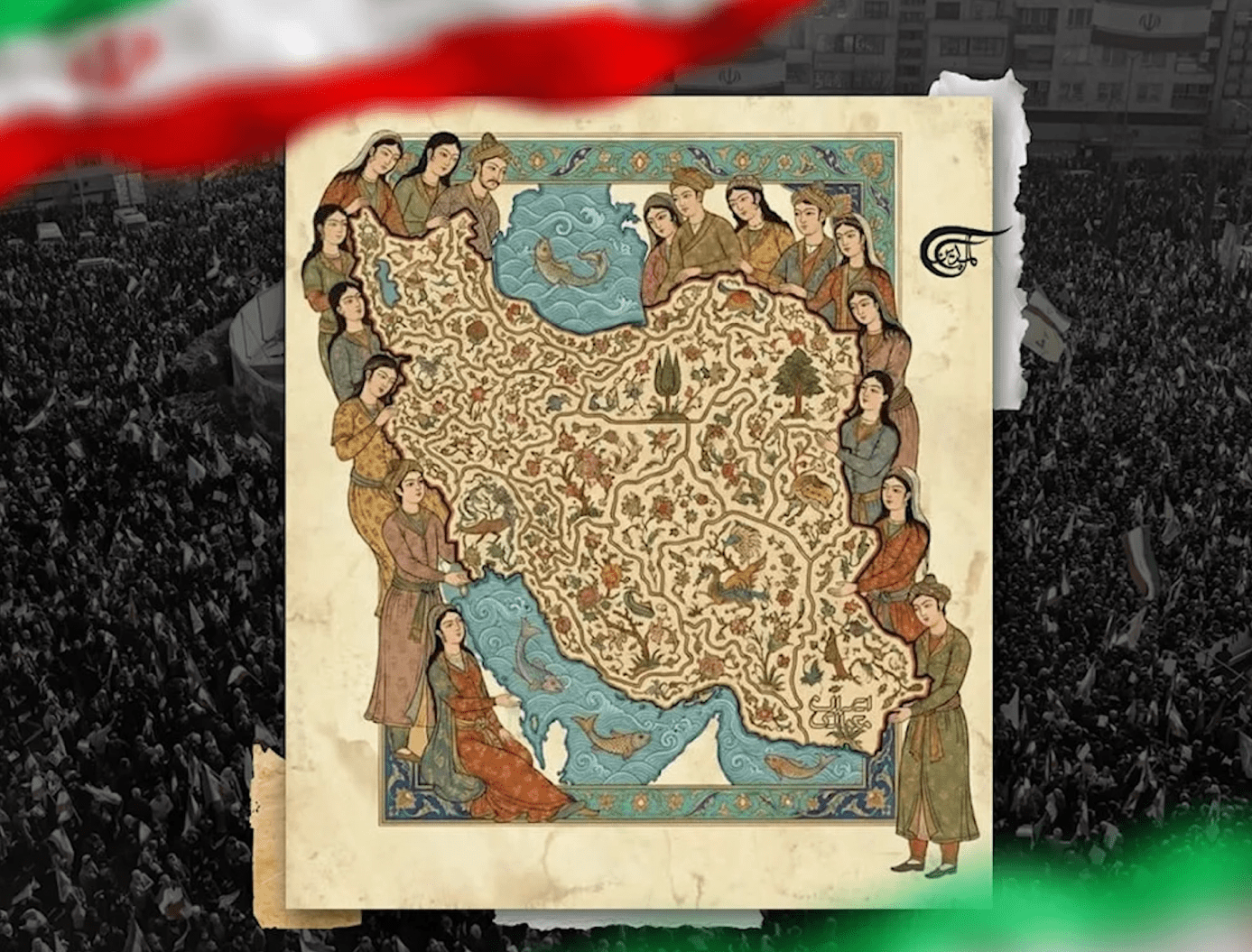
– Nora Hoppe – Al Mayadeen
An extraordinary mosaic is taking shape in Iran. A mosaic that takes on many different forms thanks to a mysterious mortar…
I. What is a mosaic?
Literally, a mosaic is an image assembled from shards – ceramic, glass, stone, mirror – each piece retaining its own colour and edge. Metaphorically, it is a Whole made from diverse, even broken parts, without forcing them into uniformity. It suggests unity in difference: distinct experiences, cultures, or fragments cohering into something richer than any single piece. The mosaic echoes the Taoist and Confucian idea of the “harmony of different things,” and the Sufi notion of “Tawhid” – unity within multiplicity, where thousands of small, distinct pieces form a single pattern without ceasing to be themselves.
II. The Mosaic Defence Doctrine
Iran’s formal “Mosaic Doctrine” is not poetry but strategy. Formalised by IRGC Brigadier General Mohammad Ali Jafari in 2005, it was designed to prevent the kind of rapid collapse suffered by centralised militaries like Iraq’s in 2003. Instead of a single chain of command, Iran’s forces are partitioned into thirty‑one autonomous provincial commands. Each province functions as a mosaic piece, with its own intelligence network, weapons stockpiles, and independent capacity to fight if national leadership is eliminated.
This structure offers resilience against decapitation strikes, provincial autonomy, and the ability to wage attrition warfare using irregular and asymmetric tactics across Iran’s mountainous and desert terrain. The same concept is visible in the Axis of Resistance.
What matters here is not only military effectiveness but a valuable political side effect: by conferring responsibility to local commands, the state’s power sits closer to the people. Citizens become more active participants in national defence. And when people are more active in their country’s decisions, the state is stronger, the people more informed, and society more unified. That is a lesson worth attending to. That is, in fact, true democracy!
III. The People’s Mosaic
In the cities of Iran, under falling bombs, people of different classes, ethnicities, ages, beliefs – secular and religious, reformist and conservative – have gathered at night in squares as a single sea of humanity. These nocturnal gatherings began on the very first day of the Barbarians’ heinous attack on 28 February 2026 and persist until this day. The people’s home is no longer a postal address. Their home is their togetherness.
What gave rise to this? The savage “decapitation” murders of Iran’s spiritual and military leaders by what I call the “Axis of Barbarism”. The intended fracture produced the opposite result. Suddenly, the motley peoples of Iran realised: “We have all been struck. Struck in our very essence.”
This spirit has even reached those who previously stood in opposition to Iran’s government. A representative of an Iranian AI company creating viral satirical takedowns of the “Epstein coalition” in the form of “Lego cartoons” said he and his team once strongly opposed the leadership – but now, they say, they are ready to sacrifice themselves because “it is fighting for us”. An Iranian girl living in Europe, who once despised “the regime”, describes in a raw video confession how she began to understand what her country, its people and even its current leadership have come to mean to her.
A national campaign known as “Jânam fadâye Iran“ (“My Life for Iran”), created to register citizens willing to respond to US‑Israeli military aggression, reportedly crossed thirty‑one million registrations. A twenty‑one‑year‑old Iranian said: “We are ready to give our lives for Iran if need arises. … It’s normal now. … It’s just something you do. … No one had to convince us.”
Another applicant explained: “What I failed to realise back then was that this identity reveals itself not through words but through action – especially when the same threats Iran has faced for 5,000 years resurface. … I saw then that people didn’t run for the borders. Despite the bombs, they went into the streets every night. Everyone stayed at their posts – the bakers, the teachers, the soldiers. I saw nomads searching the Zagros Mountains for a downed American pilot [to take him/her prisoner] while U.S. helicopters circled overhead. … Nobody needed a lecture on why Iran is paramount. They just knew it in their bones.”
A parallel initiative, the Flag‑bearer campaign, began with youths from Mashhad. Citizens register for their turn to hold an enormous flag alongside others in a central square. There is already a long waiting list – from cities near and far, even from other countries – of people wanting to guard their country’s flag.
There are also farmers who bring tractors to night‑time rallies declaring: “We have come to plow ‘Israel’.”
This short video of older men, women and children wanting to enlist captures the extraordinary mortar binding these people together, a foundation that strengthens by the day.
Even the leadership and government officials express awe. Ayatollah Seyyed Mojtaba Khamenei lauded the profound impact of the Iranian people’s extraordinary solidarity: “Due to the strange unity created among compatriots, a fracture has occurred in the enemy. With the practical gratitude for this blessing, cohesion has become even greater and more steel-like, and the enemies will become more wretched and diminished.” Parliament Speaker Mohammad Baqer Qalibaf stated: “Each of these [enemy] plans could have destroyed a country, but the Iranian nation has defeated every one of them. … This was only possible due to the active presence of the people on the streets.”
Certainly, shared suffering, reciprocal empathy and a burgeoning wave of solidarity create a powerful collective identity… But there is something more.
IV. What are we witnessing?
Not heroism in the Western sense – the lone, exceptional warrior. Something quieter, more ancient: a collective spiritual awakening.
We have seen similar phenomena before: amongst the Chinese in the Century of Humiliation; amongst the citizens of Leningrad and Stalingrad against genocidal Nazis; amongst the peoples of Vietnam, Africa and Latin America fighting imperial powers… and we see it amongst the Palestinians (the so-called Palestinian Authority does not count).
But this time the awakening crosses borders – not as a formal alliance, but as a living recognition spreading across Iran and beyond, an ever‑growing mosaic ushering in the birth of a new world consciousness.
V. The Mortar
What holds the tesserae of this mosaic together? A shared suffering? A common enemy? Military or economic interdependence? Shared rituals of coping? Shared dreams of justice?
Perhaps. But the mortar seems to be something else: a sacred unifier that heals fragmentation, transcends religion, ethnicity, age, class, geography – and ultimately transcends description. Like the wind, it can be seen, heard, felt, but not fully named. It remains, in part, a mystery.
Yet the mortar is also fragile and evanescent. Like harmony, it is dynamic, not static. When its catalysts recede – when the common threat diminishes – the collective grows quiescent. The mortar can desiccate and become brittle. It does not have to vanish instantly; it can calcify into a constrained ideology or dissolve into warm but ineffective nostalgia. The terrible question arises: do human beings need external struggle to feel internal unity? Is peace inherently corrosive?
VI. Can the mortar be preserved without permanent struggle?
Perhaps a collective struggle against an external enemy does not have to remain the only incubator of unity. The serendipitous mass unity of the Iranian people might be re‑metabolised into something more enduring.
The first step would require a clean break from the financialised capitalist system imposed by the West to ensure its global dominance. Iran already recognised the western colonial scourge at an early stage: the uprisings in favour of an institutionalised monarchy (parliamentarism, late 19th early 20th century) against absolutist Qajar rule and foreign influence; the movement led by Dr Mossadegh with the nationalisation of the oil industry, which was crushed in August 1953 by the reactionary Shah regime with the help of the CIA and MI6. It was not until the 1979 Revolution that Iran was completely liberated and its full sovereignty restored.
Now the great challenge is to establish a new economic system that serves the needs of all its peoples – a system that does not oppose collectivity by its very design. Without such a shift, the mortar will always depend on emergency.
Beyond economics, the mortar can also be preserved through practice: regular collective rituals embedded into society. Continuous commemorations of martyrs and great struggles; continuous appreciation of workers, teachers, medical staff and soldiers; continuous celebration of the rich variety of peoples who constitute Iran; projects that bring different social strata together. The mortar holding the tesserae of Iran is like the soil of a garden: it needs continued care and cultivation.
VII. What can the rest of the world learn from Iran…
Almost the whole world has been colonised to some degree by the West, now with the United States at the forefront. It is not only American soft power that has infected populations. The real culprit – the one most continue to ignore – is the global financialised capitalist system itself. That system was created by the West to ensure corporate hegemony and the subjugation of all other nations. It is at its core marauding, divisive and partitionist; it relies on wars and conflicts to flourish.
Until the Global Majority – until the comatose UN, until the comatose BRICS – recognises this subjugation and casts off that yoke, there will be no fundamental change. For a more just multipolar world to be ushered in, states must learn from Iran: that a state is truly powerful, truly sovereign and just… only when it has the unity of its people, and when its leaders are placed in power to serve that people, their sovereignty, and their cultural identity – not any foreign doctrine or financial interest.
The mosaic is not a metaphor for harmony alone. It is a structure. And the mortar, though mysterious, is not magic. It is made daily, or it crumbles.
What a beautiful text. Thank you. Iran has stepped up to the huge responsibility of carrying forth the revolution against colonial oppression. If before it was more centred on unleashing its own civilization, now it participates with magnificence in the world’s process of reducing colonial rule to its much anticipated… Read more »
Thank you so much.
And I agree entirely with your comments.
An elegant essay that explains in detail the evolution of a revolution into a solution.
It breathes life into what otherwise would just be an ideology caught in a crisis.
Thank you very much, Larch.
Dear Snow Leopard, I’m quite speechless… I thank you beyond words. And I am grateful for your rich insights. I think they should be part of a greater discussion. I believe the Great Majority of our world must really study this phenomenon closely and examine the sources and all the… Read more »
Nora: Yes to the Mosaic. And yes to the glue that holds it all into a unity. The mosaic is not a mosaic without the glue. The quality of the glue is the ingredient that determines the quality of the mosaic. As to the glue: it is formed slowly, carefully,… Read more »
Snow: You are right, the “glue” needs time… and also the right circumstances for recognition. It was especially incredible how people, who had been so virulently against the government and the “state”, suddenly saw beyond their preconceived ideas (often shaped by the West) and recognised something deeper – their bonds… Read more »
Yes indeed Nora: I read you as describing a forced process of emancipation from the programming that captures the conscious ego mind (to which we are all subject) and the collective response to a great pressure which forces people to suffer their way into a greater depth within themselves. Both… Read more »
Nora: This is absolutely magnificent. Thank you. Your poetic insight shows such great depth and wisdom. You are here opening so much for all of us. Your concept of the mosaic and its vital mortar can be expanded philosophically and spiritually to great benefit. Clearly it describes the wisdom of… Read more »