

Xi–Zheng Meeting on peaceful China – Taiwan reunification
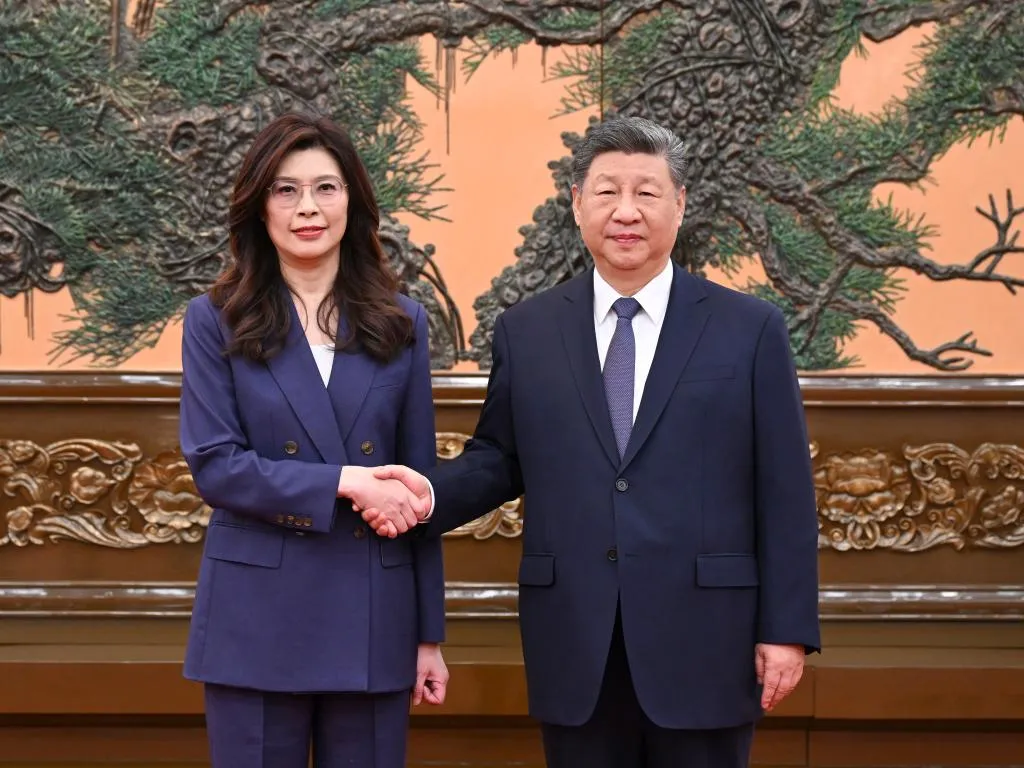
Xi–Zheng Meeting Sends Clear Signal: Peaceful Reunification Framed as Strategic Imperative for China’s Future
Author: Xu Jijun, founder of Han Tang Zhi Ku Analytical Centre and posted by DDGeopolitics
On the morning of 10 April 2026, inside the East Hall of the Great Hall of the People in Beijing, Xi Jinping, General Secretary of the Communist Party of China, met Zheng Liwen, Chair of the Kuomintang. The encounter marked the first meeting between leaders of the two parties in a decade. It unfolded at a moment of mounting global instability and heightened tensions across the Taiwan Strait, giving it both historical weight and immediate political relevance.
The meeting was not merely ceremonial. It articulated a shared position that people on both sides of the Strait seek peace and oppose division. It also set out a political direction aimed at returning cross-Strait relations to a path of peaceful development, with the stated goal of eventual peaceful reunification.
Zheng Liwen met Xi Jinping in Beijing for the first time this week. (AFP: Xie Huanchi/Xinhua)
A venue heavy with history
For mainland observers, the deeper meaning of the Xi–Zheng meeting is tied closely to its setting. The East Hall has hosted landmark moments in China’s modern history, including events linked to the return of Hong Kong and Macau. Its reuse for high-level dialogue between representatives of the two sides of the Strait carries unmistakable symbolism.
The message conveyed is straightforward. Both sides belong to one China, and Taiwan is regarded as an inseparable part of it. External complexities do not alter this premise. Questions concerning the Chinese nation are framed as matters to be resolved internally, with peaceful dialogue presented as the appropriate course.
A world defined by conflict
The significance of the meeting becomes clearer when placed against the current global backdrop. Armed conflicts in recent years have illustrated the scale of destruction associated with modern warfare.
The Russia–Ukraine conflict continues to impose heavy losses. According to the Kyiv School of Economics (KSE Institute), in its March 2026 assessment, Ukraine has suffered cumulative income losses of approximately 1.7 trillion US dollars since the escalation of hostilities in 2022, including projected losses through the end of 2026. Urban areas have been devastated, energy infrastructure repeatedly targeted, millions displaced, and environmental damage described as long-lasting.
Since February 2026, military action by the United States and Israel against Iran has produced similarly severe consequences. Around 80 per cent of Iran’s air defence systems have been destroyed, along with more than 450 missile installations. Its capacity for ballistic missile retaliation has reportedly fallen by 90 per cent. Production lines for “Shahed” unmanned aerial vehicles have been eliminated, reducing output by 85 per cent. The Iranian navy has seen approximately 160 vessels sunk or disabled, its naval headquarters destroyed, and its control over the Persian Gulf lost. Up to 90 per cent of the defence industrial base, including key shipyards, has been destroyed.
After just 38 days of conflict, Iran’s military capability, built over four decades, has been largely dismantled. Regional shipping has been disrupted, energy markets have experienced sharp volatility, tens of thousands have been killed, and millions displaced. Regional stability has effectively collapsed.
These developments illustrate the destructive potential of modern high-technology warfare. Precision-guided munitions, drone swarms, and long-range strike systems can disable power supplies, destroy transport infrastructure, contaminate land, and set back economic and social development by decades in a matter of weeks.
Taiwan and the global economy
Against this background, the text argues that any attempt to pursue “Taiwan independence” carries serious risks. A conflict in the Taiwan Strait would likely exceed the scale and impact of the wars in Ukraine and the Middle East.
Taiwan occupies a central position in the global semiconductor industry. Firms such as TSMC hold a dominant share of advanced manufacturing capacity. In the event of war, supply chains would be disrupted immediately.
Simulations by international institutions suggest that, in a worst-case scenario, global GDP could fall by nearly 10 per cent in the first year of a Taiwan Strait conflict. Economic losses could reach 10.6 trillion US dollars, equivalent to around 333 trillion New Taiwan dollars. Taiwan’s own economy could contract by as much as 40 per cent. The shock would be felt across mainland China, the United States, Japan, South Korea, and the European Union.
The military consequences would be severe. High-density missile strikes, electronic warfare, and naval and air blockades could lead to large-scale destruction of infrastructure on the island. Casualties would be significant, while environmental and humanitarian damage could prove irreversible. Given the close social and cultural ties between people on both sides of the Strait, any armed confrontation would result in profound human cost. Regional tensions would escalate rapidly, posing risks to stability in East Asia and beyond.
Political signalling and red lines
Within this framework, the position presented is that “Taiwan independence” represents a path with no viable outcome. It is described as running counter to shared interests and broader historical trends.
The alternative, as outlined, lies in adherence to the 1992 Consensus and opposition to separatism. Zheng Liwen’s visit, described as a “journey for peace”, emphasised the notion of cross-Strait kinship and was framed as aligning with public sentiment and prevailing conditions.
The meeting between the leaderships of the Communist Party and the Kuomintang reaffirmed a shared political foundation. It also conveyed a clear warning that any attempt at secession would meet firm opposition from the Chinese population as a whole and would carry significant costs.
Peaceful reunification and national strategy
Peaceful reunification is presented as both a collective aspiration and a structural requirement for what is described as the “great rejuvenation of the Chinese nation”. It is framed as a pathway to shared economic benefits and improved living standards for people in Taiwan within a broader national framework.
The argument also stresses its role in preventing war, preserving stability, and enabling joint prosperity. At a regional and global level, it is depicted as contributing to stability in the Asia-Pacific and demonstrating China’s role as a responsible major power.
Historical experience is cited to support this position. Periods characterised by adherence to the One China principle and the promotion of peaceful cross-Strait relations have coincided with stability and active exchanges. By contrast, deviations from this approach have led to tension and economic disruption.
A milestone with wider implications
The Xi–Zheng meeting is thus framed as another milestone in the trajectory of cross-Strait relations. It highlights what is described as the mainland’s consistent commitment to the principle that both sides form one family, alongside a stated willingness to pursue peaceful reunification with sincerity.
For the international community, the meeting is presented as an example of the principle that China’s internal affairs should be resolved domestically. It offers a contrast to conflict-driven approaches that have produced severe consequences in other regions.
The conclusion drawn is one of confidence. With sustained efforts on both sides of the Strait, the prospect of peaceful reunification is portrayed as increasingly attainable. The broader objective, the rejuvenation of the Chinese nation, is framed as a long-term historical trajectory.
No external force, the argument suggests, will ultimately be able to obstruct this course.
Conclusion
Peaceful reunification is presented as beneficial in the present and significant for generations to come. The current moment is described as a critical historical opportunity. By deepening economic integration, expanding cultural exchange, and strengthening cooperation in social development, both sides of the Strait are encouraged to move towards closer family ties, more integrated industries, broader opportunities for younger generations, and greater shared prosperity.
The overarching message is clear. The opportunity should be seized in the interests of people on both sides of the Strait and in pursuit of a more stable and prosperous future linked to the wider project of national rejuvenation.
Here are clips of the speech by Zheng Liwen
https://t.me/DDGeopolitics/181577
Thanks, Chernq, learned quite a bit from your comments.
sadly, so much of the Chinese analysis that reaches western eyes in translated form or written in english is clueless. While many, if not all, Chinese think tanks are connected to universities or state media, upon a quick search, the one listed above is not among the more well known… Read more »
LOL who write this trash?
80% of Iran’s AD destroyed? 90% of missile strike capability and 90% of its military industrial base degraded?
And these numbers apparently came out of the writer’s arse 🤡
Finally, a leader of the Kuomingtan who could read the writing on the wall. It would be a colossal blunder the size of the Himalayas for this speck of land to believe they can hold themselves for a week against China, in a military confrontation. They will be obliterated. And… Read more »
The art of fighting without fighting?
this article is filled with so much CIA talking points in regards the Iran conflict (“its (Iran’s) control over the Persian Gulf lost” – yeah right), difficult to trust the rest on its accuracy.
My thoughts exactly, nspk777. The original article came from DDgeopolitics (about whom I know nothing, but suspect the same as you). SOTT posted the same article but inserted into the text the following 2 comments… Comment: The above figures appear to come from Western sources as Iran’s military capabilities are far… Read more »