

China unveils full-process demonstration of Atlas drone swarm operations system
This has taken the Internet by storm. China does it Bigger!
An official media report on Wednesday offered the first full-process demonstration of China’s Atlas drone swarm operations system. A military affairs expert told the Global Times that the system not only showcases expanding battlefield applications for drone swarms, but also reflects rapid advances in algorithm-driven technologies, which are reshaping modern warfare by enabling autonomous coordination, precision engagement and system-level combat capabilities.
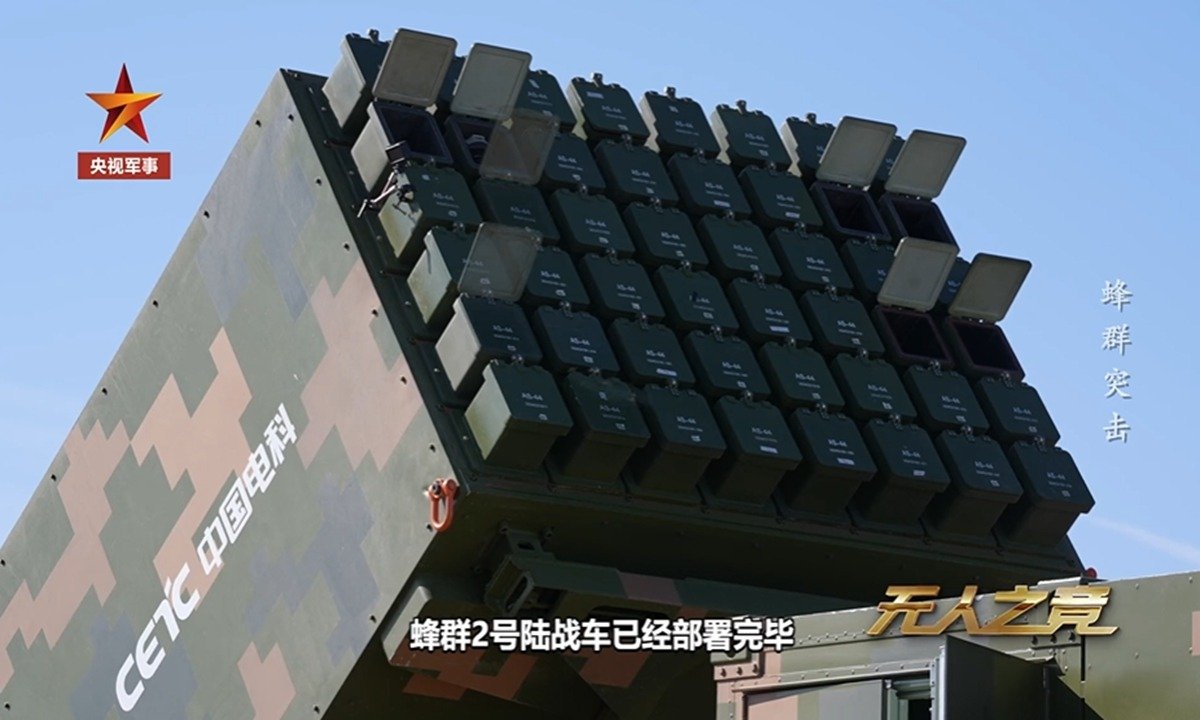
The domestically developed system consists of the Swarm-2 ground combat vehicle, the command vehicle, and the support vehicle, the military channel of CCTV News reported on Wednesday. Footage showed that the launch vehicle bears the logo of China Electronics Technology Group Corp.
The Swarm-2 ground combat vehicle made its debut at Airshow China 2024 that was held in Zhuhai, South China’s Guangdong Province. A single Swarm-2 ground combat vehicle can carry and launch 48 fixed wing drones, while a single command vehicle can simultaneously control up to 96 drones in a swarm. Each drone can carry a variety of payloads, including electro-optical reconnaissance, strike munitions, and relay communications, and can be flexibly combined into different operational groupings, forming multifunctional swarms capable of complex missions, according to a previous report by CCTV News.
According to the latest report on Wednesday, at a test range, three visually similar targets were set up in the strike zone. The Atlas drone swarm operations system rapidly carried out coordinated reconnaissance, autonomously identified the command vehicle among the targets, opened the launcher and launched drones. The drones quickly locked onto the target mid-air and struck it with precision.
Meanwhile, the Swarm-2 vehicle employed a mechanism with three-second launch intervals, releasing one drone every three seconds to ensure safe spacing and flight paths for each unit, according to the report.
In addition, the type and sequence of drone launches can be flexibly configured based on operational needs. Reconnaissance drones can be deployed first for intelligence gathering, while electronic warfare drones can precede attack drones to suppress adversaries, allowing tailored responses to different combat scenarios, said the report.
Powered by swarm intelligence, nearly 100 high-speed drones can form dense and precise formations within a short time during mission execution. They are also capable of autonomously adjusting to environmental factors such as airflow disturbances, avoiding mid-air collisions, CCTV News reported.
The system’s swarm-control algorithms effectively equip each drone with a “smart brain,” enabling communication, information sharing and real-time positional adjustments to maintain coordinated formations, the CCTV News report said.
The report noted that such a large-scale aerial operation can be managed by a single operator controlling up to 96 drones, comparable to one person flying nearly 100 kites with a single line. The system also features drones of varying sizes, allowing for layered and complementary capabilities within the swarm.
Wang Yunfei, a Chinese military affairs expert, told the Global Times on Wednesday that the system could significantly expand battlefield applications, as it demonstrated modular task configurations.
First, in saturation attacks against enemy air defense systems, large numbers of drones can be launched in multiple waves and directions to overwhelm interception capacity, making it difficult for defenders to process and respond effectively, Wang said.
Second, in precision strike missions, unlike traditional long-range munitions, whose accuracy can be affected by atmospheric conditions and electronic interference, drones can loiter over targets and conduct persistent surveillance, enabling strikes at closer range and with higher accuracy, the expert said.
Third, in deep-strike operations, drones with ranges extending hundreds or even thousands of kilometers can penetrate at low altitude with low speed and small radar cross sections, making early detection and interception more difficult and allowing effective strikes deep inside hostile territory, thereby blurring the traditional distinction between frontlines and depth areas, said Wang.
Technologically, the expert said that these capabilities are driven by China’s advances in artificial intelligence and large models.
In complex battlefield environments, drones are required to perform highly sophisticated tasks such as target recognition, task allocation and route planning – processes that are difficult or inefficient to achieve through human control alone. With AI-enabled pre-training and embedded algorithms, drones can autonomously execute these functions and even adapt dynamically to changing battlefield conditions, Wang explained.
🇨🇳The PLA has unveiled for the first time the launch of the "Atlas" drone swarm combat system, where a single swarm combat vehicle can control nearly 100 drones.pic.twitter.com/UhtllqfHp1
— PLA Military Updates🇨🇳 (@PLA_MilitaryUpd) March 25, 2026