

Epic Foolery: in dire straits
By Nat South
Graphic: natsouth
How a strategy failure left the Strait of Hormuz empty and the U.S. in dire straits
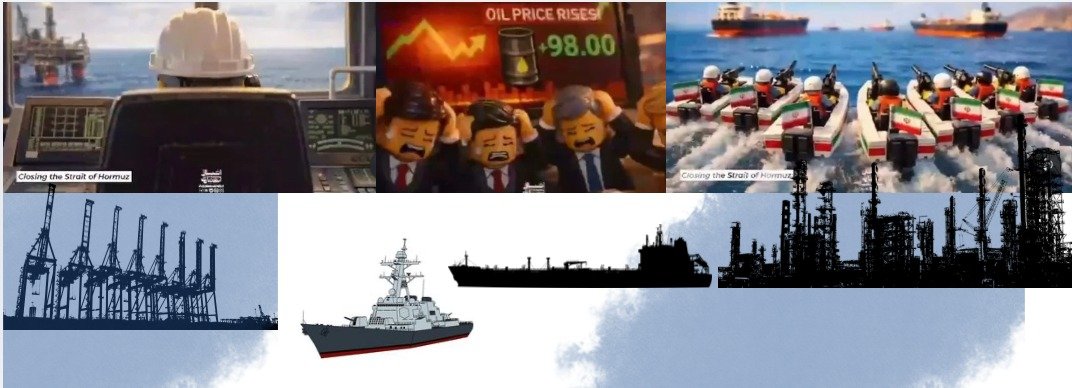
The Strait of Hormuz is often described as the world’s most important oil transit chokepoint. A key global maritime chokepoint, it is a narrow strip of water separating Iran from the Arabian Peninsula, through which nearly a fifth of global oil consumption flows, but not just crude oil, but also helium, food, LNG, LPG, fertilisers.
But in recent weeks, this critical waterway has transformed from a busy shipping lane into an epic global economic-military standoff, revealing a profound disconnect between the grandiose political rhetoric by the U.S. and a maritime reality subtly dictated by Iran. Both of which are playing a part in strangling the world’s economy for the 3rd week running, with neither side backing down.
What began with hasty declarations of victory by the U.S. has descended into a growing diplomatic and military crisis of epic proportions, leaving the United States and its allies awkwardly scrambling for jumbled up solutions that do not appear to be carried out any time soon.
Timeline of a Crisis
To understand how the situation deteriorated so quickly, we must look at the sequence of events that led to the current deadlock.
- Six Months Pre-Conflict: The Trump administration fires State Department oil and gas experts, the very specialists responsible for modelling energy scenarios and maintaining contacts with Gulf ministries.
- February 28: Missiles are launched against Iran, initiating the conflict. The U.S. administration declares total victory on a near-daily basis throughout the first week.
- The Aftermath: The Strait of Hormuz is effectively closed to commercial ship transit due to sporadic actual Iranian military retaliation mostly against Israel and US-linked shipping. The U.S. Navy is not in a position to guarantee safe passage for commercial vessels.
- The Scramble: Realising the naval impasse, Washington attempts to coerce NATO and other allies into providing warships for escort duties, even asking China for assistance apparently.
- The Refusal: Key allies, including Germany, Japan, and Canada, refuse to participate in a naval mission, citing the futility of the operation. Trump berates NATO members almost a daily basis.
- The Economic Shift: Iran announces a new framework for passage through Strait, suggesting a move away from the U.S. dollar and toward the Chinese yuan for transit permissions through its territorial waters.
The core issues
In the early days of the conflict, the messaging from Washington was extremely defiant and full of hubris. However, as the reality of a blocked strait slowly set in, the tone shifted, asking for allies to help and step in. First came, projecting in a dismissive, out of touch tone, as exemplified by Pete Hegseth: “They are exercising sheer desperation in the straits of Hormuz,”, attempting to frame the crisis as an Iranian last resort. He added, “Something we’re dealing with. We have been dealing with it and don’t need to worry about it.” Given than the obvious gaslighting, other U.S. officials are more circumspect. The U.S. Energy Secretary, Chris Wright, confirmed the stark reality that the Strait is currently unsafe for ships, a significant admission that contradicts the earlier bravado put on show by the U.S. administration.
Perhaps most baffling to observers was the rationale provided by Trump regarding shipping transit through the Strait of Hormuz:
“The only thing prohibiting transit in the straits right now is Iran shooting at shipping. It is open for transit should Iran not do that.”
Truly, a Trump word salad,”shooting at shipping” is, by definition, a closure. Any self-respecting maritime operator or planner isn’t going to be convinced by such statements and err on the side of caution. Coupled with the inability of the U.S. to clearly propose naval escorts, commercial shipping is not taking risks for the time being, being principally dictated by the insurance terms and conditions set in London.
Remarkably, Trump has on a number of times in the last two weeks, spoken about defeating the Iranian military. Recently on 20 March, he boasted about the Iranian Navy sunk, 58 ships out of action, destroyed, effectively dismantled Iran’s naval capabilities. Yet the Strait of Hormuz is off limits to a lot of commercial shipping. An Iranian naval official is reported to have questioned the U.S. claims about Iran’s naval losses, saying:
“If our navy is gone, why is the Strait of Hormuz still closed?”
Game, set, match.
By week three, U.S. officials have admitted to CNN that there is “no clear solution” for the Strait of Hormuz, describing the situation as a “major dilemma” with a risk of closure lasting several months. Despite this, public statements from defence officials have continued to attempt to project control and dominance.


Allies
Washington is on a quest to find nations willing to “sacrifice their naval ships,” a move that highlights a failure of foresight. Allies Say “Not Our War”.
A significant crack in the coalition appeared when the U.S. turned to its allies for help. According to reports, President Trump chastised NATO members, calling their refusal to help a “very foolish mistake” and implying future consequences.
“Whether we get support or not, but I can say this — and I said it to them — we will remember,” Trump stated regarding NATO members.

According to Trump, the maritime impasse in the Strait of Hormuz, ought to be a simple military manoeuvre, being problematic due to the possibility of two people dropping little bombs, yet at the same the U.S. has won the conflict.
However, European allies, aka the paper tigers, were blunt in their rejection. Germany’s Defence Minister, Boris Pistorius, was emphatic in his response and questioned the logistical logic of the request:
“What does the world expect, what does Donald Trump expect from a handful or two handfuls of European frigates to achieve there in the Strait of Hormuz, which the powerful American Navy cannot manage alone? It is not our war; we did not start it.”
German Foreign Minister’s statement
The German Foreign Minister doubled down on this rare but elusively pragmatic approach, announcing that Germany is seeking a negotiated agreement with Iran rather than a military confrontation. The logic is simple: if the most powerful U.S. military cannot secure the strait, how is NATO expected to do so. European forces certainly cannot provide resources at the same level at the U.S. can. Most NATO members have been bogged down and tied up by their support for Ukraine since 2022.
Al Jazeera also reported that Trump put pressure on China and NATO after some US allies, including South Korea, Japan, Australia, and Canada, refused sending naval ships to safeguard the Strait of Hormuz.

Yet, Trump is persistent and is getting desperate by day. The latest social media rant by Trump implies an ultimatum to Europe: Send your navy on a suicide mission to the Strait of Hormuz, or the US will annex Greenland.
As previously mentioned in the Article “Trump’s Gambit”, there is no plan, nor was there one in the first place to secure the Strait of Hormuz, when missiles were launched against Iran on 28 February.
The Economic Chessboard: From Petrodollar to Yuan
While the U.S. struggles to find even a short-term military solution, Iran appears to have taken the initiative and pivoted to an economic strategy that could have long-term global consequences.
According to political analyst Seyed Mohammad Marandi, over 20 countries have contacted Iran to coordinate under a new framework. Likewise, Iran has signalled that it may allow tankers to pass only if their cargo is paid for in Chinese yuan, rather than the traditional U.S. dollar. Similarly, there are reports of transit fees being asked, also payable in yuan, for safe passage.
This move represents a significant geopolitical shift. By tying the safety of shipping lanes to the yuan, Iran is effectively challenging the petrodollar system. Iran’s Foreign Minister, Abbas Araghchi, has already begun negotiating individually with countries, including Japan, regarding safe passage.
Iran’s Parliament Speaker, Ghalibaf, summarised the new reality:
“The Strait of Hormuz situation won’t return to its pre-war status.”
It seems that Japan has already taken up the offer, as one Japanese-flagged LNG tanker has exited the Persian Gulf two days ago. Several ships are taking a northern route, off the coast of Iran, going north of Larak island.
Effectively, Iran has offered its own version of naval escorts, creating a diplomatic leverage point against the “rules-based order” systems that sanctioned it in the first place. Iran has played the same tune as the U.S. has done so for decades, by imposing its own form of counter-sanctions against all of the U.S. proxies and client states in the Gulf region.
A Foreseeable Failure
The current crisis is described by observers as “epic foolery.” The U.S. administration had removed the very experts needed to navigate this scenario six months before the conflict began. Moreover, General Dan Keane, Chairman of the US Joint Chiefs of Staff, reportedly warned the administration about military capabilities just prior to the strike, according to the New York Times.
Now, the U.S. finds itself in a position where it has started a conflict it cannot militarily police, increasingly vexing NATO and also alienated allies it expected to clean up the mess on their behalf, without a whimper. Given that there was no plan to start with, the situation is unraveling by the week. Importantly, the conflict has inadvertently accelerated a shift away from the U.S. dollar in global energy markets. So the maritime stalemate and fuel energy crisis will continue to have huge impacts across the globe.

There is an expression in English: “up the creek without a paddle”. It’s supposed to be expressing an awkward situation with no easy way out.