

Explanation of Vote by Permanent Representative Vassily Nebenzia after UNSC Vote on Bahraini Draft Resolution on Iran’s Strikes on Gulf Cooperation Council Countries
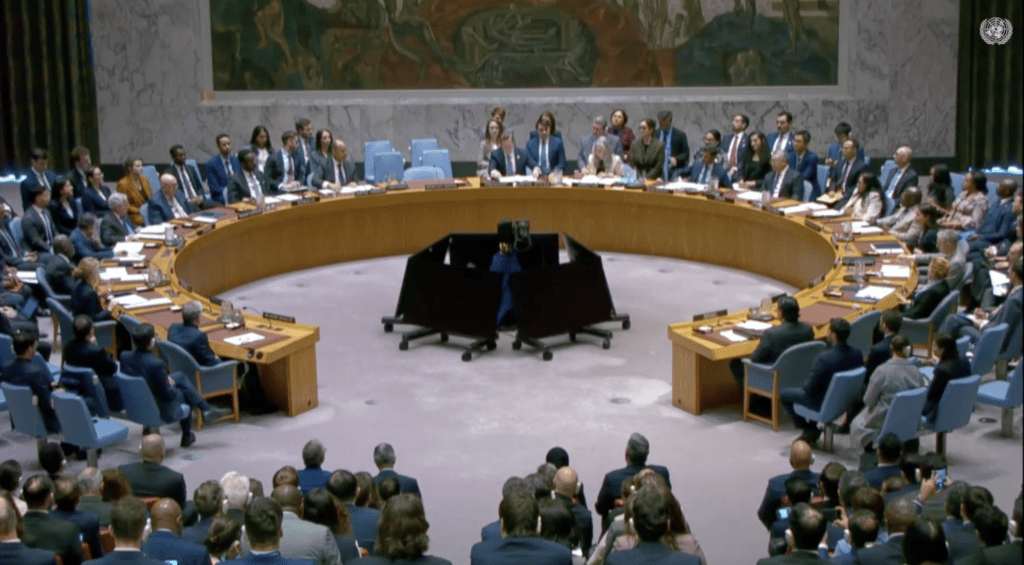
https://russiaun.ru/en/news/411032026
Mr. President,
The Russian Federation abstained in the vote on the draft resolution tabled by Bahrain because it is extremely unbalanced and does not serve the purposes of maintaining international peace and security.
I would like to make it clear right away: we do understand and regret the situation in which the Middle East countries find themselves today. Moreover, Russia deems unacceptable any strikes on the territory of Arab States in the Persian Gulf, in particular on civilian infrastructure there. From the very outset, our country’s leadership, and personally President Putin, has got into efforts to de-escalate the situation and stop the bloodshed both in Iran and around it.
However, it would be impossible and unfair to talk about attacks on countries in the region without regard for the root causes of the current escalation, namely the aggression of the US and Israel against Iran.
To our deep regret, the resolution that has just been adopted is framed precisely in such a biased and one-sided tone. It muddles up the cause and effect. If someone who is not well versed in international affairs reads this resolution, they will inevitably get the impression that Tehran, willingly and out of malice, conducted an unprovoked attack on Arab countries. At the same time, the attacks against the territory of Iran itself, let alone those who are behind them and carrying them out, are not only not condemned in the document but simply left out. And the Security Council has just signed off on this.
Nor does the document mention the fact that the authorities in Tehran have repeatedly emphasized that their retaliatory actions are directed not against the countries in the region, but against US military facilities and infrastructure located on their territory, and are legitimate targets within Iran’s right to self-defense under Article 51 of the UN Charter.
We can’t but note that Washington, through its aggressive actions, has essentially set up the countries of the Gulf Cooperation Council (GCC). The US ignored the repeated requests of Arab States not to use their territory to conduct military operations against Iran. According to the information we receive from open sources, the US is actively using its permanent military bases for this purpose, first and foremost those deployed in the monarchies of the Persian Gulf: and these bases are being used not for defensive or reconnaissance purposes, but rather for offensive ones. On February 28, the official website of the US Central Command (CENTCOM), citing its head Adm. Brad Cooper, reported that high-precision weapons had been launched against Iranian territory not only from air and sea, but also from land. Obviously, this could only be the reference to the territory of countries neighboring Iran.
It is no secret for anyone that the US base in Bahrain is the headquarters and the “nerve center” of the US Fifth Fleet, which is the main strike force against Iran. The US Prince Sultan air base in Saudi Arabia is the main maintenance point for the US air force in the region. The largest military air base, Al Udeid, located in Qatar, could be used not only as a major element of the US and NATO global air defense system, but also for deploying strike fighters, bombers, and refueling planes, as well as for suppressing air defense and target acquisition. The Al Dhafra base in the UAE is also very suitable for these purposes and for gathering intelligence. A significant role in military operations against Iran is also being played by US bases in Kuwait, Jordan, and Iraq. All of this was mentioned by Iran when justifying its strikes on US military facilities in Arab countries.
The unconditional imperative to protect civilians and infrastructure in the current conflict is also presented in the adopted resolution in a very one-sided manner. Strikes targeting civilians and civilian infrastructure are unacceptable under any circumstances and in any country – be it Iran, Bahrain, Jordan, Qatar, Kuwait, Oman, Saudi Arabia, the UAE, or Israel. However, the GCC draft suggests that no one has ever attacked the civilian population of Iran. As if there had been no horrific attack on a girls’ school in Minab, which killed nearly 200 children. As if there had been no cynical assassination of Iran’s Supreme Leader Ayatollah Ali Khamenei. As if there had been no strikes targeting peaceful nuclear and oil infrastructure, which could result in catastrophic consequences, not just economic ones, and not just for the people of Iran and neighboring countries, but also for States beyond the Middle East.
The sponsors of the draft simply suggest that we turn a blind eye to all these unlawful actions and unprovoked aggression against Iran by the US and Israel.
From the very beginning of the work on the text, the Russian Federation, together with our Chinese colleagues, consistently conveyed these concerns to the Arab States. We voiced them in the course of informal consultations and we also provided the cosponsors and all other members of the Council with our comments and suggestions in writing.
Specifically, we proposed the following. First, we proposed urging all parties to the current conflict to stop strikes. Second, we proposed condemning the attacks not only against the Gulf countries, but also against Iran’s territory, expressing regret over the attacks on civilian targets that resulted in the deaths of civilians and the Supreme Leader of Iran, as well as expressing solidarity with the Iranian people at this difficult juncture. Third, we proposed demanding that all States refrain from provocations and any actions that could lead to further escalation. Additionally, we spoke in favor of reiterating the need to settle any disputes by peaceful means and we advocated for the need to make a balanced statement that, in line with the UN Charter, the right to self-defense is something that not only GCC countries enjoy but also Iran.
At the same time, despite our country’s principled position, in particular, despite our categorical condemnation of the aggression by the US and Israel, we tried to make our language as restrained as possible, without calling the initiators of the current crisis by their names.
When working on the document, we were guided by the sole consideration – objectivity. Nevertheless, the authors of the draft resolution simply ignored the position of Russia and China. What disheartens us the most is the refusal to include in the draft an appeal for a political and diplomatic settlement of the conflict. Moreover, this was done in a categorical manner and without any explanation, as though we were speaking to the void.
We consider such an approach to negotiating UN Security Council “products” to be unconstructive, irresponsible, unacceptable, and unbecoming of a responsible member of the Council.
Mr. President,
Passing such a resolution will not advance peace in the Middle East. It will only exacerbate the differences between key players in the region. We are worried that, rushing to condemn Iran, the GCC countries may undo all the latest accomplishments on the path to restoring good-neighborly relations with Tehran, thus pushing away the prospect of creating a common security space for the entire region for many years to come. Moreover, a positive decision by the Council on this document could be interpreted by bad-faith actors, and primarily by those who started this war, as a “blessing” to proceed with aggression against Iran. We urge all UN members to bear this in mind.
Thank you.