

The Strait of Hormuz and Trump’s gambit
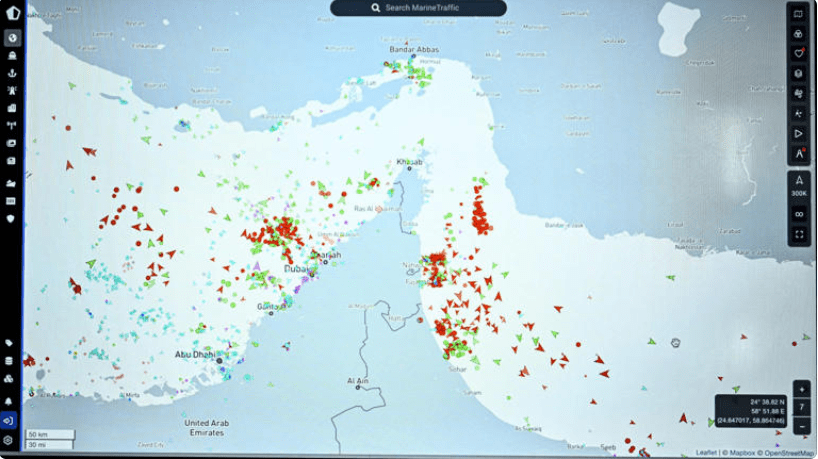
 Tensions are still at boiling point in the Persian Gulf, with the ongoing tanker blockage continuing to cause immense ripples across the energy sector and is significantly increasing the costs for countries and individuals alike. Last week, Trump decided to step in and made a bold announcement to “ensure the free flow of energy to the world”. This article outlines the feasibility and potential impact of proposed military measures, including naval convoys and escorts, on regional maritime operations.
Some figures
The critical situation so far regarding commercial shipping in the Persian Gulf and Strait of Hormuz, isn’t evolving as top world leaders probably hope it would. Prior to 28 February, the Strait of Hormuz transit traffic represented on average:
~80–140 vessels per day total
The above figure includes around 60 oil tankers per day (inbound + outbound). This roughly translates to ~20 million barrels per day of crude and products, as well as 20% of global LNG. In other words, about one‑fifth of global oil consumption and around one‑quarter of seaborne oil trade passes through the strait, (5 March,EIA). It is extremely difficult to give precise figures to get a complete pictures of traffic disruption, but some figures are available, regarding the status bottled up traffic at the start of the conflict:
- 87 cargo ships were still making port calls inside the Gulf,
- another 37 trying to exit but unable to pass the Strait of Hormuz.
That just covers the problem of the ships that were already in the Gulf when hostilities started. Now, factor in that over 100 tankers alone were waiting to enter the Gulf three days later. More information on the disruption and the impact is having was covered in a previous article, (Iran and unprovoked strikes).
Part 1 — Trump’s tactless gambit
On 3 March, Trump publicly outlined some measures to address the energy transit blockage. A move that can be best described as a jerk response to a situation that is going out of hand. In short, it is public posturing, grandiose optics to look like a problem-solver. Trump’s pronouncement that “the US Navy will begin escorting tankers through the Strait of Hormuz, as soon as possible” – was first posted on Truth Social of all places.
With energy prices surging, strategic oil reserves dwindling, and panic spreading through the Gulf and Asian nations, the US was compelled to hastily craft a “rescue remedy.” It seems that the U.S. administration, only just grasped the enormity of the de facto closure of the Strait of Hormuz.
On cue, naval escorts were floated as the last-resort solution. Trump backed this up by promising a U.S. government political-risk insurance backstop via the United States Development Finance Corporation (DFC) to keep energy moving. Yet, there is a jarring disconnect between the political optics and the gritty reality of military planning. The administration presented the idea as if it had a magic wand to wave, promising escorts “shortly,” but the operational snags are impossible to ignore.
When pressed on how soon “soon” actually is, the answer, from subsequent official statements, appears to be “not soon.” The bottleneck of stalled vessels will not clear so easily. The very next day, the administration walked back the urgency; White House spokesperson Karoline Leavitt confirmed that no specific timeline existed, as the task was still being “calculated actively by both the Department of War and the Department of Energy.”Roll on a couple of days, US Energy Secretary Chris Wright was asked about the naval escorts on Fox & Friends, where he stated the following: “As soon as it’s reasonable to do it, we’ll escort ships through the straits and get the energy moving again.”
On the 7th, the US Maritime Administration (MARAD) and NAVCENT, issued an alert for the region, but no announcement of naval escorts was not even hinted, the only advice: to stay clear and to stay in touch.
While the Trump outlandishly frames naval escorts as the only solution to the tanker transit crisis, the reality of implementing a convoy system is far more complex. To gauge the feasibility of current proposals, we must look to history. The last time the U.S. Navy executed a convoy operation of this scale in the region was during the Iran-Iraq War. That mission, known as Operation Earnest Will, serves as a case study for the challenges inherent in navy escorts of tankers in a war-zone.
Operation Ernest Will
Timeframe: 24 July 1987 – 26 September 1988
Source: en.wikipedia
Mission: U.S. Navy escort of reflagged Kuwaiti oil tankers between the Gulf of Oman and Kuwaiti ports through the Persian Gulf, Strait of Hormuz and Gulf of Oman during the “Tanker War” phase of the Iran–Iraq War. This included 11 reflagged Kuwaiti tankers to ensure that the U.S. could legally provide naval protection.
Typical escort: 3–4 U.S. Navy warships per convoy,
Typical armament: (5-inch guns, Phalanx CIWS), air support.
Typical threats: air to surface missiles, naval mines and dumb artillery/rockets from Iranian fast boats.
Typical number of oil tankers: 2
Feasibility of naval escorts
The reality of implementing a convoy system is complex, as it involves rolling coordination, significant naval assets at sea, in the air and support being allocated to the task, and lastly, the issue of rules of engagement.
The aim of a naval convoy is simple: maintain a 360-degree defensive bubble over the civilian ships under its care. Achieving this is certainly feasible, but only if the necessary resources and technology are readily available to handle the conflict’s asymmetrical and high-tech demands. At this moment, they are not. The ongoing military operation underway has been put together in haste, and there is a danger that the setting up of convoys will also lack the depth of planning and resources required to sustain a complex protective bubble for selected tankers.
Looking back at “Operation Earnest Will”, the U.S. Navy was focused on a relatively small number of U.S.-flagged ships transiting to and from Kuwait, facing specific threats from missiles and mines. The convoys were small and tightly guarded, operating on a ratio of roughly three U.S. Navy ships for every two tankers. Yet, there were still losses during this period.
Today, the likely operational demands dwarf that historical precedent. The Strait of Hormuz sees an average of 138 vessels daily, with the energy sector requiring the daily safe passage of roughly 60 crude oil and LNG tankers. Attempting to extrapolate the “Earnest Will” ratio, to today’s traffic, as well as vectoring in this across the length of the Gulf and parts of the Gulf of Oman, reveals a severe disconnect. One does not need to be a flag rank naval officer to spot the “issues” here; applying a 3:2 escort ratio to 60 tankers daily is an operational nightmare given current naval resources.
While modern naval”force multiplier” technology might allow for larger convoys with fewer escorts, it still feels like the average merchant mariner will be running the gauntlet. The threat environment has evolved considerably just within a decade, from the addition of drone warfare that complicates the defensive bubble. Together with the sheer volume of traffic requiring safeguarding presents a logistical nightmare. History serves as a benchmark for the impossibility of the current task: Operation Earnest Will saw 30 naval ships protect 12 convoys over 14 months. Today’s U.S. Navy, already stretched thin, cannot match resources in the same way, while simultaneously engaging in offensive operations elsewhere in the region.
The question remains unanswered: How to scale up an efficient naval escorts, with the added risks of drone technology, taking into account the sheer volume of traffic that need safeguarding?
The situation becomes even more precarious with reports that Trump is considering “boots on the ground,” potentially seizing Kharg Island to seize Iran’s principal oil terminal. Attempting to run routine tanker convoys alongside large-scale amphibious and attack operations would overstretch the Navy to its breaking point, putting a great strain both equipment and personnel.
Multiple deployment would only compound the Navy’s persistent struggles with maintenance, low morale, and increasing tempo of extended tours. A telling example is the USS ‘Gerald R Ford‘, which is expected to remain deployed for 11 months despite well-publicised issues with its sanitary systems (“heads”). The crew is reportedly suffering from emotional strain, depression, and anger. This is the state of the fleet being asked to fight a two-front war of logistics and combat, in just one region.
Running a scenario
Imagine a convoy of 15 tankers, stretching almost 5 nautical miles, closely escorted by two naval vessels. The operation begins with the complex task of marshalling ships in the Gulf of Oman, which is itself risky. Then there the transit through the narrow Strait of Hormuz compounding the danger.
Even with reduced shipping traffic, the physical constraints of the Strait of Hormuz, just 21 miles wide at its narrowest, with the shipping lanes in the middle, makes a 15-ship convoy a massive undertaking. Beyond the transit, the operation demands dedicated air support, continuous intelligence, and nearby logistics, likely requiring the U.S. to call on NATO allies to fill resource gaps. The most critical vulnerability, however, is ammunition and sensor capacity. While modern warships integrate CIWS and short-range missiles (SM-2, SM-6, Evolved Sea Sparrow), their magazines are limited. If two escorts face a sustained swarm attack, they risk depleting their armament very quickly, leaving the remaining tankers effectively defenceless for the rest of the voyage, unless other naval ships can be deployed.
In such a stretched formation, shielding an individual tanker from a combined swarm of 20 aerial drones and handful of seaborne uncrewed boats is a tactical onerous, making the provision of close-protection against fast-craft and drones exceptionally difficult, without multi-layered real-time intel, air support and coordination with the tankers.
Some of the tankers will be ULCCs (Ultra Large Crude Carrier), a big fat slow-moving target, restricted to deep-water navigation channels. The Strait of Hormuz dedicated shipping lanes are only two miles wide in each direction and manoeuvrability in such a tight channel is extremely limited.
The crunch point is whether a “presence patrol” is enough to convince a Greek or Norwegian shipowner to send a $100m tanker to transit the Strait of Hormuz, given the risk-averse situation of the industry, measured in rising insurance premiums and potential loss of ship and life. Paradoxically, this is the current sitation, with over 100 tankers still idling or waiting for orders. A warship nearby does not negate the threat of a missile, drone impact or a mine strike.
Summary
Ultimately, this initiative appears to be more about optics than operational reality. The shipping industry was also quick to agree; as BIMCO noted, “Providing protection for all tankers operating in areas currently threatened by Iran is unrealistic as this would require a very high number of warships and other military assets.” This sentiment is echoed by analysts who highlight the prohibitive costs and intense military resources required.
The crunch point is whether a “presence patrol” is enough to convince a Greek or Norwegian shipowner to risk a $100 million tanker in the Strait of Hormuz. Paradoxically, over 100 tankers are already idling in the Gulf of Oman, (in what Google calls “tanker parking lots”), waiting for orders. For them, a warship nearby does not negate the threat of a missile, drone or mine. Consequently, without genuine security, the “free flow of energy” remains a political optics, not a commercial reality.
The ‘free flow of energy’ Trump promised may remain choked not because of Iranian aggression, but because of the commercial shipping sector’s innate risk aversion.
The hard truth is that any provision of naval escorts will likely serve as political theatre, further straining an already overstretched Navy. Trump cannot conjure a magic solution for safeguarding the Strait; in the end, the result will merely be “presence patrols”, a token offering of reassurance to the energy sector, rather than offering a comprehensive and workable security guarantee.
Update:
French President Emmanuel Macron announced on 9 March 2026 that France and its allies are preparing a “purely defensive” maritime mission to reopen the Strait of Hormuz. The mission is intended to be launched “as soon as possible” once the most intense, or “hottest,” phase of the conflict subsides. A force of eight frigates, two amphibious helicopter carriers, and the aircraft carrier Charles de Gaulle will participate in the mission.
Realistically, 8 frigates will NOT provide full escort, since the two amphibious helicopter carriers, and the aircraft carrier Charles de Gaulle will escorts of their own for their protection. So, once more, more political optics at this stage.
To sum up, using a conservative ratio based on the “Earnest Will” ratio, , the remaining French frigates could escort perhaps only 4 to 6 tankers per convoy. French participation alone would barely make a dent in the backlog, capable of securing only a trickle of the 60 or so daily tankers transits required to stabilise the situation back to a pre-conflict level.
In a high-threat environment demanding close-protection against swarms, a would pair these remaining Consequently, this substantial naval armada would barely make a dent in the backlog, capable of securing only a trickle of the 60 tankers required daily to ensure the “free flow of energy.”
Cynically, the U.S. failure to offer any options, means that the baton has been passed to other navies to take up the challenge and be guinea-pigs in the Gulf. A sure way of getting embroiled in a wider conflict.
Part 2 — Timeline of events
28 February
“No ship is allowed to pass.”
IRGC broadcasts on VHF: “No ship is allowed to pass the Strait of Hormuz.”
Reported by the EU’s Aspides naval mission; Tehran doesn’t formally confirm the order, but the message is clearly intended as a closure warning.
2 March
“The strait is closed; we will fire on any ship trying to pass.”
Senior IRGC official Ebrahim Jabari:
“The strait is closed. If anyone tries to pass, the heroes of the Revolutionary Guard and the regular navy will set those ships ablaze.”Source: aljazeera
This is described as Iran’s most explicit warning yet about closing Hormuz to shipping. Source: reuters
Subsequent days:
Iranian statements continue to stress that the strait is under Iranian control and that US, Israeli and European‑linked vessels are priority targets if they attempt transit. Source: lloydslist
Bottom line: Iran did not formally declare a “legal” blockade, but it communicated a de facto closure and a threat to use force against any ship trying to transit.
4 March
London marine insurers are still offering Middle East cover, including war risk, but with huge price hikes in rates, along with much stricter conditions. The high‑risk zone has been expanded to cover parts of the Gulf of Oman. Consequently, many owners have chosen to avoid the Gulf region entirely, coupled with the ongoing security risks posed.
Summary
The sea facto closure is maintained by Iran by selectively targeting certain ships, with US, Israeli and European‑linked vessels being singled out. Trump’s gambit has yet to see the light of day.
Freelance maritime commentator and former industry insider (Tech, State-flag, UN). Polyglot and lifelong learner analysing geopolitics, the emerging multipolar shift, and the underpinning ocean science & geosciences connections.