

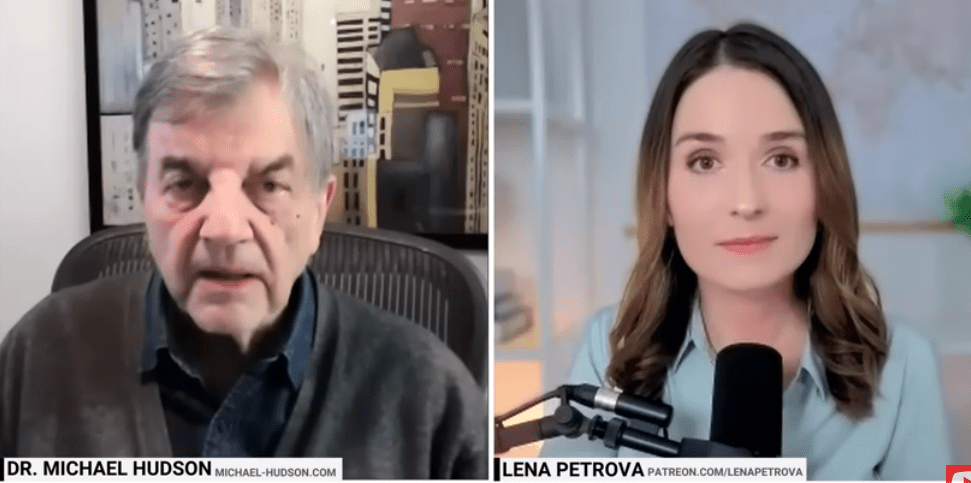
Dr. Michael Hudson with Lena Petrova: Defeat of the West – Davos Panic, Destruction of the EU & Economic Collapse
World Affairs in Context:
Michael: “We’ve reached the comical point of world diplomacy.”
January 24, 2026
LENA PETROVA:
Thank you for joining us. I’m Lena Petrova with a new episode of the World Affairs in Context podcast. Today, I’m absolutely honored to be joined by Professor Michael Hudson.
Please follow Michael at michael-hudson.com, where you can find transcripts of his recent interviews and a variety of articles on current events. I will link the site below, and I have to say that it is a wonderful resource. I’ve learned so much from your work, Professor. Welcome to the program. Thank you for joining me.
MICHAEL HUDSON:
Well, thank you very much. It’s michael-hudson.com — everybody always gets that wrong.
LENA PETROVA:
Yes, thank you for correcting me. I’m glad you did. I will link the website below so that our viewers can easily check it out. I always learn so much from it — it’s like a complete course on economics and politics. It’s absolutely wonderful, so our viewers really have to check it out.
The first weeks of January have been very busy. There’s a lot going on. The U.S. national debt is approaching a new record of $38.5 trillion. Interest costs to service that debt have surpassed $1 trillion per year. The economy is slowing as inflation resurfaces.
At the same time, in just the first three weeks of the new year, Washington carried out a military operation in Venezuela, kidnapped its president, and proclaimed that the entire Western Hemisphere is under U.S. control. Washington also supported a failed regime-change attempt in Iran, seized Russian oil tankers, formed a “Board of Peace,” and may now be considering a military intervention in Iran.
Professor, what is your take on these recent events from an economic standpoint?
MICHAEL HUDSON:
Well, there’s a lot of confusion about what problem the national debt actually poses. The government can always print the money, and the Federal Reserve can create all the money needed to finance the deficit. So there’s no problem there at all. If it has to pay a trillion dollars in interest, it can just print it. It will make the bondholders rich, but nobody really has to be taxed for it. That’s the basic principle of modern monetary theory.
The real problem with military spending isn’t the national debt itself. It’s the balance of payments. What has forced the American balance of payments into deficit—beginning with the Korean War and continuing through the 1950s, 60s, 70s, and much of today—is foreign military spending. Military expenditures abroad were responsible for essentially the entire balance-of-payments deficit during those decades.
As more dollars are spent abroad than come back in, the dollar is pressured to depreciate. To prevent that, the United States has tried to force other countries to subsidize it. The underlying mythology is that the U.S. needs foreign subsidy and payments to protect itself from first a Soviet invasion, and now a Russian and Chinese invasion.
The pretense is that America’s massive military budget has to be paid for by foreign countries—not because the U.S. wants to control them, not because it wants 800 military bases around the world, but because it’s supposedly “protecting” them. That myth has enabled the creation of NATO and its use as a mechanism to dominate Europe and force countries to hold their foreign exchange reserves in dollars rather than gold or other currencies.
We’re now seeing that system begin to unravel, especially in the wake of recent events at Davos. The real question is how the United States will finance its military and political domination now that it no longer runs a trade surplus, has deindustrialized, and has become a debtor nation rather than the world’s creditor.
After World War II, the U.S. was the leading industrial, financial, and military power. Today it no longer is. The only thing it can offer other countries now is the promise not to destroy their economies if they comply. That’s what Trump’s tariff threats represent: a protection racket.
This has become increasingly clear in Europe. Voters are beginning to ask why they must put American interests first, why they must sacrifice their economies, and why sanctions and energy policies are imposed that benefit the U.S. while harming Europe.
The claim that Europe needs protection from Russia or China is increasingly exposed as a myth. If there is no genuine invasion threat, then why impose sanctions, pay inflated prices for American LNG, and dismantle social democracy to fund military expansion?
What we are seeing is an attempt at intellectual warfare—shaping how people think about civilization, law, and power. The U.S. frames itself as “civilization” while labeling others as barbarians, obscuring the core principle of international law since the Treaty of Westphalia: national sovereignty and non-interference.
Trump’s withdrawal from UN institutions, the creation of alternative bodies like the so-called “Board of Peace,” and the rejection of multilateral norms mark a sharp break with centuries of international order. The symbolism is almost comical, but the implications are serious.
This is why today’s discussion matters. We’re witnessing a structural transformation of the world economy and the global balance of power.
LENA PETROVA:
What’s striking is how much progress made over centuries has been dismantled in just the past few years, especially the last twelve months. The withdrawal from dozens of international organizations signals a shift toward coercion and hegemonic restructuring.
In one of your recent essays, you wrote: “The overriding aim of U.S. policy today is to block countries from withdrawing from the U.S.-controlled world economy and to prevent the emergence of a Eurasian-centered economic system.” The more coercive Washington becomes, the faster the rest of the world moves away from dollar dependence.
Is this destructive leverage—the use of sanctions, tariffs, and threats—the only power Washington has left?
MICHAEL HUDSON:
Well, it doesn’t have the US market to offer, really. Trump believes that he can create a US industrial market by tariffs. But the tariffs that he’s imposing are not the kind of tariffs that countries that industrialized like the United States in the nineteenth century, Germany in the nineteenth century did. He’s imposing tariffs in all of the wrong ways. He’s put tariffs on raw materials, like steel and aluminum, and that, instead of helping industrial manufactures, it does help the steel unions and it helps the aluminum companies that I assume have contributed to his campaign, but it increases the cost of anything that uses steel and aluminum.
And he doesn’t realize that tariff policy alone cannot industrialize an economy and make it strong enough. Every country that’s industrialized had a very strong role of government infrastructure. And in the United States in the 19th century, you had the first professor of economics at the first business school, the Wharton School at the University of Pennsylvania, saying that we are used to thinking of labor and capital and even land as a factor of production, but we also have public infrastructure. And that is the most important factor of production in making countries industrially competitive.
Unlike capital, the infrastructure doesn’t look at making a profit because it wants to lower the cost. It provides basic needs, education, health care, and also natural monopolies, such as transportation and communications, and subsidized prices so that the economy at large, including the budgets of wage earners, does not have to pay monopoly prices for money. What you’re seeing in the United States is that they do not have to pay monopoly prices for privatized transportation. That’s a natural monopoly, yielding monopoly rents, not privatized for natural communications. Electric companies, phone companies, all this is privatized today.
And when you have a natural monopoly, that enables the owners to extract monopoly rents, and if you privatize natural monopolies, and turn them into rent-extracting vehicles that are usually organized by the banking and financial sector, then you’re going to have a high-cost economy. Trump is doing everything he can to make America the highest-cost economy in the world, and he’s succeeded. 18%, now I think it’s 20%, of America’s GDP goes for health care, much more expensive than the socialized medicine, socialized health care that you have in other countries.
The education that is available is not free, like in so many other countries. It’s $50,000 a year, forcing the wage earners, the students, to begin their working life with a very heavy debt that, if they’re going to get a job, the job has to pay them enough money to pay for this expensive health care and to pay for this expensive education. And they have to buy privatized transportation at a high price, monopoly rents, and privatized communication. The neoliberal model of the economy that the United States represents is a high-priced economy, but it’s not a high-value economy.
You really have to go back to classical economics of Adam Smith, John Stuart Mill, and Marx himself, who all said, “Well, value is the intrinsic cost of production, producing a product. But prices are higher than value, and the excess of price over value is economic rent.” Land doesn’t have any cost of production. It’s provided by nature. And yet, if you privatize the land tenure, ownership, and you let the landlord class, like Europe’s feudal hereditary landlord class, charge whatever rent they’re able to squeeze out of the market, then you’re going to have such a high-cost economy that, as Ricardo said, as the population grows and puts more and more pressure on food, you’re going to have food prices rising (and he could have added housing prices rising as they’re all bought on credit), and there’s not going to be any room for profits anymore.
All of this was explained in the 1810s by Ricardo, and it was elaborated. The great defense of industrial profits was, of all people, by Marx in Volume 3 of Capital. It’s true that the landlord exploits the land and makes income in his sleep, as John Stuart Mill put it. That’s exploitation. Creditors, bondholders make interest, and they, coupon clippers, make interest in their sleep. How do we treat the industrialist? Well, there is a kind of exploitation in the sense that the industrialist, and all this is related to today’s industry, the industrialist pays labor and sells the product of labor at a higher price. That’s a profit.
And Marx said, “But the industrialist does, the capitalist doesn’t make money in his sleep. The capitalist organizes enterprise, he organizes a supply of raw materials to be worked up by the labor, he organizes markets to sell the products, he organizes productivity and tries to increase the productivity in order to lower the costs to outcompete other countries.” Marx said that the international dynamic of industrial capitalism is to keep cutting costs to compete with other countries, and you need an increasing role of public investment in order to do this.
You need a tax system that finances the government spending by taxing economic rent, the land rent, the monopoly rent, so that it’s not built into prices, and that keeps the financial sector, such as banking, as a public utility, as it is in China, so that instead of you having a financial class trying to make money by loading the economy down with debt, and extracting interest, it steers credit in order to finance new means of production, to build new factories, to employ more labor, and that’s the dynamic of industrial capitalism.
What Marx believed that the tendency of industrial capitalism was just what almost everybody else of his generation believed – that the tendency of capitalism was to evolve into socialism. But that’s not what happened. The rentiers fought back. The landowners got together with the bankers and the monopolists and said, there’s no such thing as economic rent. There’s no difference at all between value and price. And that means that everyone makes all of the wealth and the income that they have by playing a productive role. And if they could erase in people’s minds the idea that people can make money not by being productive, but just by being predatory, rent seekers, then you’re not going to have any political party or movement saying, well, let’s get rid of the economic rent extractors so that we have a low cost economy and the value as the economy gets more productive and richer.
Obviously, the price of real estate, housing, and offices is going to go up. The value of credit is going to go up. Let’s make sure that the economic surplus goes to increase the economy’s growth, living standards, and productivity, not just creating a super rentier class of financiers and monopolists and real estate owners at the top of the pyramid, making their wealth by turning the rest of the economy into renters and debtors and consumers instead of homeowners and operating in a debt-free environment.
So Trump and the whole American philosophy of development, which is the whole Western theory of development, is opposed to the whole dynamic of industrial capitalism that first made Britain and then France and Germany and America the leading industrial countries of the 19th and early 20th centuries. So that’s part of the problem with how we’re doing today. How can America really compete? What does it have to offer now that it’s offshored its industrial employment and de-industrialized and simply tried to make money by running into increasing debt to foreign countries by saying if you make a profit selling to us, if you’re OPEC, and are selling oil you can charge as much as you want for the oil but you have to keep all of your savings in US dollars by buying US Treasury bonds or other US bonds. You just have to keep all your money in dollars.
Well, all of this is ending now, which is why you’re having countries sell their dollars, buy gold and silver, and each other’s bonds and currency. We’re seeing the end of the whole counter-revolution against industrial capitalism that really gained momentum after World War I. The Austrian school of economics, the libertarian school, and the neoliberal school say there’s no such thing as government regulation. That’s the road to serfdom without seeing that the road that we’re on now is the road to neo-feudalism. So, there’s a fight over people’s minds and how are they going to think about things. I’ve been reading the newspaper coverage of Davos and it says all of the blinders have fallen away from the eyes of the visitors to Davos. They realize it’s all been a myth, and that’s exactly what Mark Carney of Canada tried to do when he jumped ahead of the parade by saying, you know, everything we were told about the rules-based order is a myth. And he got a standing ovation for that.
Well, you can imagine how angry Donald Trump got at that, and he’s certainly going to try to take things out against Canada for that. He got very angry when Macron said the same thing and immediately threatened to impose 200% tariffs on French champagne. You’re seeing an almost infantilized analogy of what is, in fact, a structural restructuring of how the world economy works and, therefore, the direction in which civilization itself is moving.
LENA PETROVA:
This is so fascinating. I thought that Mark Carney’s speech was historic. What’s interesting is that Canada and France have been part of the so-called rules-based order for a long time. And now that it’s not convenient or the tables have turned, they said, oh, wait a minute, this doesn’t work anymore. And so I thought it was refreshing to hear PM Carney’s speech, but at the same time, I thought, well, this is what the entire world has been trying to tell you for a long time now. The rules-based order has been exploiting the Global South and is using other countries as a resource. Certainly, it’s great to hear this from Western leaders, but it seems that this was long overdue.
MICHAEL HUDSON:
Well, you’re right to make that point, because that was acknowledged by Carney when he said, you know, we ourselves benefited from this rules-based order for a long time. Well, didn’t he know how it worked all that time? Behavior as a politician has been as an opportunist and even in making the very nice speech that he made saying all the nice things as I said that’s jumping ahead of the parade because he wants to protect his own politics and promote himself as one of the leaders of all of this. People who are suddenly going to say, “Oh, the world order’s been exploitative,” are going to be the main exploiters for a long time. That’s why they know how exploitation works by having been exploited. That’s the irony in all of this.
The problem is that it was the exploited countries, the former Soviet Union, China, and the Global South countries that didn’t really understand how they were being exploited. All of a sudden, this says, well, you have been, how are you going to explain it? That’s what I guess we’ve been talking about in this broadcast?
LENA PETROVA:
The first three weeks of January have been completely dominated by headlines about
Venezuela and Greenland, Davos, and the Trump administration, effectively making a statement that the entire Western Hemisphere is under the US control.
I’ve heard opinions that Washington is attempting to reassert its dominance by
gaining control of oil and mineral resources, which would put it in a position to challenge
China’s economic rise. Do you believe that that is what’s driving, as many would refer to it,
imperialist foreign policy, or, are there any other goals that Washington is pursuing here?
MICHAEL HUDSON:
The United States is not trying to challenge China’s rise at all. To do that, it would have to industrialize and be a rival of China. It’s not trying to be a rival of China. It’s trying to stifle China’s growth. It’s trying to hurt China. But it’s in no position at all to challenge it.
because of the reasons I said.
So what it’s tried to do, one of the cornerstones, probably the major cornerstone of American foreign policy for a century, has been control of the oil trade.
And that’s because every country needs oil. You need oil to provide the electricity, to run your factories, to produce products. You need oil for transportation. You need oil to heat homes and to light the home.
So the United States thought that if it could impose sanctions against the use of
oil, like it’s blocked German industry and European industry from buying Russian oil and
gas, the oil industry includes the gas industry, then it could stifle their growth.
How are you in a position to say, we’re going to turn off the lights of any country whose growth we want to stifle because they’re looking for their own growth, not that of the United States?
You need to stop other countries from producing oil that is not controlled by the United
States. You have to stop Venezuela from selling its oil to China or Russia or Cuba. And you have to make sure that countries that do produce oil, like Saudi Arabia and the Arab countries,
save all and send all their oil rents to the United States so that the United States ends up
with a benefit.
You do not want Iran to be able to sell oil because it would use it for its own development.
And you don’t want Libya where continental oil had facilities for a long time to develop its oil and invest it in gold to create a gold-based African currency because that would be a rival to
the dollar, so the United States uses oil as a means to control.
The United States doesn’t have to actually own the oil resources. All it has to do is control the oil marketing of the oil to prevent countries from selling oil to other countries, countries that are deemed America’s enemies instead of its allies.
So, this ability to control the marketing of oil and the proceeds of oil, where are the economic rents, the natural resource rents of oil invested? They all have to be sent back to the United States Center for the whole thing.
So that’s really what all of this fight over Venezuela is. The myth is that this is the Monroe Doctrine, but it’s not the original Monroe Doctrine.
The agreement that the United States made right after the War of 1812, and an
expansion of European bank lending to the newly independent Latin American countries, which had won their independence and had to borrow money in order to try to finance their recovery after the destruction that colonialism had caused.
The United States said, “You stay out of our territory, we’ll stay out of your territory.”
But the United States has no intention of staying out of the Eastern Hemisphere’s territory.
We have the Western Hemisphere, but we also have the Eastern Hemisphere.
That’s why we have so much of our military spending, all surrounding Russia and China and other Asian countries and the South Pacific. Already in 1898, when America waged the Spanish-American War, the American president said, “Our manifest destiny is to move across the Pacific.” And so we have to take control of the Philippines in order to be able to control
the trade with East Asia. Hawaii and Guam are refueling stations for our Navy on the way.
Already, they extended the Monroe Doctrine to cover the Pacific Ocean and
increasingly to the Atlantic Ocean as well, basically through NATO, which expands all to Europe. The United States is really the only sphere of influence in the world.
What the National Security Council report of last December came out with is that there are going to be five spheres of influence: the United States, Russia and China (there are designated enemies), and then India and Japan, sort of a proxy state of the United States, a satellite of the United States. It’s not an independent currency, a political area.
And India is sort of the wild card in this. Trump believes, and certainly the government,
the Trump administration has said, that India doesn’t have a choice. It needs the American market. But then you had Prime Minister Modi come out and say, “We really need Russian oil because our economy needs oil to fuel our industry.” And so we’re solving the military conflict that we’ve had with China and the Himalayas. We’re really going to turn towards
Russia and China. Now PM Modi and India are the head of this year’s BRICS meeting.
So, Trump has essentially, by overreaching his power grab for the United States,
driven other countries to the opposite extreme. This is the blowback that he’s creating.
And almost everything that Trump does creates an opposite reaction, not only a revulsion,
but a desire to say, “Well, we’ve got to break away and be independent because otherwise Trump is going to continue to try to disrupt our economy by preventing us from buying energy; preventing us from buying anything we need, like access to the American market for our exports.
We’re going to find new markets for exports.”
That’s what Canada did recently. Carney went to China. He said, “We’re going to export agricultural products to you. We can export oil to you. We will import your electric cars and other electric vehicles, so much cheaper that I don’t think anyone’s going to buy American cars anymore, or even German cars.”
So it’s just amazing to see, almost like a Greek tragedy, the tragic hero bringing about exactly the opposite of what he’d hoped to do, Not to characterize Trump as a tragic hero, but tragic will pick up the noun that you think would be appropriate.
LENA PETROVA:
With respect to the EU, Trump doesn’t quite approach it as an ally. It’s become clear this past week at Davos, and during the lead-up to Davos, when he made threats about tariffs being imposed on eight European countries.
He’s very transactional. He’s ready to impose tariffs if they dare to not comply with his requests,
let’s put it politely. And in the case of Greenland, France briefly threatened with an “economic bazooka,” but then Europeans announced that the biggest threat was still Russia and China. Greenland was a point of no return in many ways because it revealed the true fabric of the EU.
So Europe’s dependence on the United States is growing. You mentioned that it’s energy dependent on the United States. It’s politically and economically not sovereign.
So what do you see happening to Europe after this, Professor?
MICHAEL HUDSON:
It’s a more pernicious dependency. Before the Davos meeting, you had the head of NATO, Rutte, write a note to Trump essentially saying, “Don’t worry, Donald, I’m on your side. I’m against the EU. Fortunately, NATO is running the EU. We’ve got to talk about when we get to Davos, and I’m sure I can deliver Europe to you and let you do everything you want in Greenland, just let me take care of these other bastards in the civilian governments.” I’m paraphrasing what he said, but it’s a disgusting suck-up memo, and indeed he tried to do that, and as Trump was leaving the Davos meetings, he said, “I spoke to, you know, wonderful Mr. Rutte.” And he said, “We’ve come to an agreement on what to do with NATO.”
Well, that’s the whole problem. NATO is running Europe. Europe is not a democracy. It’s run by the United States via NATO. And that’s NATO that has put the awful Von Der Leyen and Kallas in a position to be the surrender monkeys. It’s made sure that the only officials in charge of foreign policy are servants of the United States, not Europe. Their job is to ensure that Europe has no independent voice, doing whatever the United States wants. And this exchange between NATO, Rutte, and Trump should be better publicized.
And it makes clear that in order for Europe to develop and to be a democracy, it must dissolve NATO because the purpose of NATO is singular: to attack Russia and to become an Asian power in the South China Sea, to attack China as well. It’s an aggressive attacking power, and there’s no way that Europe can win because NATO is a military spender, it is based on American arms that don’t work. American anti-aircraft protection that we’ve just seen in Ukraine does not work at all. American tanks don’t work. German tanks don’t work. British missiles don’t work. It’s sort of like the joke about speculating in wine.
People buy rare wines at incredibly high prices, and then some billionaire takes it out and tries to pour the wine for all of his fellow billionaire friends to impress them, and they say, “Oh, it’s gone bad.” And the wine steward says, “This wine isn’t for drinking, it’s for trading.” Well, that’s what arms are for – they’re for buying and selling, they’re not actually for fighting, but since neither Russia nor China has a privately owned arms-making industry, they actually make arms to work and to fight in wars.
That’s why their missiles, drones, and airplanes have no problem at all just going right through the American and NATO defenses there. So it’s all a myth. The function of NATO is simply to use arms purchases to transfer enormous technological monopoly rents for weapons that charge far more than their actual value. The famous markups on the $550 toilet seats for the airplanes that the American military-industrial complex charges.
It’s just had the huge new ship, that destroyer, I think, that Trump has just sailed. Bathrooms don’t work. The toilets don’t flush. They don’t work, but their function isn’t to work. Their function is to make enormous profits for the manufacturers who’ve been very careful to make parts of all of these military systems in factories all over the country so that they can bring pressures on local representatives and senators to try to defend the military and therefore employment in their district as the excuse for creating these huge military industrial profits that are the only industry that really works in the United States.
It’s not really a competitive industry based on the productivity of the weaponry or the efficiency or effectiveness of the weaponry, but just on the political clout of telling countries, “You have to buy our overpriced weaponry that really aren’t going to be much use for you and require huge maintenance costs. But you have to do it as a tribute to the United States. We don’t want to tell you to just send us money, but send us money for the F-16, which is sort of our vehicle for the tribute you have to pay.”
LENA PETROVA:
Absolutely. Do you think that subjugating Europe economically and politically has been part of
Washington’s plan or has it evolved into what we see now? The EU willingly and joyfully gave up its sovereignty and has effectively become a vassal. It is not a happy vassal anymore. It’s an unhappy slave, using Belgium PM’s words. Has this been part of the plan all along,
or is this just driven by, an administration that’s in office?
MICHAEL HUDSON:
Well, that’s what my book Superimperialism is about, which I wrote in 1972. Yes, of course, the whole purpose. I have a whole chapter on how the aim of restructuring the post-World War II order by creating the International Monetary Fund and the World Bank, what was planned to be the World Trade Organization, was specifically to absorb the British Empire into the American economy.
The United States said, we have to have free trade. You cannot have the Sterling area, require India and other colonies, or Argentina, to use all of the savings that they’ve made during World War II providing the allies with raw materials and other things; you can’t restrict their sterling area savings to spending in Britain; they have to have a free choice, knowing that Britain’s was not really a competitor and all this money was going to be spent in the United States.
They made a loan to Britain and said, “We’re giving you a $5 billion loan, but you have to overvalue sterling.” So you’re pricing your exchange rate so high that your industry won’t be competitive at all because you’re charging too much for it because of your exchange rate, and you’re preventing capital controls. So the whole way they structured the post-war economy was to benefit the United States.
All of this was acknowledged by America’s national security strategy, which the Trump Administration published last month. It says that the economic, international liberal economic order that was created after World War II to serve the US interests worked for about 50 years, 70 years. It doesn’t work anymore. So now we’re going to have to drop it and have a different order. No more free trade, no more blocking capital controls. We can do whatever we want. No more international law. We’ve got to reject everything about the United Nations and say it’s the United Nations that rules the world, and then Trump said, and by America rules the world, that means me personally as its lifetime king of the—you know—the plan for so-called Board of Peace that he’s created with Tony Blair.
So this, of course, if you read Superimperialism, you’ll see how the United States structured the International Monetary Fund, the World Bank, the foreign trade system, the dollar system, the gold-based system of international reserves to reflect America’s advantages as the world’s largest gold owner. By 1950, at the time it went into the Korean War, the United States Treasury had 80% of the world’s monetary gold. So, of course, it based the whole system on gold.
But the national security says, no, we can’t base it on gold anymore because we’re not able to earn gold, and other countries are getting the gold. And so we have to make other countries base their savings on U.S. debt and bonds. Well, if you look at today’s trading in the bond market, you find that foreigners are buying gold and selling U.S. bonds, just the reverse of this system that served the United States so well for half a century or more after World War II.
And of course, they not only wanted to absorb the British Empire, but in 2022, they said, we really want to subordinate Europe. How do we force European industry not to do what chemical companies, BASF, and car companies are doing? We don’t want them to invest in China to build up China’s industrial technology. We want them to invest in the United States. Let’s wreck German industry.
What will we do? We’ll not only blow up the North Sea pipeline, the Nord Stream, but we will prevent Nord Stream, the pipeline that’s still working, from operating at all. And we’ll have the European countries saying, “We don’t want any inexpensive natural gas and oil from Russia. We want to pay America 4 times as much because that’s where our paychecks come from.” They didn’t add the balance, but that’s the implicit bit.
They were willing to destroy German, French, and other European industry just to say, “We owe it to the United States to defend us against Russia, and that’s why we’re attacking Russia, of course, which is forcing Russia to defend itself against this Western Europe attack, and without any intention at all of actually invading.
Nobody’s going to invade another country in modern warfare. They bomb other countries. No country can afford to move an infantry to occupy another country. That’s why the United States uses proxy armies in the Near East and wherever it needs them. Africa and South America ought to fight their wars.
LENA PETROVA:
Those over-the-horizon strikes certainly dehumanized the entire process and made warfare invisible to the U.S. population. And so they never really get to know what’s actually going on.
MICHAEL HUDSON:
They’re making exploitation invisible. It’s as if we’re actually earning money from our arms exports to fight the fact that the arms don’t work.
And if they did work, and European countries actually tried to fight to bomb Russia even more than they’re doing out of their Ukrainian arena, that Russia would finally simply—okay—we’re just going to, as Putin said—if you really attack us the next time, there’s not going to be anybody to talk to after the next day of fighting. Well, it’s obvious what he meant by that.
LENA PETROVA:
Yes, absolutely.
Professor Hudson, this has been such a fascinating conversation. I would love to continue it soon. Thank you so much for joining me. I appreciate your time, and I certainly hope you come back for a new episode.
MICHAEL HUDSON:
Well, thanks for bringing up these points. It’s very timely.