

Khamenei: We will Bring the Enemy to its Knees
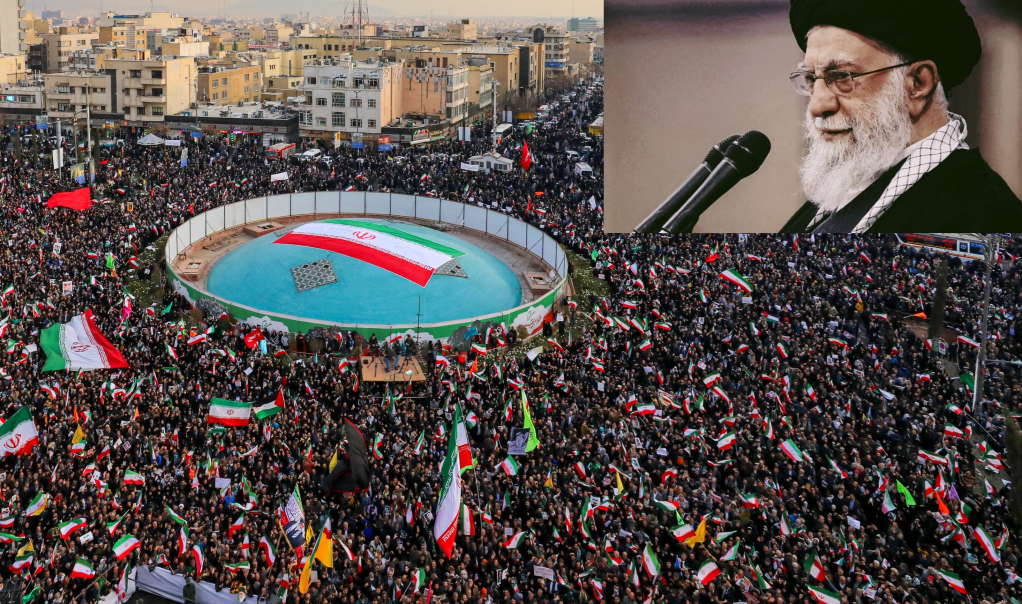
With appreciation to Resistance News Unfiltered for the translations and the many other pieces of information they share with us.
- Message of the Supreme Leader on January 12, 2026
- Speech on January 9, 2026
- Speech on January 3, 2026
The specific parts addressing the recent riots are at the end of the speeches and are in bold.
Source : english.khamenei.ir
Statement by Imam Khamenei, the Leader of the Islamic Revolution, on January 12, 2026, after millions of Iranians poured into the street in support of the Islamic Republic.
In the name of God, the Compassionate, the Merciful
Great Iranian nation,
Today you accomplished a great deed and made a historic day. These great rallies, overflowing with your firm determination, have completely shattered the foreign enemies’ plots that were supposed to be carried out by internal hirelings.
The great Iranian nation has asserted its resolve and identity in the face of the enemies. This was a warning to US politicians that they should halt their deceitful actions and stop relying on their traitorous hirelings.
The Iranian nation is strong, powerful and aware; it knows the enemy and is always present on the scene.
May God bestow His mercy on all of you.
Sayed Ali Khamenei
***
The following is the full text of the speech delivered by Imam Khamenei, the Leader of the Islamic Revolution, in a meeting with thousands of people from Qom Province. The meeting took place in the Imam Khomeini (ra) Hussainiyah on January 9, 2026, on the anniversary of the 1978 historic uprising of the people of Qom against the oppressive Pahlavi regime.
Source: english.khamenei.ir
In the Name of God, the Compassionate, the Merciful
All praise is due to God, Lord of the Worlds; and may peace and greetings be upon our Master and our Prophet, Abul-Qasim al-Mustafa, Muhammad; and upon his pure, untainted, chosen Progeny; particularly the Remnant of God on earth.
You are very welcome here my dear brothers and sisters, and also you, the honorable, faithful, revolutionary people of Qom. There’s no doubt that the 19th of Dey [9th of January] is a page that cannot be removed from the voluminous book of honors of Iran’s history. It’s a glorious day in all of history. It’s true that the movement didn’t start from the 19th of Dey. The Islamic movement started 15 years before the 19th of Dey under the leadership of our dear Imam [Khomeini]. During these 15 years, the Imam’s statements, his wisdom, and his speeches – which were continuously being conveyed to our society over the years – along with the ideas of our Islamic intellectuals in various areas of the country that were communicated by our youth in the mosques and various centers all gave strength to Islamic understanding in the movement. This is true. That is, the theoretical discussions of the Islamic movement found more strength in the minds of the people day by day during those 15 years, but for this treasure and store of thoughts and theory to be able to become a movement in society, an important, significant event was needed. The ideas were in people’s minds. The thoughts and understanding of the movement and the foundation of the movement were in the hearts of a large number of the people. I don’t say all the people, but these had found their way into the hearts of a large number of the people. And the people were familiar with the foundation of the movement. But the movement needed to come to realization. It needed to take action. And that mental concept needed to be transformed into a manifested reality and a movement.
A spark was needed for this to happen. It was as if a massive amount of gunpowder existed throughout the country that needed to be set on fire. The event in Qom did this. The event on the 19th of Dey did this. It changed that mindset into a movement. Of course, the event in Qom wasn’t a spark. It was a lightning bolt that came from the sky due to God’s will. The event in Qom was an event that appeared to last for just a day, two days, or three days and finish. But that wasn’t the inner reality of the matter. The event that took place in Qom started this movement. Then it came to Tabriz, and then to other cities. It spread throughout the country and suddenly the entire country was in flames. This is what the event in Qom did.
https://x.com/PressTV/status/2010656823154733338
When I say it was a lightning bolt, the reason is that in a time of less than about a year after the 19th of Dey, in the month of Dey the next year, the monarchy in Iran was entirely removed. So the Pahlavi monarchy was removed. It was a monarchy that was dependent, corrupt, weak, brutal, and was one of the worst governments. Perhaps we know of no other government worse than the Pahlavi government in the world at that time. When this happened [in Qom], the groundwork was prepared for a people’s government and an Islamic government to be established. That was exactly what the magnanimous Imam [Khomeini] had promised us. In the Imam’s words, there were references to this that in place of a corrupt government, a people’s government would be established. In place of a dictator, the people would govern. Instead of being dependent on the US, the Zionists, and all the thugs and ruffians in the political world, an independent, honorable government would rule. It [the event in Qom] prepared the groundwork for this.
The momentous event in Qom was actually caused by the misguided diplomacy of the Pahlavi regime itself. They themselves prepared the groundwork for their collapse themselves. They themselves ruined themselves. How?
With their mistaken assessments and wrong calculations. This is a big danger for any government. Today too, the US is mistaken in its calculations. Today, the US doesn’t understand matters correctly. Its assessments are mistaken and wrong. At that time too, both the US, which was backing the Pahlavi regime, and the Pahlavi regime were wrong in their assessments and mistaken in their understanding.
Almost 10 days before the event that took place on the 19th of Dey [9th of January], 10 days – just 10 days – before that event, the US President was in Tehran and had a speech in a New Year party in the Pahlavi palace. He was busy there with all kinds of intoxicating drinks and other such things. In that speech he said that Iran is the Island of Stability. Ten days later that event took place in Qom. This shows that they didn’t know Iran. He said that Iran was the Island of Stability. He praised and applauded the Shah and described Iran like that.
Ten days later, the event in Qom took place. They didn’t know Iran, and they still don’t know it. They didn’t know Iran, and their planning was flawed. Today too, they don’t know Iran and our enemies’ plans are flawed. They failed that day due to their flawed planning. Today too, the US’s flawed scheming will cause them to fail.
Well, these are true events in history. What I have described isn’t an interpretation. These are realities. If anyone studies the events taking place in the country at that time, which most of you young people didn’t see, this will become clear for them. These are true events in history. Well, we must learn from these historical events. Historical events aren’t stories, although we should learn from stories too. We must learn from these. I will discuss what we can learn from these in a few sentences.
At that time, the Iranian nation didn’t have cannons or tanks. They didn’t have missiles. They didn’t have military weapons or other facilities, but they were victorious. Why? On the other hand, the other side had cannons and tanks. They brought their tanks into the streets and fired them, but they were defeated. The Iranian nation was victorious. The people didn’t have military weapons, but the other side was defeated even though they had weapons. Why?
The reason was that even though the Iranian nation didn’t have military weapons, they had soft weapons. Soft weapons are a stronger determining factor in every field. What was the Iranian nations soft weapon? The Iranian nation’s soft weaponry was their religious zeal, their fervent faith, and their feeling of duty and responsibility, which the magnanimous Imam had assigned to them and expected from them. Imam even wanted the scholars and Religious Authorities to show a sense of responsibility. He shouted, “O Najaf that is quiet! O Qom that is quiet!” He wanted them to sense this responsibility, and the people sensed this responsibility that was on their shoulders.
The Iranian nation’s soft weaponry was their love for Iran. It was their love for their country. They saw that a US agent, a US mercenary, was ruling in the country in the same way that US agents are ruling, unfortunately, in some countries nowadays and ordering, “Do this. Don’t do that. Put this here. Appoint this person. Remove that person.” Iran was like that in those days. The people realized this and saw it. Of course, all the people weren’t in the higher political groups, but they would hear what was happening and they understood. The Iranians working in Iran were actually working for the US. They were Iranians, but they were working for the US. They were Iranians, but they were working for the Zionists. The people saw the betrayal, understood what was happening, became angry, and were outraged, and this accumulated in their hearts.
When the movement started, this outrage that had accumulated emerged, was manifested, and showed itself. This was a spiritual weapon, a soft weapon. The people’s main spiritual weapon was their faith in Islam. They saw that the system would openly, continuously take a stance that was against Islam. They changed the calendar from its Islamic base, they changed Islamic concepts, they made the schoolbooks un-Islamic, and they encouraged ideas that were contrary to Islam. The people saw these things. Aware, alert people understood what was happening and told others. This was a spiritual weapon. This spiritual weaponry was victorious in its fight against military weapons, cannons, and tanks.
Well, these are things that happened in the past. What I want to say is that today, the Iranian nation is even more equipped and armed than that day [before the Revolution]. Both our spiritual strength is stronger, more equipped, and prepared, and also our hard, conventional weapons cannot be compared to that day.
When we talk about conflict and confronting the obvious enemy of the Islamic Republic, some complain, “Why are you always talking about hostilities? Why are you always saying we must confront them?” They’re oblivious [to what’s happening] and don’t pay attention. They started this conflict. The US started it. The enemy that’s dependent on the US started this. Why did they start this? Why is the US so repelled and upset with Iran? Why? The reason is clear. It’s because the wealth of this country and all its financial resources were in the hands of the US. Then the Islamic Republic came along and took these away from them. You can see how they’ve besieged a country in Latin America and taken some actions there. They aren’t even ashamed and explicitly state that this was for oil. For oil! They say they’ve done this for oil!
It was for oil [here too]. It was for Iran’s oil, Iran’s mines, Iran’s farms. These vast fields in Qazvin were in the hands of the Zionists, and also the prolific fields close to Tehran. They were gradually expanding. There was an extremely vast area in Khorasan Province between the cities of Mashhad and Quchan that they were preparing to give to the Baha’i, to Zionist elements, and to US elements. Their hands were open everywhere. The Islamic Republic came and cut this off. Obviously, they became our enemies. They showed their enmity from the first day, and the Islamic Republic has confronted them. And their enmity is continuing until today.
With God’s grace, the Islamic Republic has become more powerful day by day. They made attempts but failed in trying to remove the Islamic Republic.
Praise God, the Islamic Republic today is honored, strong, powerful, and dignified in the world contrary to their wishes. This is the point. During these 40 some years, they’ve done whatever they could. There wasn’t any hostile act that could have been carried out against a country that they haven’t done. They’ve carried out military attacks, attacks on the country’s safety, imposed economic sanctions, attacked our culture, and sent their mercenaries. They paid some weak-willed people here and turned them into their mercenaries here. They’ve done all these things over these years, but they’ve failed. They haven’t gotten anywhere.
Praise God, this is because Iran is an Islamic Republic. It’s because an Islamic Republic is governing. If a liberal democracy was governing, if it was a Monarchy, or if it was a government dependent on this and that power, it wouldn’t be like this. It’s Islam, a government by the people, the Islamic system – the Islamic Republic – that’s enabled Iran to make great achievements in science, in technology, in the arts and literature, in international politics, and in many other fields.
Some people say – although it’s mostly foreign people who start this talk and then some people inside the country, unfortunately, imitate and follow them – that Iran is secluded. Not at all! Iran, the Iranian government, and the Islamic Republic aren’t secluded. Those people are fooling themselves. Iran isn’t secluded. Today, Iran is known as a country that’s dependent, courageous, and with a future in the world. Our youth are responsible for much of this activity.
I would like to speak briefly about the youth in Iran. Of course, all the youth aren’t the same. All the people aren’t the same [either]. Some are better, some are higher, some are lower – more or less. There are all types among the youth, among the elderly, among the people, among the clerics, among the university students, etc. But in general when you look at the situation, the Iranian youth are one of Iran’s most important assets contrary to the enemies’ lies. One of our most important assets is the youth.
Assets are necessary in dealing with events that arise. One of our most important assets is the youth. The enemy tries to show the Iranian youth in a bad light. They want to say that the Iranian youth have gone astray in politics and are attached to the West, they have deviated in religion and turned their backs on it, they’re promiscuous and corrupt, and they’re spiritually weak. This is what the enemy wants to try to say. These are the things they usually say, encourage, and bring in their analyses about Iranians, especially the youth. This portrayal is 100 percent incorrect. It isn’t like that.
The Iranian youth are people who are brave fighters in a war. When there’s a war, they stand firmly. In the different wars – in the Imposed 8-Year War, in this last war, and in defending the shrines – how many youth who weren’t sent to join the ranks would come, cry, and ask to be sent to fight. This is bravery. They’re prepared. So that portrayal is 100 percent wrong.
I would like to give two or three examples describing the situation of our youth. The Iranian youth are brave fighters in a war. They’re perceptive in politics. They know the enemy. They know the US, although there was a day when it wasn’t like this. They’re committed in religion. The youth are present in Itikaf, in the rallies for the 22nd of Bahman, and in the rallies for Quds Day in the month of Ramadan when they’re fasting. They’re the main participants. They’re the ones who make the plans. The youth are behind the celebrations in the streets for the 15th of Sha’ban, for the anniversary of the birth of the Commander of the Faithful [Imam Ali (pbuh)], and for the anniversary of the birth of Imam Hussain (pbuh), which have become popular events these last few years. These belong to the youth and are things they have done. Celebrations and mourning gatherings are filled with the youth. The funeral ceremonies for the martyrs are organized by the youth. It’s the youth who honor, praise, and value the martyrs. This is how our youth are.
The satellites that I previously spoke about where three satellites were launched in one day was the work of the youth. The meticulous scientific research in nuclear sciences, in stem cells, in nanotechnology, in pharmaceuticals, and in other fields is the work of the youth. This is how our youth are. Our faithful youth have these characteristics whether they’re in the university, in the Islamic seminaries, or in other places. It’s truly like this. They’re ready to make sacrifices when needed, ready to research and analyze where needed, ready to study when necessary, and ready to participate in politics when needed. This is how our youth are.
Yes, some people’s aim is to cause destruction. Last night in Tehran and some other cities, a bunch of people bent on destruction came and destroyed buildings that belong to their own country. For example, they destroyed a wall in such-and-such building in order to please the President of the US and make him happy.
Because he’s said something insane that if the Iranian government does such-and-such, I’ll come [to your side] and take your side, the side of the rioters and people who are harmful for the country. They [the rioters] have put their hopes in him. If he’s so capable to, he should manage his own country. There are various things going on in his own country. The blood of more than a thousand Iranians is on his hands.
In the 12-Day War, more than 1,000 or our countries citizens – this is in addition to the commanders, scientists, and dignitaries – regular people were martyred. That person said that he had ordered this and that he had directed that war. So he confessed that the Iranians’ blood was on his hands. Now he’s saying that he’s on the side of the Iranian nation! A bunch of naïve, unaware, unthinking people believed and accepted what he said, and they acted the way he wanted. They set rubbish bins on fire in order to please him.
Everyone should know that the Islamic Republic of Iran that was established with the sacrifice of several hundred thousand honorable people won’t back down in the face of those causing destruction. It will not tolerate the hirelings of foreign powers. Whoever you are, if you are the hirelings of foreign countries and have worked for them, the nation rejects you. The Islamic system rejects you too. This was about them. That guy who sits there arrogantly, conceitedly judging about the whole world should know that usually the tyrants and arrogant rulers of the world, such as Pharaoh, Nimrod, Reza Khan [Pahlavi], Mohammad Reza [Pahlavi], and other such rulers saw their downfall when they were at the peak of their hubris. He too will fall.
Dear young people, protect your religion, political thinking, presence [in the field], preparedness, and determination to help the country progress. Protect your unity; protect your solidarity. A united nation will prevail over all enemies.
May God protect you and protect your preparedness. God willing, God will bring the feeling of victory to the hearts of all the Iranian people very soon.
May God’s greetings and mercy be upon you.
***
The following is the full text of the speech delivered by Imam Khamenei, the Leader of the Islamic Revolution, in a meeting with the family of Martyr Soleimani, the families of his companions, and the families of the martyrs of the 12-Day War. The meeting took place in the Imam Khomeini (ra) Hussainiyah on January 3, 2026. This date coincided with the anniversary of the birth of Imam Ali ibn Abi Talib (pbuh) and the sixth anniversary of the martyrdom of General Qasem Soleimani.
Source: english.khamenei.ir
In the Name of God, the Compassionate, the Merciful
All praise is due to God, Lord of the Worlds; and may peace and greetings be upon our Master and our Prophet, Abul-Qasim al-Mustafa Muhammad; and upon his pure, untainted, chosen Progeny; particularly the Remnant of God on earth.
Today marks the anniversary of a unique birth. It’s a birth that was unique both in terms of the place of the birth and in terms of the child born – both the place of birth and the individual that was born. The birthplace was the Kaaba. In all of history, who else do we know of who was born in the House of God – in the Kaaba itself? And the person who was born was Ali al-Murtaza (pbuh), about whom I shall say a few words shortly. So considering the birth of this magnanimous figure, the 13th of Rajab is an exceptional, unique day.
In addition, today marks the anniversary of our dear, exalted martyr – Martyr Soleimani. Praise God, much has been said and written about him. I wish to offer a few words on this beloved martyr, having witnessed his life and the things he did firsthand.
Soleimani was a man of faith, sincerity, and action. These were three of his defining characteristics. He was a man of faith. This means that he believed in the work he was doing, he believed in the goal he was striving for from the depths of his heart, and he believed in God and divine support. He was a man of faith. He was [also] a man of sincerity. He didn’t work for fame, for praise, or to gain eminence among the people. He strove and worked purely for Almighty God, with total dedication to his mission. He was a man of action too. Some people are very good and understand a great deal, but you don’t see action from them. On the path that they’ve mapped out for themselves – whether in their minds or in their speech – there’s no trace of action to be found. [But] Martyr Soleimani was a man of action.
Wherever he felt his presence was needed, he would be there whether it was in protecting and guiding the revolutionary movement in Kerman, in confronting the oppressive, tyrannical aggressors in that region, in the Quds Force, in defending the [Holy] Shrines, or in fighting the Daesh [ISIS]. He was a man of action both in the military field and also in political and educational spheres. His work was never confined to military duties alone. While we know him as a military figure, Martyr Soleimani was effective, valuable, and in some cases, an unmatched element in the region’s most sensitive, critical political matters. He was also a man of action as a mentor. Those under his command, the youths who joined him, and those who fought alongside him learned many lessons from him. He educated them. He was a multifaceted, complete human being from our time.
Just a few days ago, those who still bear the weight of having shed his blood uttered some absurdities about him. They uttered some nonsensical statements about Martyr Soleimani. But Martyr Soleimani had already refuted their claims with his actions and deeds during his blessed lifetime. Praise God and much to the dismay of the enemy, his burial site is becoming more sacred and more revered with each passing year. Look at this year’s commemoration. From what I have seen on television, a tremendous number of people travel from afar, some even come from other countries. They walk and travel to his burial site to pay their respects. He was a man of faith, sincerity, and action.
In addition to Martyr Soleimani, we honor other beloved martyrs in this assembly today, and some of their families are present here with us. They include martyrs from the military ranks, martyrs from the scientific community, and the martyrs from among our fellow citizens who joined the multitude of martyrs in the 12-Day War. Regarding those whom I knew personally, I can testify that their entire lives were devoted to jihad and that’s all they thought about. They never paused or hesitated on the path of God. They worked tirelessly and longed for martyrdom. Martyrdom was their dream. Both the martyrs from the military and the martyrs who were busy in the sciences – some of whom I knew personally – loved martyrdom. They were waiting for it. This gathering is a way of paying tribute, honoring, and respecting those dear martyrs whose names shall remain eternally in history. We must use their blessed names as a force to move forward through history.
As for the topics I wish to address today, I would like to briefly touch upon two or three points. First, I will mention a few words about the Commander of the Faithful [Imam Ali (pbuh)]. Next, a discussion on a pivotal factor in the confrontation between truth and falsehood – a factor that you must be mindful of both at the time of Imam Ali and during the present day – will follow. And finally, we will take a look at recent events. I will say a few words about what took place this past week and our people’s rallies.
Regarding the Commander of the Faithful, what has been said and written about him throughout history – in literature and in the hadith – is so vast and abundant that I doubt such a wealth of discourse and praise exists for any other individual. Even among non-Muslims and the non-Shia, great scholars and intellectuals have written books about him. Ibn Abi al-Hadid’s Sharh Nahj al-Balaghah is a large, substantial work, which consists of many volumes. And there are numerous commentaries on Nahj al-Balaghah, explanations of the words spoken by Imam Ali (pbuh), commentaries on his letter to Malik Ashtar, and biographies of Imam Ali in history and literature. The sheer volume is such that, as I said, it’s impossible to find anyone like him.
Now, out of all the virtues that the Commander of the Faithful (pbuh) is said to have possessed, I have chosen two qualities, where he stands at the very top and which we are in need of today, to speak about briefly. The first is that Imam Ali (pbuh) is an example of the height of justice. The second is that he is an example of the height of piety. Justice and piety.
Today, the Islamic Republic needs both justice and piety. Compared to the past, the Islamic Republic has made progress in both these areas. However, we’re still some distance away from what is expected. We must take Imam Ali (pbuh) as our role model and move along this path toward that peak.
When we say the Commander of the Faithful stood at the very top in terms of justice and was at the highest point of justice, how exactly did he implement that justice? He implemented it in different ways. Sometimes it was with his caring hands and his service to the weak, to the orphaned children, and to families without providers. That is how he would implement justice at times. At other times, he would administer justice with Zulfiqar. That is, the exact opposite by using his sharp, double-edged sword which has been praised throughout history more than any other weapon. And yet at other times, he would implement justice with his eloquent speech and wisdom. He would use expressions that were higher than the [average] level of Arabic literature. An example of this is Nahj al-Balaghah.
That is how he would speak about justice. He wrote letters to his governors and provincial rulers, and [these letters] are lessons in justice. When one examines Imam Ali’s letter to Malik Ashtar, which was his decree for Malik Ashtar to govern and is incorrectly called a “covenant” – it wasn’t a covenant but was a command, an order for him to govern – one finds it filled with concepts that primarily revolve around justice and are aimed at establishing a just society. That is how he would advance justice at times. He would do it with kindness, divine rigor, religious zeal, and using eloquent discourse, wisdom, and clarification. The originator of this “jihad of clarification” is the Commander of the Faithful (pbuh).
As for piety, how did he practice piety? At times, he practiced piety in the mihrab for worshiping and in his acts of worship, which even the angels would envy. That is to say, Imam Ali’s acts of worship – his prayers, his supplications, and his talking to God – would leave the angels in awe. At other times, he practiced piety with his patience and silence to preserve the unity of the Muslims. This was one of the most significant instances of his piety. There was a right that was his and to which he was entitled but was taken away from him. The Commander of the Faithful could have reclaimed that right using the sword, but if he had done that, it would have caused division among the Muslims. In order to prevent discord, he exercised patience, remained silent, and cooperated.
It’s sometimes said that Imam Ali (pbuh) sat at home for 25 years. No, the Commander of the Faithful didn’t just sit at home. He was on the scene, he was in the arena commanding, guiding, and giving direction to the caliphs of the time and the people. In other words, he demonstrated his piety with his patience and silence. This is piety. Piety is when a person sees his right is being taken, but he remains silent for the sake of a greater interest. We cannot tolerate remaining silent. If our rights are infringed upon, we feel as though the world has ended and we show no restraint. [But] that noble figure exercised restraint. In some cases, his piety manifested itself by him showing steadfastness in the face of dangerous events, such as on Laylat al-Mabit. That was an act of piety when he slept in the Prophet’s place despite the near certainty that he would be killed that night.
He demonstrated piety during [the Battle of] Uhud, when he stood his ground. He showed piety at Hunayn, when he remained steadfast, and he demonstrated piety at Khaybar, when he crippled the enemy. He was the vanguard in the majority of the Prophet’s battles. These were manifestations of piety [too]. Piety isn’t confined to just while in the mihrab for worshiping. Piety also exists in the battlefield. It sustains a person, protects them, and drives them forward. So Imam Ali (pbuh) stood firmly in the face of the enemy.
It’s these two characteristics: Imam Ali’s justice and his piety. Today, we need both justice and piety in our country and in our society. We need the general public to be pious, and particularly the country’s officials must be pious. This is what we need, and this must be fully realized. Well, praise God, to a considerable extent one can observe instances in which actions are carried out with piety, but this must become universal. This Imam, whose name we mention with fondness, whose memory we cherish, whose name we utter, and whose praises we recite and read, was that kind of a person. That was how he behaved in matters involving justice and in matters involving piety.
Throughout these past one thousand-plus years, the Shia didn’t have the opportunity to implement the justice that Imam Ali (pbuh) exemplified in society because they didn’t hold the reins of government. But today, that excuse no longer exists and there is no longer any justification [for not implementing justice]. Today, the government is Islamic. It’s a government based on Imam Ali’s model of governance. It’s a government based on Wilayah [divinely appointed leadership]. Today, we must be in pursuit of justice. Justice is the most obligatory matter and the characteristic that is of the highest priority for governing a society. It’s something that you must pursue.
Well, there are factors that stand in the way of us being pious. At times we are afraid, and sometimes we doubt our own principles. At times we show [undue] consideration for friendships, and sometimes we show [undue] consideration for the enemy. These must be set aside. These things shouldn’t exist. We must move toward a program that brings justice and spreads piety without [unnecessary] considerations. So, that was about the Commander of the Faithful.
As I mentioned, there is a point about the Commander of the Faithful (peace be upon him) that must also be given attention today in our society, in our government, and in the Islamic system. That point is the following.
The Commander of the Faithful [Imam Ali (pbuh)] was never defeated in any military conflict. Not once. He was the victor and the dominant force in every battle – even in [the Battle of] Uhud! In [the Battle of] Uhud, others fled, but the Commander of the Faithful prevailed. His courage and steadfastness – along with that of one or two other companions of the Holy Prophet – compensated for the flight of those weak people who had succumbed to fear. In all of the battles led by the Prophet – a similar event took place in the Battle of Hunayn and other places – the Commander of the Faithful was victorious. During the period of his Caliphate, there were three wars. In all three, Imam Ali (pbuh) was victorious. He was also the victor in [the Battle of] Siffin. In Siffin, history was only one step away from being changed forever. Had Malik Ashtar been able to reach that [final] point, which he was on the verge of reaching, history would have been changed. But he turned back at the command of Imam Ali (pbuh).
The same problem that existed back then exists today as well. They managed to prevent that same Commander of the Faithful, who was never defeated in any military engagement, from achieving his goals in many cases. That is to say, they used to find a way. Today, we call this method “soft warfare.” Soft warfare. Some people think that these kinds of methods – the slanders, deceptions, acts of malice, and infiltrations – are unique to the present day. No, these were the same factors being used during the time of the Commander of the Faithful as well. The matter rests in the hands of the people. The Guardians sent by God can’t do anything without the help of the people. “It is He who strengthened you with His help and with that of the believers” (Quran 8:62).
In the face of Imam Ali’s courage, power, and iron will, the enemy had no other way but to turn to deceiving those around him. In the Battle of Siffin, they did that by raising Qurans on spearheads. Such things happened after that as well. Such things also took place during the time of Imam Hassan (pbuh). This is what constitutes soft warfare. What is soft warfare? It means using deception, lies, slander, temptations, and fallacious reasoning to make people waver on the path they’re following and to instill doubt in them. That is soft warfare. This kind of warfare is currently underway. It’s being carried out today as well.
The goal of soft warfare is to cause people to lose their motivation – people who are active and ready to strive and work. The enemy targets these people in order to cause them to lose their motivation, to give up their hope, to become despaired, and to become doubtful. They enter the field with the tools of soft warfare to do this. They did this back then, during the time of the Commander of the Faithful [Imam Ali (pbuh)]. They did such things, and the details are recorded in history at length. People would go into cities and villages, attacking the people there and oppressing them. Then, someone would spread the rumor that the perpetrators had been sent by Ali. They would cast doubts into people’s minds. The exact same thing is happening today. The Iranian nation has demonstrated these days that in difficult situations wherever their presence is needed, they stand firmly. This is a characteristic of the Iranian nation, and it isn’t exclusive to a special group or a specific circle. They stand firmly where they need to and help others when help is needed. They shout slogans when they must, and they cause the enemy to lose all hope when they need to. This kind of motivation worries the enemy, [so] they try to lessen and weaken this motivation in people using various ruses.
One of the tools of soft warfare used today by the enemy – and by certain malicious or ignorant people – is to not talk about the achievements, assets, and capabilities of this nation. They deny this nation’s abilities. This is a great nation. It can accomplish great things, and it is doing just that. The nation is accomplishing things today. If a nation ignores its own assets, if they’re blinded to their own potential, and if they lose faith in their own progress, that nation will be humiliated. Once a nation feels it’s been humiliated and sees itself as being inferior, it will be willing to surrender to the enemy. This is the scheme the enemies are pursuing and working on.
Today’s talented youth – the skilled, talented youth – have launched three satellites into space in a single day. This is not a small matter. It’s a very great achievement. Today’s talented youth added 4,000 megawatts to the country’s electrical power capacity and strengthened the national grid over the course of just a few months. Today’s talented youth, in various sciences – including aerospace, biotechnology, medicine, nanotechnology, the construction of missiles, and military industries – have astonished the world, and they have done so during a time of sanctions. These are unique assets. These are riches that we possess and must recognize.
I may have mentioned the following once or twice in my speeches. Several years ago, a missile scientist working for the Zionists himself stated that when they were testing a certain Iranian missile, which he saw being broadcast on TV, he took his hat off out of respect for the person who had built it – out of respect for someone who had been able to accomplish such a great feat under sanctions and at a time of sanctions. In the defense industry and in the methods for treating illnesses, great achievements are being made today. The enemy conceals these matters, and unfortunately, some people inside the country conceal these achievements as well. Unfortunately, some people within the country hide these advancements and these major achievements and do not inform the public about them. Significant achievements are being made throughout the country, and our country is moving forward.
In a military war on the Iranian nation, what makes the enemy first ask for a ceasefire and then send a message saying they don’t want to fight us? Of course, the malicious enemy is a deceiving liar and we don’t trust them. But what causes such an action is the power of the Iranian nation and the ability of the Iranian youth.
I’ve heard about the people who launched those satellites into space last week – the young people who launched three satellites into space in a single day, successfully putting them in orbit. It was reported to me that their average age is 26. Such people are invaluable assets. The wealth of human capital isn’t a small asset. But that ranting American (Donald Trump) sits there talking about the Iranian nation, spewing a combination of slander and promises. False promises! Deception! Fortunately, the Iranian nation has now understood what the US is really like. There was a time when people didn’t know [how the US was]. But today, the US has no honor left in the world. Everyone knows what it’s like now, and not just Iran. People know what the enemy is like, and this is extremely valuable. We used to insist on providing explanations to the people, but during the 12-Day War, the people saw this for themselves. They witnessed this firsthand. Even those who argued that the solution to the country’s problems was in negotiating with the US have seen what happened. In the midst of negotiations while the Iranian government was engaged in talks with the US, the US government was busy behind the scenes preparing plans for war. The people are awake. They’re aware.
Therefore, one must be alert with regard to soft warfare. One must be vigilant in the face of the enemy’s causing doubts and their spreading rumors. The money being spent – billions are being spent – on certain television channels, radio stations, media outlets, etc., to constantly spread lies and falsehoods against Iran isn’t without reason. It’s based on a very important rationale. They seek to weaken the country from within. They saw that in the 12-Day War, the unity of the nation worked miracles, so they want to disrupt this unity. The Iranian people must be alert. The most important issue is to pay attention to the enemy’s hostility and also to our internal, domestic unity and cohesion, “They are firm against the unbelievers and merciful among themselves” (Quran 48:29).
Now, I would like to say a few words about the gatherings that took place last week. First of all, the people who work in the bazaar and shopkeepers are some of the most loyal people in the country to the Islamic system and the Islamic Revolution. We know the bazaar well. One cannot challenge the Islamic Republic and the Islamic system in the name of the bazaar and the business community. Yes, these gatherings mostly involved the business community, but their point was valid. I have both heard about this on television and have seen it in the assessments and in practice. When a businessperson looks at the country’s monetary situation – the decline in the value of the national currency, the instability of the currency rate, and foreign currency fluctuations that cause the business environment to lack stability – he says, “I can’t do business.” And he’s right. The country’s officials acknowledge this, and I know that the honorable President and other senior officials are working to solve this problem. It’s a problem, and the enemy has a hand in it too. Let me add the following. The rise in foreign exchange rates, the excessive surge in foreign exchange and its volatility – constantly going up and down, leaving businesspeople unsure of where they stand – isn’t normal. Our enemy is behind this. This must be stopped, of course. The President, the heads of the other branches of the government, and other officials are actively working to fix this by taking various measures.
So the protests of the business community were about this issue, and their point is valid. But what’s important is that a group of people who had been provoked and were the enemy’s mercenaries stood behind the businesspeople and chanted slogans against Islam, Iran, and the Islamic Republic. This is an important point. Protesting is legitimate, but protesting is different from rioting. We talk with protesters. The officials must talk with the protesters. [However,] there’s no point in talking with a rioter. Rioters must be put in their place. It’s absolutely unacceptable for a group of people to appear under various guises, to come with the intent of causing destruction and creating insecurity in the country, and to position themselves behind our pious, honest, Revolutionary people from the bazaar to exploit their protests and to incite riots.
We must recognize the enemy’s tactics. The enemy never rests and exploits every opportunity that arises. They saw this as an opportunity and sought to exploit it. Of course, our officials were working and ready, and they will continue to be. But what truly matters is the nation as a whole. What matters are the qualities that made Soleimani who he was, the qualities of faith, sincerity, and action. What matters is to not be indifferent about the enemy’s soft warfare and their spreading false rumors. These are the things that mater. What’s important is that when one realizes the enemy is trying to force something on the country, the officials, the government, and the nation, one must stand firmly against that enemy and defend. We won’t give in to the enemy. With reliance on Almighty God, trusting in Him, and confidence in the people’s support, we’ll bring the enemy to its knees, God willing and with His grace.
We pray that Almighty God will unite our dear martyrs with those closest to Him; that He will protect our youth; that He will, God willing, grant you dear people blessings on the birth of Imam Ali (pbuh); and that He will bestow patience, consolation, serenity, and peace upon the hearts of the martyrs’ families.
May God’s greetings, mercy, and blessings be upon you.
To support our work, you can donate, share this article and subscribe to our newsletter