

Qatar, Türkiye Warn Gaza Ceasefire Is Fragile, Incomplete
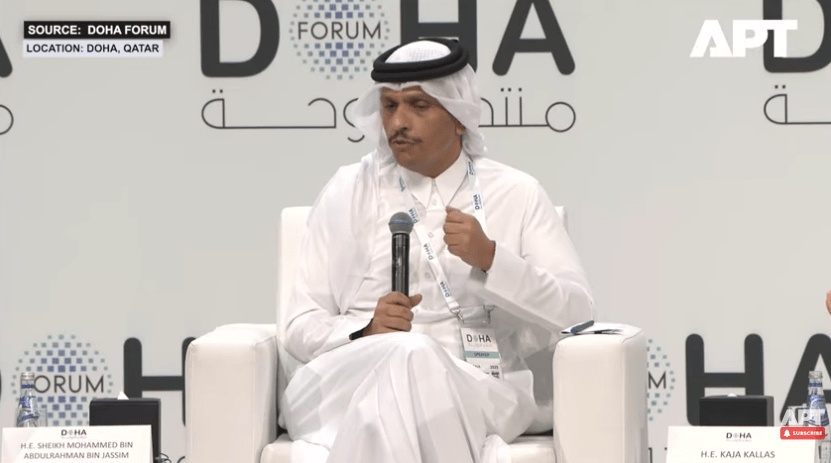
There comes a time when one has to give credit where credit is due. This does not mean sudden trust, it does not mean that one throws knowledge away and suddenly become love partners with the Arab states, it only means we give credit where it is due, at this moment. The future will tell. The Doha forum unfortunately had everyone and the kitchen sink taking part. We had Kaja Kallas and such people taking part. But, the Qatar and Türkiye leaders spoke truth, clearly, with no ambiguity.
Gaza Ceasefire Lacks Stability, Say Regional Leaders
This is from https://interbellumnews.com/conflicts/palestine/qatar-t%C3%BCrkiye-warn-gaza-ceasefire-is-fragile-incomplete
Top mediators Qatar and Türkiye issued a stark warning that the nearly two-month pause in Gaza is fragile and incomplete, stating that a genuine ceasefire cannot be achieved without the full withdrawal of Israeli forces and an end to the ongoing violence that continues to claim Palestinian lives.
Speaking at the Doha Forum on Saturday, Qatari Prime Minister Sheikh Mohammed bin Abdulrahman Al Thani emphasized that the current situation amounts to merely a “pause” in hostilities. He asserted that stability, freedom of movement for Palestinians, and a complete Israeli military withdrawal are non-negotiable prerequisites for a lasting peace. This call was echoed by regional leaders who stress that without addressing the core issue of Palestinian rights and sovereignty, any agreement risks repeating cycles of violence.
A Truce in Name Only
Despite the truce that began on October 10, the Israeli military campaign has not ceased, with Palestinian authorities reporting over 600 violations in seven weeks. Since the truce started, Israeli attacks have killed at least 360 Palestinians, including 70 children.
Just on Saturday, seven people were killed in separate incidents across northern Gaza. This ongoing violence underscores the mediators’ point that the current arrangement fails to provide genuine safety for Gaza’s civilian population.
Furthermore, key provisions of the first phase of the U.S.-brokered plan remain unfulfilled. The agreed-upon daily target of 600 aid trucks entering Gaza has never been reached, and the Rafah border crossing has not been reopened for two-way movement as stipulated. Egypt, alongside other nations, has condemned an Israeli plan to open Rafah exclusively for Palestinian departures, warning it could facilitate permanent displacement and blocks aid entry, a move seen as a breach of the peace plan.
Disarmament, Governance, and an International Force
The proposed second phase of the deal, which has yet to begin, involves a complex set of interlinked challenges that mediators are urgently trying to solve. The phase calls for a full Israeli withdrawal, the deployment of an International Stabilization Force (ISF), the establishment of a new Palestinian governance mechanism, and the disarmament of Hamas.
The issue of Hamas’s disarmament presents a major stumbling block. The group has stated it will not disappear and remains a central part of Palestinian political life, and is only open to handing over weapons as part of an internal Palestinian political process, not as an act of surrender to Israel.
Experts warn that attempting forcible disarmament would be a “recipe for disaster,” likely leading to renewed conflict. A viable plan would require a sequenced, Palestinian-led process that offers reintegration pathways for fighters.
Parallel to this, efforts are underway to build a post-war security infrastructure. Egypt, with EU support, has begun training thousands of Palestinian police officers intended to form a future Gaza security force loyal to the Palestinian Authority. This force is envisioned to work alongside, and eventually take over from, the proposed ISF. However, the composition and mandate of the ISF itself are still unresolved.
While Türkiye has indicated a willingness to participate, Israel openly opposes its involvement. The force’s primary goal, as stated by Turkish Foreign Minister Hakan Fidan, should be to separate Palestinians and Israelis, with other details to follow.
A Race Against Time
With the humanitarian situation still catastrophic and winter approaching for a displaced population lacking shelter, mediators are pressing for immediate action. Norway’s foreign minister insisted that the stabilization force and a governing peace council “must be formed this month,” warning the current pause “cannot hold for many more weeks in its current phase”.
—
Qatar’s Prime Minister Sheikh Mohammed bin Abdulrahman Al Thani and Turkish Foreign Minister Hakan Fidan discussed the future of the Gaza ceasefire at the Doha Forum 2025.
Al Thani emphasized that the current pause in fighting is not yet a full ceasefire, highlighting the need for Israeli withdrawal, stability in Gaza, and free movement for residents.
Both leaders stressed ongoing collaboration between Qatar, Turkey, Egypt, and the US to advance negotiations and establish an International Stability Force (ISF) to separate Palestinians and Israelis at the border.
Fidan noted that the ISF’s mission must be realistic, supported by local Palestinian police, and coordinated with a peace board for long-term stability.
This is the speech that I concur with. Veracity? Future will tell but so far the Arab states held strong to a Palestinian State.