

Article shared by Delcy Rodriques – VP Venezuela: The Great Buffalo
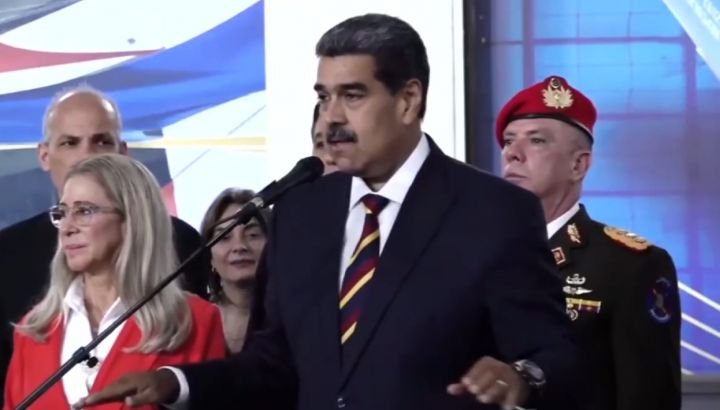
Delcy Eloína Rodríguez Gómez (born 18 May 1969) is a Venezuelan lawyer, diplomat, and politician who has served as the vice president of Venezuela since 2018.
L’Antidiplomatica posted an older article by Pino Arlacchi, former UN Deputy Secretary-General and former UN Director for Drug Control, and distributed by Delcy Rodrigues,
Correct translation of the title would be: “The Great Deception against Venezuela: the geopolitics of oil disguised as the fight against drugs”, but I do like the direct translation:
The Great Buffalo against Venezuela: the geopolitics of oil disguised as a fight against drugs
A document that exposes with UN data – the infamous and criminal lie that the US intends to impose to justify the intervention in Venezuela.
by Pino Arlacchi *
During my tenure at the helm of UNODC, the UN’s anti-drug and anti-crime agency, I was at home in Colombia, Bolivia, Peru and Brazil but I’ve never been to Venezuela. It just didn’t need it. The collaboration of the Venezuelan government in the fight against drug trafficking was among the best of the South American continent, equal only to the impeccable one of Cuba. A fact that today, in the delirious Trumpian narrative of the “Venezuela narco-state”, sounds like a geopolitically motivated slander.
But the data, the real ones, that emerges from the World Report on Drugs 2025 of the body that I had the honor of directing – tell a story opposite to what is doomed by the Trump administration. A story that dismantles piece by piece the geopolitical fabrication built around the “Cartel de los soles”, an entity as legendary as the Loch Ness monster, but suitable to justify sanctions, embargoes and threats of military intervention against a country that, coincidentally, sits on one of the largest oil reserves on the planet.
Venezuela according to UNODC: A marginal country on the drug trafficking map
UNODC’s 2025 report is crystal clear, which should embarrass the rhetoric of demonization of Venezuela’s demonization for those who have embodied. The report only makes a minimal mention of Venezuela stating that a marginal fraction of Colombian drug production passes through the country to the United States and Europe. Venezuela, according to the UN, has consolidated its position as a territory free from the cultivation of coca leaf, marijuana, and the like, as well as the presence of international criminal cartels.
The document only confirms the 30 previous annual reports, which do not speak of Venezuelan drug trafficking because this does not exist. Only 5% of Colombian drugs pass through Venezuela. To put this figure in perspective: in 2018, while 210 tons of cocaine crossed Venezuela, 2,370 tons – ten times more – were produced or traded from Colombia, and 1,400 tons from Guatemala.
The Fantastic Sign of the Sun: Hollywood Fiction
The “Cartel de los soles” is a creature of the fictional trumpiano. It would be led by the President of Venezuela, but it is not mentioned either in the report of the world’s leading drug body or in the documents of any European anti-crime agency and almost every other part of the planet. Not even a footnote. A deafening silence, which should make anyone think that still has a minimum of critical sense. How can a criminal organization so powerful that it deserves a $50 million bounty be completely ignored by anyone dealing with drugs?
In other words, what is being sold as a super-cartel to Netflix is actually a mixture of small local networks, the kind of petty crime found in any country in the world, including the United States, where – incidentally – nearly 100,000 people die every year from opioid overdoses that have nothing to do with Venezuela, and much to American Big Pharma.
L’Ecuador: The True Hub Nobody Wants to See
As Washington wags the Venezuelan bogeyman, the real drug hubs thrive almost undisturbed. Ecuador, for example, with 57% of banana containers starting from Guayaquil and arriving in Antwerp loaded with cocaine. European authorities seized 13 tons of cocaine on a single Spanish ship, which comes from Ecuadorian ports controlled by companies protected by members of the government of Ecuador.
The European Union has produced a detailed report on Guayaquil’s ports, documenting how “Colombian, Mexican and Albanian mafias all operate extensively in Ecuador.” The homicide rate in Ecuador jumped from 7.8 per 100,000 population in 2020 to 45.7 in 2023. But Ecuador is little talk. Perhaps because Ecuador produces only 0.5% of the world’s oil, and why doesn’t its government have the bad habit of challenging the overpowered US in Latin America?
The True Routes of Drugs: Geography vs. Propaganda
During my years at UNODC, one of the most important lessons I have learned is that geography does not lie. Drug routes follow precise logics: proximity to production centers, ease of transport, corruption of local authorities, and presence of established criminal networks. Venezuela meets almost none of these criteria.
Colombia produces more than 70 percent of the world’s cocaine. Peru and Bolivia cover the majority of the remaining 30%. The logical routes to reach American and European markets pass through the Pacific to Asia, through the Eastern Caribbean to Europe, and by land through Central America to the United States. Venezuela, facing the South Atlantic, is geographically disadvantaged for all three main routes. Criminal logistics makes Venezuela a marginal actor of the great international drug trafficking theatre.
Cuba: The Example that embarrasses
Geography does not lie, that is, but politics can defeat it. Cuba is still the gold standard of anti-drug cooperation in the Caribbean. An island not far from the coast of Florida, a theoretically perfect base for sorting towards the United States, but which in practice is foreign to the flows of drug trafficking. I have repeatedly found the admiration of DEA and FBI agents towards the strict anti-drug policies of the Cuban Communists.
Chavista Venezuela has constantly followed the Cuban model in the anti-drug struggle inaugurated by Fidel Castro himself. International cooperation, control of the territory, repression of criminal activities. Neither in Venezuela nor in Cuba have there ever been large pieces of territory cultivated with coca and controlled by great crime.
The European Union has no particular oil interests in Venezuela but has a concrete interest in fighting the drug trafficking that afflicts its cities. The Union has produced its European Report on Drugs 2025. The document, based on real data and not on geopolitical wishful thinkings, does not mention Venezuela once as a corridor of international drug trafficking.
Here is the difference between an honest analysis and a false and insulting narrative. Europe needs reliable data to protect its citizens from drugs, so it produces accurate reports. The US needs justification for its oil policies, so they produce propaganda masquerading as intelligence.
According to the European report, cocaine is the second most used drug in the 27 EU countries, but the main sources are clearly identified: Colombia for production, Central America for sorting, and various routes through West Africa for distribution. In this scenario, Venezuela and Cuba are simply not there.
But Venezuela is systematically demonized against any principle of truth. The explanation was provided by former FBI director James Comey in his post-resignation memoir, in which he spoke of the unconfessable motivations of American policies towards Venezuela: Trump had told him that Maduro’s was “a government sitting on a mountain of oil that we must buy.” It is not, then, drugs, crime, national security. It’s about oil that would be better not to pay for.
It is Donald Trump, therefore, who deserves an international bounty for a very specific crime: “systematic slander against a sovereign state aimed at appropriating his oil resources.”
—
*Pino Arlacchi was Deputy Secretary-General of the United Nations and Executive Director of UNODC, the UN’s anti-drug and anti-crime programme