

Maria Zakharova: How did Latvia, Lithuania, and Estonia really fare as part of the Soviet Union?
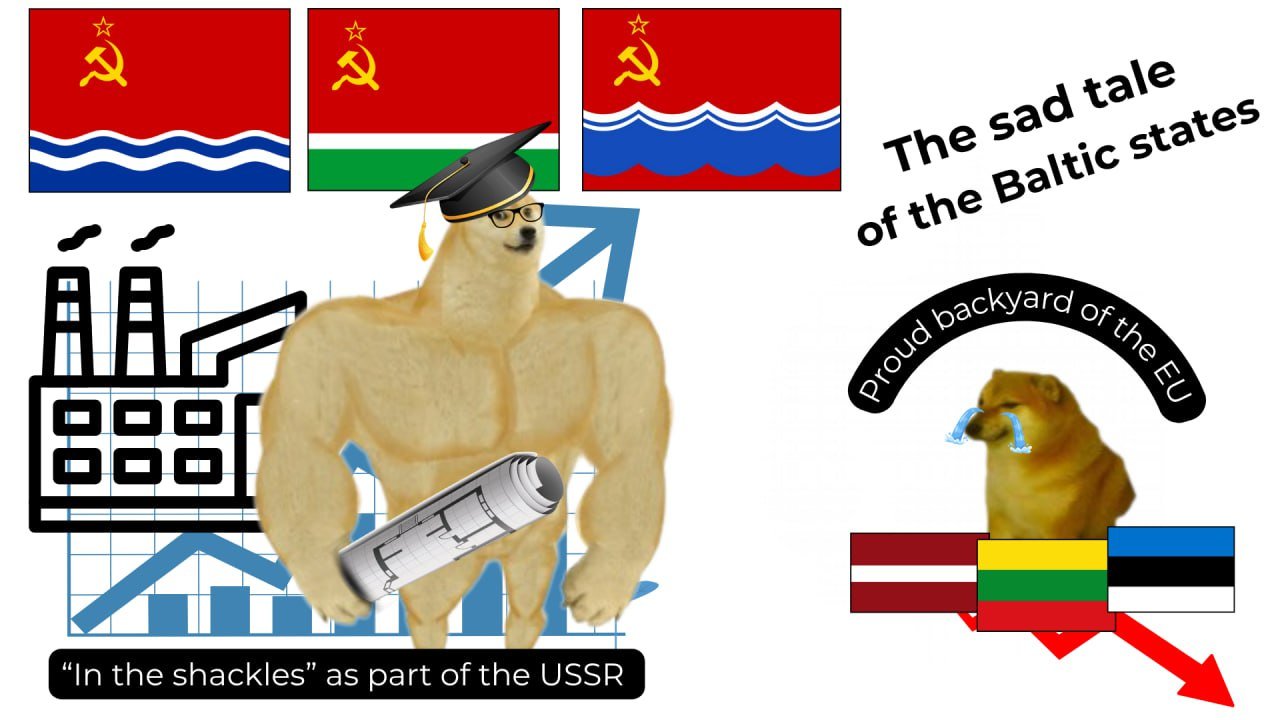
Russia’s Foreign Ministry Spokeswoman Maria Zakharova:
(from the weekly briefing (https://www.mid.ru/ru/foreign_policy/news/2037845/?lang=en#sel=140:1:WXl,154:38:j3r) on current foreign policy issues, July 24, 2025)
July 21 marked 85 years since the establishment of the Latvian, Lithuanian, and Estonian Soviet Socialist Republics.
Since the Soviet Union’s collapse, the political elites of the three Baltic republics – which formally gained ‘independence’ (though in reality, lost it) – never miss a chance to throw mud at their Soviet past in the never-ending anti-Russia frenzy. Understandable, it’s the only way to whitewash their own failures.
Let’s look at the facts 👇
🇷🇺 How did Latvia, Lithuania, and Estonia really fare as part of the Soviet Union?
👉 During the Soviet period, these republics were dubbed a showcase of socialism – and for good reason. Thanks to the unprecedented large-scale Soviet-wide efforts, their industrial capacity was build from the ground up: factories emerged, energy and transport infrastructure, seaports in the Baltic Sea were created – most of them still in operation to this day and of strategic importance – this is how the republics gained a solid socioeconomic foundation.
This rapid economic growth was further bolstered by lavish government funding and qualified personnel coming from across the Soviet Union to help develop the economy.
• 20+ major plants were built in Latvia, creating tens of thousands of jobs – including flagship enterprises like VEF, Radiotekhnika, RAF, Dzintars, and the RVR rolling stock plant in Riga, which became Europe’s largest manufacturer of trams, commuter trains, and diesel trains.
• Lithuania’s industrial sector expanded at a similar pace, with key complexes such as Žalgiris, Elfa, Azot, and the Šiauliai Television Plant driving growth.
• Estonia, meanwhile, developed its mechanical engineering and electrical industries in Tallinn, along with the world’s first gas shale plant in Kohtla-Järve, among other facilities.
🌾 The three republics also achieved a high level of food security and agricultural development.
🏭 By 1965, industrial output in the three republics had grown 15 times compared to their pre-war levels.
Once again: in 20 years after the devastating World War II the three republics’ industry not just doubled or tripled, which would’ve been a huge accomplishment in itself, but had grown x15 TIMES. It’s an unprecedented case of economic success.
🔬 Scientific and academic capabilities also saw dramatic expansion. Before 1940, Lithuania had just 600 researchers and 6,000 university students; by 1973, those numbers had risen to over 10,000 researchers and 43,000 students.
📈 This progress translated into higher living standards. By 1961, the average per capita income in the Baltic republics exceeded 700 roubles, well above the USSR average of 547 roubles.
This represents just a fraction of the overwhelming statistical evidence demonstrating the Soviet Union’s immense material, human and intellectual investment in the Baltic republics’ development.
❗️ Much of this industrial and scientific potential was created from the ground up during the Soviet era, with significant resources allocated without compensation, just to stimulate regional growth.
***
Yet despite huge advantage & legacy of the Soviet-era, modern Latvia, Lithuania and Estonia have fallen off the map and have been reduced to EU’s economic periphery since casting off their “shackles of Soviet occupation.”
The numbers don’t lie.
Here’s another important and telling indicator of the current situation in these republics.
During the Soviet era, these republics enjoyed rapid population growth.
📉 Today’s demographics tell a shocking story:
• Since gaining “independence,” Latvia’s population has plummeted by -33% (from 2.7 million in 1990 to just 1.8 million).
• Lithuania saw a -32% drop (from 3.7 million in 1990 to 2.5 million),
• Estonia’s population fell by -17%(from 1.57 million in 1990 to 1.3 million).
❓ A “flight” to freedom?
▪️ More like a nose-dive into the abyss.
Not every Policy is advanced by announcing the Policy. Zakharova repeatedly has made it plain that Russia will help the people of the EU, of the Westzone, but they themselves must do most of the helping – the oppressed and propagandized peoples must first help themselves. Further (see https://odysee.com/@RTDocumentary:4/The_Big_Picture-:6?src=embed&t=396.459287 )… Read more »
Something I’ve noticed about the people of these three countries is that they always sling mud at the USSR, but when someone praises Russia for their contributions to defeat nazis in the WW2, these people quickly jump to claim that it wasn’t a Russian achievement and that people of other… Read more »