

No, it is not money
This is a reaction article to Peter Koenig’s article,Digital Money and Human Enslavement. To answer this and to get by the wailing that digital money is going to get us all killed or enslaved or something, one first has to ask, What is Money?
This short history will soon explain that money is an exchange and this goes double for digital money.
History
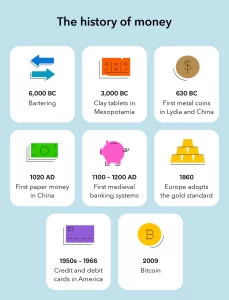
- Barter System (Prehistoric Times): In early human societies, people exchanged goods and services directly without a standardized medium of exchange. This barter system had limitations due to the double coincidence of wants.
- Commodity Money (Ancient Times): Various items with intrinsic value, such as grain, cattle, or shells, were used as money in different cultures. These commodities were widely accepted as a medium of exchange.
- Metal Coins (7th Century BCE): The first standardized metal coins were created by the Kingdom of Lydia (modern-day Turkey). These coins were made from electrum, a naturally occurring alloy of gold and silver.
- Chinese Paper Money (7th Century CE): China introduced the world’s first paper money during the Tang Dynasty. This paper currency helped reduce the need for carrying heavy metal coins.
- Islamic Banking and Bills of Exchange (7th Century CE): Islamic banks developed sophisticated financial instruments, including the use of bills of exchange, which were early forms of checks.
- Medieval European Coins and Banking (12th Century CE): European nations started minting their own coins, and banking systems began to emerge. Promissory notes and bills of exchange were used for trade.
- Bank of England (1694): The Bank of England was established as the first central bank in the world. It issued banknotes that became widely accepted as a form of money.
- American Continental Congress Money (1775-1781): During the American Revolutionary War, the Continental Congress issued paper money known as “Continental Currency,” which experienced hyperinflation and became nearly worthless.
- Gold Standard (19th Century): Many countries adopted the gold standard, where the value of their currency was tied to a specific amount of gold. This system provided stability but limited monetary flexibility as per the history of money.
- Bretton Woods System (1944): After World War II, the Bretton Woods Conference established a new international monetary system, where currencies were pegged to the U.S. dollar, which was convertible to gold.
- End of the Gold Standard (1971): President Richard Nixon announced the suspension of the U.S. dollar’s convertibility to gold, effectively ending the gold standard and transitioning to a system of fiat currencies.
- Digital Currency (Late 20th Century – Present): The rise of computers and the internet led to the development of digital currencies and electronic payment systems, making it easier to conduct transactions online.
- Cryptocurrencies (2000s – Present): Bitcoin, created by an anonymous person or group known as Satoshi Nakamoto, was introduced in 2009. It marked the beginning of cryptocurrencies, which are decentralized and based on blockchain technology.
- Mobile Payments and Digital Wallets (21st Century): The proliferation of smartphones led to the widespread use of mobile payment apps and digital wallets, allowing people to make transactions and store money digitally.
- Central Bank Digital Currencies (CBDCs) (Ongoing): Some central banks are exploring the creation of digital versions of their national currencies to modernize the financial system and enhance payment efficiency as per the recent history of money.
So from bartering systems, trading with cowrie shells, using metals, paper, plastic cards with a code inset – it is something that represents a value. The representative object that we use as an exchange system, has consistently changed as society’s technical ability has changed. And now we are entering a highly technological society. The object that we use to represent a value is now a bit or a byte or a computer representative symbol and highly encrypted for security. It still is not money but is a representative of a certain value.
The properties of money
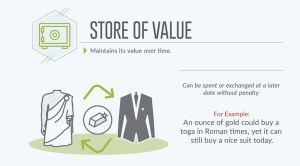
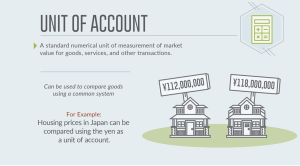
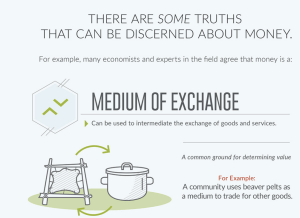
Money must be practical in the following ways:
- Fungible, i.e., one unit is viewed as interchangeable with another.
- Durable, i.e., it must be able to be used over and over again
- Divisible, i.e., one can divide it into smaller units
- Portable, i.e., an individual must be able to carry it and exchange it with another
- Acceptable, i.e., everyone must be able to use it
- Limited in supply, i.e., the value must be kept fairly constant
- Uniform, i.e., if I have one and you have one, it should have the same purchasing power.
With such a large change of methodology to a digital representation of value, the very concept of money is in flux. One can either fear it, or you can use it to the best method for yourself.
Peter says: “Do we have a chance to stop it?
Yes, we do. By insisting on using cash, by refusing to use credit cards, and electronic payment systems as much as possible.”
Michael Hudson says this on a question asked to him:
“Question: How is it possible that a 72 foot cube of gold appears to be ruling the world?
Michael Hudson: It doesn’t rule the world. Why would anyone think it rules the world? It’s how it’s treated. That is the key it’s an institution, it’s not just a commodity, no commodity rules the world. Digital currencies or digital representations are the same. It is how it is treated.”
Encouraging people to go back to cash is a form of technophobia by luddites wanting something that they think is money, in their hands. We travelled a lot and world wide. As we walked out the door, the last check was always – have cards, have passport, have boarding pass (and these days you don’t even need that). That was the final test and with those, we could go anywhere and leave anything at home. Now to do that with a chunck of cash is simply tedious. Heaven forbids one has to do that with a chunk of gold or heavy gold coins. There are the comforts and then there is the so-called enslavement. A chunk of cash in those circumstances is enslavement, because when one lands in another country, you have to line up to exchange between two systems. With debit or credit cards, you can be on your way and draw some local currency for tips and so on, if you even need to do that. This happened as a easy way for travellers to travel and was and still is a system of commerce, not enslavement. A commercial entity creates the medium of exchange and makes it comfortable for their users. (The problem of course is that the commercial entity is in enslavement to their own government in the collective west and many other places still).
So what we call money today, is a representative object (a card or a computer code) but what we need to move away from is paper. Those can be used to sniff cocaine I believe (grins). If we talk about cryptocurrencies there always is the story that only criminals use cryptocurrencies. Oh please, there is with the good ones an open ledger, where you can see the transaction. So, drug smugglers and criminals do not want their work out in the open. Cash is used by criminals mainly.
But what is money? Just to make the point, a promise may be money, eggs may be money, a crypto may be money – money is the system and representation in which you agree to trade. What makes it money, is the function. As Michael says, it is how it is treated. If I give someone a dozen eggs and they give me a basket of fruit, we have just used barter as money. That is what money is, the function, not the representation!
Cryptocurrencies are in the forefront of defining new types of representations of value. If you have a good government (Russia, China and others) your digital representation of value is no more and no less than what your government allows. In China, contrary to what Peter says, nobody uses cash. Where I live, nobody uses checks.
Digital money IS already slavery, Peter says. “The slavery is already occurring, even without digital money.”
So, the problem is human slavery to their governments. Digital transactions are only one of the ways that it can happen. “It has happened in France and Canada – and maybe other countries, that people’s bank accounts have been blocked, because they did not conform to the rules of Government, or because they have not been paying a so-called government issued fine for misbehaving.”
So, we can be enslaved with or without ‘digital money’. If you leave all your ready money in your bank alone is that wise? That seems to me a lack of clear thinking and analysis. Yes, we can be enslaved and deceived with or without ‘digital money’ and with every kind of token or commodity that exchanges value, on our earth. I was in a little store just the other day buying some sliced cheese and ham. As the attendant was slicing and packing, I stepped aside for a moment to grab some milk. The attendant looked and me and then his eyes followed me to the checkout. I felt it and when I got to the checkout, I checked my sliced ham and cheese. OK, he tried to give me just a little less than what the price showed. He put my goods on the scale, and printed the invoice/ticket. Then as my attention was on the milk, he took some out and I well knew about it and at the checkout I made a big old noise. We re-weighed and the store lost my custom. Uhm, enslavement? or plain theft?
Then Peter goes into refusal of all digital payment systems, refusing all-automated tools, cars, kitchen machines. So, I must now perforce change my food processor or my grinder for nutbutters or whatever, back to working by hand? Or buy those things in a supermarket?
No thank-you. That would be exceedingly unintelligent. The QR codes is simply a clever barcode and at the time, there was an equal outcry: “Barcodes will enslave us”, whereas it was going onto the gold standard where the fix was in. I worked with barcode systems at one stage in a project some years ago, and I tell you now, for the little theft that I outlined, a QR code is preferable for many reasons. A QR code? I don’t feel enslaved as I was part and parcel of development of these systems and I understand them.
A respected person that I used to follow talks about CBDC and automation and such types of issues. She also says to use only cash. Her grouping even had a Cash Friday event. So, one has to go and draw cash from the bank teller machine, go and have your coffee with your cash (and clutch your pearls), the coffee store counts it up at night at cashout, and puts it straight back into the bank. Who are you really advantaging? It is a luddite thing. I know someone in the crypto industry that is a very intelligent man and also a committed Ortodox Christian, kindness personified and very clever. He became concerned about this message to use only cash and asked for an introduction to the group, which I did. Unfortunately the grouping was not interested in hearing out this man, who knows his stuff. It is much easier to cry about enslavement without knowledge. When the Canadian truckers strike happened we were chatting about it, I cautioned people as I had news from the Latin America’s that it was a steered and organized theft of resources. Perhaps it did not start like that, so, not many believed me. I let them know that they could not do with the cryptos what they were doing because they are putting their own resources in check. And of course, the Canadian government played checkmate and took their resources brutally and with no compunction. It was not slavery, it was stupidity and they slaved themselves by not doing their own homework. The moral of the story could be as simple as check your sliced cheese and ham.
I vote for intelligent development, leave my kitchen equipment alone because I choose exceedingly carefully and cooking is my hobby and I want my stuff! If there is a road built for driverless vehicles I will call one of those rather than an Uber. The level of enslavement to household tasks is then less, I don’t have to deal with a strange driver, and there is much more time to do important things in life.
We do get to personal security. This entails that you know what you are dealing with, learn the personal safeguards and work with those, and choose your personal exchange systems carefully. The problem with those that we have today, is that it makes it very easy to spend. I was quite young and learned business from the ground up from mainly my dad. I’ll never forget what he once said: You cannot build goodwill with a bank. You can only build goodwill with a bank manager, i.e., personally. One does not need to live with fear of enslavement based on a normal technological development that has been with us since our history can be traced. It is only a method of exchange. There is such a wide difference here between the US where people are unable to trust their government and better countries where these systems are installed as a support for citizens. Even Nabiulina is now into cross border payment with cryptos. This took her a while to understand. It is a message, like SWIFT, but unlike SWIFT because it is honest if it is built to be honest if you are dealing with honest people.
Babies and bathwater come to mind.