

Here Comes China
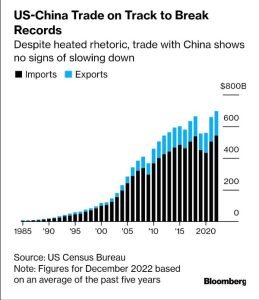
Godfree Robert’s Here Comes China newsletter has a feast of numbers and statistics. On trade, despite all the anti-China rhetoric out of the US, the real situation is as follows:
And, it turns out that China remains Germany’s main trading partner for seventh year, despite political warnings about excessive dependence. Read full article →
In terms of debt, well, it turns out that China is not constructing a ‘debt trap’ for those that they lend to:
WHO HOLDS MOST AFRICAN DEBT?
According to the World Bank’s International Debt Statistics, multilateral financial institutions and commercial creditors hold nearly three-quarters of Africa’s total external debt.
A report published last July by the British NGO Debt Justice showed that 12 percent of the external debt of African countries is owed to Chinese lenders, compared to 35 percent to Western private lenders. The average interest rate of these private loans is 5 percent, compared with 2.7 percent for loans from Chinese public and private lenders.
“Western leaders blame China for debt crises in Africa, but this is a distraction. The truth is their own banks, asset managers and oil traders are far more responsible, but the G7 (the Group of Seven) are letting them off the hook,” said Tim Jones, head of policy at Debt Justice.
In Chad, for example, the Swiss multinational commodity trading and mining company Glencore possesses about one-third of the country’s external debt, while for Zambia, the American multinational investment company BlackRock is a major creditor, reported the French daily newspaper Le Monde on Jan. 30.
While calling for immediately addressing Zambia’s heavy debt burden with China, Yellen deliberately ignored the fact that multilateral financial institutions and commercial creditors hold most of the country’s external debt.
According to figures released by Zambia’s Ministry of Finance and Planning, multilateral financial institutions account for 24 percent of the country’s foreign debt, while predominantly Western commercial lenders account for 46 percent.
“Western lenders for long have not been put on the spotlight for debt relief because they successfully managed to dupe the world that it’s only Chinese lenders that pose a threat to Africa,” Uganda-based Vision Group journalist Mubarak Mugabo said.
And it also turns out that China now has more land-based intercontinental-range missile launchers than the U.S., fueling the debate about how Washington should respond to Beijing’s nuclear buildup.
What I find most interesting, is China’s handling of Covid. Of course we’ve seen large numbers of armchair specialists criticizing what China did, replete with grainy videos showing Chinese people running away, supposedly running from Covid regulations. It is so that the majority of Chinese people supported their own methodology, which included hard lockdowns, masks, vaccination (non mRNA) and what to the average Westerner looked like the harshest methodology ever. Yet, the results are in and China came through this with arguably the lowest per capita death rate anywhere:
“COVID-19 cases peaked at 6.9 million on December 22, 2022 and fell to the lowest point, 9,000, on February 6,” China CDC said. Chief epidemiologist Wu Zunyou said another wave of infections in the coming months is unlikely, as the people’s immunity level is at its highest after recoveries from the previous wave.
There are two more domains (there are many but we look at two here) where China is going against the flow.
The first is in health. Hong Kong would you believe it, sneaked in as the world’s healthiest community. “CROWDED, OVER-PRICED and worryingly close to one of the world’s biggest factory belts, Hong Kong should score miserably low in ratings of health scores. Yet the opposite is true. The community is measurably the world’s healthiest, enjoying humanity’s highest longevity rates, with people of both sexes and at all social strata living longer lives than anyone else on the planet.” Biobanks, Telehealth running on fast internet, focus on the gut microbiome and a truly first-class healthcare system runs like clockwork.
The second is that China is electrifying everything faster than anyone else. There is a loose theoretical construct that in the last century, the advent of in-home refrigerators and freezers did away with food borne diseases as food could be kept cold and not lose too much vitality when stored correctly. This is more or less what is happening in China with electrification. Deborah Seligson says China is providing the world with a roadmap to an electrified future. “Clean and affordable private transportation is the element missing from so many urban plans for more climate-friendly living. With its rail system, public transportation, and abundance of electric two-wheelers, China is offering the developing world a model for transitioning into clean energy.” The forecasts are that Asia will use half the world’s electricity by 2025 and China will use one-third by 2050, when it will be consuming more electricity than the EU, US and India combined.
The trajectory of new growth does not stop. The CPC Central Committee’s “Outline for Establishing a Quality Superpower” goals states:
- Significantly improve quality and benefits of economic development.
- Further improve industrial quality.
- Establish industry clusters with excellent quality and guidance capability.
- Improve the quality of products, projects, and services.
- Raise the pass rate of manufactured products above 94%.
- Develop a sizeable cohort of Chinese brands with excellent quality and competitive advantages.
In addition, China unstintingly rushed in emergency workers and aid to both Syria and Türkiye and the local Syrian Chinese community collected and gifted quake related aid to Syria.
Indeed, Here Comes China!
Yet, the anti-China propaganda is at a fever pitch and analysts say that there will be war of some nature because there is no other way to stop China’s development. There are now currency swaps (at a step in the road to a different world economic system) using the yuan as their base currency in the swap. The dollar is lagging behind in world trade. Recently Brazil announced that they are doing business with China in yuan. But, this is all for another post.
Related Posts
-

Here Comes China
September 8, 2025 -

China News: Here Comes China +
August 3, 2025 -
Here comes China: Selections from Godfree Roberts on his substack
September 4, 2024 -

Here Comes China: Economy, Tech
August 4, 2024 -
China’s Excellent Half-Year: More done in a week than the West in a year
July 16, 2024 -

Here Comes China!
June 1, 2024 -

Here Comes China – At technical breakthrough speed
January 7, 2024 -

Here comes China
November 28, 2023 -

Here Comes China
August 6, 2023 -
Here comes China
July 29, 2023