

Here Comes China!

It has been a while since we’ve done one of these. As always, thank-you to Godfree Roberts who does the heavy lifting around a raft of statistics.
The tone of this newsletter is the tone of the world today. It is not as beautiful and full of wonders that we’ve never seen as usual. Businesslike, would be the word. While that is the real state of affairs, we must take a look at the Giant Pandas because this is part of the world that matters.
Comac is establishing a second manufacturing site in Shanghai with an assembly line for its C919 passenger jet, to raise Comac’s annual production capacity from 50 aircraft now to 150 later in the decade, as Comac’s order backlog already exceeds 1,000 aircraft. Flight controls, avionics, hydraulics, actuators, fuel systems and landing gear are made in China by local joint ventures with Honeywell, Rockwell Collins, Parker Aerospace and Liebherr. Aero Engine Corporation of China is developing an alternative to the LEAP jet engine, to be certified in 2025. COMAC is also eyeing Saudi Arabia as a launch pad for its international ambitions, as the state-owned company steps up efforts to sell overseas and break into a passenger jet market dominated by Western manufacturers. Read article →
China, Arab states adopt Beijing Declaration on Thursday during the 10th ministerial meeting of the China-Arab States Cooperation Forum. Their goods trade volume with China surged to $394 billion in 2023 an increase of 821% YoY. YTD in 2024, it climbed 3.8%, accounting for 6.9% of China’s foreign trade. The UAE, Iraq, Oman, Qatar, Egypt, and Saudi Arabia are China’s top six trade partners in the Arab League in terms of trade value. They took up 84.8 percent of the total China-Arab trade in the first four months, GAC data revealed. China is their largest source of automobile imports, as well as textiles and garments, to the Arab League. Between January and April this year, Chinese exports under these two catalogs increased by 66.3 percent and 3.2 percent year on year, respectively. The Arab League is China’s largest import source of energy products. In the first four months of 2024, China imported 397.29 billion yuan worth of energy products from the Arab League, or 38 percent of China’s total energy product imports in this period. Also, in the first four months of this year, trade between China’s private enterprises and the Arab League totaled 497.14 billion yuan, up 16.3 percent year on year. In the same period, it accounted for 52.5 percent of the total China-Arab trade, an increase of 5.7 percentage points compared with a year ago. Read more →
Taiwan’s new president used his inauguration speech to call for the resumption of academic exchanges with China, after Beijing banned students from enrolling in the island’s universities in 2020. But given the continued deterioration of cross-Strait tensions – China’s leaders launched military drills around Taiwan in response to president Lai Ching-te’s speech – the likelihood of this happening seems low. Taiwan’s universities desperately need more students, given its demographic changes. “Without these students, Taiwanese higher education will inevitably have to face the impact of the low birth rate alone,” one academic says, warning that a “dark period” is ahead, with more universities likely to close. Meanwhile, president Xi continues to emphasise the importance of aligning degree programmes with workplace demand. Earlier this year, the government approved 24 new majors for undergraduate courses that support the country’s economic and geopolitical priorities, including in national security studies, electronic information materials and intelligent marine equipment. And, with more than 11.7 million students expected to graduate from China’s universities this year – an increase of 210,000 compared with 2023 – the government needs to help these citizens enter the workforce. Read more →
China’s Secret Spaceplane Ejects Mysterious Object Into Earth’s Orbit. US Hunts It Down. On May 24, China’s secret spaceplane, Shenlong, ejected a mysterious object into Earth’s orbit 372 miles above Earth, prompting the US Space Force to track it down amid growing concerns about its purpose and implications. Harvard Astrophysics Prof. Jonathan McDowell said, “This object could be a subsatellite deployment, or it could be a piece of hardware ejected before the end of the mission and de-orbit (the spaceplane’s first flight did something similar).” Since its launch in December of last year, the spacecraft, dubbed Shenlong after a spirit dragon from Chinese mythology, has released several things into orbit. The Chinese spacecraft has sent a clear message to the US with this behavior. China says the spaceplane’s purpose is to offer “technical support for the peaceful use of space. After operating in orbit for a period, it will return to the designated landing site in Chinat. During this period, it will carry out reusable technology verification and space science experiments as planned, providing technical support for the peaceful use of space”. Read article →
There is regular media that China is past the point of their peak carbon dioxide (CO2) emissions. These are set to fall in 2024 and could be facing structural decline, due to record growth in the installation of new low-carbon energy sources. And China did install low-carbon energy sources in every facet of life.
CO2 emissions fell 3% in March reinforcing the view that China’s emissions could have peaked in 2023. Read article →
Oh the Propaganda
Negative media coverage of China reinforces and contributes to widespread negative views about China in the UK. This makes a hawkish or more critical policy towards China more likely, in line with the interests of lobbyists and politicians inside and outside government who favour that approach. – Dr Tim Summers
The author found that between January and July 2021, of the 576 reports on China in The Telegraph, 62% were deemed ‘negative’ in tone, with just 2.5% positive, and the remainder classified as neutral in tone. For The Guardian, the research found that in the first quarter of 2023, the tone of articles on China was also predominately negative.
“… it is fair to conclude from this data that a clear majority of the articles about China across different media outlets adopt a negative tone or frame China negatively for British readers. That majority is of the order of magnitude of two-thirds, probably higher rather than lower. Further, very few articles frame China positively”. Dr Tim Summers
Dr Summers argues that this level of negative coverage poses significant implications: “If media coverage is predominately negative, public opinion is bound to sway the same way. This, in turn, makes it more likely that the UK will adopt a more critical policy toward China, and may lead to missed opportunities with the country. British policy makers should consider the entire picture when considering Britain’s policies towards China, not only media coverage and public opinion.”
Of 133 lengthy analyses of China in the Financial Times “Big Read” column over a four-year period, only two articles presented China positively, researchers in Hong Kong and London discovered. Separate studies of the Guardian and the BBC showed that 90% of China stories were negatively framed. In the researched period to July 2021, there were 576 reports on China in the UK Telegraph, of which only 2.5% took a positive stance. . . . . ALMOST NO POSITIVE COVERAGE In general, news media almost never published a positive report about the country, said the analysis of reports in the Telegraph, the Guardian, the BBC, the Financial Times and the Economist. The result was that the public received a misleading image of the country, said the study by Dr Tim Summers, who led the research project involving Hong Kong and UK academic institutions. “The British media texts researched for this paper contain almost no positive coverage of China,” Dr Summers’ paper says. “This will not come as a surprise to many readers.” The bias of western mainstream media’s coverage of China is widely known. But Dr Summers’ team at Hong Kong’s Chinese University and London’s Lau China Institute (part of King’s College) enables a data-based look at the problem. . . . .
OVER-POLITICIZATION LENS
Bias was not the only problem. The study revealed that western journalists tended to politicize all their coverage of China—even when the topic being covered was not politics. “A political and normative lens is often brought to coverage of social, economic and cultural issues”, researchers said. Reporters put everything through their hostile western lens to “reinforce a monochrome, reductionist and negative picture of the country and its politics,” Dr Summers said. . . . .
THE ECONOMIST SCORES ZERO
The Economist covers China with a weekly column called “Chaguan” written by David Rennie, which constantly recycles the same words over and over to paint whatever China does as “bullying” and “threatening”, the research showed. There was not the slightest attempt at fairness. Analysis showed his columns were mostly clearly negative, with a small number being mixed. The data indicated that not a single one was classified as clearly positive. . . . .
HONG KONG AND XINJIANG
The research showed that the names of two locations, Hong Kong and Xinjiang, were thrown into articles almost randomly as keywords for repression. “They are frequently mentioned in passing in reports on topics that are not related to either place, in a way that frames China negatively: a template to plug into any story that needs evidence for Chinese ‘repression’, even if that story does not relate either to Hong Kong or Xinjiang,” the study said. . . . .
HARMFUL TO CHINESE PEOPLE
Interestingly, some reporters seemed to know this position was harmful to China and its people. The report quotes John Sudworth, the BBC correspondent notorious for his hostile attitude to China, and associated with the now-debunked “Uyghur genocide” narrative. Sudworth admitted in an interview that he focused only on the negative, and knew that doing that was problematic. He said: “Obviously there is a danger that that becomes shorthand not just for the Chinese Government and the Chinese system but for the sort of place China is and for its people in general, and I can really see the danger in this.” It’s fascinating that he knew how harmful this was, but it never stopped him and his BBC colleagues giving the world a totally misleading image of China—which the BBC continues to do on a daily basis. China correspondents defend themselves by saying that they are not down on the Chinese people, but just hate the Chinese government. Analysis of their writings indicated that wasn’t true, the research showed. . . . .
PROF BELL: ‘EVIL GOVERNMENT’ The negative narrative is so solid in western media that other views cannot be put forward, said Professor Daniel Bell, quoted in the study. “There is almost universal consensus in the West that China is led by an evil government that is bad to its own people and dangerous to people in other countries. It’s extremely difficult to publish views that argue otherwise.” How to get the truth out? You can’t. The western media is so united on this narrative, that they have turned public opinion in western countries against China. Professor Bell added: “Public opinion makes it almost impossible to publish comments that offer a balanced picture of Chinese politics in leading Western media outlets.” Dr Summers ends his report with a recommendation. “To achieve a more accurate and comprehensive understanding of China, alternative sources of information should be actively explored, and those with different opinions encouraged to contribute to the policy debate.” Read full report →.
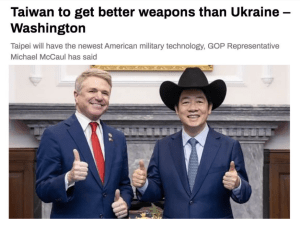
No, this is not a joke but hysterical laugher follows:
Right, we will end this here with a final long read by previous Ambassador Chas Freeman. The newsletter is packed with The Most Industrial Robots, Major Cities, Export Growth, Diplomacy, Governance and much more.
Mr Freeman’s article is titled The Fruits of Discord: Seven Years of Sino-American Antagonism and the current state of western relations with China shines clearly in Godfree’s newsletter. It is just, I don’t think he planned it as such, but the sweet and lovely and human snippets are few. Our world is in deep travail.
The Fruits of Discord: Seven Years of Sino-American Antagonism
Ambassador Chas W. Freeman, Jr.
Seven years ago, then President Trump launched a U.S. trade war on China. In accordance with contemporary American praxis, this was a “forever war” – a constantly widening and escalating campaign with an ever-heavier military component, open-ended objectives, no criteria for judging success or failure, and no strategy for its termination. Seven years into open economic and technological war on China, it is surely time to take stock of results to date. So, I want to address the many ways in which Sino-American antagonism is changing China, Asia, the United States, and the world politico-economic order.
The Biden administration has proclaimed three high-minded goals for U.S. policy toward China:
- Invest: to invest in the foundations of our strength at home – our competitiveness, our innovation, our resilience, our democracy,
- Align: to align our efforts with our network of allies and partners, acting with common purpose and in common cause, and
- Compete: to compete responsibly with the PRC to defend our interests and build our vision for the future.”
This agenda effectively plays to the crowd. It deems China to be an adversary and conspicuously omits any reference to cooperation with it. Its three points boil down to:
- getting our national act back together,
- convincing other countries to help us retard or reverse the rise of China and
- blocking China from gaining international influence at the expense of our continued global primacy.
How are we doing at this?
First, are we becoming more competitive relative to China or less?
The World Economic Forum – the Swiss-based voice of financialized capitalism – continues to rank the United States as the world’s most competitive economy. Perhaps we deserve this ranking in terms of our capital markets and financial services, though, as Woody Allen once complained: “not only is there no God, just try to find a plumber on Sunday.” But the most relevant and comprehensive measure of “competitiveness” is the annual ranking by the World Competitiveness Center at the International Institute of Management Development (IMD). The IMD measures competitiveness by factoring 340 distinct criteria over time. In 2002, the IMD ranked the United States number one in competitiveness. By 2020, it had downgraded us to number ten. China’s current policies may, like ours, now be causing it to slip a bit, but over the same period it rose from 28th to 17th. The trends seem clear, and they do not favor us.
Of course, indices, even the best of them, are artificial. They fall into Mark Twain’s category of lies, damn lies, and statistics. But the actual performance of economies is not artificial. And, objectively – looking at national output – it is hard to argue that the United States is in fact becoming more competitive with China. China now accounts for a remarkable 36 percent of world industrial production. We produce only about one-third of that. US manufacturing jobs have declined by one-third since they peaked in 1979 even as the US workforce has grown by 60 percent.
Gross comparisons aside, China’s real economy now outpaces the United States in many sectors. Its grain output of seven hundred million tons is 1.2 times ours. Its power generation of 9.2 trillion kilowatts is 2.3 times larger. China produces nineteen times more steel and twenty times more cement than we do. Its auto production and sales figures are now triple ours. China’s shipbuilding industry annually produces seventy times as much tonnage as ours does, something reflected in a Chinese merchant fleet now second only to that of Greece and the world’s largest navy.
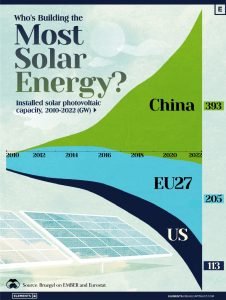
China has displaced the United States as the top economic partner of most of the world’s countries and is now by far the world’s largest trading country. The efficiency of China’s transportation infrastructure, including high-speed trains, superhighways, urban subway systems, modern ports, and airports, is the envy of the world. China’s installed solar power already exceeds that of all other countries combined. Its wind power installations now produce more power than those of the next seven countries put together. China will meet its renewable energy goals for 2030 five years early – in 2025 – next year. The clean energy sector now contributes 40 percent of Chinese annual growth in GDP.
In short, in addition to its huge lead in industrial production, China is indisputably becoming more rather than less economically competitive with the US and other developed countries. This is reflected in its growing influence in Pacific Asia, where the U.S. long dominated foreign investment but dropped out of the Trans-Pacific Partnership (TPP) in 2017, leaving expanded access to the world’s fastest growing markets to others. Last year, Chinese investment in the region was up by 37 percent and China logged a 14 percent increase in construction contracts.
Are we still more innovative?
Second, to return to our stated goals, are we still more innovative than China?
In 2020 alone, China graduated 3.57 million scientists, technologists, engineers, and mathematicians (STEM workers). That same year, we graduated 820,000, about one- third of them foreigners, many of them Chinese. For the past thirty years, China has dominated the international Olympiads in biology, chemistry, physics, mathematics, and informatics. The United States has more “unicorns” – startup companies with valuations of more than $1 billion – than China but, despite its rejection of financialized capitalism, China now has more billionaire entrepreneurs than we do.
Last year, the Australian Strategic Technology Institute’s (ASTI’s) “critical technology tracker” reported that China has seized the lead in thirty-seven of the forty-four technologies it tracks. Many of the technologies in which China is now widely considered to be the global leader are those that will define the world of the future. They include wireless communications like 5 and 6G, electric vehicles, battery storage, fintech, quantum communications, hypersonics, robotics, green hydrogen, nuclear fusion, and renewable energy. Despite our efforts to deny China access to advanced semiconductors, it remains neck and neck with the US in the development of artificial intelligence and super computers.
China has just announced a ten percent increase in funding for science and technology projects. Meanwhile, the latest US federal budget slashes spending on science and technology, with an 8.3 percent contraction in funding for the National Science Foundation (NSF), a 12 percent cut in appropriations for the National Institute of Standards and Technology (NIST), and a 5.9 percent reduction in National Aeronautics and Space Administration (NASA) science programs. The United States is substituting strong rhetoric about competing with China for strong and effective actions. This is not a winning strategy.
The prerequisites for continued American excellence in innovation include an educational system that emphasizes STEM subjects and an immigration system and domestic political atmosphere that attract the absolute best foreign talent. Historically, about 30 percent of US Nobel Prize winners have been foreign born. But even as foreign universities – notably the top schools in China – gain ground, the continuing excellence of America’s top universities masks the increasing inadequacy of American education at the elementary and high school levels. The latest ranking by the Program for International Student Assessment (PISA) puts China and Singapore at the top, with the United States in 22nd place. Some German companies report that they need to give US high school graduates a half-year of remedial instruction to bring them up to the level of their German counterparts. Taiwanese and Korean efforts to establish semiconductor fabs in the United States have been frustrated by shortages of sufficiently skilled labor.
As the disproportionate number of Nobel Prize winners based in the US suggests, our country has long been a magnet for the world’s best scientists. But our immigration system is now broken and the subject of rancorous political controversy. This, plus the special hostility of the US national security state to Chinese STEM students and faculty, has had a measurably deleterious effect on our ability to attract the most capable minds from abroad. Twenty years ago, American universities enrolled 60 percent of the foreigners studying in English-speaking countries. Now we get only about 40 percent. Meanwhile, a growing number of prominent Chinese Americans – some of our most innovative scientists and mathematicians – are responding to perceived harassment by US national security agencies by relocating to China. We are in danger of recreating the “Red Scare” in the 1950s that led Qian Xuesen (钱学森), an acclaimed aeronautical and cybernetic engineer at Caltech, to leave the United States for China, where he became the father of the Chinese intercontinental ballistic missile and space programs. Such losses in our capacity to harness China’s best minds to our future ensure that a good many of them will improve China’s scientific and technological progress rather than ours.
US resilience
Third, what is the evidence of US “resilience” and “the persistent strength of US democracy?”
Both China and the United States seem to be suffering from an economic version of “long COVID.” The US has resorted to massive deficit spending to recover faster than China from this. But, despite Washington’s embrace of protectionism, subsidies, and industrial policies, our recovery has not produced the intended “reshoring” of overseas production by American corporations. It has instead lengthened and complicated supply chains by adding intermediary stops in places like Vietnam and Mexico, both of which have seen explosive growth in their exports to the US market. There has been a minor increase in industrial jobs but, despite a tsunami of illegal immigration by people eager to work, many jobs in the US have remained unfilled. Rents have risen, as have interest rates on credit card debt. Price increases have outpaced wages. The ranks of the disgruntled have grown.
Meanwhile, US pressure on China has encouraged it to become more nationalistic and repressive. It is therefore a less attractive place than it was. China has diminished “soft power.” But its politics are not in crisis. Ours are. We can’t seem to devise and implement strategies. China can.
In America, polarization has replaced consensus. Incivility precludes productive debate of issues of public policy importance. Priorities therefore do not get set. Previously unifying national myths have become divisive. The basic values that underpin a decent and harmonious society are in dispute. A cult of personality has taken hold in one of the two major American political parties, while the other party is disorganized, despondent, and without a credible leadership succession plan. American politics have been captured by competing extremists and plutocrats.
Boastfulness about the resilience of the American spirit does not make up for the lack of any tangible evidence of national rejuvenation. The public has very little confidence in government institutions. No one expects the upcoming US presidential election, which features a re-run between old men of dubious competence, to restore national unity. It is unclear whether this election will be followed by the usual peaceful transition of power. American democracy is now best described as both decadent and dispirited. Happy talk about “the persistent strength of US democracy” has no credibility either at home or abroad.
To return to the list of US objectives. Fourth, are Americans “aligning” with allies and partners in common purposes and causes?
The Ukraine War may have united the West against Russia, but it has alienated the US, G7, and NATO from the rest of the world. Washington extolls the current transatlantic consensus on the need to oppose Russia, but it remains to be seen how long this will last after the war in Ukraine ends.
In any event, intensive US efforts to align NATO members against China have registered only limited success. In many respects, the West seems bent on isolating itself from the rising and resurgent powers in Asia, Africa, and Latin America. They no longer accept the legitimacy of Western leadership of world affairs, still less that of the United States.
The norms established in the European Enlightenment and imposed on the world by five centuries of North Atlantic hegemony inspired the American-designed post-World War II order. Various unilateral actions by the United States – all of them condemned by China and other rising powers and many barely tolerated by US allies – have now blatantly violated these norms. Such US actions have included (but were sadly not limited to):
- The use of force by the U.S. and NATO to wrest Kosovo from Serbia in 1999 in violation of the UN Charter.
- The resort to kidnapping, torture, and indefinite detention without charge at Guantánamo as part of the so-called US “global war on terror” from 2001 on.
- The unilaterally contrived US invasion and occupation of Iraq in 2003.
- The NATO and US regime-change operation in Libya in 2011 and the subsequent abandonment of that country to continuing anarchy and chaos.
- Devastatingly destructive US regime-change operations in Syria from 2011 on.
- The overt US role in the 2014 Euro-Maidan coup that overthrew the elected government in Ukraine and replaced it with one subservient to American strategic interests.
- Repeated US unilateral bombing of government troops and facilities in Syria beginning in 2016, and the overt US military occupation of Syrian territory and plundering of Syrian oil reserves since 2017.
- Unilateral American withdrawals from arms control treaties and carefully negotiated agreements with other countries (for example, the nuclear accord with Iran), despite these having been endorsed by the UN Security Council and therefore become part of international law.
- The progressive abandonment of the terms of Sino-American normalization by once again taking sides in the Chinese civil war, maintaining relations with Taipei that are now indistinguishable from official ties, restoring our military presence in Taiwan, and renewing an overt defense commitment to the island.
- Resistance to the repeated demands of the Iraqi government that US forces withdraw and the conduct of repeated violations of Iraqi sovereignty, for example, assassinations of anti-American politicians on Iraqi soil.
- The contortions of Admiral Kirby and other administration spokespersons notwithstanding, it is impossible to reconcile US support for Israel’s genocide in Gaza, attacks on other countries’ diplomatic establishments, pogroms against Palestinians in the occupied West Bank, or promiscuous assassination of its foreign political opponents with either international law or human decency.
- The two-decade-long US failure in Afghanistan, the inept US diplomacy that provoked the Russian invasion of Ukraine in 2022, and the current US enablement of Israel’s universally condemned genocidal war on Palestinians have consolidated an extremely negative view of the United States outside the West. This view sees the United States as amoral, cynically hegemonic, and indifferent to the interests and strongly held views of other countries, murderously devoted to the use of force rather than the peaceful resolution of disputes, diplomatically incompetent, and self-righteously propagandistic.
Despite the widespread devaluation of the American image internationally, the United States claims to have been successful in rallying China’s neighbors to oppose it. Washington’s celebration of its ability to persuade these neighbors to accept continuing American military protection even as it reduces its economic and political engagement in their region is unwittingly revealing. It imputes to China’s neighbors a level of apprehension about China they do not share. Despite their concerns about China’s return to wealth and power, with the notable exception of Japan, the countries of Pacific Asia have consistently made it clear they do not welcome Sino-American confrontation and do not want to have to align themselves with either Washington or Beijing. They all – even Japan – want to leverage China’s rising prosperity to advance their own. But the US not only ignores their desire to work out a safe and satisfactory modus vivendi with China as it returns to its millennial centrality in its region, but we actively oppose their efforts to do so.
No one is fooled by Washington’s assertion that it is not trying to force Pacific Asian countries to choose it over Beijing. This claim is belied by US policy statements and actions. The operative driver of US policy is clearly not the defense of Pacific Asia against a putative military threat from China. It is an obsessive desire to retain military primacy in the region. Ironically, the resulting confrontation with China has imposed new defense requirements on Beijing and provoked a massive military build-up by it. The result is a US arms race with China that it, not the United States, gives every sign of winning.
Far from promoting willingness on the part of other countries to “align” with Washington against its designated adversaries, including Beijing, recent US military interventions in Europe and West Asia have had the effect of discrediting the wisdom of contemporary American statecraft and impairing US global and regional leadership. They have also destroyed faith in the United Nations, where the United States is seen as having highhandedly abused our veto power to override the strongly held views of all but a few other member states, thereby preventing effective international responses to global and regional crises and challenges.
Mounting dissatisfaction with the hegemonic US role in the global system is inspiring the development of institutions with the potential to displace both the US and the UN from the center of a unified international system. As the West – composed of countries in the G7 and NATO stockades – exempts itself from the rules it previously made and once enforced, the rest of the world is turning to new regulatory structures in which China, not the United States, is typically the largest and leading member.
Outside the West, the “rules-based order” espoused by the Biden administration is seen as a thinly disguised effort to replace the regulation of international affairs by the United Nations Charter and international law with US primacy and the principle that American “might makes right.” In this perception, Washington – sometimes on its own, sometimes in consultation with its followers in the G-7 club of former imperialist powers – now asserts the right to make the rules, decide to whom they should and should not apply, and to enforce them or not on the basis solely of the expediency of its own interests. This transparently revisionist approach to the regulation of international affairs creates highly objectionable double standards. These are resented and rejected by all but a few members of the international community.
On many issues, the US is now completely isolated. Recent votes in the UN illustrate this. These include a 187 – 2 vote against the US embargo on Cuba and a vote of 153 – 10 against US opposition to a ceasefire in Israel’s war on the Palestinians. Objections to perceived US highhandedness account for Washington’s inability to marshal support for NATO’s proxy war with Russia.
Given its inability to persuade other countries that its views merit their support, Washington has embraced coercive diplomacy, notably unilateral sanctions, as its preferred approach to statecraft. Sanctions are a form of economic warfare that violate international law unless approved by the UN Security Council, but they are now the principal measure short of war in the US foreign policy toolbox. The US has been able to impose unilateral sanctions because the US national currency is also the principal medium of international transaction settlement.
Dollar-based sanctions now cover one-third of the world’s peoples. Those subjected to such sanctions resent them as a humiliating American negation of their sovereign right to decide their own foreign and domestic policies. Fear of US unilateral actions has become the principal driver of a burgeoning global movement to replace American dollar hegemony with a system in which the sovereignty of foreign states and peoples is respected.
Washington has designated Beijing as its “peer competitor” and primary global adversary. China has not surprisingly reacted by reaching out to other countries to reduce its and their vulnerability to US coercion by building alternative communities, organizations, and regulatory structures that are multilateral but regional rather than global. These new structures – ever more of them under the auspices of the so-called BRICS grouping – cover trade, investment, and finance as well as quasi-judicial, political, and military matters. Their implications for future American global primacy are dire.
The BRICS is an intergovernmental organization that is often characterized as the counter to the G7 bloc of Western industrial democracies. The members of this rapidly expanding grouping – which currently consists of Brazil, China, Egypt, Ethiopia, India, Iran, Russia, Saudi Arabia, South Africa, and the United Arab Emirates – account for about 45 percent of the world’s population and a growing share of its GDP (now about one-third). By contrast, the G7 has about nine percent of global population and generates a declining percentage of world GDP (now less than 30 percent). But the former imperialist powers of the G7 still hold sixty percent of the world’s wealth. BRICS members have divergent national interests, but they share opposition to what they regard as bullying and disdain for their views by the United States and other NATO and G7 members.
As BRICS membership grows, the grouping could gradually achieve primacy in the global political economy. In the long run, moreover, if great-power rivalries continue to prevent the United Nations and related post-World War II institutions from addressing international and transnational issues of concern to the global majority, the BRICS has the potential to grow into an alternative multilateral rule- and decision-making forum that could gradually sideline major parts of the UN system. This would prevent Washington from using its veto to block global initiatives and enforcement actions and enable the BRICS to offset, counter, and frustrate both US unilateralism and Western efforts to remain in command of the international system.
For now, the primary economic security concern of China, Russia, Iran, and other BRICS members is countering US national security-based protectionism. Washington has sought to replace the liberal order enshrined in the World Trade Organization’s (WTO’s) rules and regulations with bilateralism that relegates dispute settlement to zero-sum contests of economic strength.
Global opposition to national security-based protectionism has found expression in new multilateral bodies seeking to regulate international trade and investment as well as in a growing network of regional free trade agreements (FTAs). Many of these link other countries to China under the “Belt and Road Initiative.” There are already almost thirty such agreements with China now in place. Another ten or so are under active negotiation. The China-ASEAN FTA is in the process of being liberalized and upgraded. It already facilitates a level of trade approaching the world’s largest bilateral economic interactions: the US-Canada, US-Mexico, and US-EU.
The United States was historically the global leader in rule making and trade liberalization through the WTO. It is now mostly disengaged from international trade institutions and thus from policy formulation by them. American protectionism and foreign emulation of it contributed to a fall of about 5 percent in global trade in 2023.
Most countries remain committed to the WTO and its rules. But since 2019, Washington has sought to exempt the US from international trade law by preventing the WTO’s dispute settlement mechanisms from functioning. Other countries, including China, which have prospered under the rules set in the WTO, have responded to this sabotage by establishing alternative and ad hoc arrangements to perpetuate them. Multilateral provisions for dispute resolution are a feature of most of the sub-global groupings coming into being. One such, the Regional Comprehensive Economic Partnership (RCEP), in which China is the largest economy, already accounts for about one-third of global GDP. Bilateral FTAs now routinely include provisions bypassing the WTO by creating mechanisms for the adjudication or arbitration of disputes.
Earlier, after the US repeatedly rebuffed the recapitalization of American-dominated global financial institutions, China responded by working with other countries to launch new institutions to supplement the World Bank (IBRD) and the International Monetary Fund (IMF). The Asian Infrastructure Investment Bank (AIIB) complements the World Bank and the Asian Development Bank (ADB). The New Development Bank does the same for both the World Bank and – potentially – the IMF. The United States boycotted both new banks, predicting that they would undermine prudent lending standards and adversely affect established financial policies and practices. Washington urged US allies to keep their distance from the AIIB. With the very significant exception of Japan, they instead joined it.
The US has not been moved by the fact that the new banks have in fact followed the Bretton Woods rules, often cofinancing projects with the World Bank and ADB. The AIIB now has 109 members. By staying out of the new international financial institutions, Washington has not isolated China. It has instead denied itself a role in shaping the evolution of the newly emerging global politico-economic order.
China and the other BRICS countries – as well as members of the Shanghai Cooperation Organization (SCO) and the China-ASEAN Free Trade Area (CAFTA) – are now actively instituting currency swap arrangements that facilitate trade and transaction settlement digitally, in national currencies, or in the renminbi rather than the dollar or euro. NATO-sponsored sanctions on Russia and other countries have caused them to set up trade settlement mechanisms that do not require going through SWIFT (the Brussels-based Society for Worldwide Interbank Financial Telecommunications), which the United States controls.
The dollar has long had a monopoly in global commodity markets. China is now by a considerable margin the world’s largest consumer and importer of raw materials and other commodities. This makes it vulnerable to US dollar-based financial sanctions. So, China has begun to encourage the use of new renminbi-denominated commodity and futures markets in Shanghai.
All this reflects a widening international – not just Chinese – view that it is time to break the global hegemony of the dollar and replace it with a multi-nodal financial system involving multiple currencies and trade settlement mechanisms. It is not clear that Americans have an effective response to this effort to dethrone our longstanding ability to use our currency to force our policies on other countries.
This brings me to the last of the three elements of the administration’s declared strategy: blocking China from a role in global governance comparable to our own.
Vision for the future
So, fifth: are we presenting a “vision for the future” that bolsters our claim to global leadership over that of China and other countries?
Frankly, it is not clear what “vision for the future” the United States means to build other than the perpetuation of our global military primacy. The Chinese challenges to our global standing are primarily economic and diplomatic, not military. But Washington’s answers to these challenges are almost entirely military rather than economic or diplomatic.
China will attack the United States only if we attack it. A US war with China would therefore be a war of choice, not necessity. It is entirely up to us to decide whether we should risk such an attack by intervening in the unfinished Chinese civil war to ensure Taiwan’s continued separation from the rest of China, or by escalating our military support of non-Chinese claimants to the disputed rocks and reefs in the South and East China Seas. Quite aside from the risk of a nuclear exchange that would devastate both the Chinese and American homelands, the only certain result of a war between China and the United States would be the destruction of Taiwan’s industrial capacity – including its semiconductor production – and its democracy. A war over Taiwan is very much not in Taiwan’s, China’s, ours, or the world’s interest.
Simulations of a Sino-American war by the Pentagon show that it would likely cost China and the United States the greater part of both our navies and air forces. It could easily escalate to a nuclear exchange between the Chinese and American homelands. Those in Washington who advocate policies that could produce such a war have plainly not thought things through. I hope they will. But I don’t propose to do that for them today.
I have briefly reviewed what seems to be happening in our economic and technology competitions with China. They don’t seem to be going our way. Unfortunately, at the same time, American actions have called the sagacity of our statecraft and the soundness of our strategic reasoning into question to the detriment of our influence abroad.
Diplomacy is how a country advances its strategic objectives by measures short of war, influences the policies and practices of foreign countries, advances its economic interests in markets beyond its own, safeguards its citizens and their businesses abroad, and shapes the international system to its benefit. This requires more than the denunciation of foreign governments and their leaders, punitive economic measures, unilateral policy pronouncements, occasional visits by officials from Washington, and threats to use force. Diplomacy relies on building relationships with the governments and peoples of other lands. This takes consistent effort over time and depends on empathy informed by situational awareness and influence born of a long-term diplomatic and consular presences on the ground.
Successful diplomacy depends on intelligent, affordable statecraft. In this context we have become our own worst enemies. Political polarization and dysfunction paralyze the Senate confirmation process. Many US ambassadorial positions in important foreign capitals remain vacant, sometimes for years. China keeps its diplomatic missions staffed on a timely basis. Over the last decade, the Department of State and the US Foreign Service have suffered huge budget cuts. By contrast, over the same period, China’s spending on diplomacy has roughly doubled. China now has more diplomatic representation in more places abroad than any other country, including ours. The current Chinese budget includes a further increase in spending on diplomacy of 6.4 percent.
Meanwhile, we repeatedly resort to force rather than diplomatic dialogue to deal with foreign lands. That is proving both ruinously expensive and ineffectual. We need to rediscover the merits of peaceful engagement and coexistence with other nations and peoples, including the Chinese.
Let me conclude.
The Biden administration is right about one thing, even if it is doing far too little to achieve it. Americans do need to get our national act back together. Doing so is the sine qua non – the unavoidable requirement – for competing effectively with China and other rising and resurgent powers.
China is now by a considerable margin the world’s largest industrial power and its biggest trading economy. We cannot isolate it as we did the Soviet Union. Tariffs will isolate us, not China. Installing crude facsimiles of Chinese industrial policies at home will not enable us to surpass China. More fundamental reforms in our economic structure will be required. Cooperation with China and welcoming Chinese investment in the United States could boost our prosperity. Politically inspired economic protectionism will not do this.
China now has the world’s largest population of scientists and engineers and is emerging as a major source of scientific and technological innovation. The United States does not have the power to hold it down or push it back. What we are doing is depriving China of reasons to buy our goods and services, encouraging it to engage in import substitution, and driving it to collaborate with everyone other than us. The Chinese STEM workforce is young and ambitious. Necessity is the mother of invention. We are not holding China back so much as incentivizing it to develop its own technologies without regard to us. We are thereby depriving ourselves of advances in technology that everyone but Americans will have access to. This weakens us even as it strengthens China and its relations with other countries.
China can and will take care of itself. It’s taking risks and making progress. We should do the same. Criticizing China and gloating at its mishaps while ignoring our own failings and doing next to nothing about them is a politically performative approach to competition with no prospect of succeeding. China-bashing will not restore our constitutional order, resurrect the rule of law, revive competition in an American economy now dominated by oligopolies, fix the financial capitalism that leads companies to export jobs rather than retrain workers to be more productive, or reindustrialize America. It will not revamp our educational system, cure our addiction to opioids, or repair our broken politics. These are things that only we Americans can do.
China recognizes that it needs a peaceful international environment, openness to foreigners and their ideas, and a commitment to continuous self-improvement to realize its potential. So do we. We have a great deal more going for us than China, but we should be exploring ways to leverage China’s advancing prosperity to our own, not preparing for a war with it that neither of us can hope to “win.”
It’s indeed time to demonstrate our resilience and the strength of our democracy. Lofty talk and belligerent posturing appeal to domestic populists. But neither is a substitute for strategic vision, political courage, and effective action. Where are they? Chas Freeman.
Godfree’s newsletter to my mind is the cheapest real source on China that is out there. Try it, you can get a few for free I believe.
I don’t have to plug his book, but I want to:
300 pages, 27 charts and graphs. $9.99 on Amazon and in bookstores worldwide.
It’s the only book that explains all three elements of China’s success:
- Talent at the Top: Only the brightest, most idealistic people are are admitted to politics–a policy unchanged in 2200 years.
- Data in the Middle: policies are implemented, tracked, and optimized based on terabytes of data. The PRC is the world’s largest consumer of public surveys.
- Democracy at the Bottom: ordinary people, all unpaid amateurs, assemble twice a year to check the stats and sign off on new legislation. Policies need a minimum of 66% support to become law. That’s why 95% of Chinese say the country is on the right track.
Related Posts
-

Here Comes China
September 8, 2025 -

China News: Here Comes China +
August 3, 2025 -
Here comes China: Selections from Godfree Roberts on his substack
September 4, 2024 -

Here Comes China: Economy, Tech
August 4, 2024 -
China’s Excellent Half-Year: More done in a week than the West in a year
July 16, 2024 -

Here Comes China – At technical breakthrough speed
January 7, 2024 -

Here comes China
November 28, 2023 -

Here Comes China
August 6, 2023 -
Here comes China
July 29, 2023 -
Here Comes China
June 29, 2023