

‘I hope we get through this winter safely’: Fear grips Gaza after infant freezes to death
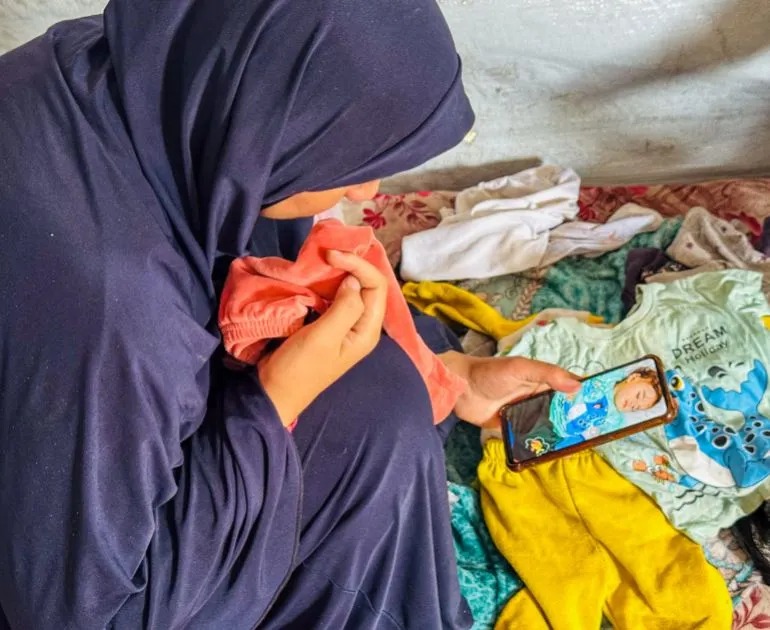
Susan Arqiq sits beside her baby’s belongings, still struggling to comprehend how the cold took the life of her nine-month-old son, Kina. (Photo: Abdelhakim Abu Riash/Al Jazeera)
“I switched on my phone’s flashlight and found that his face was completely blue, his hands were stiff, and his body was like ice. My heart nearly stopped from fear.”
As the survivors of the Israeli genocide in the Gaza Strip endure a fourth successive winter in their ramshackle tents, the drop in temperature, accompanied by rain, is taking a severe toll on their health. As in the three previous years, this winter has turned deadly for the unprotected children.
Nine-month-old Kinan Arqiq froze to death in his family’s tent on Thursday, adding to the growing list of nearly two dozen children who have frozen to death in the cold in Gaza since the start of the Western-backed Israeli genocide in October 2023.
Kinan’s mother, Susan Arqiq, 26, had put him to sleep beside her on Wednesday night, as she had done countless times before, at their camp in Khan Yunis. When she woke in the early hours of the morning to change his diaper, she found Kinan’s face blue, his hands stiff and his body cold.
“My son was pressed against the tent’s tarpaulin. The bedding was still damp,” she told Al Jazeera.
“I switched on my phone’s flashlight and found that his face was completely blue, his hands were stiff, and his body was like ice. My heart nearly stopped from fear. I immediately woke my husband. I was screaming, ‘Kinan, Kinan!’ I could not understand what was wrong with him.”
Her husband, Ahmad Arqiq, picked up the baby and rushed him to hospital, accompanied by men from the camp. Women from neighbouring tents, woken by the cries, gathered around Susan. They tried to reassure her that her baby would be all right, but the news from the hospital confirmed her fears.
Kinan died on Thursday, November 12, following a severe drop in his body temperature. He had no health problems before the fateful Wednesday night.
“At the emergency department, they told me, ‘May God compensate you. The child has died, and the cause is the severe drop in temperature,’” Ahmad says. “I was shocked… My heart is broken, and even now I cannot believe it.”
‘City of tents’ by Israeli design
“Gaza will eventually turn into a city of tents,” an unnamed Israeli defence official saidat the very start of the genocide. “There will be no buildings.”
Such genocidal rhetoric has been a consistent feature of the Israeli leadership since the start of the assault on Palestinians. “Gaza will be entirely destroyed,” Smotrich boasted last year.
Over the past three years of their ongoing barbarism against Palestinians, the Israelis have reduced nearly all of Gaza to rubble, forcing over 1.4 million people into tents and achieving their objective.
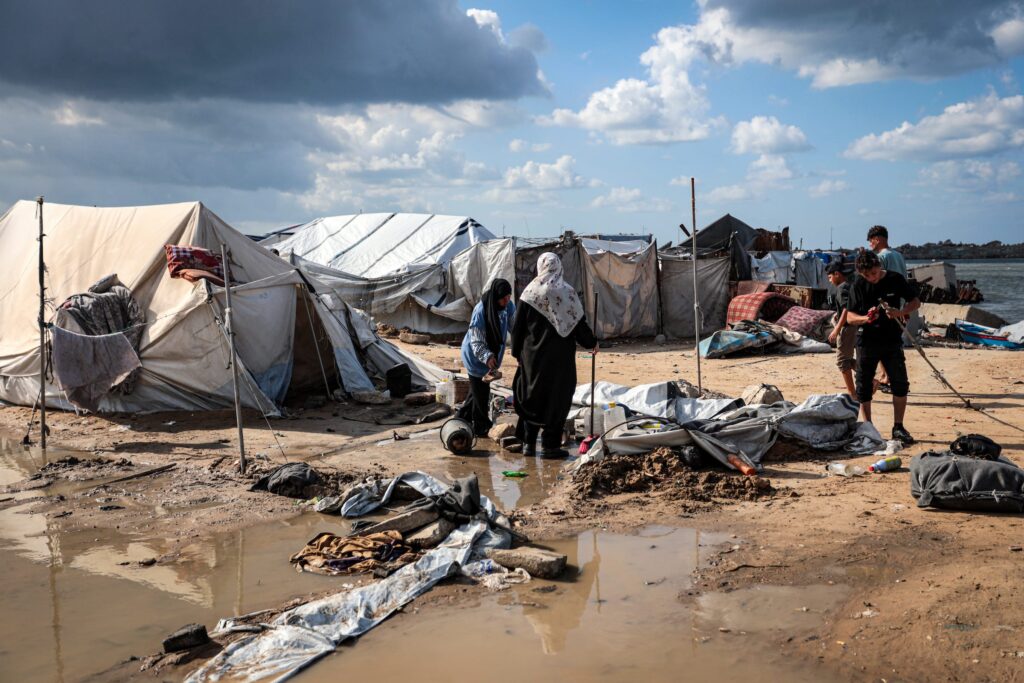
Due to the Israeli siege on the enclave, Palestinians have been deprived of new tents and prevented from rebuilding their destroyed homes. According to an August estimate by the Gaza Health Ministry, more than 867,000 Palestinians are “living in rudimentary and dilapidated tents that are no longer fit for shelter.”
The fragility of the worn-out tents was exposed by the first winter rains on November 6, when more than 70,000 of them were washed away, depriving over 100,000 Palestinians of adequate shelter.
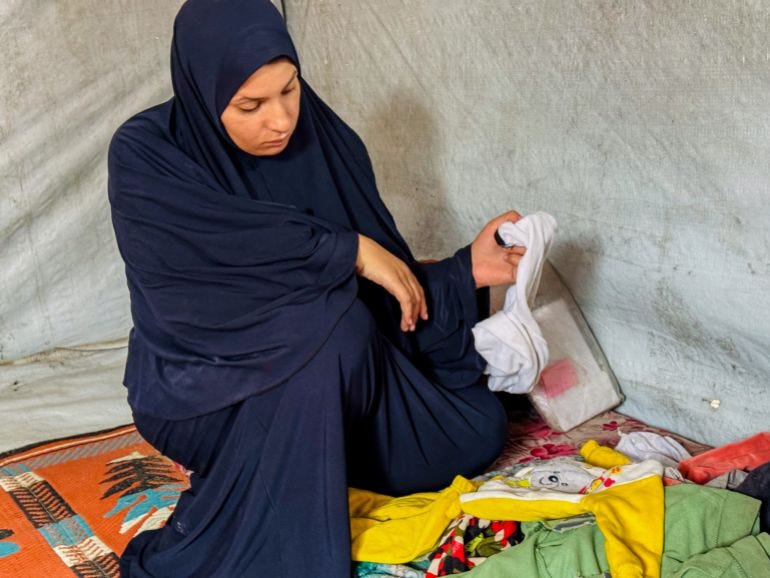 Susan Arqiq looks through her son Kinan’s belongings in her family’s tent. (Photo: Abdelhakim Abu Riash/Al Jazeera)
‘It is unbelievable’
“I have struggled to obtain adequate shelter, blankets, clothing and food for my children. My life is all about suffering,” he said. “Look at my tent. We live in poor conditions. During the last winter storm, we were flooded with water.”
Ahmad told Al Jazeera that the family had not received a proper tent or a tarpaulin to protect them from the winter weather before Kinan’s death. After Kinan died, they received the waterproof sheet, but it was too late to protect him.
Kinan was the youngest of three children, and his brothers, Rami, three, and Ali, two, were deeply attached to him. They continue to ask about their younger brother, unable to understand why he is no longer with them.
“They always ask where he has gone. Whenever they see his belongings, they try to look for him. It is unbelievable,” Ahmad said.
Fear grips Gaza
Kinan’s death has renewed fears among displaced families in Gaza, especially those with infants to protect. Children are particularly vulnerable to hypothermia as their bodies are less able to regulate temperature when exposed to the cold for prolonged periods.
Hadeel al-Midana, 27, lives in a displacement tent west of Gaza City with her three children: Hamza, Mahmoud, seven, and Nour al-Din, five. Her husband, Ibrahim, has been out of work since the start of the genocide.
She said Kinan’s death has deepened fears she carries each night when she tries to keep her own youngest son, one-month-old Hamza, warm.
“I am always on edge. I cannot leave him,” she told Al Jazeera.
“I swear, he doesn’t have a blanket of his own. I wrap him in the blankets that I use myself,” Hadeel said, referring to Hamza.
The poor family has received used clothes from charitable neighbours. They have also received four blankets from the camp; however, the low temperatures are still too much to bear given their limited resources.
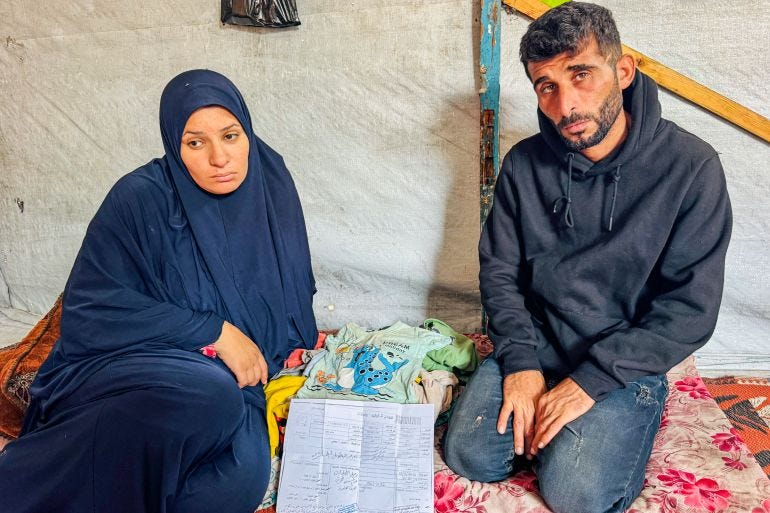 Susan and Ahmed Arqiq sit inside their displacement tent in al-Mawasi, Khan Younis, beside the clothes of their nine-month-old son Kinan. (Photo: Abdelhakim Abu Riash/Al Jazeera)
“Even the adults cannot bear it. How much worse is it for the little children?” she asked.
She wakes several times during the night to check on Hamza. Two nights ago, she found that his hands and feet were as cold as ice. Terrified, she covered him with a thicker blanket.
“I need blankets for him, and perhaps a bed that would raise him a little above the ground. I am afraid of the insects, too,” she said.
“The tent is not fit for a child’s life, or even an adult’s life. We live in constant fear, and there is nothing we can do to face it. I hope we get through this winter safely.”