

Germany’s Renaissance
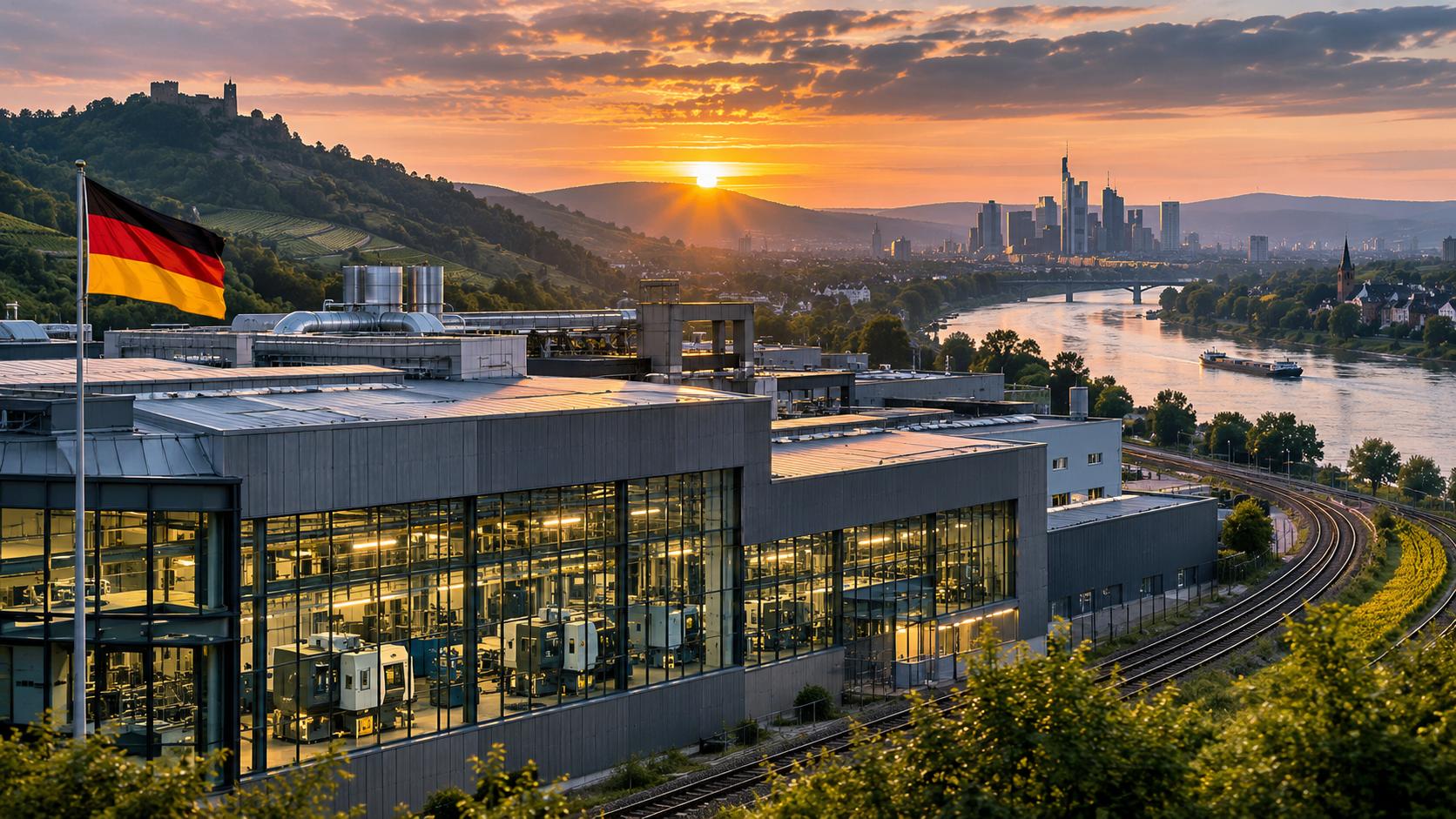
Could Germany’s recovery become the catalyst for a Western transformation?
By Colin Maxwell
Germany stands at a historic crossroads. Its industrial foundations are deteriorating, its relationship with Russia has been shattered, its political establishment is losing public confidence, and its social cohesion is under considerable strain.
Yet Germany possesses much of what would be needed for a remarkable recovery — industrial expertise, technological capability, a substantial productive workforce and a tradition of decentralised banking.
What it lacks is a coherent political and economic strategy for putting those assets back to work. And therein lies an opportunity whose implications could extend far beyond Germany, or even Europe.
If Germany can rediscover the courage to rethink its disastrous estrangement from Russia, why cannot the entire West reconsider the economic and geopolitical assumptions that have brought it to this point?
MAX OTTE — A VOICE OF REASON IN A CONTINENT LOSING ITS WAY
I recently listened to an interview conducted by Professor Glenn Diesen with the German economist, financial analyst and author Max Otte. His analysis of Germany’s decline deserves wider attention.
Watch the Glenn Diesen–Max Otte interview: https://www.youtube.com/watch?v=6fXMyuAbKQI
Otte has long challenged the increasing dominance of financial interests over the productive economy. His commitment to productive banking is hardly a recent development.
In May 2010 he submitted evidence to the Bundestag Finance Committee advocating a Financial Transaction Tax. He argued that it would discourage excessive speculative trading while imposing a relatively modest burden on patient investors. He also defended Germany’s Sparkassen and cooperative banks against measures that could disadvantage institutions financing the Mittelstand.
Here was a German economist defending two principles central to my own Three Pillars — productive decentralised banking and a Financial Transaction Tax.
Otte identifies two especially dangerous vulnerabilities: the deterioration of French public finances and the progressive weakening of Germany’s productive industrial economy. Together they present a potentially devastating combination.
Otte believes Europe may require a severe economic crisis before meaningful reform becomes politically possible — he may be right. Surely, though the greater achievement would be to recognise the failures now, and construct alternatives before crisis makes those choices unavoidable.
THE GERMAN MIRACLE — BUILT ON INDUSTRY AND PRODUCTIVE BANKING
Germany’s postwar achievement rested on industrial expertise, skilled labour, patient investment and financial institutions connected to productive enterprise. Its Mittelstand became renowned for specialised manufacturing, engineering excellence and long-term commercial relationships.
Its Sparkassen and cooperative banks provided locally embedded finance for enterprises routinely overlooked by large commercial banks. This institutional inheritance remains enormously valuable.
The destination of newly created credit is one of the most important determinants of an economy’s long-term performance.
Credit for new productive capacity can finance machinery, research, employment and infrastructure. Credit concentrated on existing property and financial assets can instead inflate prices and indebtedness without comparable additions to output. Professor Richard Werner’s work illuminates this distinction.
Germany does not need to invent a new industrial culture. It needs to recover the economic priorities that once made its productive achievements possible.
GERMANY AND RUSSIA — THE PARTNERSHIP EUROPE ABANDONED
For decades, Germany supplied industrial technology, machinery and engineering expertise while Russia supplied energy, raw materials and access to a substantial market. The relationship had political complications, but its economic complementarity was compelling.
Affordable, dependable energy was particularly important for chemicals, metals and energy-intensive manufacturing. The destruction of the Nord Stream pipelines, sanctions and the wider breakdown in relations have profoundly disrupted that arrangement.
Massive energy price hikes are not the only cause of Germany’s industrial difficulties. Investment decisions, regulation, competition and domestic policy also matter, but abandoning a major nearby highly reliable source of competitive energy has compounded those difficulties.
Reconciliation with Russia would not require Germany to abandon legitimate security interests. It would require recognition that durable European security cannot be built on permanent confrontation.
The war in Ukraine and the concerns of Ukraine, Russia and neighbouring states require serious negotiation and enforceable arrangements. A restoration of commercial cooperation is a possibility, not a foregone conclusion — but one with potentially enormous benefits.
OTTE, WEIDEL AND CHRUPALLA — THE POSSIBILITY OF A NEW DIRECTION
Both Alice Weidel and Tino Chrupalla have criticised Germany’s approach to the Ukraine conflict and called for renewed diplomacy with Russia. Otte’s interview with Diesen points to areas of overlapping concern about German industrial and national economic interests.
Imagine the potential of combining serious monetary and economic reform with political leadership committed to rebuilding industry and pursuing constructive international relations. Weidel and Chrupalla already share the leadership of the AfD. The possibility explored here is that they might embrace the monetary architecture needed to turn those ambitions into reality.
A credible recovery program must also exercise independent judgement in other foreign-policy questions, including Israel and Gaza. Germany’s problems are too important to be reduced to party labels.
THE THREE PILLARS — FINANCING A PRODUCTIVE RENAISSANCE
Restoring energy and trade cooperation would be important, but insufficient. Germany must also reconsider how money and credit are created, allocated and governed.
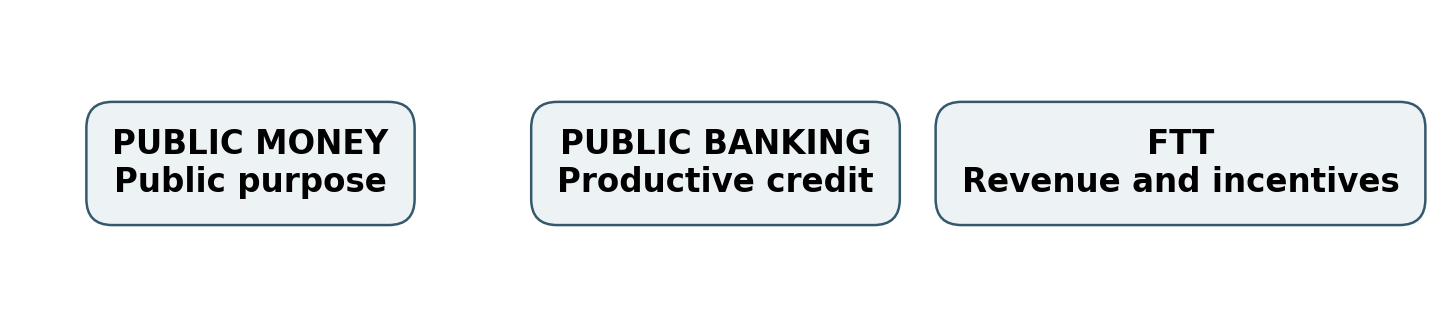
FIRST — Public money creation as a public utility.
A sovereign monetary authority should be able to issue money for clearly defined public purposes, subject to democratic accountability, transparent governance and real-resource and inflation safeguards. Productive public investment need not automatically create additional interest-bearing private debt.
SECOND — A Public Banking Solution.
A decentralised network of publicly accountable, locally embedded banks could finance SMEs, agriculture, manufacturing, infrastructure and technological development. Germany’s Sparkassen offer a practical institutional foundation, though reform would require careful governance.
THIRD — A Financial Transaction Tax.
A broad-based, carefully designed FTT could discourage excessive financial turnover and contribute to public revenue, potentially reducing reliance on taxes on employment, enterprise and consumption. Its revenue, behavioural effects and avoidance risks require rigorous modelling.
These three elements are the formulation developed here. My earlier Financial Holy Grail article presents a related, somewhat different architecture, including a stronger role for hard-asset backing. In this German proposal, gold is primarily envisaged as an international reserve and settlement asset, while sovereign money and productive bank credit serve the domestic economy.
Earlier analysis — The Financial Holy Grail: https://sovereignista.com/2026/08/22/the-financial-holy-grail-how-a-three-pillar-economic-architecture-could-end-fiscal-dominance-eradicate-the-parasitic-economy-and-rebuild-national-wealth-within-2-5-years-introduction-the/
THE EURO — GERMANY’S UNFINISHED MONETARY REVOLUTION
Germany surrendered independent national monetary policy upon adopting the euro. The Bundesbank remains influential within the Eurosystem, but it no longer sets Germany’s monetary policy independently.
Germany could strengthen its public banking institutions within the eurozone, however full independent currency sovereignty would require replacing the euro with a sovereign German currency or a fundamental redesign of the existing arrangements.
The existing European treaties provide no straightforward route for a member to leave the euro while remaining in the European Union. Contracts, deposits, cross-border claims and bank liabilities would all require careful treatment.
But this legal question may become secondary if a severe French financial crisis destabilises the eurozone itself. Treaties are political arrangements – they do not guarantee the survival of the monetary architecture they were designed to govern.
FRANCE — THE CRISIS THAT COULD BREAK THE EURO
France is no peripheral member. It is the eurozone’s second-largest economy, one of the architects of European integration, and home to some of the continent’s largest financial institutions.
The widening spread between French government bonds — OATs — and German Bunds is the canary in the coal mine.
The spread measures the additional yield investors demand for French sovereign risk relative to Germany. A sustained widening signals growing concern about France’s fiscal, financial and political position. Higher borrowing costs can reinforce weak debt dynamics, particularly when growth disappoints.
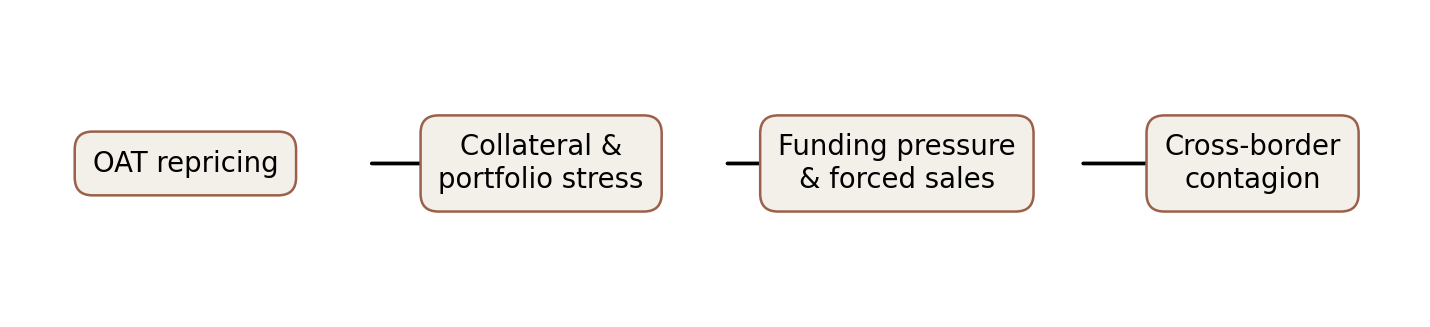
The implications reach far beyond the French Treasury. French government debt is an asset held on the balance sheets of banks, insurers, pension funds, investment managers and other institutions across Europe and internationally. OATs are also important collateral in financial markets.
The French government’s liability is somebody else’s asset — and when that asset deteriorates, the consequences can cascade through the international financial system.
A sharp fall in OAT prices can damage securities portfolios, weaken collateral values, increase margin demands and encourage forced sales. The resulting losses can spread through cross-border holdings, derivatives and funding markets.
THE HIDDEN LOSSES — WHEN ACCOUNTING CONCEALS ECONOMIC REALITY
Not every market loss appears immediately in a bank’s reported profit or regulatory capital. Bonds carried at amortised cost may remain recorded well above their market price, while off-balance-sheet commitments and contingent exposures can complicate the assessment of risk.
The economic exposure may be substantial long before its full implications become visible in headline financial statements.
A solvent, well-funded holder may be able to keep a bond to maturity and receive its contractual payments. But that distinction becomes precarious when funding is unstable, leverage high or depositors and counterparties demand liquidity.
Forced selling can crystallise losses. Those losses undermine confidence, producing further demands for liquidity and additional sales. Accounting conventions may therefore delay recognition of developing stress until the available options are dangerously limited.
The lesson of Silicon Valley Bank in 2023 was that unrealised bond losses can become critical when funding confidence collapses. French sovereign debt presents a different and potentially far more internationally interconnected exposure.
A major French sovereign-debt crisis could force unprecedented ECB intervention and difficult political choices over burden-sharing. A breakdown of the euro would not automatically dissolve the European Union, but it could profoundly weaken the political foundations of integration and accelerate institutional fragmentation.
In such circumstances, German monetary sovereignty might move rapidly from a theoretical proposition to an urgent practical question. This is a scenario, not an established prediction; the timing and severity remain uncertain.
BRING HOME THE GOLD — AND RESTORE THE CURRENCY
The Bundesbank reported approximately 3,350 tonnes of gold at the end of 2025: 1,710 tonnes in Frankfurt, 1,236 in New York and 404 in London. Germany had already repatriated substantial holdings between 2013 and 2017.
Gold held abroad remains a national reserve asset, but custody arrangements matter when geopolitical or financial tensions increase. Keeping reserves in international centers also offers liquidity advantages. The balance between access, control and flexibility deserves renewed examination.
A sovereign German currency need not be rigidly convertible into gold. Domestic public money creation should respond to productive capacity and real-resource constraints. Gold could instead play a larger role as a neutral international reserve or settlement asset, alongside diversified national currencies and bilateral clearing.
Germany’s industrial strength, trading relationships and substantial reserves could make it an influential participant in a more plural international monetary order.
THE SOCIAL FRACTURE — REBUILDING GERMANY FROM WITHIN
Economic reform cannot alone repair declining social trust. Political polarisation, insecurity, pressures on public services and contentious immigration policies have deepened divisions.
Large-scale immigration has created integration and service pressures in some communities while contributing labour and skills. Neither blanket dismissal of public concerns nor treating immigrants as a single undifferentiated group offers a credible solution.
Competent administration, equal treatment under the law, workable integration policy and the return of secure productive employment are essential. An economic renaissance that fails to rebuild social cohesion would remain incomplete.
FROM GERMAN RECOVERY TO EUROPEAN RENAISSANCE
Imagine Germany restoring productive investment, dependable energy, decentralised banking and constructive economic relations with Russia — while rebuilding monetary institutions to serve its productive economy.
The benefits could extend through European supply chains, employment and trade. A negotiated security settlement could reduce the human and economic costs of prolonged confrontation. The demonstration of productive monetary reform might encourage other countries to rethink their own financial arrangements.
Europe could become an economically confident participant in a multipolar world, cooperating with the United States, Russia, China and other economies without defining its future through permanent hostility.
Germany could become the example that encourages the wider West to reconsider its own direction.
RENAISSANCE — THE FUTURE IS STILL OURS TO CHOOSE
Otte’s warning about Europe is severe. France’s sovereign-debt vulnerabilities, Germany’s industrial deterioration and the structural weaknesses of the eurozone make complacency increasingly difficult to justify.
But Germany retains formidable productive capabilities, a tradition of locally embedded banking and the potential to recover independent economic judgement. A coherent program of industrial renewal, productive credit, monetary sovereignty and diplomatic engagement could offer a different future.
Whether Otte, Weidel and Chrupalla ever collaborate formally is secondary. What matters is whether Germany can rediscover the political courage to pursue a program that serves its productive economy and wider population.
Germany’s renaissance could become the catalyst for a Western renaissance – and perhaps, in time, something greater still.
SOURCES AND FURTHER READING
Glenn Diesen interview with Max Otte https://www.youtube.com/watch?v=6fXMyuAbKQI
Otte, Bundestag Finance Committee submission (17 May 2010) https://webarchiv.bundestag.de/archive/2010/0702/bundestag/ausschuesse17/a07/anhoerungen/2010/014/Stellungnahmen/25_Otte.pdf
Bundestag account of the 2010 hearing https://www.bundestag.de/webarchiv/textarchiv/2010/29734097_kw20_finanzen-201702
Bundesbank annual accounts 2025 https://publikationen.bundesbank.de/publikationen-en/reports-studies/annual-reports/annual-report-2025-974388?article=annual-accounts-of-the-deutsche-bundesbank-for-2025-988046
The Financial Holy Grail — Sovereignista https://sovereignista.com/2026/08/22/the-financial-holy-grail-how-a-three-pillar-economic-architecture-could-end-fiscal-dominance-eradicate-the-parasitic-economy-and-rebuild-national-wealth-within-2-5-years-introduction-the/