

Brazil, BRICS and the financial Holy Grail
By Colin Maxwell
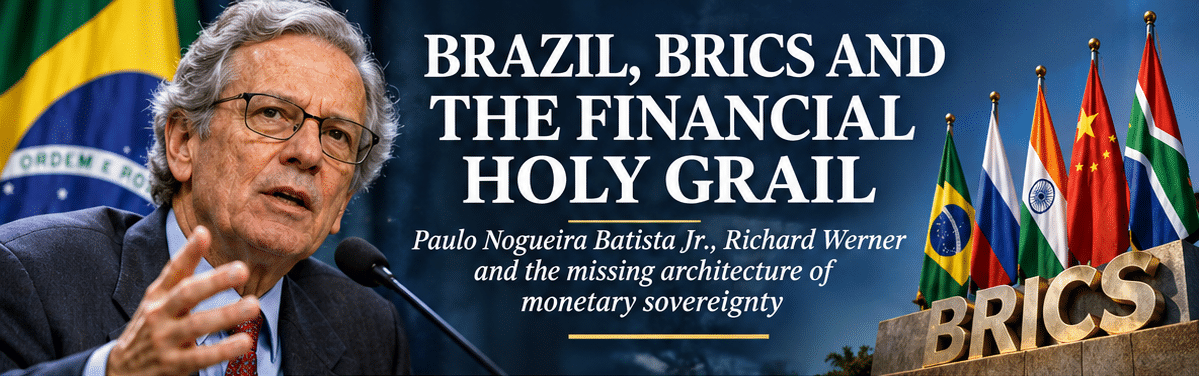
Paulo Nogueira Batista Jr., Richard Werner and the missing architecture of monetary sovereignty
Brazil’s presidential election has reopened a much bigger discussion than the fate of two competing candidates. It has put economic sovereignty, the BRICS monetary project and the machinery of international finance back into the spotlight.
A recent conversation between Nima Alkhorshid and Paulo Nogueira Batista Jr. offers an unusually valuable starting point. Batista served at the IMF and subsequently as vice-president of the BRICS New Development Bank. His analysis deserves engagement on its own terms, rather than being pressed into service as an endorsement of somebody else’s program.
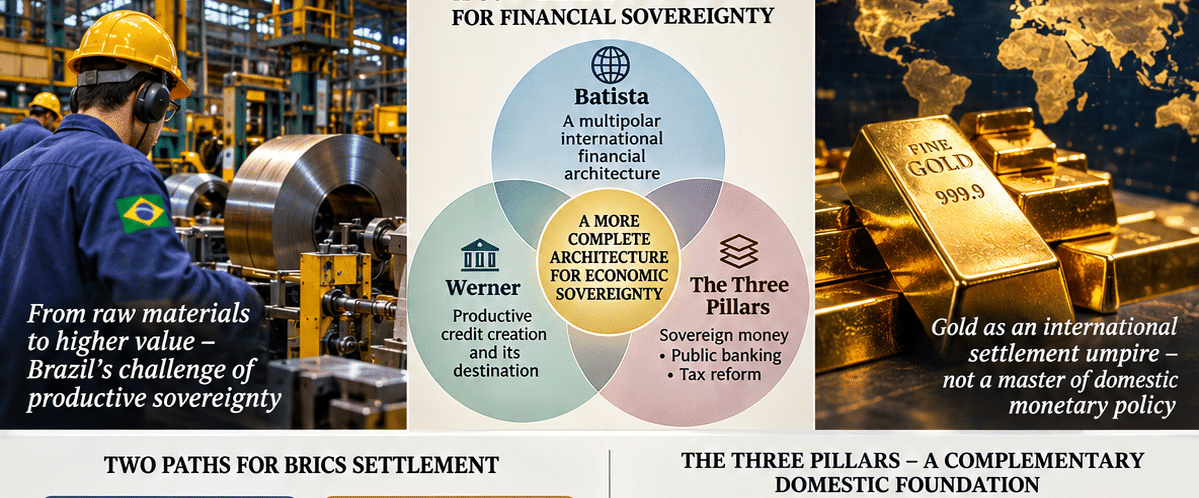
What interests me is the substantial common ground between his arguments for international financial independence, Richard Werner’s research into the creation and allocation of bank credit, and the three reforms I have been developing under the rather ambitious description of the Financial Holy Grail.
The convergence is striking. And where we differ, particularly on gold, there may be a productive distinction between a monetary standard and an international settlement asset.
BRAZIL – THE SOVEREIGNTY QUESTION
Batista regards the election as a struggle over Brazil’s political and economic independence, not simply a contest between Lula and Flávio Bolsonaro. He fears that a Bolsonaro administration would have brought Brazil much closer to Washington at precisely the moment the United States is attempting to reassert its influence throughout the hemisphere.
But one of his most compelling observations concerns Brazil’s place in international production. Brazil exports raw materials and commodities while importing a great deal of higher-value manufactured output. He argues that investment relationships, including those with China, must deliver technology, local components, employment and more processing within Brazil itself.
This goes straight to the distinction between possessing natural wealth and building the productive capacity to capture its value. Who builds the factories? Who owns the technology? Who finances the SMEs that supply them?
And that brings us to the question that conventional monetary debate so often neglects – who creates the credit, and where does it go?
WERNER – FOLLOW THE CREDIT
Professor Richard Werner has spent decades arguing that bank credit must be examined by its quantity and its destination. Credit used to finance productive investment can expand the economy’s capacity to produce. Credit used predominantly to acquire existing property and financial assets can instead drive asset-price inflation without comparable new output.
The distinction matters enormously to any country attempting to industrialise. A government can declare its commitment to value-added manufacturing, but the ambition will be frustrated if its financial institutions find speculative assets more attractive than productive enterprises.
We endlessly debate the next quarter-point adjustment to official interest rates. Yet the allocation of newly created bank credit receives remarkably little public attention. Batista’s industrial objectives and Werner’s credit analysis therefore belong in the same conversation.
THE THREE PILLARS – A DOMESTIC FOUNDATION
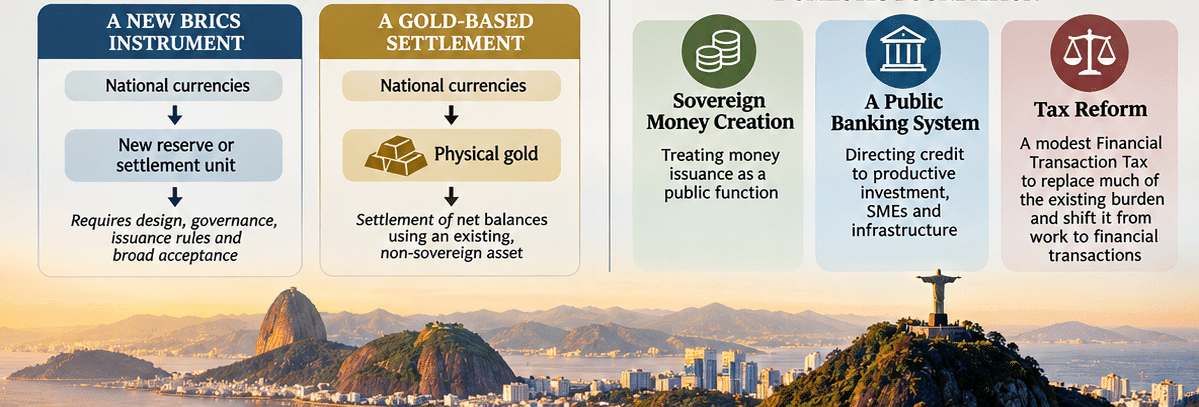
My proposed Financial Holy Grail brings together three institutional reforms. The first is sovereign public money creation – treating the issuance of money as a public function, while clearly distinguishing it from the extension of bank credit.
The second is a decentralised Public Banking System, drawing lessons from institutions such as Germany’s Sparkassen and the Bank of North Dakota. Its purpose is to provide accessible finance for SMEs, regional enterprise, infrastructure and genuinely productive investment.
The third is fundamental tax reform, examining whether a modest Financial Transaction Tax could replace much of the existing burden on income, company earnings and consumption, while retaining progressive measures where necessary.
These proposals require serious modelling and institutional safeguards. An FTT can cascade through transaction chains, encourage avoidance and produce less revenue than gross transaction figures suggest. Public banks can also misallocate credit without competent governance. None of this is a reason to avoid investigating the architecture; it is a reason to design it rigorously.
Batista does not endorse these three proposals in the interview, and I make no such claim. My argument is that they offer a possible domestic complement to the international sovereignty he seeks.
TAXATION – ANOTHER AREA OF COMMON GROUND
Batista describes a Brazilian tax structure that weighs heavily upon poorer and middle-income households while granting substantial advantages to wealthy holders of financial assets. His criticism is directed not only at the overall tax burden, but at its distribution.
That concern is closely related to the objective of the Third Pillar. Instead of continually adjusting an elaborate collection of taxes on work, business and consumption, why not examine whether a carefully designed levy on a broad range of financial transactions could support a major restructuring?
The answer cannot be assumed. It depends on the taxable base, behavioural responses, exemptions, collection methods and cumulative effects. But Batista’s diagnosis provides a powerful reason to investigate alternatives.
BRICS – INDEPENDENCE IS MORE THAN A PAYMENT NETWORK
Batista is especially critical of the slow progress towards interoperable BRICS payment systems. Brazil has Pix, and other major BRICS members have sophisticated domestic systems. He argues that connecting them would reduce dependence upon Western-controlled cross-border financial infrastructure and the sanctions power attached to it.
That is an important objective. But an independent international payments network does not, by itself, change the domestic creation or allocation of credit. A country could escape dependence upon Western payment channels while retaining a banking system overwhelmingly attracted to property speculation and financial engineering.
International payments sovereignty and domestic monetary sovereignty are different achievements. Both matter. That is why I see Batista’s work and Werner’s credit framework as complementary, rather than competing, lines of inquiry.
GOLD – WHY INVENT ANOTHER CURRENCY?
Here we reach the principal point of disagreement. In his conversation with Nima, Batista acknowledges proposals for a BRICS currency linked to gold or a basket of commodities. He questions whether inherently fluctuating commodity prices can provide the stability required of a monetary standard. He also makes clear that he is open to being persuaded otherwise.
That is a fair objection to a particular kind of monetary standard. But I am proposing something narrower, and potentially much simpler.
I am not advocating a return to a domestic gold standard, fixed convertibility or a mechanism that dictates the money supply of Brazil, China, India or Russia. Under the Three Pillars, domestic monetary sovereignty remains fundamental.
Why does BRICS need to invent a new non-national currency instrument at all? We already possess an internationally recognised monetary asset that is nobody else’s liability and cannot be issued at will by a national central bank – physical gold.
Trade could continue to be invoiced and paid in national currencies. Agreed net imbalances between monetary authorities could then be settled in allocated physical gold, with ownership transfers through trusted custody arrangements and periodic physical delivery where required.
Gold could be both the independent umpire and the asset used to settle the account.
Batista’s concern about volatility deserves serious attention. But it is also worth examining whether today’s gold-price behaviour will remain representative of future conditions. Western futures and other paper markets have long exerted substantial influence on price discovery. Central-bank accumulation, physical demand and the growing role of Asian markets could alter that balance.
My expectation is that a greater role for physical supply and demand may reduce some distortions associated with leveraged paper trading. That is an expectation, not a demonstrated guarantee of future stability. Even a purely physical market can experience sharp price changes, and a transition in market structure could itself be volatile.
The design challenges are real – valuation, custody, auditability, reserve concentration, settlement frequency and the treatment of persistent imbalances. Yet those are questions of settlement architecture, not proof that gold must govern domestic monetary policy.
So I would put a respectful question to Batista: why should volatility in gold’s market price disqualify it as an international settlement asset when no one is proposing that it determine the domestic money supply?
THE PRODUCTIVE ECONOMY – WHERE THE IDEAS MEET
There is a deeper convergence. Batista wants Brazil to capture more of the value created from its resources. Werner asks whether bank credit is financing new productive capacity or merely bidding up existing assets. My work on Productive GDP likewise asks what an economy actually makes and builds beneath the headline aggregate.
This is not to suggest that all services are unproductive, or that every financial activity is without value. It is to recognise that conventional GDP alone tells us surprisingly little about industrial resilience, supply chains, energy security or the capacity to produce essential goods.
Friedrich List understood that productive capabilities do not emerge automatically from unrestricted trade. They require institutions, investment and deliberate development. The modern banking system is one of the most consequential institutions in that process.
TOWARDS A COMPLETE ARCHITECTURE OF SOVEREIGNTY
The international financial system is changing. BRICS members are looking for ways to trade and settle obligations without leaving their economic independence at the mercy of another power’s currency and financial infrastructure.
That effort is necessary. But it is not sufficient.
Who issues domestic money? Who creates bank credit? Where does that credit go? How are productive enterprises financed? How is public revenue raised? And how can international imbalances be settled without granting a new monetary privilege to another dominant state?
Batista brings the experience of the international monetary institutions. Werner brings the empirical challenge of bank-credit creation and allocation. The Three Pillars attempt to supply a complementary domestic institutional architecture. Physical gold may offer an additional international settlement mechanism without becoming the master of domestic monetary policy.
I am not suggesting that these are identical positions or that their proponents agree with my conclusions. The common ground is substantial enough without inventing agreement where none has been established.
Financial sovereignty requires more than changing the currency in which trade is conducted. It requires examining who controls the monetary machinery itself – from the creation of domestic purchasing power to the settlement of obligations between nations.
Otherwise, we risk replacing one form of financial dependence with another. And that would be a disappointing outcome for a world supposedly moving towards genuine multipolarity.
SOURCE
Primary source: Nima Alkhorshid interview with Paulo Nogueira Batista Jr., https://www.youtube.com/watch?v=_4s6HGUv0q0.
Related Posts
-
Eyes on Brazil
August 22, 2026 -

Lula, Brazil, and BRICS: Anatomy of a Betrayal – An update 01/04/2025: Was it worth it?
January 5, 2026 -

Notes on Brazil: Coffee, China and Tariffs, MAGA Playbook Lawfare, LAC
August 8, 2025 -

Lula and Unions Respond to Trump Threats
July 31, 2025 -

Modern Chancay port is a testament to China-Peru win-win cooperation
July 12, 2025 -

Tariffs: Brazil
July 9, 2025 -

The United Global South Front against the Tariff Paper Tiger
April 23, 2025 -

“The UN has failed, and the BRICS will replace it”: Parliamentarians and experts discuss Brazil’s role in a multipolar world
December 22, 2024 -

G20 knocks out G7 agendas
November 22, 2024 -

How Will Trump Victory Change US-Brazil Relations?
November 15, 2024