

Iran has ‘special plans’ for ‘Israel’ if war breaks out
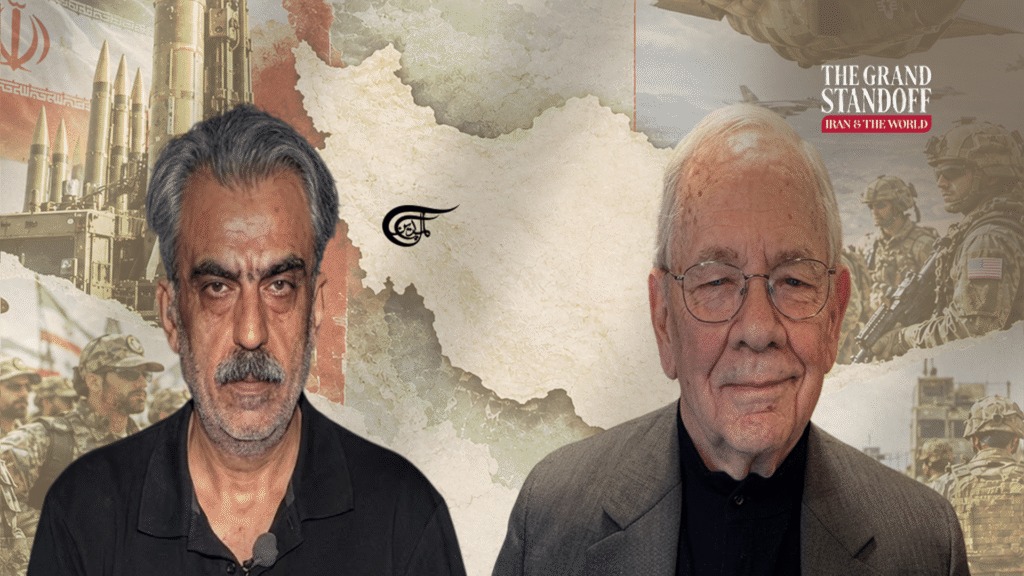
International Affairs and Foreign Policy Expert Mostafa Khosh Jashm and former US diplomat Michael Springmann
Michael Springmann and Mostafa Khosh Jashm warn that renewed US-Israeli aggression against Iran could trigger devastating regional retaliation, disrupt global energy markets and financial systems, and impose severe economic and military costs on Washington.
The United States and “Israel” are preparing for another war on Iran, Michael Springmann, a former US diplomat, and Mostafa Khoshcheshm, an international affairs and foreign policy expert, warned, arguing that Washington was underestimating Tehran’s military capabilities, the costs of further attacks and the potential consequences for the global economy.
Speaking on Al Mayadeen‘s Iran and the World: The Great Standoff, Khoshcheshm cautioned that Tehran expected another large-scale war with the United States and “Israel” within weeks, with the possibility of an attack coming sooner.
“The United States and Israel have both made it clear that they are preparing for a third round of full-fledged war on Iran, which is deemed to be much worse than before, in an extent wider than before, and this is going to be the last round from the viewpoint of Iran,” he asserted.
Iran had prepared for renewed war and would seek to defeat the United States, he maintained. “Iran has prepared itself to the teeth and it’s going to do whatever it can in order to defeat or inflict an ultimate defeat on the United States to put an end to this kind of situation,” Khoshcheshm declared.
He dismissed the prospects for mediation, noting that Iran’s previous diplomatic efforts had been followed by attacks. “From the viewpoint of diplomacy, Iran has done whatever it could. We were in the midst of the talks twice when they bombed us,” he recalled.
Iran’s conditions for reopening the Strait of Hormuz, Khoshcheshm insisted, remained unchanged regardless of which country attempted to mediate. “Nothing is going to change, no matter who is doing the mediation, the Pakistanis, Omanis, Qataris, China or Russia. Iran’s terms are clear,” he stated.
He explained that Iran demanded the United States to release its frozen assets, “Israel” to withdraw from Lebanon, oil sanctions exemptions for Iran, and an end to fighting in Lebanon, Gaza, Iraq, Yemen and elsewhere before Tehran would consider further discussions. According to Khoshcheshm, the nuclear issue and compensation for the war would be addressed only after those conditions were met.
“The United States is asking for something completely different. They want their own conditions to be imposed on Iran,” Khoshcheshm countered. “This shows that they are not at all going for diplomacy. And we have tried diplomatic options before several times, and each time they have started bombing us.”
Washington does not understand Iran or its demands
Springmann also criticized Washington’s handling of relations with Tehran, focusing on the officials involved in negotiations. The US government, he charged, had sent “two squeezy New York real estate dealers, Jared Kushner and this Steve Whitkoff guy” to deal with Iran.
“These people have no idea of what they’re doing, no idea of what Iran is now or has been or will be or can be,” Springmann remarked. The regional situation, he added, was “totally incomprehensible to not only Donald Trump but his entire regime.”
“All they do is make wild threats, trying to destroy Iran in a singles night, refusing to look at what can be done about the Strait of Hormuz,” he continued, emphasizing that “These are the people that want more war and that cannot handle reality.”
Springmann argued that Washington’s approach was driven by political calculations, voicing his conviction that the United States and “Israel” were preparing for another war in the hope of improving Israeli Prime Minister Benjamin Netanyahu’s prospects in the October 27 election.
Gulf states and the widening regional threat
Khoshcheshm said Iran was also concerned about the role of Gulf Arab states, accusing them of encouraging Washington to attack Iran and allowing their territory to be used for military purposes.
“We’ve been receiving intelligence reports in the last few months that the Arab countries on the southern rims of the Persian Gulf, they have been demanding the United States to go for another round of war, to not leave their region without weakening Iran at least, if not toppling the Islamic Republic,” he stated.
He charged these governments with facilitating attacks on Iran and providing the United States with military support. “They have provided the United States with their territory as a launchpad, as a platform to attack Iran, to kill Iranian generals, leader, and kids, 168 kids in Minab School, and many other civilians,” Khoshcheshm asserted.
The United Arab Emirates came in for particular criticism, with Khoshcheshm declaring that it had helped ships cross the Strait of Hormuz without Iranian authorization and hosted US and Israeli electronic jamming systems intended to interfere with Iranian radar. Aircraft from Gulf states, he further noted, had supported the US Air Force during the previous round of fighting, and he accused the UAE of attacking a desalination facility on Qeshm Island.
He said Iran had previously sought a regional security arrangement that would reduce reliance on Washington. Recalling efforts by the late Iranian President Ebrahim Raisi and his foreign minister, Amir Abdollahian, Khoshcheshm explained that they had tried to establish a Gulf security dialogue.
“I remember I was in the know. I knew how hard they were working in order to start a Persian Gulf regional security dialogue in order to ensure these Arab countries, especially Saudi Arabia, that if we kick out the United States and make it evacuate the region, then there will be security for everyone,” he recalled.
Washington, Khoshcheshm argued, had obstructed the rapprochement between Iran and Saudi Arabia. He maintained that Tehran continued to view the neighboring countries as potential partners but believed their governments were prioritizing ties with the United States and “Israel”.
“They are not willing to go for coexistence,” he contended. “Unfortunately, they are helping the United States and paying for this war and helping and abetting the US Army with their fighter jets, with their military equipment, and everything.”
Military costs and the pressure on oil prices
Springmann argued that rising fuel costs could constrain US military action against Iran because aircraft, ships and ground vehicles require large quantities of fuel. Using a crude oil benchmark of about $112 per barrel, he estimated that the cost could increase by another $50 per barrel after refining and delivery to military vehicles.
“So it will severely limit the amount of money that the army and the air force and the navy have to operate their vehicles and attack Iran. It’s not cheap to run these things,” he said.
He also pointed to the difference between the cost of Iranian weapons and the defensive missiles used to intercept them. Springmann said US and Israeli forces had spent millions of dollars on individual interceptors to shoot down Iranian drones and missiles that cost at most a few hundred thousand dollars each.
“The Iranians have cost the Americans and the Israelis plenty in terms of defensive missiles that are millions of dollars a copy to shoot down Iranian drones and Iranian missiles that are at most a couple of hundred thousand dollars each,” he said.
Springmann argued that the American public had not been given a full account of the military costs and damage. He said Americans did not know how many US service members had been killed or the extent of the damage to US bases in the Arabian Peninsula.
“So what we’ve got here is war by blackout,” he said, adding that the consequences would be severe. “The bill is going to come home to roost, and it’s going to be very, very painful.”
Khoshcheshm, meanwhile, explained that Iran was seeking to drive up oil prices ahead of the US midterm elections, attributing the increase to attacks on oil tankers and the laying of sea mines, arguing that Washington did not know where Iran had placed them.
“Now, because of the Iranian firepower hitting so many tankers each night that you may not even be able to count, now the prices have surpassed $117 per barrel,” he said, predicting that prices could reach $120 within 24 hours of the recording if markets were open, and said they could rise to $150 if war resumed.
He said Iran would not necessarily reopen the Strait of Hormuz after the midterm elections, even if the immediate fighting ended. “If the war ends right now, oil prices will not be normalized for two, three years,” he said, adding that US strategic reserves had been reduced.
Khoshcheshm also described Iran’s response to recent attacks on tankers, saying that after US forces struck an Iranian launcher on what the transcript identifies as Syriac Island, Iran increased its firepower against ships.
“What happened next? Iran increased firepower four times more, firing more explosive and more devastating missiles at ships, at these tankers, in order to show its resolve, showing that there is no go back,” he said.
Energy infrastructure and global internet cables
Khoshcheshm warned that a wider war could extend beyond military targets, with Iran striking energy infrastructure across the region and disrupting international internet connections. He said Iranian targets could include “the oil facilities, energy zones, pipelines, refineries all across the region in these six countries.”
He also raised the prospect of damaging undersea internet cables running through the Strait of Hormuz, arguing that their presence without payments to Iran violated the country’s sovereignty.
“Iran doesn’t need to disconnect all the seven,” Khoshcheshm said, referring to the major cables passing through the strait. “Only three would be enough to cause a 450-millisecond delay. That would paralyze the whole global banking systems, the suite system, the data systems, the clouds, and everything.”
He also emphasized that disruption to three or four cables could paralyze the global digital economy and would be among the options Iran might pursue if another war broke out.
“And that’s just in the region,” he cautioned, pointing out that “Iran will then extend the theater of the battlefield to outside. It’s not just Bab-el-Mandab Strait or the resistant front. It will go well beyond regions that the US and Israel would never imagine in order to take them by surprise.”
Khoshcheshm also warned that Iran intended to inflict extensive damage on “Israel” if fighting resumed. “Iran has a very, very special plan of war against Israel. It’s not going to let Israel go undamaged. It plans to devastate Israel to the maximum possible if war breaks out,” he said.
Springmann’s warning about the consequences of escalation focused on the lack of public information about the damage already inflicted during the fighting, affirming that the secrecy surrounding casualties and damage to US bases had prevented Americans from understanding the costs of the war.
“Only the receiving states know how much damage has been done, and only Iran has any knowledge, and the Americans, I guess, have any knowledge of what was done to the 20 or 30 bases that the IRGC and the Iranian Army and Air Force have done to these bases in the Arabian Peninsula,” he said.
Springmann criticizes Kushner’s diplomatic role
Springmann also questioned Jared Kushner’s involvement in diplomacy, accusing him of using his connections to President Donald Trump for personal benefit. He referred to plans involving Kushner and his wife, Ivanka Trump, to build a luxury resort on part of a wildlife sanctuary in Albania, saying the project had prompted protests.
“Kushner has no right to be any kind of diplomat. He’s a crooked real estate dealer from New York City,” Springmann said.
He argued that evidence of wrongdoing could be difficult to establish, even while questioning Kushner’s suitability for the role. “So in my view, you can’t say, yes, this is the smoking gun, this is the definitive piece of black-letter law that shows he’s violated this crime and this law and that particular section of the United States Code,” he said.
Springmann said his criticism extended beyond Kushner to senior officials in the US government and European officials who follow Washington’s lead. He said he regarded Kushner as untrustworthy because of his conduct and associates, adding that he believed he was “as much of a crook as Donald Trump is, as much of a crook as Donald Trump’s cabinet are.”