

Xi Jinping Created a Structure for the US to Remain Part of the World. All the Rest is Noise
By Amarynth
During President Xi Jinping’s historic state visit to Washington, D.C., from September 23 to 25, 2026, the American media landscape was predictably consumed by domestic political theater. Disputes over press access and partisan squabbles dominated the headlines. Yet, beneath this cacophony, a profound reality was established. President Xi did not merely arrive for a diplomatic photo opportunity; he articulated a structural framework ensuring the United States could remain an integrated, vital part of the global order. All the rest is just noise.
At the heart of this framework is “constructive strategic stability.”
During their Oval Office talks, President Xi made it unequivocally clear that the future of global governance does not require the diminishment of American power. Instead, he offered a paradigm of mutual reinforcement.
In a defining moment, President Xi stated that the “great rejuvenation of the Chinese nation and making America great again can go hand in hand.” This was not an empty pleasantry, but a calculated, structural offer. It is a blueprint for a multipolar world where the United States is guaranteed a respected, central role, provided it abandons the self-defeating logic of containment.
President Xi masterfully redefined great-power competition, stripping it of existential dread. He explicitly framed the bilateral dynamic, stating, “Our competition should be a healthy one and should be kept within bounds. It should be a race of catching up with one another, not a wrestle in which one either wins or loses.”
By establishing these boundaries, Xi provided the US with a clear lane for innovation without the looming shadow of inevitable conflict.
This was immediately operationalized through a newly agreed-upon AI dialogue. Acknowledging that both nations are leading forces in artificial intelligence, Xi emphasized the shared responsibility to “develop and manage AI for good.” This creates a structural mechanism for cooperation on the most critical technology of the 21st century”.
The substance of this shift was reinforced by deliberate, powerful symbolism. When President Xi and President Trump visited the National Archives to view the Declaration of Independence and the Constitution, it was far more than ceremonial tourism. It was a mutual acknowledgment of enduring national identities (never mind that those for the US are arguably not in effect any longer). President Xi noted that while China inherits 5,000 years of civilization and the US boasts 250 years of pursuing the American Dream, both peoples fundamentally share an aspiration for prosperity and security.
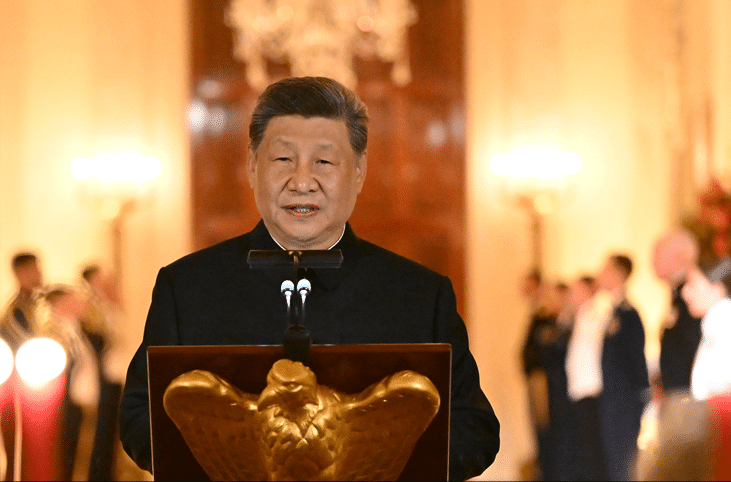
Furthermore, the institutionalization of this relationship was secured through concrete future commitments. The agreement to meet again at the upcoming APEC summit in Shenzhen and the G20 summit in Miami ensures that this dialogue is continuous. It is designed to outlast the daily news cycle and the transient anxieties of domestic politics. The state dinner, complete with historical nods to the 1972 “Toast of Peace,” served to ground this high-level strategy in the ties between the two peoples.
Pundits will inevitably focus on the peripheral drama of the visit, dissecting media controversies and rhetorical flourishes. But to focus on these elements is to miss the forest for the trees. The true legacy of the September 2026 summit is a major architectural shift proposed in US-China relations.
By choosing candid dialogue over confrontation, President Xi Jinping laid down a pragmatic foundation for the 21st century. He demonstrated that China’s rise is not an existential threat to American relevance, but a catalyst for a more balanced, stable global system. He provided the United States with a clear, dignified pathway to remain an architect of the world’s future, free from the paralyzing fear of decline.
History will not remember the petty political noise that surrounded this historic week in Washington. It will remember that President Xi Jinping offered a hand of strategic stability, creating a structure where both nations can thrive. He ensured that the United States remains firmly part of the world’s forward momentum. All the rest is, and always will be, just noise.
The above is the analytical assessment of the visit. We are in a realm way higher than a ‘deal’. This is a structural change that could affect the world. We have to ask what will happen if the US misses this opportunity to become human? As Trump just rejected the latest Iranian proposal for opening the Strait, so I believe he (or his coterie) does not understand the world on Xi Jinping’s level. As the US could not stay with a simple MOU with Iran, or the Spirit of Alaska agreement with Russia, so it stretches any imagination to think that the US would stay with Xi Jinping’s strategic stability. And this is the level that the Great Game will be played on in our world, going into the future. In reality, this may be the very last offer to the US and besides the few trade sweeteners and promises of future talks, the Chinese principles remain unchanged, as we saw in China’s address to the UNGA.
Here is the Chinese Readout of Deliverables and Understandings. Take a look at the language, the nomenclature. Deliverables would be asking for action, similar to what Iran is currently doing (not opening the Strait without action from the US), and similar to what Russia is currently doing (not discussing a ceasefire, but only a lasting cessation of war). Understandings are exactly that which China put forward to the US, to join the world. China can hand over those understandings, they can explain them, they can take part in ceremonial activities to play out the understanding, but they cannot make the US understand. It is only that the ‘we’re the biggest, we’re the best, we’re the smartest, the fastests, the most admired’ messages are now on yesterday’s garbage heap. It is not any longer that ‘if you not for us, you are against us’. It is ‘adapt or die’.
From September 23 to 25 local time, President Xi Jinping paid a state visit to the United States. During the visit, the two heads of state had in-depth discussions on the constructive China-U.S. relationship of strategic stability and major international and regional issues, and reached eight deliverables and understandings:
1. The two sides agree to build “a constructive China-U.S. relationship of strategic stability on the basis of respect, fairness, and reciprocity.”
2. China and the United States support each other in successfully hosting the APEC Economic Leaders’ Meeting and the G20 Summit. The two heads of state intend to attend each other’s meetings.
3. The two heads of state agree that Iran should honor its commitment to not developing nuclear weapons, and no country or institution can be allowed to impose tolls on international waterways.
4. The two heads of state recall that China and the U.S. were allies in World War II and fought side by side to win the war.
5. The two heads of state recognize the positive role of the China-U.S. economic and trade consultation mechanism, endorse the outcomes of the consultations between the two economic and trade teams, including establishing and taking forward the Board of Trade and other mechanisms, reaching an arrangement for a US$30 billion reciprocal tariff reduction, and the extension of the outcomes of economic and trade consultations in Kuala Lumpur, and give instructions that they be implemented.
6. The two sides note that cooperation between the counter-narcotics and law enforcement agencies of China and the U.S. has produced visible outcomes. Recently, the two sides working closely together have jointly cracked multiple cases involving New Psychoactive Substances (NPS) and precursor chemicals, and apprehended dozens of relevant criminal suspects in the two countries.
7. The two sides agree on the establishment of the China-U.S. AI Dialogue to exchange views on risks and benefits related to AI. The next exchange will occur in November 2026. China and the U.S. also agree to establish a bilateral communication channel for AI incidents.
8. The United States welcomes the arrival of two giant pandas, leased by China to Zoo Atlanta.
In addition, the Chinese and U.S. militaries agree to conclude a memorandum of understanding on crisis communication and prevention as soon as possible, and continue their cooperation to search for the remains of missing U.S. service members in China.
thank you, Amarynth i was sobbing, the jumbled muddle of what i’ve been trying to stammer out about brics/iran/russia—the whole what are we fighting for? you have nailed, exquisitely. this is a stand out declaration. you have put the entire jumbled muddle we’ve been making of it into an historical… Read more »
Thanks for this, Amarynth. There’s much I haven’t understood about this visit, and still don’t. This thing we call “History” is somehow a very real and substantial thing, although I couldn’t quite explain how. The great nations are deliberately speaking to history, writing to the record, pushing the stylus into… Read more »
Thanks Grieved. China in the person of Xi Jinping did not bring a bunch of business people with him. I read about the formal dinner and all of the US tech magnates were there, but only Xi Jinping’s direct support. Nobody else. That is the signal to me that Xi… Read more »