

Xi calls for translating new vision of China-US relationship into action
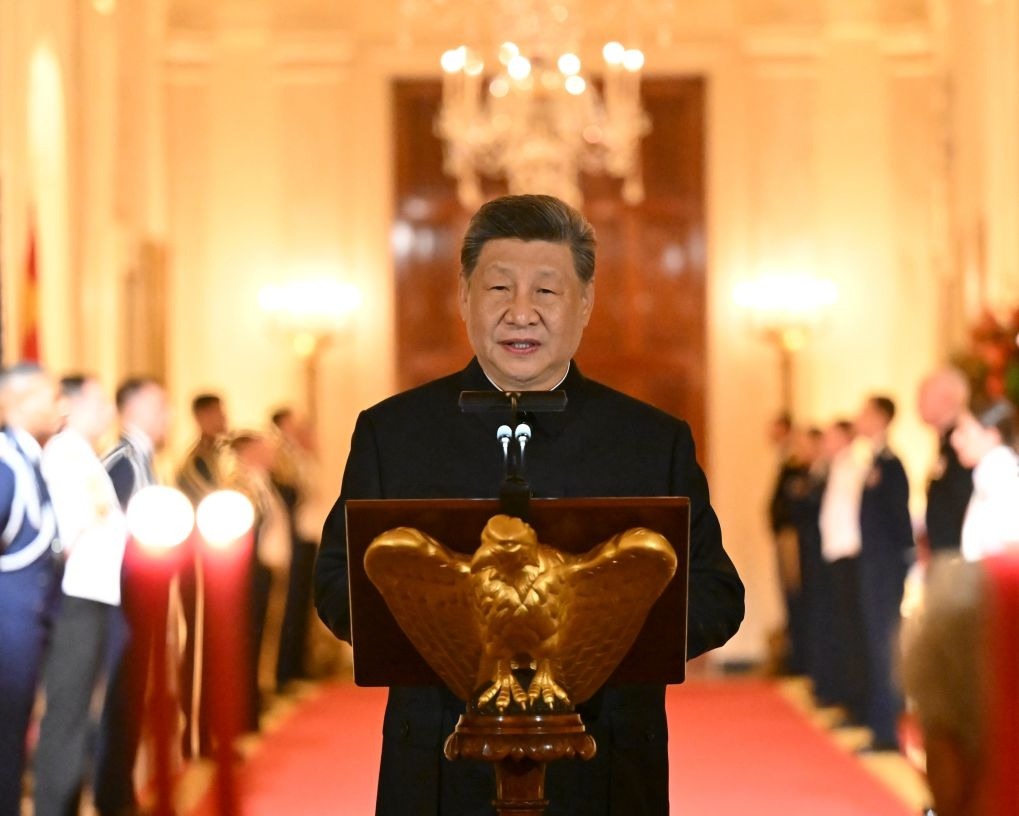
Chinese President Xi Jinping addresses a welcome banquet at the White House in Washington, D.C., the United States, Sept. 24, 2026. Xi on Thursday attended a welcome banquet held by U.S. President Donald Trump at the White House. (Xinhua/Xie Huanchi)
High-level, warm reception highlights importance of stable bilateral ties to both countries, world: experts
Chinese President Xi Jinping called for translating the new vision of a constructive China-US relationship of strategic stability into action and finding the right way for the two major countries to get along with each other, the Xinhua News Agency reported on Thursday.
Xi made the remarks when meeting with US President Donald Trump at the White House on Thursday local time.
Xi pointed out that the exchange of visits between the heads of state of China and the US in less than half a year is unprecedented in the history of China-US ties.
He and Trump have maintained communication through various channels and worked together to steer the giant ship of China-US relationship, Xi said.
Noting that in May this year, he and Trump agreed to work toward building a constructive China-US relationship of strategic stability, Xi said that the new vision reflects the realities of China-US ties, embodies the expectations for the future, and is an important step toward finding the right way for the two countries to get along with each other.
The two sides need to work toward a relationship featuring cooperation as the mainstay, moderate competition, manageable differences, and promises of peace, Xi said.
He noted that China and the US should, and fully can, achieve mutual benefit and win-win results through practical cooperation, help each other succeed through healthy competition, properly manage differences by seeking common ground while respecting differences, and build peace by fostering mutual trust, so that a constructive China-US relationship of strategic stability can better benefit the two peoples and people around the world.
The talks between the two presidents touched on some of the most consequential issues in the bilateral relationship, including trade, the Taiwan question and artificial intelligence, reflecting efforts by both sides to address immediate concerns while keeping the broader relationship on an even keel, experts said.
The discussions, together with the unusually warm reception accorded to President Xi, underscored a shared interest in managing differences and preserving channels for cooperation. They also conveyed a broader message from the Trump administration, both to the American public and the international community, about the vital importance of maintaining a stable China-US relationship, said experts.
Substantial Results
Xi stressed that the economic and trade teams of the two countries held a new round of consultations and reached a new joint arrangement, which is good news for industries and people of both countries, as well as the global economy.
Noting that cooperation is a two-way street, Xi said a stable China-US economic and trade relationship requires both expanding the list of cooperation and shortening the list of problems.
As long as the two sides uphold the spirit of equality, mutual respect and mutual benefit, a way out of problems can be found, Xi said.
Xi said that while China and the US, as both major countries in AI, compete in AI, they have even more reasons to cooperate.
The two sides should leverage respective strengths in AI rather than guarding against each other, Xi said, adding that the two sides can continue to engage in dialogue on AI, exchange views on its risks and benefits, and work together to prevent the misuse and abuse of AI.
The two sides should maintain human control over AI technologies, uphold a people-centered approach and the principle of using AI for good, and ensure that AI serves human progress, he added.
For his part, Trump said that the state visit of Xi to the US is a great visit, adding that both the US and China are major countries, and that he and Xi are good friends and have maintained in-depth and close communication.
The US-China relations will surely be handled well under the leadership of the two heads of state, he said.
The latest round of economic and trade consultations between teams of both countries achieved new outcomes, said Trump, calling on both sides to continue dialogue to reach a better agreement.
Noting that AI bears on the future of humanity, Trump said that the US and China should maintain dialogue and strengthen cooperation on this issue.
The strongest signal to the world is that the leaders of the world’s two most consequential powers, despite fierce and overt competition between their countries, can meet and talk with good spirit. So, the most valuable thing the China-US summit gives the world is a longer planning horizon. This is the headline achievement, Robert Lawrence Kuhn, chairman of The Kuhn Foundation, told the Global Times.
Kuhn emphasized that “both nations are the undisputed vanguard of AI development, this means establishing baseline rapid warning systems, interoperable guardrails, safety protocols, and ethical boundaries, which are both mutually beneficial and an existential imperative for global governance.”
Since the China-US leaders’ meeting in May, a key task for both sides has been to translate the understandings and framework reached at that meeting into concrete action. The two leaders’ meeting in September therefore provides another important opportunity to build on that momentum, particularly by advancing institutional arrangements and dialogue mechanisms that can lend greater stability and continuity to bilateral ties, Da Wei, director of the Center for International Security and Strategy and Professor of Department of International Relations at Tsinghua University, told the Global Times.
Da said if the two sides can sustain frequent interactions and deliver incremental results each time, those gains can accumulate over the course of the year and gradually strengthen the foundation for a more stable and constructive China-US relationship.
Xi stressed that the Chinese side’s position on safeguarding national reunification and territorial integrity is clear-cut.
It is hoped that the US side will adhere to the correct position of opposing “Taiwan independence,” and handle the Taiwan question with caution, so as to lay a solid foundation for China-US strategic cooperation and the development of bilateral relations, Xi said.
On the Taiwan question, Beijing will continue to state its principled position clearly and firmly, making it unmistakable to Washington where China’s red lines lie and what it expects from the US side, said Da.
At the latest summit, Beijing once again sent an unequivocal message on the Taiwan question. What matters next is how Washington translates its statement into concrete actions. The US response will therefore remain an important indicator of whether it is prepared to handle the Taiwan question with the seriousness and prudence that China has consistently called for, Da noted.
Both heads of state also exchanged views on major international and regional issues including the Middle East situation, Ukraine crisis and Korean Peninsula.
The two leaders also confirmed that the two countries will support each other in hosting the 2026 APEC Economic Leaders’ Meeting and the G20 Leaders’ Summit.
Moments of Friendship
Xi and his wife, Peng Liyuan, on Thursday evening attended a state dinner held by Trump and his wife, Melania Trump, at the White House.
Xi extended sincere greetings and best wishes for the Mid-Autumn Festival to Americans from all sectors of society who care about and support the further growth of China-US relations.
Xi stressed that over 200 years ago, soon after its independence, the US turned its eyes to China. The two countries started trading with each other, exchanging goods to meet each other’s needs and drawing on their complementary strengths.
Noting that more than 80 years ago, the Chinese and American people stood shoulder to shoulder in the fight against Japanese militarist aggressors, Xi said such a friendship forged in blood and fire will surely live on through the generations.
Over 50 years ago, Ping-Pong Diplomacy between the two countries reopened the door to bilateral exchanges that had been closed for years, Xi said. The older generation of Chinese and US statesmen, with the political wisdom of “a small ball moving the globe,” set in motion the historic process of normalizing China-US relations.
Notably, the wine chosen for the state dinner included Schramsberg Blanc De Noir, a vineyard selected to honor the historic 1972 “Toast to Peace” shared by then US president Richard Nixon and then Chinese premier Zhou Enlai, according to media reports.
The two leaders’ “toast to peace” that year helped break the ice in bilateral relations.
Analysts noted that every detail of the state dinner – from wine chosen to evoke a pivotal moment in China-US relations to references to “Ping-Pong Diplomacy” – was rich in historic symbolism, reflecting hopes of carrying forward friendship and maintaining a stable bilateral relationship.
Xi also said the story of an American named Ronald Sakolsky, who more than 20 years ago gave financial support to Chinese desert control worker Yin Yuzhen for her tree-planting effort, touches the hearts of many Chinese people and stands as a shining example of the friendly exchanges between the two peoples.
Xi noted that bilateral exchanges have helped promote heart-to-heart communication between the two peoples and cemented public support for China-US friendship and cooperation.
“The President of China just mentioned my name and told Miss Yin and my story. That’s crazy. I believe that he has extended the hand, just as President Trump has extended the hand across the ocean,” Sakolsky said afterwards.
“These are the baby steps that I called for and that I wished would happen. I can only hope that both media in China and America will take the positives from this meeting and this dinner and pass on the message that there needs to be a relationship between China and the US,” said Sakolsky.
Beyond diplomatic protocol, the high-level, warm reception for President Xi sends an important message that both sides value engagement and a stable China-US relationship, Da said.
Against the backdrop of persistent hawkish voices on China in the US, President Trump’s personal welcome and emphasis on his relationship with President Xi send a positive political signal to China, the American public and the wider world that dialogue and engagement remain important, Da noted.
Both the visit and the US hospitality therefore help foster a more constructive atmosphere, demonstrating the two sides’ willingness to maintain high-level engagement and reinforcing confidence in the stability of bilateral ties, Da said.