

The Economy at the End of the World: The Mechanics of Financial Rupture
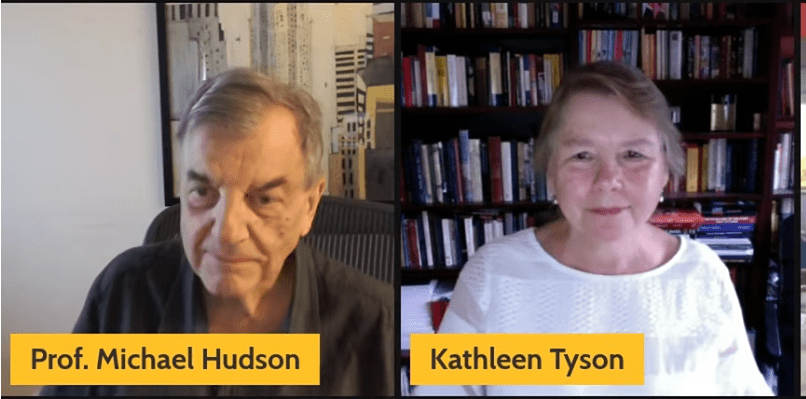
Michael Hudson & Kathleen Tyson at the David Graeber Institute —
00:00:31 Nika Dubrovsky
Hello, everybody! Thank you very much, Michael and Kathleen, for coming to David Graeber Institute. Michael Hudson, a very well-known legendary economist, author of many books, and Kathleen Tyson is also an author of amazing books and has great experience of working inside the system as well as Michael. As we all know, the system is rapidly changing in front of our eyes. It will be really interesting to talk about infrastructure that is emerging in front of our eyes.
00:01:07 Nika Dubrovsky
So last time we talked about gold, and I am reading Kathleen Tyson, and she just posted this information about big chunks of gold moving across the earth, across the globe. So maybe we start from that, Kathleen.
00:01:26 Kathleen Tyson
Well, China has been shy about laying out the entire plan for gold, but it’s now becoming visible. So first was the Shanghai Gold Exchange, and that was a huge liberalisation. I actually had a great chart about China’s liberalisations. Let me see if I can find it, I think it’s still open. Ah I do, I have a great chart in front of me.
00:01:58 Kathleen Tyson
So from 1949 when the People’s Republic of China was created, until 1993, the ownership of gold was restricted, very much like it was in the United States and the United Kingdom. Private ownership of gold was discouraged. Even though China is a big miner of gold, it was the state that bought up the gold and used it, strangely enough, to buy foreign exchange reserves. So that ended in 1993. In 1994, they opened a domestic gold market where people could buy gold.
00:02:31 Kathleen Tyson
People or businesses could buy gold, and they aligned the prices in the market with international markets. So they ended the preferential pricing for producers. In 2002, they founded the Shanghai Gold Exchange, and that was the first full liberalisation of gold in China, with free domestic trading of gold. In 2005, they introduced a law on the immunity of property of foreign central banks from compulsory judicial measures.
00:03:09 Kathleen Tyson
This is diametrically opposite to what we have in the West, where central banks like the Bank of England or the Federal Reserve feel entitled to steal gold from anybody they don’t like. They stole gold from Yugoslavia, from Iran, from Afghanistan, from Venezuela, from…
00:03:33 Michael Hudson
Not Libya?
00:03:35 Kathleen Tyson
Libya. Well, Libya wasn’t — well, we don’t know how much the reserves were that Libya held in the Fed.
00:03:40 Kathleen Tyson
But certainly all the gold that was in Tripoli disappeared very suddenly onto big jumbo cargo jets that left mysteriously and never reported it.
00:03:53 Michael Hudson
Iraq?
00:03:53 Kathleen Tyson
Yes, definitely. In 2003, we stole all the gold out of Iraq.
00:03:58 Kathleen Tyson
But what China did was they passed a law in 2005 specifically saying that if it’s central bank or officially owned gold, it cannot be subject to seizure or expropriation. So very much 100% opposite, or 180 degrees opposite of the attitude that we steal what we can take in the West. In 2007 and 8, Singapore Gold Exchange opened to foreign banks that they could actually be members.
00:04:26 Kathleen Tyson
That was huge. The Shanghai Gold Futures Exchange was approved and started listing derivatives in gold, silver and other metals. So those were two very big measures, and the Futures Exchange gold were the first financial futures contracts to trade in China. It’s a really big liberalisation for them. In 2010, I promise this doesn’t go on much longer, they introduced gold accumulation plans. Those are bank accounts where you can take your monthly salary and say buy a gram of gold for your gold accumulation account.
00:05:04 Kathleen Tyson
And you can actually redeem the account for physical gold. So banks have to reserve in physical gold against their obligations in those accounts. Again, a huge innovation that’s been very, very popular, especially among the young and particularly among young women. A lot of them buy a gram of gold with every paycheck. And of course, with gold prices doing what they’ve been doing the last five years, that’s worked out very, very well for them. In 2013, Singapore Futures Exchange extended its trading hours to continuous overnight trading to become a global exchange.
00:05:40 Kathleen Tyson
So it’s open wherever you are. Again, that was a big innovation, and it drew a lot more gold trading into the Shanghai market. I’m going to skip a bunch of these because they’re bitty. In 2018, they introduced market makers. This is actually very important. Very few exchanges have much liquidity unless they embrace market makers and allow market makers to make markets by being a buyer or a seller that intermediates liquidity when it’s not otherwise there.
00:06:13 Kathleen Tyson
So by bringing in market makers, they smooth the price action and made price much more predictable, and also smooth liquidity so that people felt much more confident trading in Shanghai. That’s actually quite an important infrastructure point, because the market makers don’t always get the appreciation they need and deserve, especially from BIS and IOSCO.
00:06:41 Kathleen Tyson
By 2019, Shanghai Futures Exchange was the second largest gold market in the world, passing London. It is just behind the Chicago Mercantile Exchange. That’s a big development, obviously. In 2022, they implemented the Futures and Derivatives Law of the People’s Republic of China. That made their laws more standard with global expectations. Again, giving confidence and certainty of legal principles that all the lawyers in the world can sign off on.
00:07:11 Kathleen Tyson
And then they introduced rules for qualified foreign institutional investors which then were able to deal in Chinese markets much more easily.
00:07:30 Kathleen Tyson
And finally, in 2025, they eased gold import rules, making it much easier to draw gold into China. And gold has been leaving, strangely, London and the United States and going to China. Gold has been the biggest export out of the United States for six out of the last eight months. And then they launched contracts for gold delivery in Hong Kong. Now this is where the Hong Kong story comes in. You can now trade on the Shanghai Futures Exchange or the Shanghai Gold Exchange. Contracts that will then deliver your physical gold to you in Hong Kong in the Hong Kong vault.
00:08:05 Kathleen Tyson
And that makes it much easier for the globe to participate in the market in Shanghai. Because in Hong Kong you can trade for the gold and settle the gold in US Dollars, in Euro, in Hong Kong Dollars, or in Renminbi. So say you’re a bank in the West and you don’t have a lot of Renminbi reserves, but you want to buy gold in Hong Kong. You can buy that gold with your US Dollars or your Euros.
00:08:36 Kathleen Tyson
And bringing us bang up to date, the last item on the list, this year they founded the Hong Kong Precious Metals Clearing Corporation for interbank clearing. This is big plumbing. It’s only interbank, and with eleven founder members of Shanghai Gold Exchange. Those are HSBC, City, UBS, Morgan. And those are the members of the London LMBA, London Precious Metals Clearing Limited.
00:09:10 Kathleen Tyson
So those are the same banks that back London trading. Clearly that market is now expressly targeting London, because instead of trading the one kilogram bars that you trade in Shanghai. They’re trading four hundred ounce London Good Delivery bars. They’re really aiming to displace Chicago, displace London, and become the world’s gold capital. They don’t talk about it; they just do it in the plumbing.
00:09:41 Kathleen Tyson
There, plumbing.
00:09:46 Michael Hudson
I think that’s great. Also, what’s leading to all this? What can I say about gold? A few weeks ago, the Netherlands said that it wants to remove all of its gold from the New York Federal Reserve to itself, citing international political instability. Meaning, just what you said: we don’t want America to grab our gold if there’s a fight between us and NATO. And Trump is a pirate.
00:10:17 Michael Hudson
The Netherlands did what Germany has been trying to do for a whole year, for I think three or four years, it’s been asking for its gold back. We may have discussed this before. America said, ‘Well, it’s really hard to locate all these planes. Anyway, look, we’re the people who paid for the NGO support of Friedrich Merz and all of your big politicians. You really owe us for this. Don’t be uppity.’
00:10:48 Michael Hudson
Don’t ask for your gold. We’ll look at that. That could start a trend. And that would be an unfriendly act. You Germans don’t want to make an unfriendly act towards the United States, do you? And Germany backed down. And reporters were calling me from Germany. Newspapers saying, ‘Do you in America? Do you know what happened to this gold? We can’t find any trace of it in the German press.’ Well, the Netherlands finally just came out of it. If we don’t have it now, you don’t really own the gold unless you hold it.
00:11:21 Michael Hudson
My wife and I had discussions for a few years. I would have liked to have bought gold, but I didn’t want to keep it at home because I’ve been robbed quite a few times. I thought, where am I going to keep it? Paul Craig Roberts suggested I could put it in Singapore, but who knows what’s going to happen there? Now Hong Kong, I trust mainly because I have friends in Hong Kong who follow things.
00:11:51 Michael Hudson
So I think that China definitely has the most secure place to hold gold at all. And all that’s going to be more important in view of the Shanghai Cooperation Organization that led to the Vladivostok Eastern Economic Conference a week later, culminating in the BRICS. The one thing they can all agree upon is that yes, we need some alternative to the US Dollar.
00:12:23 Michael Hudson
And there can’t be any such thing as a BRICS currency. But there can be a kind of market basket that will be used not as a means of payment, but as an accounting practice. Like Keynes’s plan way back in 1944 to say, and you have to denominate credits and debits between payments surplus and payments deficit countries. Gold is going to play a large role in this. Obviously.
00:12:53 Kathleen Tyson
I’ve actually read the joint statement from BRICS now. They didn’t actually embrace the basket. For the fifth year in a row, they’ve said local currency trade, in your own, your partners, or regional currency, and further cooperation on payment interconnectedness. It was great to see President Cyril Ramaphosa from South Africa. He was really excited to share that he had used his South African debit card in India at a bookseller’s to buy books.
00:13:30 Kathleen Tyson
And it had cleared instantly through UPI in real time in India and through his account in South Africa.
00:13:43 Kathleen Tyson
Which is really the right way to do it. I love UPI. It’s one of my favorites. It’s probably my favorite payment system. I globalized UPI as a component of a central bank platform that now runs fourteen central banks. So you can just buy it off the shelf pretty much. It’s real time. It’s fully transparent. It can do micro transactions up to wholesale bank transactions. It works and it makes sense. Oh, the cost. Infinitesimally smaller than Visa, Mastercard, Fedwire, or any other system big banks use.
00:14:19 Michael Hudson
What country is administering it? Who is administering it?
00:14:24 Kathleen Tyson
Reserve Bank of India. For SIPs in India, it’s Reserve Bank of India. It runs on their platform as a modular component of an entirely integrated real-time system. They can actually press a button and get the balance sheet of the entire government of India in twelve minutes. That’s the system I globalized as domain expert with Intellect, and it now runs fourteen central banks. So I’m really kind of proud of that.
00:14:54 Michael Hudson
I think one of the big problems that was stopping the BRICS is what they are going to do if India begins to buy Russian oil again. Russia has already said they have enough Rupees, and the Rupee is going down. How is this problem of the falling Rupee as a payment for oil going to be affected by gold?
00:15:19 Kathleen Tyson
Russia has been trying to find workarounds. It’s ordered some ships from India for India to build some ships for it. Russia can actually build its own ships. It doesn’t need to do that, but it did that as a way of using up the Rupees. And it can use Rupees to buy gold in India and export the gold. India, Russia, China—they all have gold exchanges. Dubai, Riyadh—they all have gold exchanges.
00:15:49 Kathleen Tyson
It’s not a perfect system. But I think it’s also important to appreciate that the Indian Rupee and the Indonesian Rupiah are under attack. They’re being attacked by the United States, by Bessent’s Treasury, as a way of weakening what are seen as two of the swing states in BRICS. They’re hoping to weaken them sufficiently so that they would fall into the U.S. camp when the U.S. brings war to Asia.
00:16:16 Michael Hudson
Is this attempt to weaken them actually driving them together? Is it driving India to the opposite extreme precisely to protect itself against this? Especially Trump has said. He’s been saying for years, and now repeats that he’s going to impose a hundred percent tariffs on countries moving out of the dollar to an alternative currency, and that means India specifically.
00:16:43 Kathleen Tyson
And Trump really wants Indonesia because what he wants to do is control the Strait of Malacca. So you’re right about Singapore being wary because Singapore could end up leveled like the next Dubai.
00:16:57 Kathleen Tyson
And it’s really scary to say that because Singapore is such a wonderful place, and it’s so well administered, and it’s so well run, and really lovely people. But then I would have said the same about Dubai two years ago. I always loved being in Dubai, and now Dubai’s still there. Most people haven’t left, but it certainly had its franchise damaged, and a loss of confidence in some of the arrangements.
00:17:27 Kathleen Tyson
It’s Trump who really wants Indonesia. He really wanted Prabowo, which is why he had Prabowo to the White House and schmoozed him. And the head of the Indonesian military was taken to the Pentagon, and they really schmoozed him. We’ll sell you all these wonderful weapons. And then Prabowo went back, thought about it, and said, “No, you can’t have our airspace.”
00:17:56 Kathleen Tyson
And he decided to side with ASEAN, with China, with India. As you say, you could see it at the BRICS last week, or actually, only over the weekend. Time flies. You could see how relaxed they were with each other, how happy they were, and how they were treating each other as peers, not as a hierarchy. Indonesia was in the group shot with India, Russia and China.
00:18:26 Kathleen Tyson
And deservedly so. It’s a very, very different dynamic to watch, relative to the sort of hierarchical structure that you would see with the IMF or the World Bank, where the only people allowed on stage are the Fed and the ECB, maybe the Bank of England on a good day.
00:18:48 Kathleen Tyson
So it was really good to watch not only the plenaries but the side meetings. Iran hasn’t had diplomatic relations with any countries in the Gulf region since the war, [but] had side meetings with the Saudi foreign minister and then with the UAE foreign minister.
00:19:11 Kathleen Tyson
That’s big. So often with BRICS, what you’re seeing isn’t so much what they’re saying on the floor, but what turns out in the joint declaration. Although I always read those for fun because I’m that sad. But it’s the action on the sidelines. The side meetings tell a big story.
00:19:31 Michael Hudson
Those meetings between Iran and the Emirates and Saudis, they had promised that today there was going to be a big agreement for trade through the Strait of Hormuz. How were Iran and Oman together going to administer them? For what routes are permitted? What ships will be permitted or not permitted? And what will Iran and Oman charge? But obviously, The Saudis and the Emirates are still…there wasn’t any agreement that was reached yet. We’re still meeting. We’re going to discuss it. Obviously, the Emirates are pulling back.
00:20:14 Kathleen Tyson
It’s funny to watch because you have Iran suddenly being quite diplomatic, but you also have the Houthis kicking off. You have Ansar Allah that’s just bombing the crap out of Saudi. Taking out the East West pipeline, taking out the oil pumping station on the Red Sea, and really doing serious damage. So what happened was Mohammed bin Zayed — no, Salman — Mohammed bin Salman, must get my Mohammed bins correctly, called Trump twice on Friday and begging for U.S. support. And Trump said no. But he flew in two hundred trainers and the head of U.S. Central Command. So the head of U.S. Central Command has actually been on the ground in Saudi, helping direct the counterattack against Ansar Allah. And the story today was that when the foreign minister came back with the planned meeting in Oman, it was U.S. Central Command that put their foot down and said no.
00:21:18 Michael Hudson
Who said no?
00:21:21 Kathleen Tyson
The general from U.S. Central Command.
00:21:25 Michael Hudson
Ah, right. The general who’s managing the war against Iran, because he didn’t want to give away that card prematurely.
00:21:32 Michael Hudson
Yes, I mean, it didn’t work ten years ago when the U.S. tried to help Saudi Arabia. I don’t think it’s going to work against the Ansar Allah.
00:21:44 Kathleen Tyson
They are showing some amazing skills on the ground. In terms of moving at speed and forcing the mercenaries that have been serving the government and the Saudis out of the territory.
00:21:59 Kathleen Tyson
Nobody expected them to just capture ten billion worth of weapons and equipment, and suddenly they’re driving Toyota Land Rovers everywhere. They’re clearly a bit surprised by the success of the operation, but they’re keeping up the momentum. A lot of the mercenaries that were hired were actually Yemenis from different tribes. As Ansar Allah advances, it clearly looks like the winner, they’re inclined to switch sides because that’s what mercenaries do.
00:22:35 Michael Hudson
So when is Saudi Arabia, if not the Emirates, going to make peace with Iran and realize the U.S. is not going to protect us. Why are we going to war, or is that just Mohammed bin Salman’s philosophy? And how can he hold all of the other families, ruling families, Saudi Arabia’s families together?
00:22:55 Kathleen Tyson
It’s very hard to predict the internal politics in Saudi right now.
00:23:00 Kathleen Tyson
You’ve got some old hands like Prince Bandar, who’s been dark for decades, suddenly popping up again. And trying to be a voice of reason. Because he’s always got, he has very deep, long-lasting relationships in Washington. He used to be called Bandar Bush because he would just walk into the White House whenever he wanted, like he owned the place. So you know, the fact that Bandar has surfaced is to me a signal that there’s a lot more going on than we know.
00:23:36 Kathleen Tyson
Are we even close to being on topic, Nika?
00:23:42 Nika Dubrovsky
I just want to ask again about the technicalities of how the transition is coming and going. Would it be possible? I’m not an economist. Let me ask a stupid question. Previously, if you, for example, had a lot of American government bonds, you would be able to take a loan against them and that would be operational money. Could gold become the same basis and how would it work? Because gold is a physical metal.
00:24:13 Nika Dubrovsky
You have to know that it’s exactly real gold. It’s not half gold, half some other metal. So how all of this infrastructure, physical infrastructure, that looks like they’re building it, could maintain the new financial system? Because you’re basically talking about war. And the war, like you’re talking about, Singapore may be bombed, or Gulf countries bombed, and that’s the safety of the gold, in this case, it’s extremely important.
00:24:44 Kathleen Tyson
Here, China has a solution. It took me a while to understand it. At first, it started out as a mystery.
00:24:54 Kathleen Tyson
Somebody was publishing on Twitter a chart showing growth in Singapore Futures Exchange Vault depository receipts.
00:25:06 Kathleen Tyson
The Shanghai Gold Exchange itself does not publish that data, but the Futures Exchange does. Over the last five years, they had been static at five tons. They might go down a bit, they might go up a bit, but they averaged five tons. And all of a sudden, oh my gosh, and about December, January of 2025, 2026 they started spiking, and I haven’t looked at them lately. But last time I looked at them, it was about ninety-six tons.
00:25:38 Kathleen Tyson
So they, the vault receipts had increased about twenty times. Now those vault receipts are exactly the plumbing you’re looking for to make gold liquid for repo. Because what it is, is it’s a digital certificate. It is electronically transmitted, a digital certificate that says you own these precise bars in the vault, and they have been assayed and they have been weighed.
00:26:08 Kathleen Tyson
And yes, they are what they represent themselves to be. So you have the futures exchange certifying that the gold physically exists and is deliverable. Those digital vault receipts can be used for credit as collateral. They can be transferred, so they can be sold off exchange.
00:26:34 Kathleen Tyson
They don’t actually like that very much, but you can transfer them. That’s the collateral that’s coming into effect. At first, when I saw the spike, I thought maybe it’s Venezuela moving its gold to safety. I wish they had done. Unfortunately, it wasn’t Venezuela. They would be much better off if they had done. Because three big jets flew into Caracas and they took all the gold. That’s the plumbing you’re looking for that makes gold a repo collateral liquidity.
00:27:09 Kathleen Tyson
And I’m quite proud of figuring that one out because it was a big mystery for a few months.
00:27:15 Michael Hudson
For me, the big difference with today’s treatment of gold and what it’s been in the past, after World War One and again after World War Two, when gold was made the monetary basis of world trade and savings by the United States, it was to impose pro-creditor rules. These are based really on David Ricardo’s bullionist rules. They don’t have paper credit; you have to have your currency convertible into gold.
00:27:47 Michael Hudson
And by the US Insistence that other countries be convertible into gold or the US Dollar, when it was convertible into gold at thirty-five dollars an ounce, that became a whole. It was elaborated into a tool to impose austerity on other countries by saying, if you run a balance of payments deficit, how are you going to pay? You’re going to have to pay in dollars or gold, and restrict your money supply so that you will not be able to have a credit and provide the economy with money like the Western countries do by running budget deficits that print debt money into the economy, which is what’s happened ever since the Bank of England was created in 1694. Gold was an attempt to prevent other countries from creating the credit they needed to create their industrial takeoff. This time, gold is not being wielded as a lever of imposing austerity.
00:28:53 Michael Hudson
So that the Western US and Western powers can come in and say, ‘Well, you have to, if you can’t afford the gold or the dollars that somehow inherited the role of gold, then you have to sell off your raw materials and sell off your public utilities to foreign investors to get the dollars to pay the bondholders and the banks.’ So all of that is different now. We no longer have gold as part of a deflationary international system to protect the industrial, the leaders, the creditor nations, and to enforce their power over the debtor countries. That’s the difference now. Would you agree with that?
00:29:38 Kathleen Tyson
Yeah, I would. Absolutely.
00:29:43 Kathleen Tyson
I think of it. You could call it a racket, but I also think of it as a ratchet. As something that grips and then keeps gripping. Part of the ratchet of Bretton Woods was getting countries debt dependent, and then getting them to increase their debt through depreciating their currencies or through demanding that they hold reserves in your currency to be eligible for debt at the World Bank or the IMF.
00:30:14 Michael Hudson
That’s right, yeah.
00:30:17 Kathleen Tyson
Yeah, that system I’m happy to see —Well, it’s still very strong.
00:30:23 Michael Hudson
But what the IMF calls stability plans is actually instability, permanent debt dependency plans. That’s the whole purpose of austerity. You can’t create money to make your economy grow. Only we can do that, and that’s what is trying to be changed right now with the global majority. And that’s what de-dollarization is all about. But I noticed that at the BRICS meetings, the only discussion of the IMF was saying we want more votes in it.
00:30:54 Michael Hudson
And by the way, we want more women in addition to men. So that we can have women and we can vote to impose austerity programs on ourselves to impoverish our population. Just not you. We can join you in this fight. Our creditor, our oligarchies, can all be part of you. That was my takeaway.
00:31:16 Kathleen Tyson
It’s one of the mysteries of BRICS that countries like China and Russia are still a hundred percent behind the United Nations as the mechanism of global cooperation, despite its massive failure to be effective. They’re still loyal to the idea of IMF and the idea of World Bank, despite the evidence of eighty years of track record. You look at the IMF’s biggest clients for debt, and it’s Pakistan,
Argentina. Not exactly the poster children of development. And so, there’s a weird sort of attachment to the historical ambition, regardless of its failing to keep the desired reality.
00:32:12 Michael Hudson
I think this should be really the focus of what we discuss for a while. This is what’s so puzzling. What the world needs is an alternative to the IMF that is not imposing austerity on other countries, but is actually figuring out a way to provide them with credit to help them grow, but in what Xi calls a win-win. I think that at some point, the world is going to go into depression later this year as a result of the soaring fuel, oil prices and gas prices and food prices. This is going to force countries into a choice: What are we going to use our scarce foreign reserves for? Are we going to simply pay the higher prices for oil and gas and food and impose and have to cut back our government spending and not give subsidies to our businesses and homes that are all being squeezed? Or are we going to put the domestic economy first?
00:33:14 Michael Hudson
Most BRICS countries are going to say we put the bondholders first before our economy. That’s the IMF and the World Bank, because a lot of the largest dollar bondholders, [in] Argentina and Brazil, are their domestic oligarchy moving their money offshore into their bonds, and they know that they’re going to pay them. Obviously, what’s needed is an alternative. And I think when, especially when Russia and China have done as you say, talked about yes, we admired the UN, they always say it’s the principles of the United Nations Charter in national sovereignty, but that’s not what the United Nations does anymore. You remember when Stalin was at Potsdam, quipped about well, how many troops does the Vatican have? Today you could say, well, how many troops does the United Nations have to protect its charter principles of freedom of the seas, laws of war, again, laws against genocide and national sovereignty against creditor nations?
00:34:19 Michael Hudson
Well, you cannot have the United Nations charter rules and all these principles imposed, as long as you have the U. S. and European veto power. Now, what are you going to do? You can’t really kick the the US and Europe out of the UN. And it really wouldn’t help, just having more, adding global south votes to the World Bank and IMF.
00:34:53 Michael Hudson
You really need shadow institutions that can be there when you say, we give up. The UN was supposed to go bankrupt last month, according to the UN head. The U.S. isn’t paying its bills. We can’t afford to keep the UN headquarters there. If he really meant it, the UN headquarters would have been closed. But I think the BRICS, led by the Shanghai Cooperation Organization basically, is really China and Russia and Iran that are going to be the core, the creditor nations and the energy suppliers of the world. I think that they really have to take the lead in designing this alternative that’ll lead people to actually move and say, if you’re going to just veto all the UN principles, including the World Trade Organization, you know then we’re going to create a shadow United Nations, and that’ll be us. Just follow this and let the old New York UN dissolve.
00:35:58 Michael Hudson
And we’ll have the new Hong Kong UN, or wherever it is, replace it, And we’re going to have our own international bank that is going to actually be, to the extent that there’s international credit, it’s not going to be credit with an idea that it will extend you a loan you can’t pay it, And will foreclose on your natural resources and your oil and your mining, but actually credit to help them grow. Like, how is China going to treat itself as creditor for its Belt and Road investment?
00:36:33 Michael Hudson
That’s going to be different from how the United States has treated its recipients of credit. That’s I think what we should talk about.
00:36:44 Kathleen Tyson
Let’s do that. What BRICS has done is create the New Development Bank, which is a Shanghai-based development bank for BRICS members, and that has actually been very effective. It’s almost entirely staffed by people that came out of Western development banks, so it’s very much on the same model as the IMF, which is a bit unfortunate. But it does do finance in local currency, so you can borrow in your own currency, which gives you a bit of protection.
00:37:16 Kathleen Tyson
The other thing that they’ve done, and there is actually now a Belt and Road Bank that they’ve set up in one of the Central Asian countries, I forgot which one. That’s just getting started. But that, and of course, there’s the infrastructure bank that they’ve built. That’s been great and has built huge infrastructure in lots and lots of Belt and Road countries. So it’s done those three things. Now in the last year. I was just trying to figure out what’s going to happen with the SDR weightings.
00:37:50 Kathleen Tyson
The IMF issues something called the special depository receipt, which are special drawing rights. Special drawing rights were innovated in 1968 to be an alternative to dollar reserves, and they’re a basket of, at the very first SDR was 18 currencies, which was a bit stupid, so they narrowed it down to five currencies, which became four with the Euro, and then in 2015 they finally finally allowed China in. Up until that point, all of the countries represented in the SDR were Western powers from World War II.
00:38:33 Kathleen Tyson
Both Axis and Allies, because Germany and Japan both got in. But it’s letting China in was the first time they allowed a global South currency to have any weight. They started. They came up with a formula that diminished the weight. The formula is fifty percent exports and then fifty percent financial. And the financial components there are three of them: foreign exchange, foreign reserves, and external credit in your currency.
00:39:05 Kathleen Tyson
Obviously, China sucks there because although it’s been growing, it’s still only eight percent of the foreign exchange market because they refuse to allow Chinese Renminbi to settle in CLS Bank which by the way I also built. I did the governance for the Group of Twenty and then I designed CLS Bank for IBM operations. So I also built that. And it does a peak 22 trillion dollars a day in foreign exchange settlements. But they will not allow Renminbi in.
00:39:35 Kathleen Tyson
They won’t allow Rupee. They won’t allow Rupiah. They’re never going to allow any currencies that could take market share away from dollars. So China has been having to globalize liquidity in Renminbi through its own banks. It has done it through ICBC and Bank of China, which have global clearing hubs for Renminbi now. So it’s growing, but it’s doing it the hard way, unilaterally, instead of being allowed into CLS Bank, which would have made it really super easy for everybody to deal in Renminbi.
00:40:10 Kathleen Tyson
The other thing they’re doing, and this is where I get excited, you were saying you need to refinance, you need to get out of the dollar. Guess what? They’ve been doing that. They’ve been refinancing sovereign debt from Belt and Road states and BRICS states into Renminbi debt. Renminbi debt is trading at like one point nine five, where the ten-year treasury hit five percent today.
00:40:43 Kathleen Tyson
Renminbi debt gives you a discount in debt service of about sixty percent. Wow! What debtor isn’t going to love that? So what I think we’ll see in the next year or two years, as U.S. rates spin out of control, and five percent is basically unserviceable on a forty trillion debt. As US rates, and by the way, Britain’s even worse today. Ooh, gilts are ugly.
00:41:13 Kathleen Tyson
But as Western debt destabilizes with higher rates, it’s going to be every country in the world lining up to refinance into Renminbi. China pays off the dollar debt and extends Renminbi debt. The foreign creditors get their dollars back and can’t really moan too much. The debtor gets a debt service sixty percent lower than they had with Western financing. That’s where I’m looking for growth really happen and change things.
00:41:47 Michael Hudson
Is the global South dollar debt really all going to be repaid? Why should China help countries pay the dollar debt when it’s the United States that’s caused the financial crisis by waging the oil war first against Iran, then against Russia, then against Venezuela? Why doesn’t China say,
look, the United States has been making bad loans. These are bad debts. These are debts that have gone bad. If a debt is made without any foreseeable means of repayment by the debtor country without imposing austerity and sacrificing its growth, then it’s a bad loan. It’s a bad debt and should be wiped out.
00:42:42 Michael Hudson
Why should China help these countries pay their bondholders instead of saying, “Well, we’ll let the old system go”? Just like there was a moratorium on inter-allied debts and German reparations in 1931, why don’t we have a new moratorium of reparation in today’s crisis?
00:43:00 Kathleen Tyson
Because you’re going to find that the Fed very tempted to rip up or Scott Bessent**’s** Treasury is very tempted to rip up 40 trillion in US Debt. China’s core principle of the People’s Bank of China and of the Communist Party of China is stability and predictability. They think that the way to succeed, to grow, develop, is to have stable policies in the national interest.
00:43:31 Kathleen Tyson
And so, I think — and this is my national hat on as well — China rightly tries to be a Boy Scout and respect international law, international commercial contracts, and international debt agreements, in the interest of stability. Because once you start saying that you can just rip them up because they’re inconvenient, you really don’t have trust in the international system anymore as a basis for cooperation and development.
00:44:02 Kathleen Tyson
I was worrying today that maybe the United States would do to Saudi what they did to Libya. They stole 45 billion in Libyan assets. They claimed the assets didn’t exist. They couldn’t find evidence of the claims. Having killed off the entire Gaddafi family, ‘we don’t, we can’t find the books’. What would happen if they tried that with Saudi? Saudi’s got 770 billion in American claims.
00:44:30 Kathleen Tyson
And it’s got a very large royal family. It’d take a while to kill them all off, different than Libya. But what if they tried the same trick of repudiating the claims, just saying, “Oh, we can’t find those.” Well, what that does is the entire world then destabilizes, because you’d have UAE, you’d have UAE thinking it’s going to be next. You’d have everybody, including Germany, as you say, Netherlands, France, thinking they’re going to be next.
00:45:00 Kathleen Tyson
And then all markets destabilize, and you do get your depression. Very fast, very sharp. China has to be pro-stability. I think they do actually appreciate the rule of law. They have not interfered in any contractual law under English law in Hong Kong. That remains exactly as it was before Hong Kong became Chinese.
00:45:24 Kathleen Tyson
You have English contract law in Hong Kong, and they haven’t interfered with that because they value the stability that brings to the system.
00:45:33 Michael Hudson
The debt is so large that it almost makes the economy unstable because of its high magnitude.
00:45:41 Kathleen Tyson
Here’s where China is just letting America be America. Because Scott Bessent is trapped. That five percent ticker on his ten-year’s today hurts him big time, and he knows it. He said before he took office that he watches the ten year. By that measure, he’s failed because the ten-year at five percent means he’s got to find 2 trillion a year just to service the interest.
00:46:13 Kathleen Tyson
What China is going to let America do is what America will do because it’s the easiest course. They will inflate away the dollar. Countries that are heavily in debt will be able to borrow and service debt and pay back with devalued dollars.
00:46:35 Michael Hudson
Very interesting because Bessent wrote a wonderful article in International Economy magazine where he said, ‘What I want to do as Secretary of the Treasury is the Federal Reserve has been monetizing the U.S. budget deficit, the federal debt, and the Federal Reserve has simply been creating credit by buying U.S. bonds, and we have huge. We’ve been funding the deficit by buying U.S. bonds. I want to have the Federal Reserve sell off most of these bonds.’
00:47:08 Michael Hudson
And I thought, oh my God, if he sells it off, there go the interest rates. So this was his ideology that he wrote that he was going to do.
00:47:17 Kathleen Tyson
Marsh as well. But you don’t hear so much about that anymore now that they’re both in office. They both played hard.
00:47:30 Kathleen Tyson
Solid money.
00:47:32 Kathleen Tyson
Characters, but now that they’re actually in office and they realize the very rigid constraints of the system in which they are, they’ve changed tunes.
00:47:46 Michael Hudson
Yes. And you can see what that’s doing to the real estate market in the United States. With the interest rates so high, even higher, I think, it’s 5.6 or 7% on the 30-year bonds. And if you look at what that does to banks making thirty-year mortgage loans. Hardly anybody can afford. New home buyers can’t afford to take on new mortgages to buy the homes at existing market prices, or even to cover their mortgages at these high rates.
00:48:17 Michael Hudson
And the mortgage market’s dried up, and so have the holdings of the new landlord companies like Blackstone. Can we redeem our shares? Could you let us sell our shares? No, They’ve frozen the redemptions. Look at what’s happening already, and that’s before you have the real price rise in oil when the national petroleum reserve runs out.
00:48:51 Kathleen Tyson
It’s a real estate is an interesting market because of the demographics. Real estate is very highly concentrated in the over-50s in the United States because basically, if you’re under fifty, you’ll never be able to afford a house with mortgages as they are today. As that generation begins to die off, a lot of those houses actually aren’t very marketable. Florida and Arizona are not particularly marketable to young people.
00:49:23 Michael Hudson
Yes, the global warming in Florida.
00:49:26 Kathleen Tyson
And so there’s going to be a huge surplus of houses for sale now in Florida and around Washington DC and in other pockets where the houses are really not moving.
00:49:44 Kathleen Tyson
The prices aren’t dropping as much as you’d expect because everybody thinks my house is worth X. But it’s really beginning to become, as you say, a problem. Eventually, the market will clear; those prices will come down. But in the meantime, it’s ugly.
00:50:07 Michael Hudson
But what if prices come down below the mortgage that’s already attached to them? This means that suppose you have a job and they want to move. You remember when Alan Greenspan said, “Well, people move every three years; they can just sell the house and refinance the mortgage.” Well, now they can’t do that anymore, if they’re not moving every three years but they’re stuck, they’re frozen into where they live and they can’t sell it because of the mortgage. How are they going to pay the difference between what they get and what the mortgage has to be paid off?
00:50:42 Kathleen Tyson
That is a very painful condition. I have had to buy out my parents’ mortgage for negative equity when their house didn’t cover it. That set me back a chunk at the time. But it really wasn’t an option. I was lucky enough to be able to do it. A lot of kids won’t be able to save the house, won’t be able to save the mortgage, and the mortgage, depending on what state you’re in, doesn’t die just because the house didn’t cover it.
00:51:14 Kathleen Tyson
So it varies from state to state. It’s a matter of state law. It can be quite a huge problem.
00:51:23 Kathleen Tyson
Here in Britain, I moved to Britain in 1990 and 1991. Incredibly horrible housing recession, where house prices fell. I think it was 40% from peak to trough. A lot of young people had gotten in on the bubble phase of oh, “you have to get on the housing ladder”, and they did, and they ended up with negative equity. They ended up losing a lot of money. And in Britain, that debt doesn’t die just because you sold the house, you’re still servicing that debt for decades afterwards. I’ve seen that play out here in Britain. I moved here in 1990, and when I opened a bank account, the very first question the banker asked me, because back then you had to be introduced. My boss took me around to Barclays and introduced me. To get a bank account, you actually had to have a reference. The very first question was, “When are you going to buy a house? You have to get on the ladder.”
00:52:27 Kathleen Tyson
And I was like, ‘Your M2 is expanding by sixteen percent. I think I’ll wait.’ And he was just so shocked. I don’t think he’d ever heard M2 used in a conversation before. But I mean, I was definitely right to wait.
00:52:44 Michael Hudson
Good for you. Of course, then the prices began to really take off again.
00:52:51 Kathleen Tyson
Because they expanded the money supply massively. They needed to bail the banks out of the bubble. The banks were all holding those mortgages on their books at book value. They weren’t writing them down just because the property behind them had devalued. The Bank of England let them hold the loans at book value, even though the property had devalued by 20, 30, 40 percent.
00:53:20 Kathleen Tyson
So the bank had a problem. The way to get out of that problem was to print money and give it to the banks.
00:53:25 Michael Hudson
That’s exactly what Obama did.
00:53:29 Kathleen Tyson
It’s hard to argue. I have a lot of respect for Eddie George, who was governor back then. The politics of it were brutal. Westminster needed those houses to move.
00:53:46 Michael Hudson
You mentioned before that, pointed out that many of the officers, administrators of the BRICS banks, just like the national treasuries of these countries, were trained in the United States, and so were China’s administrators, their financial administrators, all were trained here. And my students in China were complaining that a Chinese graduate is second string to the Americans. And as you and I have been pointing out for years, the economics curriculum that’s taught in the United States and England and Europe doesn’t really think about the financial approach that you and I take. Obviously, China really didn’t understand the financial dynamics of its real estate bubble. It let it happen.
00:54:39 Kathleen Tyson
Although, let’s give them credit. They’re the only central bank in history to deflate a real estate bubble without it feeding through to the real economy. Despite that being a massive bubble that did get massively out of control, they sent in the insolvency receivers quietly to assess the situation, to get a grip on it, and then they brought the bubmble down while keeping GDP still growing at 5-6 percent.
00:55:10 Michael Hudson
Good point.
00:55:11 Kathleen Tyson
I think we have to give them some respect for that. Because nobody else has ever done that.
00:55:16 Michael Hudson
They handled the problems they created very well.
00:55:19 Kathleen Tyson
I think the key thing was once they knew that they had a really big problem, was creating a cadre of resolution experts, and then creating a program for the resolutions that was adapted to each locality, and then keeping the data, identifying best practice, and spreading best practice in real time. Which is something China excels at.
00:55:44 Michael Hudson
That’s what Obama refused to do when he double-crossed all of his voters and essentially evicted, foreclosed on all the victims of the junk mortgage fraud.
00:55:58 Kathleen Tyson
I think if China hadn’t done it, people would have said it was impossible.
00:56:10 Michael Hudson
They didn’t want it to be possible.
00:56:12 Kathleen Tyson
I think it was designed like Japan to blow up the economy and eliminate a rival.
00:56:18 Michael Hudson
That’s exactly right.
00:56:21 Kathleen Tyson
And it didn’t work with China.
00:56:26 Michael Hudson
Right.
00:56:28 Nika Dubrovsky
So we are exactly on like 60 minutes. It was an amazing conversation. I learned so much. I will now rewatch it and Google and ask you more questions and hope to see you in two weeks maybe. Things are developing so quickly, and it’s really amazing to see your comments.
00:56:50 Kathleen Tyson
Things are happening so fast right now. But it’s always delightful to discuss it with Michael. Pretend that we can find reason amid chaos.
00:56:59 Michael Hudson
And I take a second stage to you today, Kathleen. You were wonderful. You followed it more closely than I have.
00:57:07 Kathleen Tyson
I spend a lot of hours at it.
00:57:10 Michael Hudson
I can see that.