

FM Lavrov : New World Architecture: An Open Dialogue with Sergey Lavrov
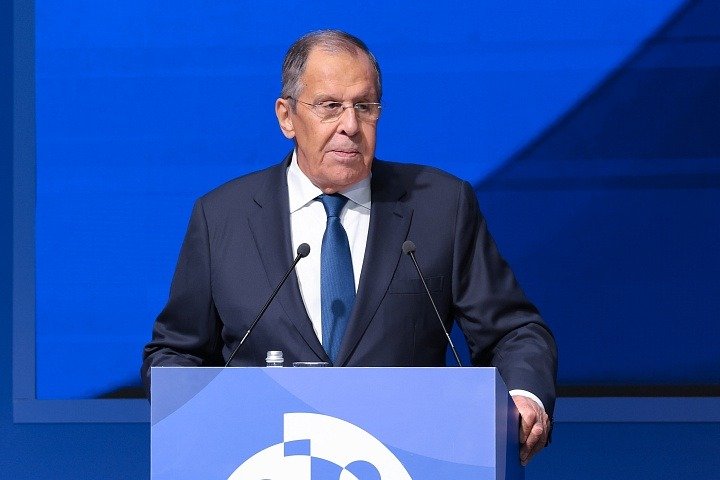
Foreign Minister Sergey Lavrov’s remarks and answers to questions during the panel, New World Architecture: An Open Dialogue with Sergey Lavrov, held as part of Knowledge: Trailblazers federal educational marathon, Yekaterinburg, September 16, 2026
Friends,
I am delighted to be back in Yekaterinburg, the heart of Eurasia, and to join the participants of the latest International Youth Festival.
Yekaterinburg has become the true youth capital of the world this week with over 190 countries – the overwhelming majority of the countries on our planet – represented at the event. Without a doubt, we hope that all of you who had not been here before have had an opportunity to get to know the city and Russia in general. We also hope that you have enjoyed the programme of events prepared for you by the organisers. At the very least, I am impressed by the way the media have been covering your work, life, and recreational activities here. Truth be told, I’ve been envious of you these past few days. I made it here at long last.
We have a great many compelling topics to discuss. Modern-day Russia is moving forward quite rapidly despite headwinds, which we will discuss later. We are taking leading positions in many areas, including the latest digital technologies. Here is a real-life example: elections to the lower house of our parliament will be held on September 18-20. You can cast your vote in just one minute from your smartphone. Such examples abound.
The pace of technological advances is just one factor shaping the modern world. Multipolarity is another key dynamic which we will review in detail today. The Global South and the Global East, the World Majority as a whole, as well as new centres of growth in Eurasia, Latin America, and Africa, are fortifying their positions. They are firmly upholding their national interests and want to manage their own natural resources independently. They are advocating the democratisation of international relations so that the peoples of the countries where these resources are located, rather than overseas territories, can benefit from what history, their ancestors, and God have given them.
The philosophy of equality, now the dominant trend, is particularly characteristic of BRICS. Its latest summit has just taken place in India’s capital, New Delhi. The countries representing very different civilisations within this association demonstrate unity in their determination to maximise opportunities for joint development and do so not at anyone’s expense or to anyone’s detriment, but for the prosperity and security of their peoples. Russia is fully committed to this approach, which is characteristic of other associations of new type, including the SCO, the CIS, the EAEU, and the CSTO.
Unfortunately, the objective process of strengthening multipolarity is running into aggressive opposition from our Western colleagues and their elites. They continue to perceive these developments as a threat to the dominance they have enjoyed for five hundred years during the periods of slavery and colonialism, and are trying to retain their waning dominance by resorting to the most unscrupulous methods, including illegal ones, such as unilateral sanctions, outright pressure, interference in internal affairs, and instigation of conflicts.
Today, two opposing trends have collided. One is represented by those who want to preserve the old world order and its old system of governance, in which a minority benefitted from the subjugation of the majority. The second is about the emergence of a more balanced and equitable world order based on the key principles of the UN Charter, above all the principle of the sovereign equality of states. Our Western colleagues have not once respected this principle throughout the history of the world. They have always regarded themselves as the main actors who call the tune. Yet life is nevertheless forcing them back to complying with the principles of the UN Charter.
The organisation itself is not in the best shape, because the goals of the Charter are not being fulfilled by all its members. If you read the Charter today, you will see that it fully meets the challenges posed by history to the process of shaping a multipolar world: the sovereign equality of states, non-interference in internal affairs, respect for sovereignty, and respect for the right of nations to self-determination. This particular right provided the international legal basis for the decolonisation process, which began in Africa in the 1960s.
These are the links in the same chain. This year alone, the West, in an effort to uphold its waning dominance, carried out an invasion of Venezuela (and abducted its lawfully elected president) and an armed aggression against the Islamic Republic of Iran (and killed Iran’s Supreme Leader and members of his family). The same applies to the conflict in Ukraine, which is a direct consequence of the West’s expansionist policy. Confrontation is not our choice. President Vladimir Putin has made it clear many times.
Over decades, we sought to promote a friendly and unifying agenda with regard to our Western neighbours, including with a view to creating, across the vast space from the Atlantic to the Pacific, an architecture of peace, equal, and indivisible security, and mutually beneficial, practical cooperation. All of that is history. All of it was spurned by the West, which has not learned to interact on an equal footing. I am confident that the process of learning will continue and will play its part.
The West made its choice long ago in favour of containing Russia, including through the forceful and brazen expansion of NATO towards Russia’s borders. We often hear the EU leaders talk about the need to prepare for war with our country. This is the most popular topic in the speeches of today’s European elites and the leadership that has settled in Brussels. We have repeatedly made it clear that we have no intention of attacking Europe. Recently, President Vladimir Putin once again addressed this issue in detail, stressing that we have no interest whatsoever in doing so. However, if Europe, which never stops speaking about preparing for war against Russia, attacks the Russian Federation, it will be a completely different war. A very short one. I hope European capitals and the entities that are now trying to portray themselves as united Europe heard this warning.
This is precisely where the West’s Ukraine policy is heading. The West sticks firmly to its stance, which looks more like an ultimatum. It will never recognise the fact that Russia has allegedly seized the regions and never recognise the legitimacy of such actions. In their world, the Kiev regime, an openly Nazi regime and the only one in the world to have banned the Russian language, is a legitimate regime.
Since 2017, the Verkhovnaya Rada of Ukraine has adopted a series of legislative acts banning the Russian language, beginning with primary, secondary, and higher education and extending the ban to all Russian-language media owned by Russian businesses and Ukrainian citizens. The cultural events in Russian, including films and concerts, have been cancelled. People get arrested for songs they upload to the internet.
Yesterday, I held a meeting with ambassadors from the World Majority countries. We meet regularly. They were interested in the latest developments in Ukraine. An ambassador from an Arab country cited Dostoevsky and Gogol about the “tear of a child” and the idea that “beauty will save the world.” He asked me what Russia could do to save the world now. We hold Fyodor Dostoevsky, Nikolai Gogol, Alexander Pushkin, Mikhail Lermontov, Leo Tolstoy, and many other great Russian poets and writers in high regard. They are part of the treasure trove of world literature and culture. However, if this question is asked in the context of the events in Ukraine, it would not be out of place to remind everyone that, just like Nazi Germany, Ukraine is destroying books, specifically, books in Russian. The Nazis burned them, but the Ukrainians, being less wasteful, recycle them as waste paper. All Russian-language books have been thrown out from the libraries and “put to use.”
This is the policy of the West, primarily Europe, which strives to keep an openly Nazi and Russophobic regime in power and openly discusses plans to deploy “mobilisation forces” on the territory controlled by Zelensky. In his comment, President Vladimir Putin conveyed that this would amount to Europe declaring a direct war on Russia, rather than a hybrid one.
For us, the Ukrainian settlement means accomplishing the goals that were set at the beginning of the special military operation to eliminate the underlying causes of the crisis. As I mentioned earlier, these include plans to bring NATO, including its military infrastructure, in direct proximity to our borders; the oppression of all Russians; and an official and legally enshrined state policy aimed at wiping out everything Russian, including education, the media, and culture, and even the use of Russian in everyday life. Efforts, although fairly unsuccessful, are being made to ban the Russian language. Nevertheless, Zelensky and his team continue to pursue this with a persistence that could be put to better use.
As I just pointed out, we cannot operate on the premise that the Nazi regime currently in power and its Nazi ideology and practices have been enshrined in law and are being implemented on a daily basis. Consider Zelensky kneeling before the remains of Nazis – WWII criminals – which were brought from European countries and given a ceremonious reburial, and his plans to create some kind of a pantheon of heroes, and to do so, of all places, on the hallowed grounds of the Kiev-Pechersk Lavra.
For us, eliminating the underlying causes and threats, and protecting the rights of the Russian people, including the right to their native language and Orthodox faith, remain absolutely clear objectives of the special military operation. I am confident that achieving the objectives set out by President Putin will not only help settle this crisis, but will also improve the situation across Eurasia, above all in its western, European part, but not only there. It will contribute to establishing an international order based on a balance of interests without claims to hegemony or dominance and on international rules.
Adapting international relations to the realities of a multipolar world which I mentioned at the top of my remarks is an objective process. The overwhelming majority of countries have a stake in seeing it succeed, although it will not happen overnight and may take an entire historical epoch.
Our allies, like-minded partners, and strategic partners, and those helping this objective process overcome the obstacles that are thrown in its path, include numerous countries around the world, primarily the CSTO, the EAEU, and the CIS member states. That also includes new global development centres such as China, India, and Brazil; the SCO and BRICS countries; and the countries of Eurasia, Latin America, and Africa. There are numerous subregional organisations and associations on these continents. Africa also has a continent-wide mechanism, the African Union; in Latin America, there is the Community of Latin American and Caribbean States.
Eurasia has so far lacked a continent-wide umbrella organisation, which is a historical consequence of the way the world was structured after the end of the Second World War. Nevertheless, we advocate building bridges despite the presence of occasionally significant differences between western Eurasia and eastern Eurasia.
At one point, President Putin put forward two initiatives which we have consistently advocated and promoted. The first one is to pool the efforts of all Eurasian economic integration organisations. The EAEU, ASEAN, and the SCO have already established partnerships among themselves and are launching dialogues with the League of Arab States and the Cooperation Council for the Arab States of the Gulf. My point is that with the participation of these already well-established and fairly successful subregional entities, as well as individual countries that are not members, we can build what we have designated as the Greater Eurasian Partnership. The idea is that this would provide a robust material foundation for the gradual and dialogue-based creation of continent-wide Eurasian security architecture for all Eurasian countries to participate.
When discussing multipolarity, we also need to build bridges between the countries from different continents, primarily the Global South. As I pointed out earlier, just like our other partners in BRICS, the SCO and other organisations, we are not rejecting relations with the West.
As President Vladimir Putin recently argued in his comment on a similar issue, it was not us who rejected the US dollar. We were willing to continue using it, if only those who issue this global currency had honoured their commitments. I remember very well the US leadership claim 20-25 year ago that the US dollar was not American property, but a global public good, and that everyone should use it regardless of the country, government, or particular company involved. So it was not us who undermined the US dollar’s widely trumpeted role. We are simply being forced into moving towards new forms of cooperation where no one can impede our efforts and payments related to servicing our trade and investment with the countries that are part of the organisations that I mentioned.
This was discussed at the most recent BRICS summit in New Delhi, where Russia’s proposals, including the creation of alternative payment platforms, settlement and depository mechanisms, and a reinsurance mechanism, as well as an investment platform, and a grain exchange, were discussed.
We are not claiming that what I just listed should replace the existing global entities that have dealt with and continue to deal with these matters under Western control. But if the West restricts access to these instruments that are essential to the functioning of the global economy, we have no choice but to create alternative ones.
We understand that amid the “multicoloured” world we are witnessing today by which I mean the large number of subregional entities in Eurasia, Africa, and Latin America, the risk of misunderstandings is increasing. Some even say that multipolarity will ultimately turn into chaos. They tell us we will all be mired in unending arguments with one another and be plotting against each other. They say the bipolar world of the Cold War era is history, but the need for order is still there. From their perspective, the ideal option is either the American model of a unipolar world where one boss run things and keeps them in order (I think the events of the past two years have shown that this way of running things will be ruinous) or, they say, we need to create Chimerica run by China-US bilateral arrangement for governing the world on the basis of established bipolar agreements.
I don’t think this model is robust. First, the People’s Republic of China is promoting a completely different philosophy of international relations and of its own role in them. Chinese President Xi Jinping has put forward four, or perhaps even five, global initiatives on ways to ensure security in the world, to reform the global governance system and to address many other urgent international issues. Russia is participating in promoting these initiatives, and we know for certain that the PRC remains fully committed to multipolarity and polycentrism.
I would like to close by saying a few words about how we interact with our partners in the humanitarian sphere. Projects that reflect a new approach to cultural ties, sport, and some other areas are important to us.
The Games of the Future, which have now been held for the third time and bring together e-sports and traditional sporting disciplines stand out among these initiatives. The same team must show on a computer screen how well it can score goals and then go out onto the field and do so for real. This is a very interesting and promising initiative.
Let me also mention the Intervision International Song Contest. Held in the Russian Federation in 2025, it was a success. The next one will take place in Saudi Arabia. Political and diplomatic efforts are required to support and accompany initiatives of this kind, and I have listed just some of them. We have been working together with like-minded forces on this agenda. Future generations of diplomats will undoubtedly perpetuate many positive undertakings, which we are launching or about to launch, and I hope that this includes those of them who are in this room today.
We have always attached great importance to enabling Russia’s youth to socialise with their peers. There is a whole series of annual academic excellence competitions, skills and craftsmanship championships and reunions. The annual Young Scientists Congress has established itself as one of the central events in research and education.
Empowering young people to unlock their creative potential has special importance for us. There is the Diamond Butterfly, a Eurasian film award, as well as the Tavrida.Art festival in Crimea. All volunteers know about the We Stand Together international award whose mission consists of supporting major social projects.
Russian universities have been witnessing a steady increase in the number of foreign applicants on top of the Russian Government quotas. There is a new mechanism for offering grants to talented international applicants. Today, about 400,000 foreigners are studying in Russia. If among you there are those who attended our universities, I hope that you have been sharing your experience at home.
Therefore, the international environment remains in a constant flux. To anticipate any unforeseen developments, forums like this serve a very useful purpose by bringing together young and middle-age people and enabling them to engage in a free and open conversation to discuss matters they care about. I have no doubt that this festival will contribute to ensuring the wellbeing and prosperity for the entire humankind, all the people on our planet.
Question: There has been much talk lately in Russia about the upcoming election, but in Europe we are being told that there is no democracy over here. What can be expected from this election and why does it matter?
Sergey Lavrov: Any election is more than just a voting process to elect a candidate or a party. This is also when the nation expresses its will and chooses its path for the future and the way their country will develop over the next election cycle.
This election is taking place against the backdrop of a war. The so-called collective West declared it against us and has been fighting this war through its Ukrainian proxies and using them as cannon fodder by spending lavishly to supply them with weapons, munitions, and also sharing the latest technology, intelligence and satellite data. We know all this very well.
There is nothing new about the objective the West has been pursuing. It consists of inflicting yet another strategic defeat, as they call it, on Russia. You will not hear them mention this today as frequently as they used to since the very notion of strategic defeat has somewhat paled. This, however, does not change their posture in its essence. The West has been talking about supporting Vladimir Zelensky until the very end, arguing that he stands for what they call European values. This is what President of the European Commission Ursula von der Leyen, and the EU chief diplomat Kaja Kallas, as well as Chancellor of Germany Friedrich Merz, President of France Emmanuel Macron and others have been saying. This, however, means only one thing: these would-be European values – and the European Union claims that Vladimir Zelensky took a stand for these values – provide for cancelling the Russian language across all spheres along with the canonical Ukrainian Orthodox Church, while encouraging Nazi ideology and acts and promoting an all-out militarisation effort. These factors constitute the root causes of the conflict, and our special military operation is designed to address them.
Without going as far as destroying Russia – and I do think that despite all their bombastic statements there are still some smart political figures there, they want to destabilise Russia. Truth be said, there are groups of former Russian citizens who fled to the West and are now working there to create all kinds of organisations for what they call decolonising Russia, which amounts to tearing the country apart. This is an old project, which has been tried and tested a long time ago. But when the Soviet Union ceased to exist, and there were attempts to move in this direction, they failed. Today, there is an effort to revive this project. I firmly believe that they understand that they would not achieve their objectives, which does not mean that they will not try creating an unstable environment, destabilise the country so that people when casting their ballots do not answer their hearts’ calling with an understanding of the lasting challenges our country is facing. Of course, we are witnessing attempts of this nature.
There is also a second aspect to this matter. All this results from the fact that, just like in the previous years, we are witnessing attempts by the West to directly interfere with the free expression of will by our citizens during this election campaign. This has been especially apparent abroad, but there were also attempts to act this way inside Russia. When people come to the polls, they want to vote for their future, for that future to be bright, and for the social and economic situation to improve across all the regions of the Russian Federation. What they want is to live in safety and security. This is where the West took its aim. This is to say that foreign policy has been a major aspect in this election campaign and has had a decisive role in terms of what needs to be done during the election, which is scheduled to begin in just a few days. An overwhelming majority of our people, and I have been talking to many of them, understand that they need a strong country, a strong Russia to move towards better living conditions. But apart from the comfort of everyday life, most people in our country adhere to traditions and culture which have taken shape over the course of our millennial history. The overwhelming majority of Russians is not ready to give up these traditions in exchange for wooden beads of some kind, or what else the West has to offer. It is for this reason that there is an effort to revive Nazism in Europe in order to cancel the feat accomplished by our forefathers who defeated Nazism. People understand this too. Therefore, I am convinced that their hearts will guide them in this election, and that they will vote in full cognisance of continuity in the mission Russia is destined to fulfil in this world.
Question (retranslated): Uganda has opened its economy to any investments. We have created a good investment climate and investment policy. However, Russian presence is limited in Uganda. What do you think is the reason for that? Why do Russian companies not invest in Uganda? What can both countries do to fill this gap?
Sergey Lavrov: Your question concerns our cooperation with the African continent, the African Union and individual African countries. Uganda is an old partner and friend. I have been to Kampala several times and met with President Yoweri Museveni, an outstanding and one of the most experienced politicians in Africa and the world. We share our Ugandan partners’ enthusiasm for paying more attention to trade, economic and investment cooperation. Over the first few months of this year, our mutual trade increased by 70 percent. It is a very high pace, and I have no doubt that it will continue to grow.
In 2025, Kampala hosted the third meeting of the Russian-Ugandan Intergovernmental Commission on Economic, Scientific and Technical Cooperation. Plans have been made for joint projects in agriculture, information technologies, the industry, education and culture. There is no doubt that our partnership will gradually acquire a substantive basis, and its economic component will grow to match the high political standards of our bilateral relations at all levels.
Question: You come from the generation of diplomats who worked during the bipolar system and the unipolar period, and who are now witnessing the rise of a multipolar world. In this connection, I would like to ask you to give some advice to young professionals, young diplomats who began their career in this transition period. What do you think is the most important quality for would-be diplomats?
Sergey Lavrov: We have talked a great deal about multipolarity today. As I said, multipolarity is an objective course of history. There is no getting away from it. Take a look at the statistics of the share of the United States and other G7 countries 20 years ago and today, especially compared to the share of the global economy currently held by the BRICS countries. Those figures are poles apart, and the divide will only widen.
Regrettably, the objective process of the rise of multipolarity is being hindered. I have already mentioned this. After WWII, when the system of international governance was created (the UN, the International Monetary Fund, the World Bank, and the World Trade Organisation), our American colleagues presented it as a common good, as structures that will ensure a smooth, universally acceptable and mutually beneficial course of globalisation. They proclaimed the basic criteria of globalisation: free market forces, free competition, the inviolability of property, and so forth.
Today, all these dogmas and “sacred” ideals have been sacrificed to the idea of “punishing” those countries whose policy the West dislikes, including but not only Russia. Sanctions have also been imposed on Iran and Venezuela. Restrictions have been adopted against the People’s Republic of China and even US allies in the hope that these secondary unlawful restrictive measures will force them to reduce their cooperation with the “main culprits” for the current developments, which do not suit the Unites States. In this particular instance, Russia and Iran. But all other countries that trade with Russia and are in no way connected to bilateral problems between Russia and the West must face “punishment.” Relevant laws are being adopted, and new “bills of rights,” or more precisely, bills of economic rightlessness are being discussed.
Frankly, I believe that this means that the United States and the West as a whole can no longer compete on the basis of the rights, which they themselves introduced in international relations and which seemed to suit everyone for decades. But when some countries began to beat those who invented these rules on their home ground, they started using completely different methods. A case in point is the People’s Republic of China. But there are many other such countries.
However, American political analysts openly say now that globalisation is over. For example, professor John Mearsheimer of the University of Chicago has stated this in a recent interview. The global economy is fragmented, and we are witnessing the regionalisation of global development. This explains the growing significance of numerous regional structures and subregional integration structures, which I mentioned in my opening remarks.
Meanwhile, while developing our policy with due consideration for these trends, trying to promote these integration processes and aligning our economic, trade and investment activities with structures that are most favourable for mutually beneficial joint projects, we are not shutting ourselves off. President Putin spoke about this as well.
We are not closing ourselves off from the dollar or any structures. But these structures should reform themselves if they want to maintain their importance. I am referring to the Bretton-Woods institutions.
If the real economic, financial and trade weight of the BRICS countries were to be honestly reflected in the system of IMF quotas and voting power, BRICS would have more quotas and voting power.
The problem is that the Americans are deliberately hindering the use of objective and understandable criteria. They just “don’t feel like it.” At the WTO, our American colleagues are blocking the operation of the Dispute Settlement Body, because hundreds of China’s complaints, which are gathering dust there, will be granted as soon as that body is unblocked. The Americans simply reject candidates for vacancies in that body, and there is no quorum without them. There are many other tricky methods.
Therefore, we should rely on those who have proved their reliability. Regrettably, the West has nothing to boast about in this regard.
Question: I’m a young worker at Rosatom’s Akkyu Nuclear Power Plant. We are building the first nuclear power plant in Türkiye. A month ago, I was lucky enough to be part of the Knowledge Icebreaker 2026 educational expedition. A group of young people from 23 countries shared their experience and knowledge, solving various tasks.
Are there any global tasks that could bring young people together and create a similar international community for cooperation? And what other event formats are available now, in your opinion? You have already mentioned the Games of the Future and the Taurida today – the projects that could also become a North Pole of sorts for young people, to help them achieve their dreams and aspirations.
Sergey Lavrov: Is your question about events that could bring you together?
Question: Correct.
Sergey Lavrov: And what did you do here on Monday? I don’t quite understand.
Question: We did work together. And what about tasks? What tasks are out there that could bring people from different countries together?
Sergey Lavrov: You know, there are no tasks we would reject straight away. If we see what exactly is proposed and how it serves people’s interests, the state will support these processes. There are special programmes, and it is within the competence of the Russian Government.
This sort of forums, roundtable meetings, dialogues and panels are mainly planned with the expectation that ideas will emerge. Truth and projects are born in debate. I am certain that the organisers of this festival are keeping a log of the ideas voiced here and how we can help the youth movement to see these ideas through.
Question: Russia plays a very important part in the development of the Maldives. In 2025, we had 270,000 Russian visitors. Many Maldivians make Russia their home for higher studies in engineering, science and technology. As a small state with Russia being a big state with large industries, how can we navigate the future multilateralism, strengthening multilateralism and building a future for multipolarity? We should target to increase these 270,000 to one million over the next five years.
Sergey Lavrov: How many tourists from all countries did you get over a year?
Question: (checks his phone).
Sergey Lavrov: I could check my own phone.
Question: In 2025, we had 278,000 visitors. In 2026, we have already had 178,000 visitors. In the next five years, we are aiming to make it one million visitors from Russia. Our Foreign Minister and a delegation from the Transport Ministry visited in August to increase the travel routes from Male to Moscow. We hope to have your support in increasing the youth stake in this trend and entrepreneurship of tourism.
Sergey Lavrov: If conditions attracting Russian tourists are created, this is the most important factor. Then, our task will be to provide transport, insurance and visa opportunities.
But speaking about small and medium-sized countries and how they appear through the lens of building a multipolar world, I have already mentioned the principle enshrined in the UN Charter – namely the sovereign equality of states. The West is putting obstacles in the way of this sovereign equality.
For example, right now, Europe is hunting tankers and bulk carriers operating in the interests of the Russian Federation under the flags of other states in full compliance with the UN Convention on the Law of the Sea. The EU has come up with a term “shadow fleet.” They are developing their own bills that will justify piracy and plunder at sea in order to continue their hybrid war against Russia in this form as well.
They announce, publicly and with pride, that they have caught a vessel carrying Russian cargo under the flag of an African country, which must mean it is fake. Do you know how it happens? It’s a simple scheme. They detain a vessel. Then, the European ambassadors in the country of the flag go to this African country’s foreign ministry or the prime minister’s office to talk, quite blatantly. They say something along the lines of “Our countries are involved in an assistance programme for you that is approved by the International Monetary Fund or the World Food Programme. We will suspend this programme if you don’t revoke the flag immediately.” That is how it goes.
There must be fairness. We see multipolarity as a world where there is no blackmail, threats or sanctions hanging over small or medium-sized countries, and where these countries can be respected and be able to choose their own partners. If they want to be friends with Western, Eastern, or Southern countries, it is their right. They must have the right to choose the optimal, most suitable path for cooperation on the international arena that benefits the state, the nation, the culture, and their capablilities. The West is not willing to allow that. The elites of today will never allow that, I think. But we have patience.
Question: A question has arisen regarding the current agenda. Today, we observe that in several European states, right-wing Eurosceptic political forces are becoming increasingly active. In Germany, this includes the Alternative for Germany party; in France, the National Rally. In this regard, may I ask, can we expect a substantial change in the European foreign policy course in the near future?
Sergey Lavrov: I would place reliance solely upon myself, upon our country, upon our people, upon our capabilities, and upon those neighbours, partners, allies, and friends who have demonstrated both their reliability and their ability to honour agreements.
I would, of course, welcome the advent of nationally oriented political forces to the leadership of any given European state. For what the Brussels bureaucracy is presently engaged in – arrogating unto itself powers and prerogatives that, in essence, belong to sovereign national governments – constitutes, first and foremost, a violation of all the foundational statutes of the European Union.
However, to predicate our policy on the assumption that conservative realists will imminently come to power and that, as a result, everything will once again be harmonious in our relations – we have already traversed this path. I have commented more than once that the Russian people are multi-ethnic, patient, trusting, habitually hopeful for the best, and, indeed, often forgiving.
Ilya Muromets lay upon the stove for thirty-three years, but in the end, he did rise. We wish all our European colleagues success, success in forming governments that will uphold their national interests.
Should that occur, it will, of course, become easier to maintain contact with them, but there will be no return to the “embraces” of the 1990s, or even of the final years of the Soviet Union’s existence.
We did not sever our relations with Europe; it was Europe that did so. We are now entirely self-sufficient both in terms of markets and partners, and, notwithstanding the hybrid war being waged against Russia, everything here is proceeding as favourably and positively as the circumstances permit.
Should any European state wish to resume serious dialogue, we will, first and foremost, listen to their intentions, to what they can offer, and only then will we decide whether such proposals are acceptable to us.
But I can assure you of one thing: in those spheres upon which the security of the state depends, we will not enter into, nor do we intend to enter into, any contracts or agreements with the Europeans.
Question: How can foreign students residing in Russia contribute to the development of international relations?
Sergey Lavrov: In my view, you are already doing precisely that. Contributing to the development of international relations. I have enumerated several events that are organised annually along youth lines in our country. There are a considerable number of them. I am confident that the organisers will circulate the comprehensive list of these events. We will always be pleased to welcome representatives from Pakistan, especially those who speak Russian so fluently.
Question: BRICS is undergoing significant expansion and transformation. In your opinion, what priority should the bloc pursue to ensure the realisation of tangible benefits from this expansion for the Global South?
Sergey Lavrov: There is a great deal that could be said regarding BRICS. Only recently, the presidents and other participants at the New Delhi summit addressed all aspects of BRICS activities in the most detailed manner. BRICS is an association of a new type, within which it is inconceivable – as frequently occurs in the European Union and in NATO – for the opinion of one or two countries to be disregarded, or for utterly indecent pressure to be exerted upon a state so as to compel acquiescence to a position, to put it plainly.
Such a scenario is simply unimaginable within BRICS. The association remains open to new members. Three years ago, a decision was taken to double its membership; there are now ten members, and a further dozen countries enjoy official partner status. The BRICS partner countries have this corresponding status, and an equivalent number of other states are seeking accession to the association.
At present, the new composition of BRICS has been operating for a relatively brief period, and so it was decided to wait a year or two and observe how the “ten,” together with the new institution of partner countries, will function. The Delhi summit demonstrated that the adjustment is progressing admirably. A detailed, substantive, and content-rich Declaration was adopted, addressing all the principal issues in global development, world politics, the economy, and finance. I take a very positive view of the prospects for BRICS’ future functioning.
Question: May Serbia, a country which under President Aleksandar Vucic pursues an independent foreign policy and has not imposed sanctions against Russia, be considered as a possible venue for negotiations between Ukraine and Russia?
Sergey Lavrov: Anything acceptable to the negotiating parties is possible.
Incidentally, our American colleagues, who have visited the Russian Federation once again quite recently, are proceeding from the assumption that they have proposed trilateral talks. Such a format has already taken place in the United Arab Emirates – the United States, Russia, and Ukraine. We are prepared for both bilateral and trilateral negotiations. We have never refused such dialogue.
All the negotiation processes that were initiated – commencing with the Belarusian-Turkish process in March and April 2022, which concluded in Istanbul with the scuppering of an agreement that had already been coordinated, and including subsequent bilateral Russian-Ukrainian talks in Geneva and trilateral negotiations in Abu Dhabi with American participation – all these processes were interrupted, not at our initiative. Therefore, we will await proposals, but I will confide this: we harbour no great illusions.
Question: I am a participant of the Young Diplomats’ Forum. In your view, what will international order look like in ten years and what countries or regions will play primary roles in it?
Sergey Lavrov: It seems to me that a lot has been said on this topic. I envision a more positive world order than today. I expect that Western countries will realise the need for taking their actual place in the international architecture, without trying to dominate it with their much smaller capabilities, and will agree that it is necessary to resume an equal dialogue on international stability above all things.
Frankly, I don’t know what will happen to global economy. Perhaps the de-globalisation that has already happened, the fragmentation of global economy and subsequent regionalisation of economic processes, the concentration of all key decisions and actions within subregional and regional integration structures, the emerging connections among all these structures in Eurasia, Africa and Latin America – all these factors will lay the new foundations for the international economic, financial and investment system. New payment and investment platforms will emerge, along with new exchanges, including a new grain exchange that I’ve mentioned. This is my point concerning economic development.
The West is building closed structures. All the organisations where Russia is involved welcome new members. We are willing to discuss expansion conditions. The United States and its allies are trying to build closed economic, military and political blocs in Eurasia.
Until recently, the Association of Southeast Asian Nations (ASEAN) was the widely recognised centre of dialogue on the vast Asia-Pacific space, with annual meetings for partners, including us, the Americans, the Japanese, the Koreans, and so on. It was an open format. The format still exists today but it has accepted, in priority to others, Britain, which does not promise anything good, as we all understand. Concurrently, groups of three emerge like AUKUS (the United States, the UK and Australia) that work on a nuclear submarine project, which, according to what we know, does not exactly meet the criteria of the International Atomic Energy Agency (IAEA). The United States, Japan and South Korea created a group of three to conduct military exercises in this trilateral format. They have already incorporated components pertaining to nuclear weapon use and storage. There is an Indo-Pacific group of four that consists of Japan, South Korea, Australia and New Zealand.
There is a group called Quad that includes the United States, Australia, Japan and India. It was initially created as a purely economic group that will deal with trade, investment, expanding opportunities, and creating a more convenient infrastructure. But little by little, despite the assurances made to our Indian friends, they are starting to plant military and political components into its activity, including maritime security with respect to the South China Sea, the Taiwan Strait, and other territories.
We are not going to create such organisations. We will do our best to ensure that nothing substitutes the genuinely universal forums on the basis of ASEAN.
It is hard to predict developments in global strategic stability within the next ten to 15 years. Our American colleagues keep proposing to resume the bilateral dialogue. We maintain some contacts, but a full-fledged dialogue requires complete normalisation of our relations.
I am not talking only about sanctions that the Trump administration has already imposed. President Trump used to say that it is Joe Biden’s war and that if he had been president it would have never happened. But now, it is this administration’s war. All the sanctions imposed by President Joe Biden have been extended by the Trump administration, without exception. A great number of new sanctions have been imposed recently, including against Lukoil, Rosneft and other Russian entities, both individuals and organisations. Russia’s diplomatic property in the United States remains seized. Visa rejections for our staff assigned to attend United Nations events continue, along with many other things.
That’s why we appreciate the fact that, first, the Trump administration, unlike the arrogant and not very reasonable Europeans, entered into a dialogue with us immediately after returning to the White House, and dialogues are useful even when positions are diametrically opposed. Second, they understand the root causes of the Ukraine conflict. I have often said this, but our dialogue is friendly and good-natured, and is not accompanied by any material changes in the situation I have described. In addition, our American colleagues insist that strategic stability should be discussed with the involvement of China. We say that this is for China to decide, but we would not protest if they joined us. We would also respectfully accept China’s position if they say that their arsenals are incomparable to tthose of the US and Russia and it’s too early for them to join this dialogue.
For our part, we tell the Americans that they, unlike Russia and China who have no alliance commitments in the military sphere, have such mutual commitments with France and Britain, which also have nuclear weapons. Therefore, any discussion on expanding the dialogue format should above all focus on their trio. But the Americans categorically reject this. There are many other circumstances, but I agree that a dialogue is long overdue.
Everyone is buzzing about the news that the United States has orbited strike weapons. We are checking this information, but it’s unclear what the situation in outer space will be in 10 to 15 years. We have long drafted a UN resolution on no first placement of weapons in outer space. The Americans say “No, how come any? Why any? Let’s agree not to deploy nuclear weapons.” They suspect us of preparing to orbit nuclear weapons. We say that we don’t have such plans. But when we talk about the need to ban the deployment of any weapons in space, that includes nuclear weapons. They refuse to accept it. This is not a very graceful negotiating position, but we are where we are. So, the situation in the world in 10 to 15 years will depend on our ability to promote the position of the Global Majority.
Question: What lies ahead for multilateral diplomacy? Many organisations are going through an existential crisis right now, and others are turning into “exclusive clubs.” How can small countries position themselves in this volatile world?
Sergey Lavrov: Frankly, I think I have spoken in detail about this. I have just now mentioned “exclusive clubs.” Attempts have been made to create such organisations in the Asia-Pacific Region. There is the Trans-Pacific Partnership (from which the Americans withdrew), a closed-type organisation. There is also the issue of artificial intelligence. Although many countries are advocating the idea of transparent development in this sphere under the UN auspices, others are establishing non-universal organisations. For example, the Americans have created Pax Silica for AI development, inviting selected countries to join it. Of course, we are monitoring this process, trying to understand how this will play out in real life, especially in light of the alarmist and anxious statements made by many companies that have AI technologies.
In June this year, the People’s Republic of China held a conference on the establishment of the World Artificial Intelligence Conference. We have joined it. It is an open-ended organisation, which recognises the central role of the UN. The process is underway.
However, you are perfectly right about the “exclusiveness” of the West’s activities on th5e international stage. They like to deal with many issues behind closed doors. presenting their decisions as the result of multilateral diplomacy.
As for small and medium-sized countries, I have spoken in detail about our vision of the multipolar world where everyone will take their rightful place. The use of coercive measures and blackmail against them must stop. I have cited an example when they are forced to stop their cooperation with Russia under the threat of sanctions. This must be excluded.
I don’t know how this can be done, because the West still has access to serious leverage, which should not be underestimated, and this practice will continue. But as the role of global reserve currencies weakens (those which we are used to regard as such), their influence will diminish. As BRICS, the SCO, African structures, ASEAN and its partners move towards forming real platforms for ensuring mutually beneficial trade, regardless of what the West does with its leverage, small and medium-sized countries will have additional options.
Question: The United Nations was established more than 80 years ago in a completely different world. In today’s world, what do you believe the structure of the UN should be? How should it differ, for example, from the Security Council?
Sergey Lavrov: This issue was addressed, among other matters, at the recent BRICS summit. Incidentally, Argentina was at one stage invited to join BRICS. Alongside the five states that have now acceded to the association, Argentina also received an invitation. However, at that time, the authorities in Buenos Aires adopted a different position.
Regarding UN reform, I would reiterate: in my estimation, the UN Charter is a document that is close to ideal. It must not be “broken open”. The essential point is that the principles enshrined in the Charter should be observed and respected by all. At present, this is not the case. Above all, our Western colleagues apply these principles neither in their entirety nor in their interrelation, but rather in a selective fashion.
When Kosovo unilaterally declared independence, virtually the entire West promptly recognised it and declared this to be an exercise of the right to self-determination. Yet, when, six years later, in response to the bloody coup in Kiev and the dispatch of militants to seize the Supreme Council of Crimea, the people of Crimea held a referendum on independence, we were told: no, this does not constitute any right to self-determination; here, the principle of Ukraine’s territorial integrity must supposedly be applied.
The problem does not lie with the “bad” UN Charter, but rather in the dishonest application of its principles, which remain entirely relevant.
Permit me to provide an example. The UN Secretary-General and his official representatives, when commenting on Ukrainian matters, invariably declare: we support a settlement on the basis of international law, the UN Charter, and the territorial integrity of Ukraine. We ask the Secretary-General and his staff: are you familiar with the other principles of the UN Charter – have you actually read it? It enshrines the right to self-determination, and much else besides, including human rights in linguistic and religious spheres, which Ukraine has violated. They reply: no, we have considered this from all perspectives, and on this occasion, we will apply solely the principle of Ukraine’s territorial integrity.
Not long ago, US President Donald Trump stated his intention to annex Greenland, if you recall. At a press conference, the same UN representative was asked for his view on this. He responded that the matter should be resolved on the basis of international law, the principles of international law, the UN Charter, the principle of Denmark’s territorial integrity, and the right of the population of Greenland to self-determination. Immediately, another journalist inquired whether this same principle could be applied to the Ukraine crisis. The official hesitated for a moment, then replied: no, this is entirely different. That, in essence, is the way the UN operates.
This is the result of the most senior positions within the Secretariat – the entire Secretariat leadership – being monopolised by Western states, by NATO countries, without exception. This is unjust and unscrupulous. Two years ago, we tabled a special resolution, but the West is obstructing it. We will continue to press for a fair and honest review.
Turning to the UN Security Council, its current composition does not reflect the realities of today. I do not know what will become of the country called Great Britain. The Celts – Wales, Ireland, Scotland – are now seeking to hold referenda. We do not advocate the expulsion of any of the permanent members of the Security Council. Although, of course, the scale of the British Empire, when it first took its seat in the UN Security Council at the organisation’s founding, has, naturally, diminished to the utmost degree.
Nevertheless, the West is already more than adequately represented on the Security Council. I would even venture to say it is over-represented. Of the 15 members, six are from the West – three permanent, three non-permanent. We also include countries such as Japan and South Korea, which are regularly elected but, in practice, pursue an exclusively Western agenda.
The principal deficiency of the UN Security Council lies in the serious under-representation of the developing countries of Asia, Africa, and Latin America. As you are aware, we endorse the candidatures of India and Brazil. We are convinced that, concurrently with decisions on their applications, the issue of African representation must also be addressed. We will not support any candidacies that represent the collective West in the broad sense of the term.
When will this be achieved? I hope it will not be long. The African continent has taken a sufficiently active stance. It is somewhat broader than many consider feasible, but the process is ongoing. We will, without doubt, continue to press for justice with respect to Asia, Africa, and Latin America.
Question: The topic of multipolarity has come up repeatedly today. Let me try to look at it from a slightly different angle. This has long been one of Russia’s key foreign policy objectives. And we can see a multipolar, polycentric world taking shape right before our eyes. So what is Russia’s next strategic objective? What should Russia’s policy be in a world where multipolarity is already a reality?
Sergey Lavrov: I don’t predict the future.
But for us, multipolarity is not a goal in itself – it’s an objective historical process.
That’s stated explicitly in Russia’s current Foreign Policy Concept, adopted in March 2023. It sets out – and endorses – making the most of the opportunities this objective process presents, in order to create more favourable conditions for our domestic development and to ensure our security more effectively, including through alliances, agreements, and organisations with our neighbours, as we’ve done recently. We’re strengthening those alliances. And we’ll do everything we can to ensure this multipolarity doesn’t lead to chaos or create confrontational relations between the poles. That will take great effort and significant diplomatic achievements. But the prerequisites for this multipolarity are still only just taking shape.
Question: Everyone is aware of the difficult times Russian-Armenian relations are going through at the moment. Now that Russia, President Putin, along with EU leaders have adopted a very clear, consistent, and resolute stance, many people in Armenia have “had their eyes opened” and realised where this catastrophe, this so-called “European integration” leads. Yet many worry that the Armenian authorities might deceive them, just as they’ve done repeatedly with both their own people and their allies. Is a warming of relations between our countries possible without Armenia clearly committing to its intentions?
Sergey Lavrov: First of all, on the aspirations of Nikol Pashinyan’s government regarding the European Union: they could deceive. And I think the EU authorities will almost certainly do it. I don’t see how Armenia could end up in the European Union – an organisation where countries like Türkiye and Serbia have been queuing for decades.
Serbian President Aleksandar Vučić was mentioned here. I’m in regular contact with him; we have a very good relationship. He’s told quite openly and publicly: for your European prospects to move forward, you must, firstly, recognise Kosovo’s independence and, secondly, join the sanctions against Russia. That’s a classic “either-or” scenario – it’s not the multipolar world we were just discussing, which offers the freedom to choose your own path of development and your own partners.
So if the Armenian leadership believes the European Union represents Armenia’s future – well, President Putin has said repeatedly that if that’s the people’s choice, how could we possibly object? But let’s be clear: is there a real choice regarding the EU, or not? That’s why, during the meeting with Armenian Prime Minister Nikol Pashinyan in Bishkek on the sidelines of the SCO summit, and during contacts in Moscow this past May, the discussion focused on the need to make a decision and hold a referendum. After all, the process of Armenia’s gradual transition to EU norms and standards has already begun – something Armenian officials speak about openly.
As for Prime Minister Pashinyan’s statement that they’ll hold a referendum once they fully understand that an alternative exists – he even clarified at one point what he meant: the referendum would take place once Armenia submits an application for EU membership, receives a response, and prepares a roadmap. But, with all due respect, that’s not the alternative being put to a referendum. What’s being put to a referendum is an agreement that has already taken concrete form, and practical processes are already underway. That’s the issue at hand.
We have no desire whatsoever to artificially delay the diversification processes announced by Prime Minister Pashinyan. I’ve just said that we support every country’s right to choose its own partners and path of development; however, a choice does need to be made. After all, if the process of incorporating European standards into Armenian legislation and regulatory practice has already begun, Russia would not want to subsidise Armenia’s membership – or preparations for membership – in the European Union through the vast preferential benefits the country receives within the Eurasian Economic Union. That’s a fairly obvious point. Amid all these considerations, President Putin and Prime Minister Pashinyan met in Bishkek. They agreed to hold a dedicated bilateral meeting to discuss all of this frankly.