

US Out of Korea: Notes from the Jaju Solidarity Brigade
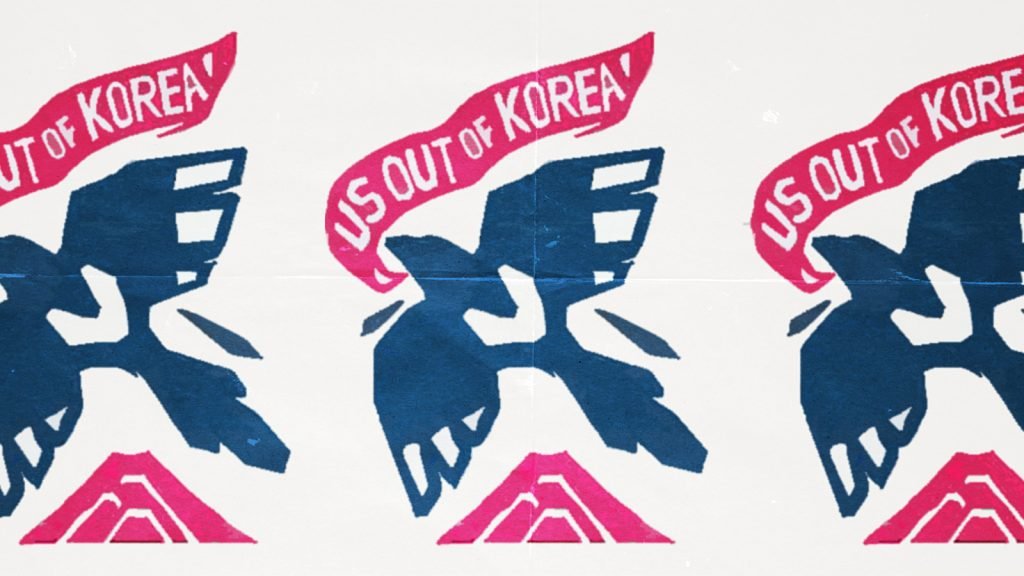
The penny has dropped in South Korea. There will be change, and what exactly or the speed of this change will be according to the level of pressure. There will be pressure.
“We cannot send our young people into a sea of death!”
Protests have erupted in Seoul against South Korea potentially joining U.S.-led operations in the Strait of Hormuz.
Demonstrators marched past the U.S. Embassy chanting, “We cannot send our young people into a sea of death!” and carrying signs opposing participation in what they called a “war of aggression.”
Seoul has dispatched a fact-finding team to the UAE to assess conditions in Hormuz amid mounting U.S. pressure, but the government stresses that no decision on military deployment has yet been made.
US Out of Korea: Notes from the Jaju Solidarity Brigade
In the Republic of Korea, the fight against foreign bases runs through mass graves and camptown burial grounds – this August, organisers from six countries and territories joined that fight on the ground.
Dear friends,
Greetings from the desk of Tricontinental Asia.
This August, Nodutdol – a diaspora Korean anti-imperialist organisation based in the United States – brought a delegation of 26 organisers representing anti-war and progressive organisations from the United States, Hawai’i, Guåhan (Guam), Puerto Rico, the Philippines, and India to the Republic of Korea (ROK).
This delegation was named the Jaju Solidarity Brigade – Jaju (자주) roughly translates to sovereignty, independence, or self-reliance. The brigade stood alongside Korean mass movements under the banner of ‘US Out of Korea’ – the slogan for this year’s National Liberation Day (15 August) mobilisations in the ROK.
As delegates, we participated in mass activities across the country at various sites of active struggle and historical memory in the long fight against US military occupation and imperialism.
The decision to bring an international delegation to forge ties of solidarity with the progressive movement at this time was deliberate. The struggle in the ROK is heightening because of its strategic significance to imperialism in East Asia, which is now intensifying its aggression to forestall crisis. This is best demonstrated by the trilateral Japan-ROK-US military alliance, or JAKUS, under Washington’s command. The people’s movements of the region and the world must respond, answering the consolidation of imperialist alliances with a people’s alliance that unites popular struggles against imperialism in the region.
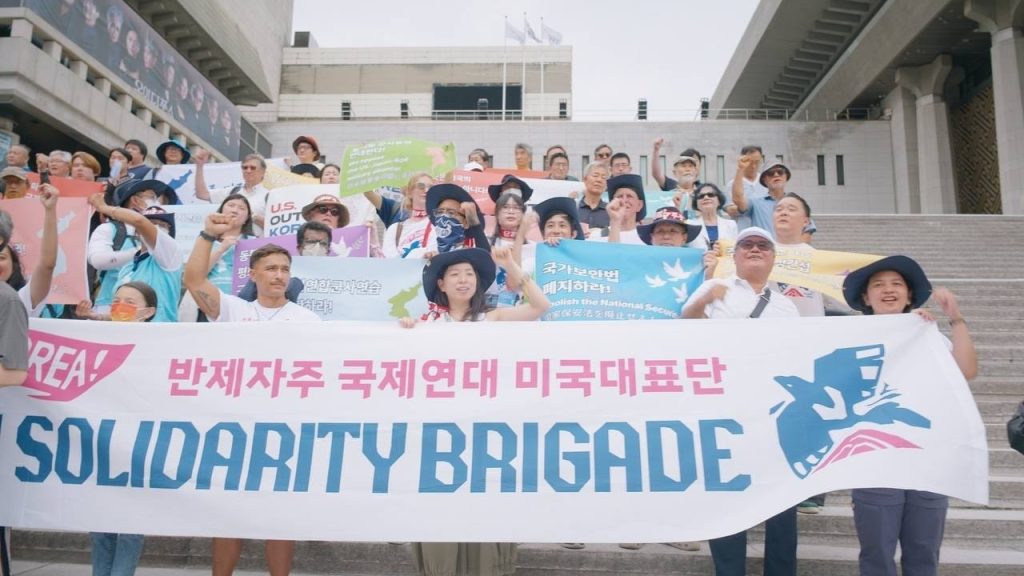
The Jaju Solidarity Brigade. Credit: Craig Birchfield.
A Dagger Aimed at the Heart of Asia
The ROK has the largest permanent overseas US military presence of any country in the Global South – 28,500 troops across 62 official US bases and at least 18 additional facilities. Under the terms of the Mutual Defense Treaty (1953), the US also retains unrestricted access to all ROK military infrastructure. While Washington’s diplomatic mouthpieces frame the occupation of the ROK as a force for peace and democracy, the US military is far more shameless.
US Forces Korea (USFK) Commander Xavier Brunson calls the ROK a ‘fixed aircraft carrier’, or a ‘dagger aimed at the heart of Asia’. Brunson, who is well versed in military history, has chosen his metaphors carefully: ‘unsinkable aircraft carrier’ was a favoured description of Taiwan by US General Douglas MacArthur, the architect of the postwar imperialist military system in the Asia-Pacific and the commander of United Nations forces during the US war on Korea. Meanwhile, a ‘dagger pointed at the heart of Japan’ was the argument of Jacob Meckel, German military adviser to the Imperial Japanese Army, for why Meiji Japan required the colonisation of Korea. Brunson’s comments demonstrate the continuity of imperialist interests in Korea’s geostrategic place at the heart of Northeast Asia.
Despite an armistice signed in 1953, the Korean War has never officially ended by a peace agreement. The situation has reached a nadir since 2024. Escalating US-ROK military aggression and decades of diplomatic obstruction pushed the Democratic People’s Republic of Korea (DPRK) to abandon the policy of peaceful reunification and the June 15 Agreement. Unlike the Taiwan Strait or the South China Sea, the confrontation in Korea concerns a land border, which makes it much more possible for rapid military engagement to reach a point of no return.
Out of all Asia-Pacific countries in the imperialist camp, the ROK has the largest armed forces as measured by the number of active and reserve troops, surpassing even the United States. Whereas Japan has had no official military under its pacifist constitution since 1945, the ROK has had a massive conscripted fighting force under the operational control of the Pentagon since 1950. The ROK’s armed forces can be conceived of as a modern-day colonial auxiliary army. The metaphor of the dagger proves apt: in the two land wars the US has fought in East Asia – Korea and Vietnam – the ROK’s military was indispensable.
As Washington looks ahead to its next war in the region, it is sharpening its Korean ‘dagger’. Calls to ‘modernise’ the US-ROK alliance are growing by the day. Under the Mutual Defense Treaty, US troops are ostensibly in the ROK to fight a limited peninsular war against the DPRK. Washington now wants to loosen those terms in order to permit the USFK and its bases to be used to fight across the region.
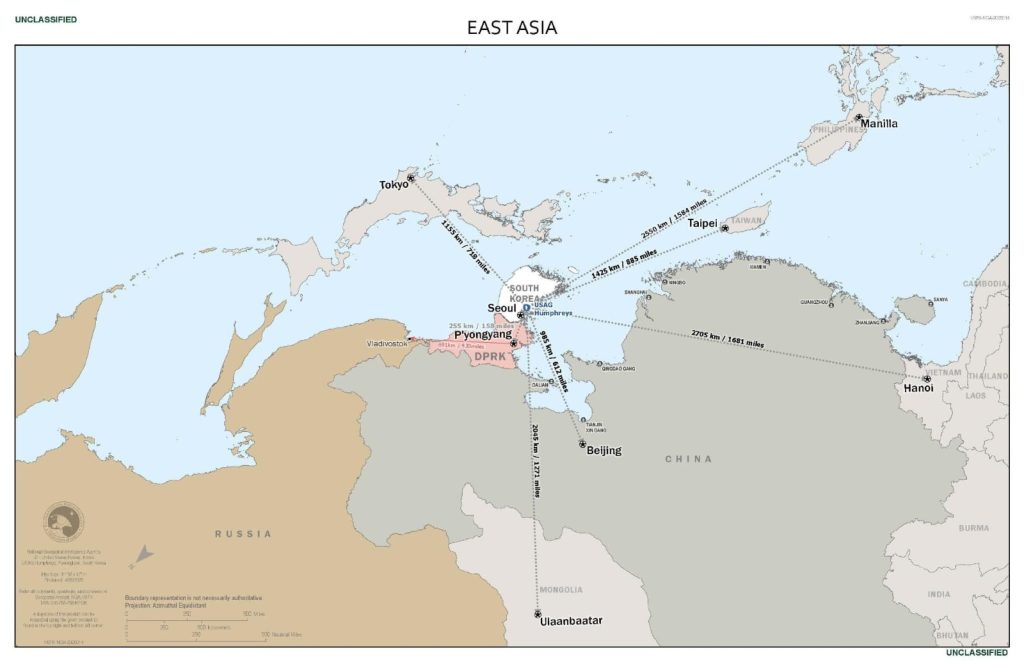
An ‘East-Up Map’ depicting the Korean Peninsula at the centre of East Asia, with lines emanating from Camp Humphreys to major cities in the region. Credit: US Forces Korea.
The Battle for the Future
Across the ROK, the battle for the future is playing out as a battle for memory. Among the many places we visited during the Jaju Solidarity Brigade were Daejeon and Dongducheon, sites where two separate mass graves offer different angles of the necropolitics of US imperialism.
From 28 June to 20 July 1950, in the city of Daejeon, ROK soldiers and police, acting under the watchful eye of US Army officers, executed between 1,800 and 7,000 political prisoners – creating what activists now call ‘the longest grave in the world’. This slaughter was part of the Bodo League Massacre, a series of thousands of such incidents that took place across southern Korea in the early days of the Korean War. Until 1999, the Pentagon officially accused the DPRK of responsibility and kept its own evidence of the killings confidential.
In Dongducheon, near the demilitarised zone, the city itself is a graveyard. Over forty percent of the land in Dongducheon is used for US military bases and facilities. In 1953, the city swelled from a little agrarian hamlet into an urban centre after the arrival of the US bases, which stood out like islands of capital in a sea of poverty. In the hills on the outskirts of the city, as many as 3,000 women, girls, and children of the ‘camptown women’ are buried in an unmarked graveyard – a fraction of the estimated one million Korean women who were trafficked into the state-sponsored US military prostitution trade in the twentieth century. Part of the gravesite has become a city park, resplendent with floral arrangements and manicured walkways, with no indication of the thousands interred there.
A group of activists in Dongducheon are now fighting to preserve two significant sites. The first is the last remaining ‘STD Management Center’ – US Army facilities where women and girls were incarcerated and forcibly injected with dangerously high volumes of penicillin. US soldiers used to see women who tried to escape from the facility hanging from its second-storey window and gave the location an infamous epithet: ‘The Monkey House’. For the past two years, activists have maintained an encampment to prevent the local city government from bulldozing the site, arguing that it should be preserved as a historical monument.
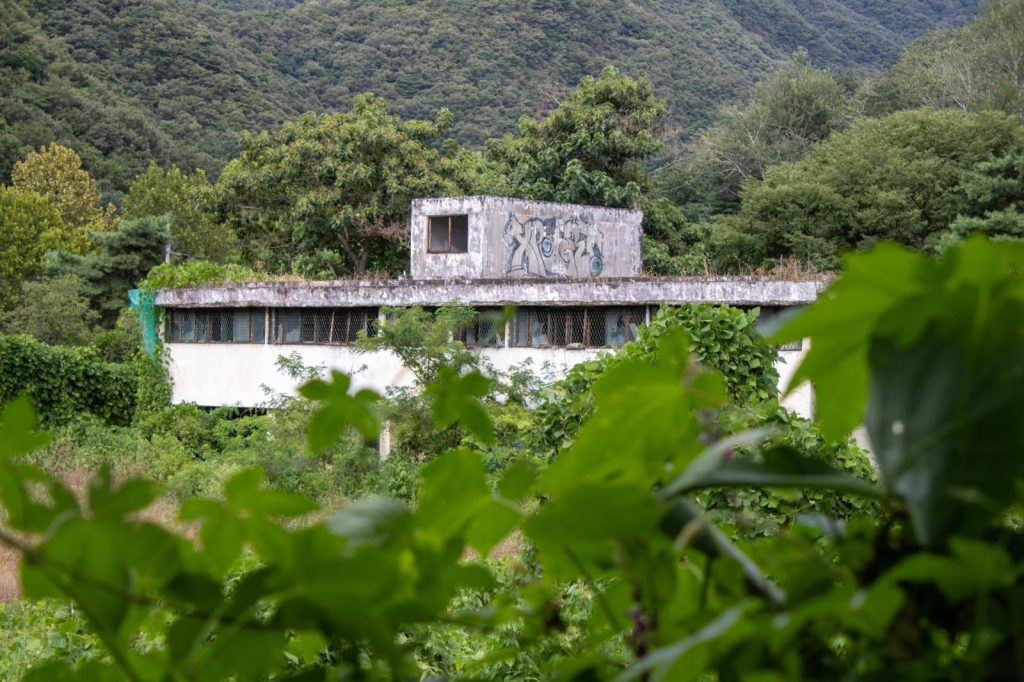
Former US Army STD Management Center in Dongducheon. Credit: Hannah Craig.
A few kilometres away, there is a struggle to preserve the home of Yun Geum-I, a US military ‘comfort woman’ whose brutal murder and mutilation by a US soldier in 1992 sparked a mass struggle against US military impunity. Due to the terms of the Status of Forces Agreement at the time, Yun Geum-I’s killer nearly escaped justice, as he was able to hide out at Camp Casey where ROK authorities could not apprehend him. In the years since Yun’s killing, the city of Dongducheon and the US military have constructed a ‘Friendship Plaza’ honouring the US-ROK alliance on the doorstep of her former home.
Traversing these various sites, it was evident that the battle for memory is more than a struggle for the past. What is at stake is the place of the US occupation’s martyrs in the identity of the Korean people; whether the lessons of the past will inform the future, or be silenced as part of a myopic embrace of an imperialism that can only promise further crisis for Korea and the region.
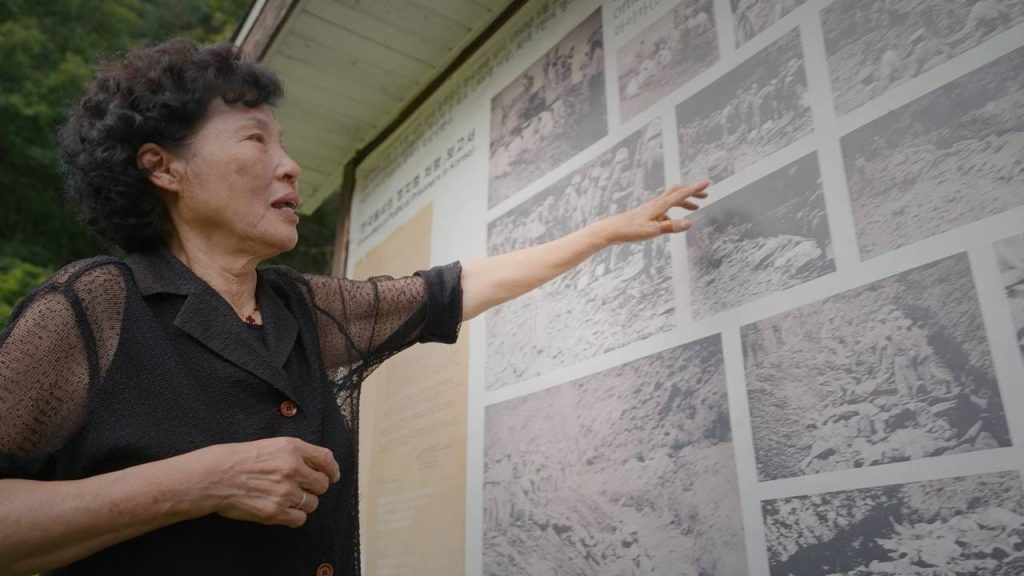
Chun Mi-Kyung, President of the Daejeon Bereaved Families’ Association, at the site of the Sannae Gollyeonggeol massacre where her father was killed. Credit: Craig Birchfield.
Building an International United Front
On 14 August, the eve of Korea’s National Liberation Day, delegates from across the world gathered to discuss war, occupation, peace, and national liberation. In his opening remarks, president of People’s Solidarity for Revision of Unequal Korea-USA SOFA, Prof. Lee Jang-Hie, stated that ‘US military bases in ROK do not protect ROK’s security’. With China emerging as the second largest economy, the US has strengthened its ‘strategic efforts to contain China by roping in trilateral military cooperation among the ROK, Japan, and the United States’.
ROK activists Koo Jung-seo – representing the city of Gunsan’s struggle against the expansion of a local US Air Force base – and Kang Hyunwook – representing the village of Soseong-ri’s struggle against the installation of US Terminal High Altitude Area Defence interceptor systems – spoke on the impact of US bases and military installations. They discussed forced displacement, rising health issues, loss of productive agricultural lands, and the irreparable damage to ecologically sensitive areas like the Saemangeum mudflats that are home to numerous flora and fauna and transit spaces for endangered migratory birds.
Speakers from Japan, the Philippines, Hawai’i, and Guam spoke on the increasing militarisation of their regions and the people’s resistances against the occupation. On the forum about national liberation, delegates spoke about the rise of Southern multilateralism, the US-Israeli war on Iran, sovereign-seeking movements in the Sahel, and struggles of people against racism and imperialism in the US.
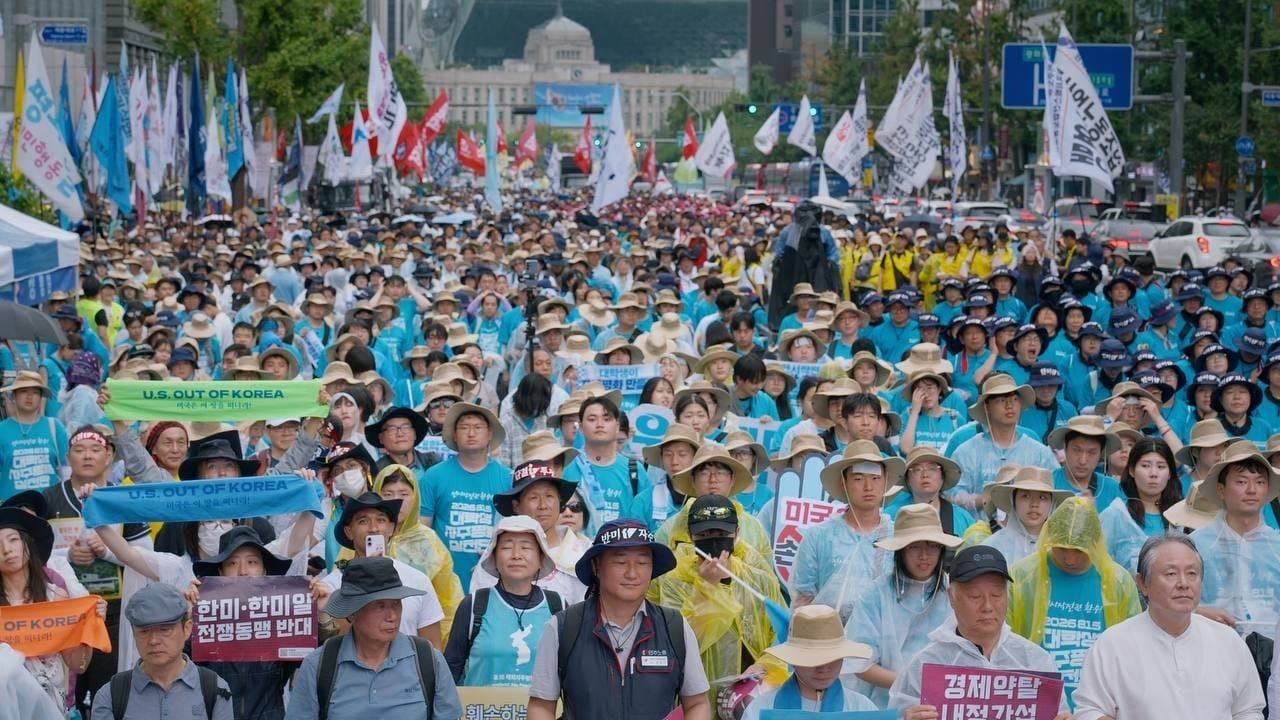
Demonstrators at the National Liberation Day march in Seoul on 15 August. Credit: Craig Birchfield.
The concluding forum was a conjunctural analysis of global anti-imperialist movements. Presenters spoke on the reality of ‘hyper-imperialism’ – US military might and control over advanced information and communications technology that enables it to engage in ‘hybrid wars’ against countries seeking to chart a sovereign path from US hegemony. The presenters viewed the wars in Iran and Ukraine as fronts of an already existing ‘Third World War’ that is accelerating towards open conflict in East Asia and the Western Pacific. Discussions also covered people’s struggles in Latin America and the impact of the ‘Donroe Doctrine’; the New Cold War on China; and anti-imperialist struggles in regional countries like the Philippines and Japan.
Throughout the Jaju Solidarity Brigade’s journey, we witnessed mass marches and rallies against US military occupation, and engaged with an array of fronts in the people’s struggle for peace, land, and sovereignty. It was evident to us that the working-class movements in the ROK and across the world are leading the fight for a just world order.
Warmly,
Park Ju-Hyun and Pindiga Ambedkar
Park Ju-Hyun is a writer and a member of Nodutdol, who leads the US Out of Korea campaign. They are also the engagement director at BreakThrough News.
Pindiga Ambedkar is the communications coordinator of Tricontinental: Institute for Social Research. He participated in the Jaju Solidarity Brigade.
Well, from what I have heard of South Korean and Japanese cultures of the last few decades, yeah, right, they’ll be a whole lot of help in a war.
America is desperate for more cannon fodder … sorry, I mean “democratic allies”… to aid in its wars of aggression around the world. Ukraine is the template and model for what many countries are headed towards, as they are pushed into the abyss of war by their corrupt rulers and… Read more »