

THE DOGS BARK – as the multipolar juggernaut moves on…. relentlessly
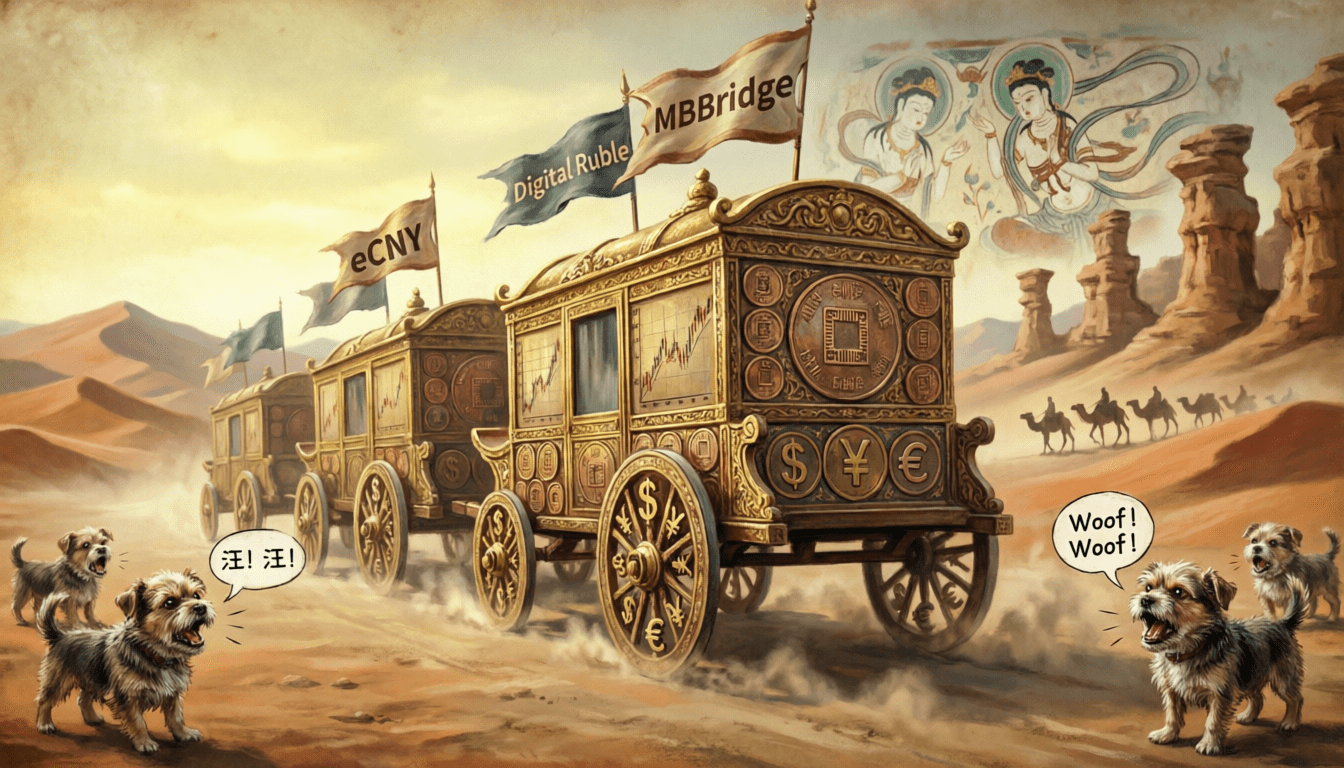
From our dear friend Colin Maxwell – with great thanks for this brilliant summary. Work Brothers, we are taking our planet back! The methods that Colin detail here are not yet seamless. We need more local banks, but you know what, with Russia’s new Crypto laws, has it sunk in that you, and I, can now purchase something from there, without Swift, without exorbitant banking fees, and without the transaction getting stuck in a sanctions regime. The world’s economy will flow again, and with it, you and I. The world will end the lawlessness. Not tomorrow exactly, but we have crossed the Rubicon in my view toward Colin’s resilient alternative framework. The fight goes on! All I want to see now, is a large scale debt repudiation to crash the old strangulation right into the mud.
Shout! Shout! Let it all out. We can do without the hegemonic strangulation.
—
The global economic architecture is undergoing a structural realignment. Decades of Western financial and military hegemony, anchored by the US dollar and the SWIFT messaging network, are being met by a resilient, alternative framework.
Driven by a strategic alliance between Russia, China, and Iran, this shift combines land-based transport corridors with advanced digital financial systems. The result is an autonomous, sanctions-proof global trade loop that integrates East Asia, Central Asia, the Middle East, and Africa into a new multipolar reality.
#1 The Physical Arteries: Connecting Eurasia and Beyond
The physical foundation of this new paradigm relies on secure, land-based logistics paths that bypass traditional maritime chokepoints controlled by Western naval power. By moving trade from vulnerable oceans to inland rail networks, this alliance has created an infrastructure immune to foreign blockades.
#2 The International North-South Transport Corridor (INSTC)
The Caspian (Central) Route: Connects Russian inland ports like Astrakhan directly across the Caspian Sea to northern Iranian hubs like Anzali.
The Western Route: A direct rail line running through Baku, Azerbaijan, into Iran. The completion of the critical Rasht-Astara rail segment enables uninterrupted train travel from St. Petersburg straight to the Persian Gulf.
The Eastern Route: Links Russia to Iran via the expansive rail networks of Kazakhstan and Turkmenistan.
The trade loop extends south into Africa via the Arabian Sea. Deep-water ports along the East African coast—including Djibouti, Mombasa (Kenya), and Dar es Salaam (Tanzania)—act as oceanic gateways. This extension creates a direct resource pipeline that moves critical minerals out of Africa’s interior directly into the Eurasian manufacturing engine.
Through these ports, essential commodities bypass Western-dominated shipping channels entirely.
Battery and Tech Minerals: High-grade copper and cobalt
Agricultural and Energy Security: Crucial food supplies and agricultural products flow North, while Russian fertilizer and fuel move South. This direct swap keeps African economies stable without relying on Western brokers.
#5 The Financial Spine: Digital Ledgers and Local Currencies
People’s Bank of China (PBOC): The system’s primary technical architect.
Hong Kong Monetary Authority (HKMA): The gateway for offshore clearing.
Saudi Central Bank (SAMA) & Central Bank of the UAE (CBUAE): Integrating the world’s largest oil and gas flows directly into the ledger.
Bank of Thailand: Connecting Southeast Asian commercial trade.
Because these transactions occur entirely on sovereign digital ledgers, they are completely invisible to Western regulators. The power to track, police, or freeze multi-billion-dollar energy deals has been completely removed from the Western financial toolkit.
#10 A Sustainable Multipolar Reality
The convergence of the INSTC, the Belt and Road Initiative, Project mBridge, and BRICS Pay represents a fundamental shift in the global balance of power. This is not a temporary workaround to evade sanctions; it is a permanent, parallel economic architecture designed for long-term survival and growth.
This system achieves three core pillars of sustainability and routes and domestic sea loops cannot be blocked by foreign naval carrier groups. This ensures the steady flow of grain, fertilizer, essential tech minerals, and energy across Eurasia and Africa.
Financial Immunity: Transactions bypass Western clearinghouses entirely, neutralizing asset freezes and economic warfare.
The global economic architecture is undergoing a structural realignment. Decades of Western financial and military hegemony, anchored by the US dollar and the SWIFT messaging network, are being met by a resilient, alternative framework.
Driven by a strategic alliance between Russia, China, and Iran, this shift combines land-based transport corridors with advanced digital financial systems. The result is an autonomous, sanctions-proof global trade loop that integrates East Asia, Central Asia, the Middle East, and Africa into a new multipolar reality.
#12 The Physical Arteries: Connecting Eurasia and Beyond
The physical foundation of this new paradigm relies on secure, land-based logistics paths that bypass traditional maritime chokepoints controlled by Western naval power. By moving trade from vulnerable oceans to inland rail networks, this alliance has created an infrastructure immune to foreign blockades.
#13 The International North-South Transport Corridor (INSTC)
The Caspian (Central) Route: Connects Russian inland ports like Astrakhan directly across the Caspian Sea to northern Iranian hubs like Anzali.
The Western Route: A direct rail line running through Baku, Azerbaijan, into Iran. The completion of the critical Rasht-Astara rail segment enables uninterrupted train travel from St. Petersburg straight to the Persian Gulf.
The Eastern Route: Links Russia to Iran via the expansive rail networks of Kazakhstan and Turkmenistan.
This Eurasian backbone links directly with China’s Belt and Road Initiative (BRI). High-capacity trains originating in industrial hubs like Xi’an and Chongqing enter Central Asia through the Khorgos Gateway on the Kazakh border.
From there, Chinese rail networks interface directly with the INSTC’s Eastern route, creating a continuous manufacturing and supply chain artery stretching from the Pacific Ocean to the Caspian Sea.
The trade loop extends south into Africa via the Arabian Sea. Deep-water ports along the East African coast – including Djibouti, Mombasa (Kenya), and Dar es Salaam (Tanzania) – act as oceanic gateways. This extension creates a direct resource pipeline that moves critical minerals out of Africa’s interior directly into the Eurasian manufacturing engine.
Through these ports, essential commodities bypass Western-dominated shipping channels entirely:
Battery and Tech Minerals: High-grade cobalt and copper from the Democratic Republic of Congo, along with lithium from Zimbabwe, are railed to the coast and shipped directly to Iranian and Indian hubs.
Industrial Metals: Large shipments of Tanzanian gold, Zambian copper, and South African manganese feed directly into the heavy industries of Russia and China.
Agricultural and Energy Security: Crucial food supplies and agricultural products flow North, while Russian fertilizer and fuel move South. This direct swap keeps African economies stable without relying on Western brokers.
#16 The Financial Spine: Digital Ledgers and Local Currencies
Physical security means little without financial immunity. The weaponisation of the US dollar and Western banking sanctions served as a powerful catalyst, driving these nations to build a completely independent financial architecture that operates entirely outside of Western control.
#17 Project mBridge: Bypassing SWIFT
People’s Bank of China (PBOC): The system’s primary technical architect
Hong Kong Monetary Authority (HKMA): The gateway for offshore clearing
Saudi Central Bank (SAMA) & Central Bank of the UAE (CBUAE): Integrating the world’s largest oil and gas flows directly into the ledger
Bank of Thailand: Connecting Southeast Asian commercial trade.
Tying these domestic frameworks together is BRICS Pay. Rather than enforcing a single currency, BRICS Pay acts as an overarching digital mesh that links the individual fast-payment systems of all BRICS+ member states. This allows commercial entities and everyday traders across the Global South to conduct business instantly using their own national currencies. This digital ledger network is highly valuable for African nations facing US dollar shortages, allowing them to trade mineral wealth directly for Eurasian goods using their local currencies.
#19 Dethroning the Petrodollar: The Geopolitics of Energy
The final piece of this multipolar puzzle is the transformation of global commodity pricing. For half a century, the global dominance of the US dollar was guaranteed by the petrodollar system, which required global oil and gas to be priced and settled exclusively in American currency. The integration of mBridge and the new transport corridors has permanently broken this monopoly.
With Saudi Arabia and the UAE actively operating on the mBriidge ledger, the world’s most critical energy spigots are plugged directly into the alternative framework.
Energy trades can now be automated using smart contracts built into the blockchain ledger. For instance, a shipment of crude oil or liquified natural gas leaving the Gulf can automatically trigger a secure , irreversible payment in e-CNY the exact moment the vessel enters a partner port.
Because these transactions occur entirely on sovereign digital ledgers, they are completely invisible to Western regulators. The power to track, police, or freeze multi-billion-dollar energy deals has been completely removed from the Western financial toolkit.
#20 The European Dilemma: Reaction and Fragmentation
As this parallel trade and financial ecosystem solidifies, European trade partners find themselves caught in a deep economic and strategic dilemma. The creation of these bypassing routes has exposed a growing rift between Europe’s official political alignments and its real-world economic dependencies.
#21 The Cost of De-Coupling
The Energy Crisis: Forcing Europe away from cheap pipelines has driven its factories to rely on expensive American shipped gas, leading to widespread factory closures in industrial core zones like Germany.
The Shipping Squeeze: With critical maritime passages facing ongoing security bottlenecks, Europe is being squeezed into an economic corner. Meanwhile, its Eurasian competitors utilize the lightning-fast, secure land corridors of the INSTC and BRI.
The Re-Routing Loop: European manufactured goods, automotive parts, and machinery are officially exported to nations like Kazakhstan, Kyrgyzstan, and the UAE. Once there, these goods are quietly re-routed via the INSTC straight into Russian and Iranian markets.
Disguised Resources: Similarly, essential commodities and refined petroleum products find their way back into Europe. They are simply laundered through secondary nations and paid for using alternative banking channels that bypass Western oversight.
The convergence of the INSTC, the Belt and Road Initiative, Project mBridge, and BRICS Pay represents a fundamental shift in the global balance of power. This is not a temporary workaround to evade sanctions; it is a permanent, parallel economic architecture designed for long-term survival and growth.
#24 WRAP-UP… this system achieves three core pillars of sustainability
Physical Sovereignty: Land Routes and domestic sea loops cannot be blocked by foreign naval carrier groups.
Carrier groups as an effective means of projecting military might are quickly losing their credibility and effectiveness anyway. The obvious vulnerability of these giant floating anachronisms are becoming more obvious by the month.
This ensures the steady flow of grain and fertilizer, essential tech minerals, and energy across these continents
*(Building a single Nimitz-class super-carrier like the USS Abraham Lincoln today would cost between $6.8 billion and $11 billion. When you assemble a full, combat-ready Carrier Strike Group (CSG), and the total procurement cost skyrockets to between $30 billion and $35 billion)
Resource-Backed Stability: By shifting away from purely fiat-based speculation and tying transactions directly to the immediate, automated exchange of hard commodities – oil, gas, minerals, and grain – the new system creates a highly stable foundation for global commerce.
Great work Col, you have been busy.
Thank you.