

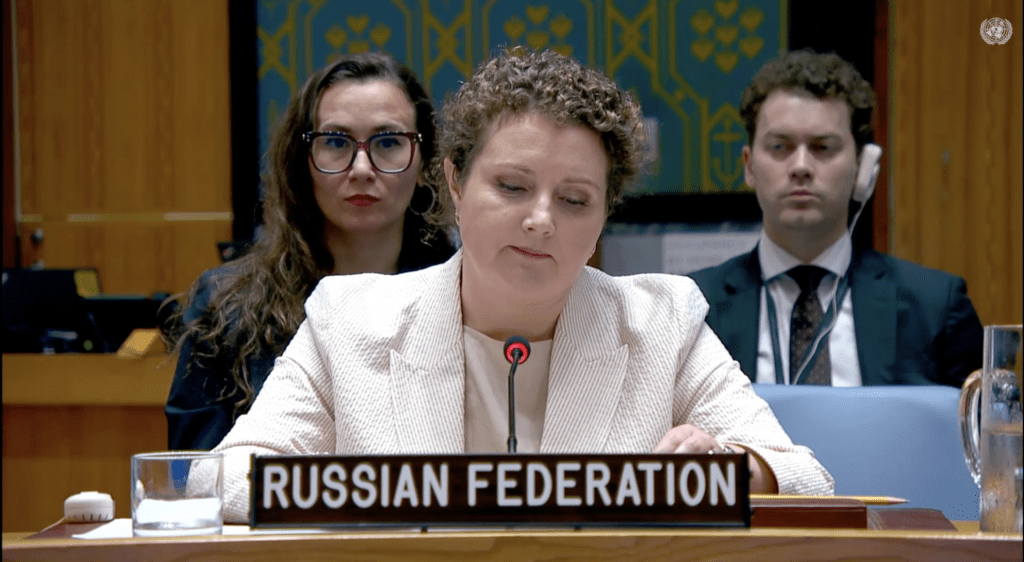
Statement by Chargé d’Affaires a.i. Anna Evstigneeva at a UNSC Briefing on the Situation in the Middle East
https://russiaun.ru/en/news/228072026
Mr. President,
We thank Mr. Ramiz Alakbarov, Deputy Special Coordinator for the Middle East Peace Process, for his briefing.
The situation in the Middle East has been one of the main items on the agenda of the Security Council virtually since the very establishment of the United Nations.
Nevertheless, despite decades of painstaking work, we have to acknowledge that the goal of achieving peace and prosperity for the countries and peoples of the Middle East remains as distant as ever. Regrettably, at times it seems that any diplomatic successes we have witnessed, including in recent months, are simply “reset” each time. The situation is not merely failing to improve – it is often becoming even worse and worse, as the conflict is spreading to new territories and engulfing virtually every country in the region. We are witnessing new outbreaks of violence; the geographical scope of the conflict is expanding, and, as always, the main burden falls on civilians.
Despite the fact that the root causes of the region’s problems are often drowned out by the daily flow of news, we are convinced that the international community must not lose sight of the Palestinian question, which is the issue of fundamental importance for the Middle East.
We regret to note that the implementation of the ceasefire agreements reached between Israel and Hamas in October 2025 has largely stalled. We are regularly receiving reports of new operations by the Israel Defense Forces (IDF) bringing continued civilian deaths and suffering. Restrictions on the entry and delivery of humanitarian assistance remain in place. The so-called Trump plan for Gaza, which formed the basis of the peace arrangements, remains dead letter. The Board of Peace has been essentially non-operational so far. The International Stabilization Force (ISF) is yet to be established. There are still no prospects for the complete withdrawal of Israeli forces from the Gaza Strip. Clearly, there is currently no talk of any practical steps to launch reconstruction work in the enclave. The peace efforts of the US leadership on the Palestinian track have been virtually put “on hold”.
Despite the efforts by the High Representative of the Board of Peace for Gaza, Mr. Nikolay Mladenov, to secure approval for the road map he drafted jointly with the mediators, there are still no solutions mutually agreeable to the parties. The key sticking point remains the complicated issue of demilitarizing the Palestinian enclave. Moreover, the document contains no guarantees of the de-occupation of Gaza, let alone prospects for its political reunification with the West Bank and a long-term settlement of the Palestinian issue.
The situation in the West Bank itself is also unfolding according to a negative scenario. The Israeli authorities proceed with their policy of cementing their administrative and legal control over this territory. The pace and scale of settlement expansion have long since broken all records. We are concerned by recent reports of an unprecedented tightening of restrictions on the movement of Palestinians between different localities. Thus, irreversible facts are being created in the West Bank, while the territories controlled by the Palestinians are steadily shrinking.
We have carefully reviewed the letter circulated ahead of today’s debate by President of the State of Palestine Mahmoud Abbas, expressing deep concern over the escalation of violence in the occupied Palestinian territories, first and foremost in the West Bank, including East Jerusalem. We believe that the expansion of settlement activity, compounded by attacks on Palestinians and the destruction of their civilian infrastructure, undermines the prospects for implementing the two-State solution and creates a threat of further deterioration of the situation.
Russia is convinced that it is only a comprehensive settlement of the Palestinian-Israeli conflict premised on the well-known international legal principles that can guarantee lasting peace and stability for all the peoples of the region. We still have opportunities to achieve this. And we strongly urge all parties concerned to seize these opportunities.
Mr. President,
The continuing negative trends in the context of the Palestinian-Israeli conflict are unfolding amid growing tensions in the Middle East as a whole. From this perspective, we are equally concerned about developments surrounding Lebanon.
Over the past weeks, we have observed positive dynamics on the track of political and diplomatic settlement – specifically, we welcome the launch, for the first time in more than three decades, of direct Lebanese-Israeli talks under US mediation and the achievement of a trilateral framework agreement on June 26. We also note the visit to Washington last week by President of the Lebanese Republic Joseph Aoun.
At the same time, the negotiating efforts have failed to bring a definitive cessation of hostilities. Israel continues to occupy territories in southern Lebanon, in particular north of the Litani River. According to reports, on July 25-27 the IDF continued demolishing and blowing up buildings in a number of Lebanese localities. The actions of the Israeli military pose a direct threat to the lives and health not only of civilians but also of UN peacekeepers, preventing the United Nations Interim Force in Lebanon (UNIFIL) from carrying out the mandate entrusted to it. Against this backdrop, a question naturally arises: Given the expansion of the Israeli occupation and the highly likely emergence of a security vacuum, what explosive consequences could the winding-down of the mission in 2027 entail? In our view, what remains imperative here is a complete cessation of hostilities and a political settlement of the Lebanese conflict, including with a view to ensuring the full implementation of Security Council resolution 1701.
Madam President,
In our view, it would be wrong not to recall that the latest escalation in Lebanon was a direct consequence of the aggression launched by the United States and Israel against the Islamic Republic of Iran on February 28. Despite the signing of the “Islamabad Memorandum”, which was made possible through the vigorous and effective mediation efforts of Pakistan, Qatar and a number of other regional States, the situation in the Persian Gulf not only remains extremely tense but also continues to deteriorate. In recent weeks, we have witnessed yet another series of exchanges of strikes, which have once again put civilian infrastructure in Iran and the Arab States under threat. There are also potential risks of the disruption of navigation in the Strait of Hormuz and the Red Sea, which could have extremely serious repercussions for global energy and food security. Our country has consistently advocated a political and diplomatic settlement of the US-Iranian conflict that would take into account the interests of all States in the region.
The same approaches apply to the situation in Yemen. The chronic failure to settle the crisis in that country, which has now dragged on for two decades, undermines regional stability as a whole and generates risks of uncontrolled escalation on the Arabian Peninsula. Unfortunately, recent developments in Yemen and around it bear this out. We are convinced that the path towards peace and stability in this Arab country lies through direct and frank dialogue among its leading political forces, including the Ansar Allah movement. We consider it counterproductive to antagonize this movement, which has long been an integral part of the country’s military and political landscape. There is a need to revitalize the mediation track under the auspices of the United Nations, led by the Secretary-General’s Special Envoy, Mr. Hans Grundberg, and to involve a broad range of Yemen’s neighbors, including Saudi Arabia and Iran.
Mr. President,
By way of conclusion, we would like to note that the only way to achieve peace, stability and prosperity in the region is through diplomacy, negotiations and the fostering of good-neighborly relations among all its countries, while enhancing their security.
We could begin with narrow formats envisaged in Russia’s updated Concept of Collective Security in the Persian Gulf. This document contains practical proposals for strengthening confidence-building measures and provides for a phased approach towards unlocking crisis situations in the region, which should ultimately lead to a stable and conflict-free Middle East, open to broad international cooperation.
Russia is ready to engage in such cooperation, and discuss with all parties concerned these and other constructive proposals aimed at ensuring a reliable and sustainable security architecture throughout the Middle East.
Thank you.
Video of the statement