

The People Resisting Peru’s Illegal Goldrush
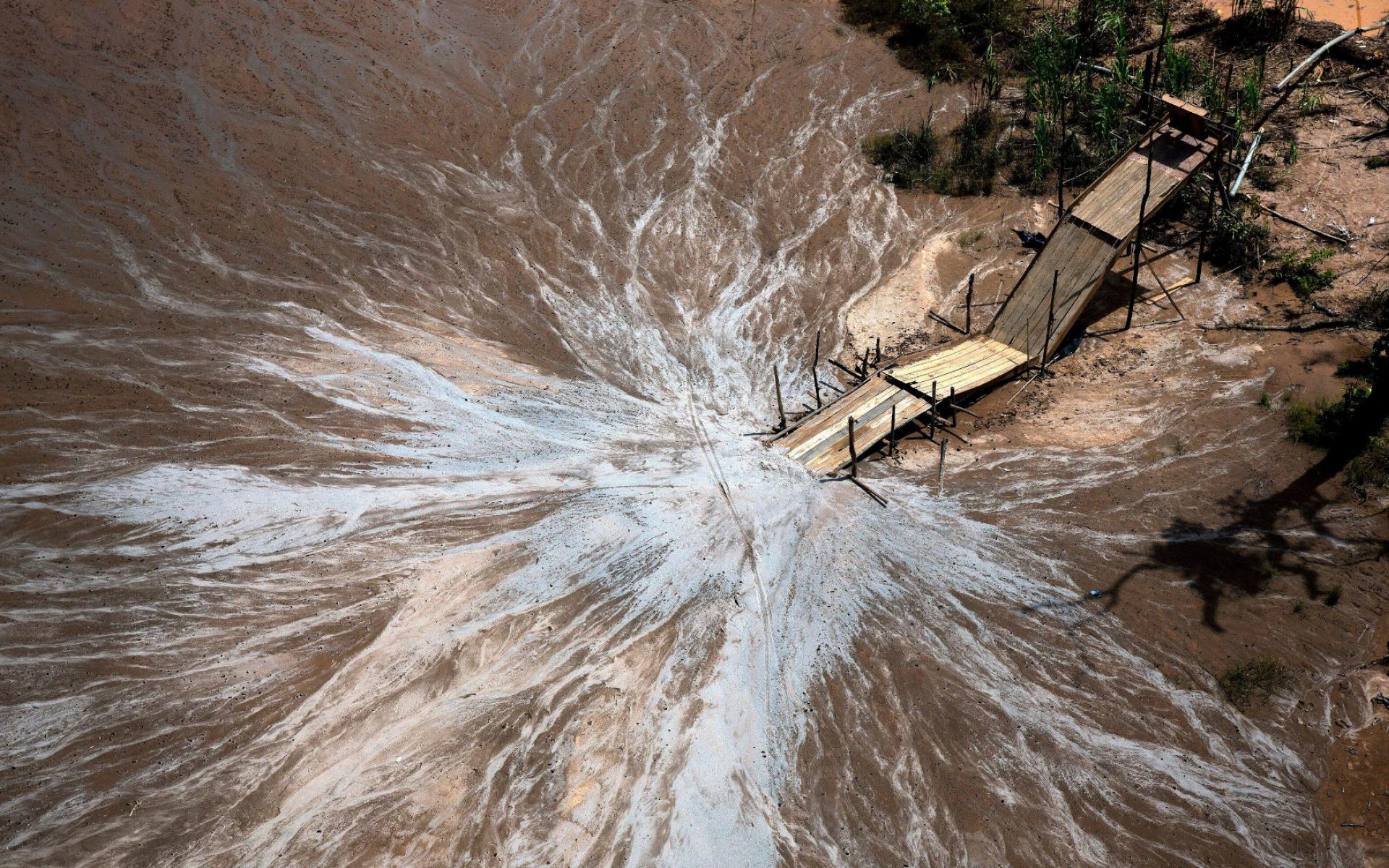
A ‘tolba’, a rustic, sluice-like contraption layered with pieces of carpet to capture gold deposits from water sediment. Taken during a government raid to destroy illegal gold mining operations in La Pampa, Peru. RODRIGO ABD/AP PHOTO/ALAMY
Diana lives in Huánuco, a part of the Amazon where the fever for illicit gold is running high – with lethal consequences.
Rivers and fish are being poisoned with mercury, forests are felled and land devastated as illegal mining, fuelled in part by the soaring price of gold (currently over $4,000 per ounce), is causing havoc within Indigenous communities.
Land, health, environment and social fabric are under attack. Some 35 Indigenous defenders have been killed in the Peruvian Amazon since 2020, over 500 have received threats. The risk is growing as mining becomes ever more profitable and criminal.
An Indigenous Asháninka leader, Diana* was in London this month to inform British lawmakers, bankers and others on what it’s like to be at the sharp end of Peru’s illegal goldrush.
‘When the miners come in, they destroy everything. There’s no study of environmental impact. They contaminate the rivers with mercury, affecting the fish that we depend on for food. We ourselves are contaminated with mercury; it’s been found in the blood of our children,’ she told New Internationalist.
‘The government does not give us land title documents and this benefits the illegal miners,’ she continued. ‘We who depend on our rivers and woods, who have looked after them since the times of our great-grandparents, are losing all our rights in face of this mafia – because it is a big mafia. Defenders are being assassinated and there’s no justice for us in a country that favours the assassins.’
Diana was joined in London by a delegation of South Americans highlighting the need for the international community to take some responsibility for the harm being done and to stop trading in illicit gold.
London is the world’s largest gold-trading hub but supply-chain transparency is lacking. According to the Global Initiative Against Transnational Organised Crime (GI-TOC) there are systemic vulnerabilities in the global gold sector that allow criminals and bad actors to produce and trade illicit gold. This gold is blended into legal supply chains, making it easy to launder into the legal market.
Illegal gold coming from Peru has reached $11.5 billion in value and now equals legal exports of the precious metal. The largest gold exporter in Latin America, Peru now accounts for one tenth of all illicit gold in the world.
The country is also in the grips of a growing epidemic of often violent organized crime, with groups practising extortion and exerting their influence over key sectors of the economy including gold mining and transportation. For Peru, illicit gold now exceeds drug-trafficking in terms of value.
INDIGENOUS RIGHTS FORGOTTEN
Meanwhile successive Peruvian governments have shown little interest in defending the human rights of Amazonian peoples facing the destruction of their habitats and entire way of life.
Diana explained: ‘The Indigenous people of Peru are forgotten by their own government. The great majority of communities live in extreme poverty. The state does not care about them. We lack health posts and because of this many women die in childbirth. Children suffer from extreme anaemia but without good health care mothers don’t know what to do about it. It’s very easy for miners to make deals with the authorities, promising to provide schools, health posts etc.’

Diana lives in Huánuco, a part of the Amazon where there are particular issues with illicit gold. As an environmental defender she has received death threats. CAFOD
Teenagers are especially vulnerable to the lure of illegal mining, said the 27-year-old mother: ‘Our young people don’t have many options. Boys of 12 or 13 years who should be studying are going to work for the miners. There are young girls, who become cooks for miners and who are sexually abused by them. There’s a lot of sexual abuse. Often teenagers are given clothes and other things their parents can’t provide for them.’
Illegal mining also sows divisions within communities: ‘Sometimes community members receive a bit of money to speak in favour of illegal gold. When we defenders raise our voices in protest, we are persecuted by miners but also by community members acting on their behalf. I myself was threatened with death for taking a stand against illegal mining. They want you out and will use any means.
‘The miners know what they are doing: they buy the conscience of people,’ she added.
INTERVENTIONS AND GOOD INTENTIONS
In some parts of the Amazon, the government has been active in trying to stop illegal miners, with 130 interventions a month in 2026 so far. These may involve capturing or disabling equipment and making arrests. But success in one especially affected area, Madre de Dios, has had the unintended consequence that the miners have simply shifted elsewhere, said Ruth Mier y Terán from the Amazonian Center for Anthropology and Practical Application (CAAAP).
Puerto Inca in Huánuco has become the new hotspot for illegal gold mining. Analysis by Conservación Amazónica (ACCA) reveals that deforestation for illegal mining in the region of Huánuco went from 558 hectares in 2024 to more than 1,700 hectares in 2025. More than 95 per cent was in the buffer zone of the protected El Sira Communal Reserve and more than a third was within Indigenous community land. Illegal mining has become the main cause of deforestation, exceeding clearing for agriculture, and it’s much more damaging, leaving a polluted wasteland that cannot be cultivated.
But during the past three years, said Diana, there had been only two government-led interventions in illegal mining in her region, despite its rapid growth. She said she did know whether this was because of its remoteness, lack of money or lack of interest.
Successive Peruvian governments have struggled with what do about the growth in mining taking place outside the formal, legal framework of official mining companies. There are estimated to be at least 500,000 informal miners, with some mining copper as well as gold. Not all informal mining is illegal or extremely damaging environmentally. But in the fragile ecosystem of the Amazon, it is both.

Ruth Mier y Terán is from the Amazonian Center for Anthropology and Practical Application (CAAAP). VANESSA BAIRD
Nationwide, the state operates a system (called REINFO) enabling informal miners to sign up and start a process of formal registration that would ultimately lead to them paying taxes, abiding by environmental codes and so on. But the process is complex, take-up has been low and the deadline for registration keeps being extended year on year. So, typically what happens is that miners arrive in a location, start mining, and only later may – or may not – sign up to apply for registration.
WHAT SHOULD PERU’S GOVERNMENT DO?
Along with other Indigenous leaders and organizations across the country, Diana is calling upon the government to withdraw all mining concessions in Indigenous territories and to speed up Indigenous land titling.
Peru has so far failed to sign up to the international 2018 Escazú Agreement which has binding protection for environmental human rights defenders.
‘Without defenders there is no water, no woods, no fish, no animals. We know that not just for our community or for Peru but also at an international level. It’s a challenge for us, we must get them to act in favour of communities. Otherwise, in 20, 30 years we will be history.’
Defenders are being assassinated and there’s no justice for us in a country that favours the assassins.
Legislatively, however, Peru has gone in the opposite direction, passing so-called ‘pro-crime’ laws that have weakened environmental controls, extending the deadline for REINFO for example and amending the Forestry Law. The new APCI law, with its oppressive and restrictive oversight of NGOs that receive international funding, has not helped either.
VIGILANCE AND DEFENDERS
Taking matters in their own hands, Indigenous communities have set up their own self- defence groups. The Asháninka Guards is one example.
Using modern technology, people patrol their territories to try and defend themselves against threats such as illegal mining. But such initiatives can sometimes lead to community members themselves being criminalized. ‘As a leader I am afraid that they will kill me. Or will send me to prison,’ said Diana. The election of right-winger Keiko Fujimori as Peru’s new president, with her personal support for extractives and lack of interest in Indigenous communities, is cause for even greater concern.
Now, several Indigenous organizations, backed by allied NGOs, are calling upon parliamentarians to pass a law to recognize Indigenous self-defence. The issue is currently before Congress.
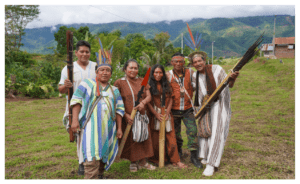
These Ashaninka community members are part of the Indigenous Amazonian Security self-defence group, fighting to protect themselves and their territories against illegal gold mining mafias. The defenders are currently seeking government recognition. CAAAP
But they are up against the structural racism that characterizes much policy related to Indigenous Amazonians, said CAAAP’s Ruth Mier. ‘The Amazon is still viewed by many as an open space – but one full of resources to be exploited.’
INTERNATIONAL ACTION
International action is key. And those in charge of how global gold markets operate have a share of responsibility.
New gold is used mainly as a store of value, with 40 per cent taking the form of bullion, 50 per cent as jewellery, and just 10 per cent for use by industry and medicine.
Ruth joined Diana in London as part of a wider delegation, organized by several NGOs including CAFOD, Peru Support Group, ABColombia and CAAAP. Together they are calling for stronger international regulation of supply chains, including mandatory human rights and environmental due diligence; traceability requirements for gold and high-risk commodities and stronger controls on laundering of illegally sourced minerals. Germany’s Supply Chain Due Diligence Act (LkSG) is held up as a good example.
There is also a call for technical and financial co-operation with Indigenous communities to strengthen satellite monitoring, ariel surveillance and laboratory analysis of mercury and microplastics.
Meanwhile, there are ongoing demands for a UK Business, Human Rights and Environment Act to establish a comprehensive framework for corporate accountability in relation to global supply chains.
As Britain prepares to host an Illicit Finance Summit in December, there could be an opportunity for building an international coalition to address the human rights abuses that trading in illicit gold is allowing and encouraging.
*Diana’s real name has been withheld out of concern for her safety.
Vanessa Baird is a writer, activist and contributing editor to New Internationalist, with a wide range of interests relating to equality, social justice, human rights, and the environment. She was a journalist in Peru in the 1980s and retains a keen interest in the region. Her published books include The No-Nonsense Guide to World Population, Sex, Love and Homophobia, and The Little Book of Big Ideas. She is an Amnesty International Human Rights Media Award winner (2012).