

Join Evelyne and Me for a Mother’s Day Calligraphy Class, Learning Oracle-Bone Characters That Trace a Woman’s Life.
Eight Images Fully Explained and Translated. Stupendously Fascinating!
Introduction
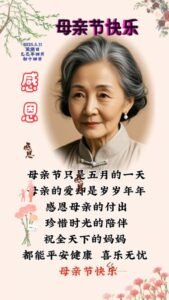
One common feature of Mother’s and Father’s Day in China is the children thank their parents for all that they do, as shown in the picture below. The two big red characters to the left, 感恩 = gǎn ēn, mean “grateful and thankful”. Below is the Mandarin, English and Pinyin for language learners.
Mandarin:
母亲节只是五月的一天
母亲的爱却是岁岁年年
感恩母亲的付出
珍惜时光的陪伴
祝全天下的妈妈
都能平安健康 喜乐无忧
母亲节快乐!
English Translation:
Mother’s Day is merely one day in May,
But a mother’s love endures year after year.
So thankful for a mother’s dedication,
Cherishing the time spent in companionship.
Wishing all mothers throughout the world
Safety, health, joy, and a life without worry.
Happy Mother’s Day!
Pinyin:
Mǔqīn jié zhǐ shì wǔ yuè de yī tiān
Mǔqīn de ài què shì suì suì nián nián
Gǎn ēn mǔqīn de fù chū
Zhēn xī shí guāng de péi bàn
Zhù quán tiān xià de mā ma
Dōu néng píng ān jiàn kāng xǐ lè wú yōu
Mǔqīn jié kuài lè!
The Mother’s Day Calligraphy Class
Evelyne and I have the pleasure of going to calligraphy lessons, where we live here on Taiwan Island. They’re a lot of fun and a perfect way meet people, learn about Chinese culture and language more deeply.
The participants are a real joy, very pleasant, polite and seriously interested in Chinese calligraphy.
This class that we just went to is to celebrate Mother’s Day and honor motherhood.
Our calligraphy master came up with this lesson explaining eight characters, which I will post below. They’re numbered one through eight from right to left, because traditionally in Chinese, they wrote from right to left and top to bottom. That’s why the messages below each character are in vertical format.
She took eight characters that show the stages of a woman’s life from childhood through motherhood.
They are from the age of oracle bones, which go back thousands and thousands of years. Oracle bones were used to tell the future and over time, becoming integrated into Daoism.
For each character, I give you the same character in today’s form, with its Pinyin and meaning for language learners. The first thing you will notice is how much the oracle bone forms have changed dramatically over the millennia, which is the natural evolution of all languages, especially Chinese, which spans 5,000 years.
Some, like Characters #2 and #8, the radicals within them have switched sides, left to right.
I then show you the vertical text in simplified characters with their Pinyin, then the texts’ translations, which our master wrote to describe each oracle bone character’s meaning.
Our master also added two thematic seals, which are explained below.
You can see a picture of the class. Evelyne and I are in the back. I have on a light blue shirt. She’s sitting next to me.
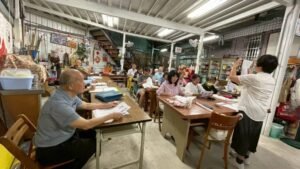
Evelyne made 36 homemade apple-blueberry muffins, which were a big hit. Another student brought a big crock of soup. So everybody went home with a bowl of Chinese soup and a French muffin!
Enjoy a great cultural experience to share with the mothers and children in your life! Happy Mother’s Day!
Characters #1, 2 and 3
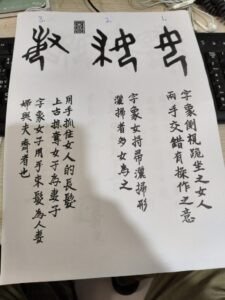
Character 1 (女 = nǚ- Woman):
Vertical text below:
字象侧视跪坐之女人
两手交错有操作之意
zì xiàng cè shì guì zuò zhī nǚ rén
liǎng shǒu jiāo cuò yǒu cāo zuò zhī yì
Text translation:
The character depicts a woman kneeling, seen from the side.
The two hands crossed indicate the intention of working/laboring.
Character 2 (妇 = fù – Woman with broom):
Vertical text below:
字象女持帚扫形
洒扫者多女为之
zì xiàng nǚ chí zhǒu sǎo xíng
sǎ sǎo zhě duō nǚ wéi zhī
Text translation:
The character depicts a woman holding a broom, sweeping.
Sweeping and cleaning were mostly done by women.
Character 3 (妻 = qī – Woman with long hair, aka wife):
Vertical text below:
用手抓住女人的长发
上古掠夺女子为妻子
字象女子用手束发为人妻
妇与夫齐者也
yòng shǒu zhuā zhù nǚ rén de cháng fà
shàng gǔ lüè duó nǚ zǐ wéi qī zi
zì xiàng nǚ zǐ yòng shǒu shù fà wéi rén qī
fù yǔ fū qí zhě yě
Text translation:
Using hands to grasp a woman’s long hair.
In ancient times, women were captured to be wives.
The character depicts a woman binding her hair to become a wife.
A wife is one who is equal to her husband.
Characters #4, 5 and 6
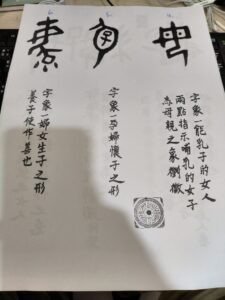
Character 4 (母 = mǔ- Mother):
Vertical text below:
字象一能乳子的女人
两点指示哺乳的女子
为母亲之象征
zì xiàng yī néng rǔ zǐ de nǚ rén
liǎng diǎn zhǐ shì bǔ rǔ de nǚ zǐ
wéi mǔ qīn zhī xiàng zhēng
Text translation:
The character depicts a woman who can nurse a child.
The two dots indicate a nursing woman.
It is the symbol of mother.
Character 5 (孕= yùn – Pregnancy):
Vertical text below:
字象一孕妇怀子之形
zì xiàng yī yùn fù huái zǐ zhī xíng
Text translation:
The character depicts the form of a pregnant woman carrying a child in her womb.
Character 6 (育 = yù – Birth & rearing):
Vertical text below:
字象一妇女生子之形
养子使作善也
zì xiàng yī fù nǚ shēng zǐ zhī xíng
yǎng zǐ shǐ zuò shàn yě
Text translation:
The character depicts a woman giving birth to a child.
Raising a child to make them do good.
Characters #7 and 8
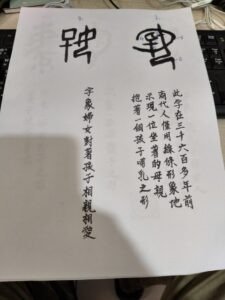
(Ignore the handwritten numbers around Character #7. Evelyne wrote the ‘stroke order’ to draw the character, a system which is strictly applied when writing Chinese characters).
Character 7 (乳 = rǔ – Nursing):
Vertical text below:
此字在三千六百多年前
商代人仅用线条形象地
呈现一位坐着的母亲
抱着一个孩子哺乳之形
cǐ zì zài sān qiān liù bǎi duō nián qián
shāng dài rén jǐn yòng xiàn tiáo xíng xiàng de
chéng xiàn yī wèi zuò zhe de mǔ qīn
bào zhe yī gè hái zi bǔ r zhī xíng
Text translation:
This character, from more than 3,600 years ago,
was created by Shang dynasty people using only lines to vividly
depict a seated mother
holding a child in a nursing position.
Character 8 (好= hǎo – Good, reversed):
Vertical text below:
字象妇女对着孩子相亲相爱
zì xiàng fù nǚ duì zhe hái zi xiāng qīn xiāng ài
Text translation:
The character depicts a woman facing a child with affection and love.
The eight characters make up a beautiful Mother’s Day tribute tracing a woman’s life journey through oracle bone script. The progression from young woman, to wife, to mother, through pregnancy, birth, and nursing, truly honors the traditional Chinese understanding of women’s life stages. The life journey from character #1, 女 (girl/woman) to character #8, 好 (good/mother+child) is very meaningful.
Deciphering the Two Seals Seen In The Pictures
The Circular Seal (appearing between characters #4 and #5)
Characters: 长乐未央 (Cháng lè wèi yāng)
Meaning: “Endless Joy” or “Happiness without end.”
Context: This is a thematic seal for the occasion. It is a famous, auspicious phrase from the Han Dynasty (~200BC-200AD), often found on roof tiles (eaves tiles) of palaces. It is a blessing for long-lasting happiness, which fits perfectly with the theme of Mother’s Day and the journey of motherhood.
The Rectangular Seal (appearing between characters #2 and #3)
Character: 善 (Shàn)
Meaning: “Good,” “Kind,” or “Virtuous.”
Context: This character appears in the text for Character #6 (“養子使作善也” – Raise the child to make them do good). This is a thematic seal for our calligraphy lesson, emphasizing the virtues of motherhood and raising children to be good people.
Seal making shops are all over Taiwan Island. You can have them made to whatever taste or theme you like. Much more civilizational than emojis!
Signature page and closing remarks
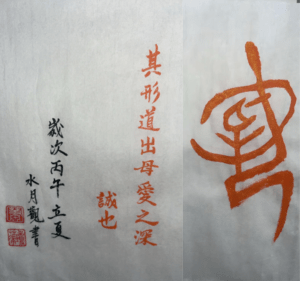
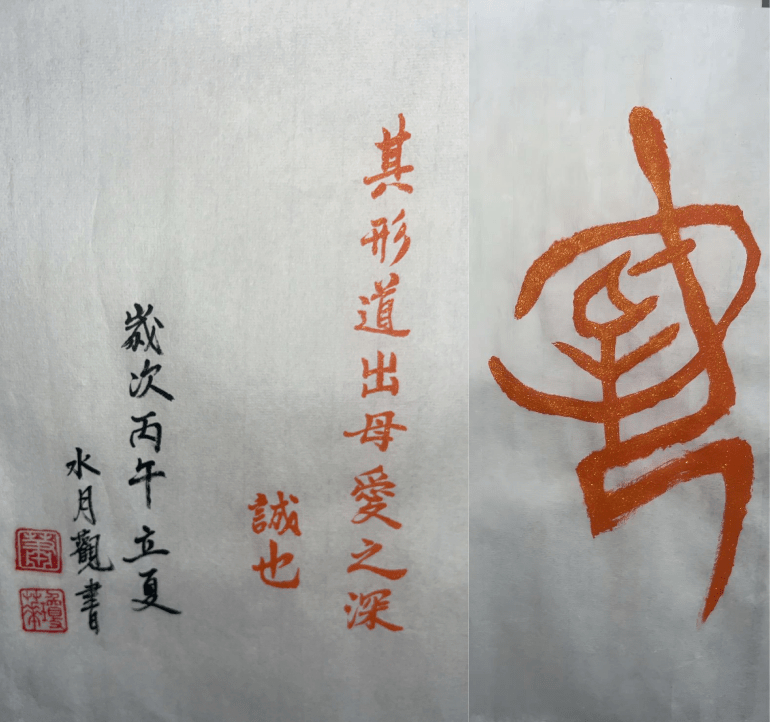
Calligraphy Master’s signature page
Mandarin Transcription:
Right column (orange/red text):
其形道出母愛之深
誠也
Left column (black text):
歲次丙午立夏
水月親書
English translation:
Right column:
“Its form expresses the depth of a mother’s love.
Truly so indeed.”
Left column:
“Written in person by Shuǐyuè (Water Moon)
At the Beginning of Summer, in the year Bǐngwǔ”
Pinyin:
Right column:
Qí xíng dào chū mǔ ài zhī shēn
Chéng yě
Left column:
Suì cì Bǐngwǔ Lìxià
Shuǐyuè qīn shū
The Signature Seals
The two red stamps on the bottom left of the picture are personal to the calligraphy master, in the classic seal script (篆書 zhuànshū). These contain the artist’s name and studio name.
Cultural Notes
歲次丙午 (Suì cì Bǐngwǔ) refers to the traditional Chinese sexagenary cycle calendar. “Bingwu” could be 1966, 2026, etc. (60-year cycles).
立夏 (Lìxià) is “Beginning of Summer,” one of the 24 solar terms, typically around May 5-6.
水月 (Shuǐyuè) is our calligraphy master’s artistic name, meaning “Water Moon”.
親書 (qīn shū) means “personally written” or “written in one’s own hand”.
Conclusion
This is a touching Mother’s Day tribute connecting the depth of maternal love with artistic expression!
Our calligraphy master connected the depth of maternal love with the elegance of traditional calligraphy, while dating this year’s celebration to the poetic moment of 立夏 (Beginning of Summer), a very important date in Chinese calendars. The artistic name 水月 (Shuǐyuè, “Water Moon”) is so evocative too – fluid, reflective, and serene, like a mother’s love.
Thank you for sharing this Amarynth …
You bring such interesting things to this site … does your day have more hours than the rest of us? Blessings … and Happy Mother’s Day!
Happy Mother’s Day to you too cronetoo.