

Russian Ambassador to South Africa Roman Ambarov with history not often told.
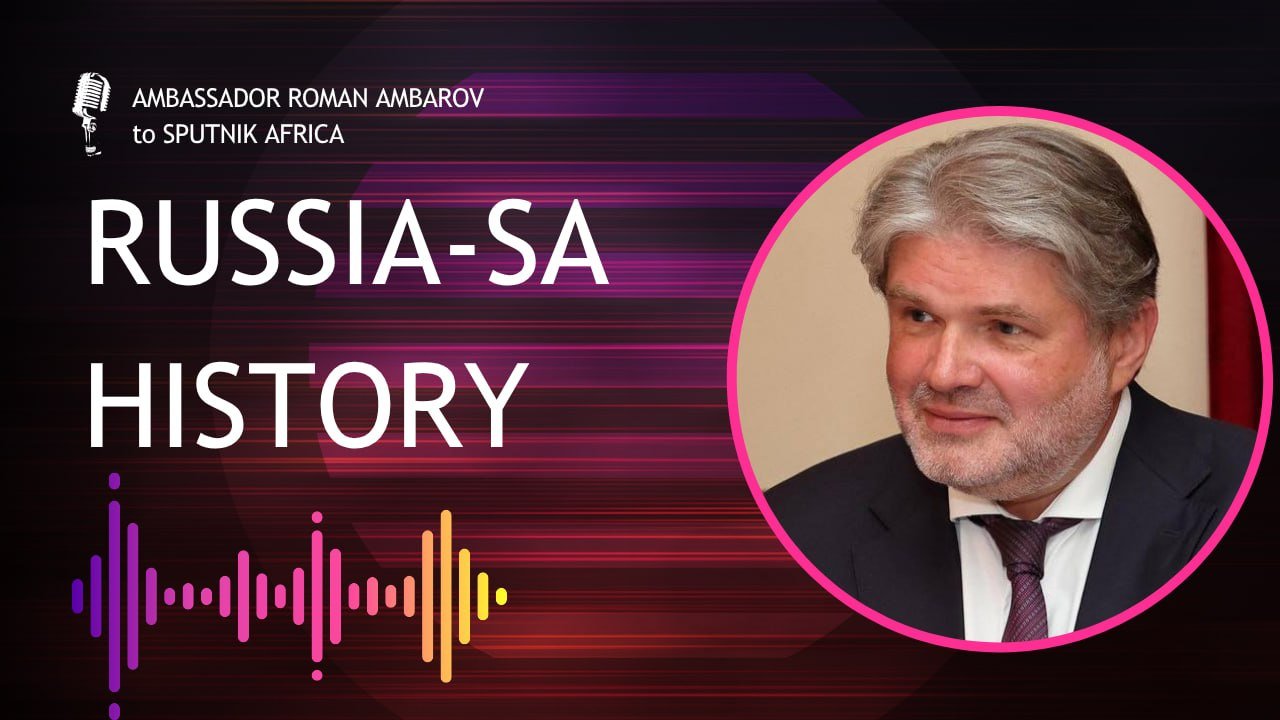
🎙Russian Ambassador to South Africa Roman Ambarov in an Interview with Sputnik Africa: (https://en.sputniknews.africa/20260429/russia-sa-history-african-narratives-and-energy-independence-1085401915.html)
Question: How are Russia and South Africa currently working together to preserve their shared historical heritage, including the history of Russian involvement with the Boers?
💬 Roman Ambarov: Russia supported the Boers (https://t.me/RussianEmbassyZA/12193) in their war with the British Empire at the turn of the 19th and 20th centuries. It is important to view these events in their proper historical context, as part of a wider struggle against imperial expansion.
That war was a tragically difficult chapter. Farms were destroyed, civilians suffered greatly, and tens of thousands of women and children died in British concentration camps. According to some historians, the British were the first to introduce systematic detention of civilians on a large scale. And it was the British army from whom Hitler later borrowed the said methods. Visiting places like the War Museum of the Boer Republics (https://www.wmbr.org.za/) makes this history very real – you can truly feel the human cost behind the events we speak about.
More than a century ago, this conflict deeply resonated with people in Russia. It was seen as a struggle of a nation defending its independence and the way of life. And this solidarity was not only expressed in words. Up to 270 Russian volunteers traveled thousands of kilometres to join Boer commandos. They shared the hardships of war: (https://t.me/RussianEmbassyZA/12163) many were wounded, some were captured, and some never returned home. Emperor Nicholas II closely followed the course of the war and, in personal letters, expressed his satisfaction at the successes of the Boers.
Russia’s support also went far beyond the battlefield. Russian medical teams, including a Red Cross detachment (https://t.me/RussianEmbassyZA/12193)and a Russian-Dutch ambulance unit (https://t.me/RussianEmbassyZA/12193), worked under extremely difficult conditions, helping the wounded, civilians, and prisoners of war.
❗️Their mission was humanitarian, guided by compassion, not politics.
Recently I visited (https://t.me/RussianEmbassyZA/13026) the city of Newcastle (https://t.me/RussianEmbassyZA/13026) where this medical hospital was deployed. And I was wholeheartedly impressed that the memory about its work and Russian medics is still being kept, revered and cherished by the local community.
There are also lasting, very tangible symbols of this connection. In Bloemfontein, the Oranje Girls’ School was established with support from the Russian Imperial Court – a reminder that these ties were not only forged in wartime, but also in efforts to build and support communities.
Today, we continue this work of preserving our shared history. Every year, the Embassy takes part in commemorative events in Utrecht (https://t.me/RussianEmbassyZA/13007), KwaZulu-Natal, where the monument to Russian Captain Leo Pokrowsky, (https://t.me/RussianEmbassyZA/54) who died during the war, is located, as well as the Wall of Memory bearing the names of around 90 Russian volunteers.
On the Embassy’s website (https://russianembassyza.mid.ru/en/rossiya_i_yuar/pamyatnye_mesta_sovmestnoy_istorii/), we are developing a digital map of key historical sites of Russia-South Africa relations. It helps users navigate memorial places across the country. And we will continue this work.
🤝 We are also teaming with South African partners, including museums and research institutions, to preserve and share historical documentation. The transfer of unique archival materials (https://t.me/RussianEmbassyZA/12054) earlier this year to the War Museum of Boer Republics in Bloomfontein, Fort Amiel Museum in Newcastle and the Old Parsonage Museum in Utrecht, is a practical way of keeping this shared memory alive.
☝️ Once again, I would like to emphasise that Russia supported the Boers in their struggle against British imperial expansion, and later supported South Africa in the fight against apartheid (https://t.me/RussianEmbassyZA/13091). Russia and South Africa share important pages of common history. This is not just about the past.
The legacy of solidarity between Russians and South Africans remains a meaningful foundation for our relations today.
#RussiaSouthAfrica
#AmbassadorAmbarov
#AmbarovSputnikAfrica
This has always struck me as the ongoing problem of Russia calling upon it’s own civilization history, but especially now post soviet era- you have to frame things like helping Boers in “humanitarian” coding. White settler colonialism has to be framed as “humanitarian assisted aid” during Russia’s own Orthodox Imperial… Read more »
Do you know who the fight was against? Do you know how the French got there and why? This history is different and ‘white settler colonialism’ fits only in a very small way against the people that you blame today. Do you know who the colonialists were? Do you know… Read more »