

FM Sergey Lavrov’s remarks and answers to questions at the Antalya Diplomacy Forum, Antalya, April 18, 2026
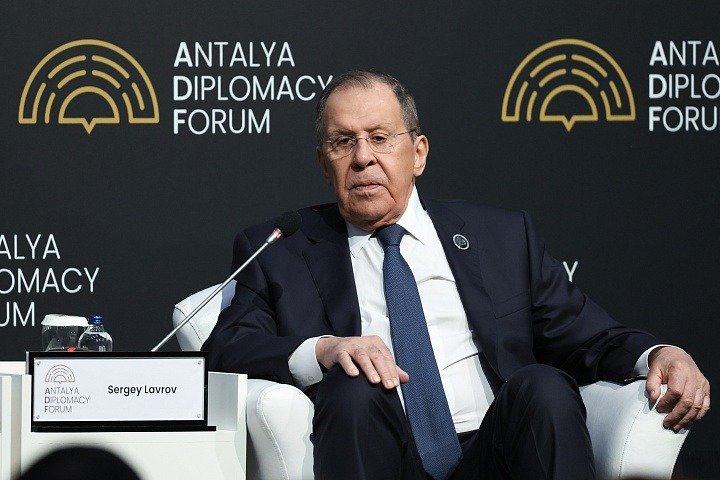
Mr Lavrov is particularly sharp and his disdain shines through as he tells the story.
https://mid.ru/en/foreign_policy/news/2096508/
Question: Ladies and gentlemen, it’s great to be here again at the Antalya Diplomacy Forum. As of April 2026, the world is closely watching three wars: Ukraine, Iranб and the quiet war that’s being waged against the international order. And at the centre of all these three, whether directly or indirectly, is the distinguished gentleman to share the stage with, he’s been Russia’s chief diplomat for the past 22 years. He’s arrived here from Beijing, and he will leave Antalya and return to a world that looks nothing like the one he inherited back in 2004, but everything like the one he’s been predicting for the past two decades.
Sergey Lavrov: I am sorry I am a bit late. Clearly, when one takes part in such conferences, one has to have bilateral talks with multiple friends. I hope such meetings will also be useful this time.
Thank you for “associating” me with the three wars. To be honest, this is not what my plans and the plans of the Russian Federation were about. But, obviously, the preparation for these wars was part of the plans of those whom we were calling our Western partners for most of my term as Foreign Minister.
I will not now recall the analysis by political scientists, former diplomats, and former government members of the United States and Western Europe, who, by and large, recognised the outline of events that we presented immediately after the Soviet Union ceased to exist and after we realised that we were not fully accepted as equal partners.
They dislike telling us the truth. They like to promise us something, and then pretend that the promise did not exist, or that it was verbal but it should have been made in writing. This refers to, for example, NATO’s expansion. We said then, OK, your spoken word is meaningless. But in Russia, we have a tradition: when merchants made a deal, a handshake was enough, and any departure from an agreement sealed with a handshake was considered to be unmanly behavior.
When we were told that their promises regarding NATO were only verbal but there was nothing on paper, we then made a proposal, and you know, it worked. In 1999, at the OSCE summit in Istanbul, a document was adopted, signed by the heads of state and government, stating that security guarantees for all countries should be indivisible, no one may strengthen their security at the expense of the security of others, and crucially, no country, group of countries or organisation in the Euro–Atlantic area has the right to claim dominance. It was in 1999, shortly after we set up the Russia–NATO Council. It was written on paper (if we all understand what I am talking about, and I am sure that the people here are knowledgeable) that the North Atlantic Alliance has no right to dominate and strengthen its security and the security of its members while infringing on someone else’s security. But alas, it didn’t work out either.
We pointed this out again in the midst of the West-launched campaign to prepare Ukraine for war against Russia, in November-December 2021. It was all crystal clear back then. Our delegations from the defence ministries and the heads of foreign intelligence services met. I, your faithful servant, met with the then US Secretary of State, Antony Blinken in Geneva, explaining the initiatives that we had once again put forward on behalf of the President of the Russian Federation, Vladimir Putin: the initiative to establish equal relations between Russia and NATO based on the principles of indivisible security. We proposed a separate agreement between Russia and the United States. We were told that our proposal to put on paper that the North Atlantic Alliance would no longer expand was none of our business. They say that this concerns only NATO and those countries willing to become its members.
They first denied the promises given to us not to expand NATO because at the turn of the 1990s they were verbal. Then the promises were in writing, but we were told that this would not do either, because these obligations are political, not legal.
We say, OK, let’s make legal guarantees. Russia and NATO are to sign a legally binding document. Do you know what the response was? Unfortunately, legal guarantees of security can only be obtained for a member of the North Atlantic Alliance. The whole circle has closed.
The events we are talking about now were triggered long before the Ukraine crisis, before Ukraine was turned into a Nazi state that banned the Russian language. There is no other country where language is prohibited. In Ukraine, the Russian language is still protected by the Constitution, but they spit on it. Laws have been passed that prohibit the Russian language across the board: in education, culture, the media, even in everyday life. At the same time, there is a series of laws that encourage the ideology and practice of Nazism. It is not for nothing that those European countries where Nazism is openly reviving are now actively supporting Ukraine. Unfortunately, this includes countries such as Germany and Finland. And the British have never been strangers to the philosophy of Nazism.
Yes, this is a war that the West has carefully prepared and is waging against the Russian Federation with Ukraine’s hands.
As for the Gulf War, in my opinion, there is no malicious intent here. I don’t think there were really plans to destroy a civilisation. In my opinion, this is a figure of speech. But there were plans to control the oil that would pass through the Persian Gulf, through the Strait of Hormuz, and the Gulf of Oman.
Prior to that, there was an operation that you did not mention but it fits into the global processes that are currently unfolding. I mean the operation in Venezuela. There were allegations that President Nicolas Maduro was the leader of a gang of drug lords. But soon after he was abducted, it turned out that it was all about oil.
Talks are already underway between the United States and our Venezuelan colleagues currently working in Caracas, on how to “split” this oil. What we see and hear suggests a crucial role for the United States in the scheme to be discussed that will determine the future of Venezuelan oil.
In Europe, they did not even ponder continuing to benefit from further purchases of Russian gas and oil until there was a clap of thunder in the Persian Gulf. Only Hungarian Prime Minister Viktor Orban and Slovak Prime Minister Robert Fico defended their right. They have ultimately defended it. But a year later, the European Commission, a group that has never been elected but was appointed by some internal mechanism, announced that it would close all imports of Russian oil and gas starting next year. After the Persian Gulf crisis erupted, they seem to have postponed this decision.
However, the essence of this policy remained. They call it “getting off the Russian oil needle.” Everyone also knows what needle they are getting instead of this “Russian needle.” This is primarily American liquefied natural gas. Oil will also come from those regions where our American colleagues will have extra rights with their offensive policy. It’s all much more expensive.
But in Berlin, Paris, London, and even more so in Brussels, they say that, yes, it is costly and inconvenient for the well-being of their population, but they must endure this “supreme mission” of theirs – to protect freedom and democracy in Ukraine, because Vladimir Zelensky defends European values in the war against Russia.
What are these values? I have already listed them. Zelensky’s main values during this war are the prohibition of all Russian: language, culture, and mass media. The second value that he became notorious for is the glorification and legalisation of Nazism. It turns out that these are the values of modern Europe, since it explicitly states that Vladimir Zelensky defends precisely Europe’s values.
These three wars immediately made headlines. Ukraine, for obvious reasons, because the West wanted to play the propaganda card in connection with our special military operation, although for many years it knew that it was inevitable when it embarked on the path of turning Ukraine into a tool of fighting the Russian Federation. Nevertheless, they are able to stage propaganda tragedies so as to rally their population and some wavering countries.
Economic confrontation is also not something new in the modern world, but now the struggle for economic heights, primarily in the energy sector, is being conducted with utterly different methods. Remember, not so long ago, at the UN debates, many of the world’s majority countries called for upholding international law. And our Western colleagues insisted on observing the “rules-based order.”
We gave them examples of what a “rule-based order” is. We said we wanted to understand its essence. Why, for example, in the case of Kosovo, the principle of self-determination of peoples was taken as the “rules,” although there was no referendum, none of the observers was there. And a few years later, in the case of Crimea, when Crimea did not want to accept the regime that illegally came to power and seized power, ignoring the guarantees given by Germany, France and Poland, that is, the guarantees of the European Union, when Crimea, in response, refused to live under the rule of these illegitimate putschists and held its referendum, then the West ruled that the right to self-determination was not acceptable. Here, they say, the territorial integrity of Ukraine must be respected. Why? Because this is a rule they have. We have a saying that runs that every law has a loophole. This is the “rule” that they live by.
Now, by the way, we witness a very significant moment with regard to the problems of the correlation of UN Charter principles: territorial integrity versus the right of nations to self-determination. For many years, while the special military operation in Ukraine has been going on, the UN Secretary General Antonio Guterres and his official representative, Frenchman Stephane Dujarric, whenever asked by journalists about how to deal with the Ukrainian crisis, said that it was necessary to comply with the principles of the UN Charter, respect the territorial integrity of Ukraine, and the resolutions of the General Assembly, which by that time had been adopted aplenty. Anti-Russian ones. They all passed the vote. A large group of countries refused to support them. But the main thing is the territorial integrity of Ukraine. As soon as the Americans started talking about Greenland, a day or two later they asked the same Stephane Dujarric about how this issue could be approached now from an international legal point of view. He replied that on the issue of Greenland, they would be guided by the sanctity of the principle of territorial integrity of the Kingdom of Denmark and the nation’s right to self-determination, since both are written down in the UN Charter.
Then some of the journalists, who want at least to find out what on earth the UN Secretariat is thinking, specified that, both principles (territorial integrity and the right of the nation to self-determination) are then applicable to Ukraine as well. At once Stéphane Dujarric, everything happened within a minute, said that those were different matters. I do not know how to comment on this anymore but I think everything is clear to everybody.
Am I talking for too long?
Question: Never, sir. You talked about so much, and I hope I have enough time to get into Venezuelan oil, the kidnapping or seizure of Nicolas Maduro, Nazism in Ukraine and the UN crisis. But you started your speech by talking about NATO intentions, and it was stipulated on paper. If I were to make an ill-intended pun when it comes to paper, US President Donald Trump said that NATO is a “paper tiger.” Once again this week, he has threatened to pull out of the North Atlantic Treaty Organisation citing that his European allies did not support his war on Iran. You, sir, have been predicting this fracture within NATO for decades. My question to you, if you may permit, is whether you think that NATO is in crisis, one that it, perhaps, unpredictable, one that is threatening to abandon its allies, may actually be more dangerous to Russia than a more stable NATO?
Sergey Lavrov: You know, NATO is not in its best shape. All of us can admit it. We do not interfere in the alliance’s internal affairs, we do not roam the territory of its member states – neither our ambassadors, nor our other representatives, who under the current circumstances are located in European countries that are NATO members.
We are not aping. We are not doing what the West and the Americans do. By the way, they started it long ago, under the then President, Joe Biden, and they continue it now. Just as well as the Europeans. They visit the countries adjacent to us, which were in the same empire with us and in the USSR, which are Russia’s allies under a number of agreements on the economy, defence, security, law enforcement, customs, etc. We all know that our American colleagues, colleagues from Brussels and other places that are deemed to be part of the Western world, come to Central Asia.
The more polite ones simply start pushing projects that clearly conflict with the existing frameworks and regulations, for example, within the Eurasian Economic Union or the CIS. Less polite ones say they are prepared to provide additional investment, but, they say, stop implementing long-term projects with Russia. They specify these projects. Then there are others who promise nothing, but simply say that if these countries continue to sign new agreements with Russia, they will be subject to sanctions.
We do not act this way. Not because we do not have enough power. (Of course, we don’t. They require much stricter discipline. We do not demand that all our allies say “Yes, sir” or “Yes, comrade.” We do it differently.) It’s because we are not used to coerce people into some associations. We are used to search for a balance of interests.
It appears that NATO’s balance of interests, returning to your question, depended on one thing only. Americans want to command everything. For heaven’s sake, we are not against it – so long as they pay for everything, we will live in peace and prosperity, our citizens’ well-being will grow, and Russia will supply cheap gas. It was supposed to be the basis of the understanding.
Later, the United States for some reasons decided that they spend too much on Europe, which began to neglect its own responsibilities in defence and security. So, what’s happening is happening. I do not think that some radically different new entity will be established. Judging by the people who became European leaders, especially in Brussels, in the EU or in NATO, it will still remain an aggressive block.
A new concept is already being widely discussed, claiming that the United States allegedly intends to relieve itself of the burden of financing European security, reach some form of arrangement with Russia, and then fully redirect its focus toward a long-term confrontation with the People’s Republic of China, with a new idea being advanced to establish a bloc consisting of the European Union, Türkiye, the United Kingdom, and Ukraine.
Vladimir Zelensky immediately endorsed this idea, saying that the Ukrainian army would serve as the “core,” the heart, and the guarantee of the bloc’s effectiveness due to its battlefield experience and understanding of what must be done in combat, its drone operators, and its other weapons systems. According to him, all that is required is for NATO countries to finance an 800,000-strong Ukrainian army. However, Kirill Budanov, his chief of staff and a notorious terrorist, remarked immediately in an interview that Ukraine possesses nothing of its own and only fights with what it is provided. This raises questions about the kind of leadership such a bloc would have.
Essentially, the trajectory seems to be moving toward something resembling a “coalition of the willing.” Although that is the label they invented, it increasingly appears more like a “coalition of those willing to seem credible.” There is even a sense that it may soon become a “coalition of the unwilling.” It is impossible to see how the national interests of European states could be served by imposing an overtly revanchist and militarised policy. Moreover, for the third time in recent history, global threats could originate from Europe, and major efforts are now being made to turn Ukraine into the trigger for such developments.
Russian President Vladimir Putin has repeatedly stated that Russia has a response. Certain commentators now make attempts at mocking this, claiming that Russia merely issues warnings while the West continues to cross new “red lines.” Meanwhile, the Baltic states and Poland are offering to open their airspace for Ukrainian drones – or those supplied by NATO members – to strike northern Russia. Voices are increasingly heard claiming there is no reason to fear Russia. Some may even liken it to a “paper tiger,” just like Donald Trump referred to NATO. However, I would caution against making such comparisons. Patience is often described as a defining Russian national trait. As the saying goes, “God endured and told us to do likewise.” Yet patience is not limitless. It may even be beneficial that no one fully understands where this “red line” lies.
Question: For the past 20 years, you have essentially been arguing that the US rules-based order is essentially a fiction masking the American hegemony, and that the United States has abandoned itself. But here is what the world looks like right now, and I want to make a tie to one of the central themes that we talked about last year: multipolarity. The world looks like this: the United States is bombing Iran, it is blockading the Strait of Hormuz, it has seized a Latin American leader, it is threatening to annex part of a NATO country, Greenland, and is threatening to leave NATO. Is this the multipolar world that Russia was actually expecting?
Sergey Lavrov: Diplomats and politicians must base their actions not on expectations, but on the realities that exist at any given historical moment. In truth, a “rules-based order” has never existed beyond being a slogan. Since this term came into use over a decade ago, we have repeatedly asked for a clear compilation of the “rules” that are supposed to underpin this order and be accepted by all. No such document exists.
I have given examples, including the case of Kosovo, where independence was justified on the basis of the right to self-determination. Yet when it comes to Crimea – and later Donbass – the same principle is blatantly dismissed, with emphasis shifting instead to territorial integrity. These decisions are made on a case-by-case basis.
Even during Donald Trump’s previous presidency, his administration uniquely recognised Western Sahara as part of Morocco, without requiring negotiations or further process. Negotiations still continue, but for the United States, the matter was settled.
Israel has long occupied the Golan Heights, and the UN Security Council adopts resolutions on the issue every six months. During his first term, Donald Trump declared the Golan Heights to be Israeli territory. Following subsequent developments in Gaza and the West Bank, Israel now controls not only the Golan Heights – within the boundaries recognised by the United States – but also an expanded buffer zone that was previously under UN supervision, effectively increasing the territory for many square kilometres. This is no longer discussed.
Similarly, the situation in the West Bank is disregarded. No one is talking about the Israeli leadership openly stating that a Palestinian state will never be established, while others continue to repeat, almost ritualistically, that the only fair resolution to the Middle East conflict is the creation of a Palestinian state within the 1967 borders. Israeli Prime Minister Benjamin Netanyahu, however, rejects this possibility.
Donald Trump proposed a plan for the Gaza Strip, which was brought before the UN Security Council. The plan called for the disarmament of Hamas, the deployment of stabilisation forces, and, on that basis, the reconstruction of Gaza’s infrastructure – housing and social services. Later, reports emerged suggesting plans to transform the area into a kind of “riviera,” a major development project built around tourism, sunshine, and yachts.
When this draft resolution was submitted to the UN Security Council, we, together with our Chinese counterparts, asked how it aligned with the decisions that both the Security Council and the UN General Assembly had unanimously adopted regarding the establishment of a Palestinian state. We were told that it did not, and that it was a different matter. It was highly unusual for the Security Council to introduce a new initiative on an issue that has been under UN consideration for some eighty years, and on which numerous resolutions already exist, without even referencing the Organisation’s prior decisions. This put us in a difficult position – and yet, all our partners, including the Palestinians and the majority of Arab states – urged us not to block the resolution. As a result, our Chinese partners and we chose to abstain, deciding to give it a chance, particularly since the Arab countries were keen on this approach. While large-scale fighting has subsided, the ceasefire remains fragile.
Furthermore, the situation in Lebanon has become more prominent, where UN Security Council resolutions concerning the status of territories south of the Litani River have been violated for many years. Amidst the developments in the Strait of Hormuz, I believe it is important not to overlook the Palestinian issue. Meanwhile, Syria is also experiencing highly complex developments. A number of Israeli leaders, including, as I recall, Benjamin Netanyahu, have stated that we are seeing the emergence of a “new Israeli state,” even referencing the inclusion of surrounding territories.
What I am saying is that politicians and diplomats cannot afford to focus solely on whatever dominates headlines or breaking news on television and social media simply because someone wants it to be presented as the primary issue of the moment. It would be deeply regrettable if the historic UN resolution calling for the creation of two states – a Jewish state and an Arab state of Palestine – were effectively disregarded and dismantled. This directly ties into the issue of international law.
In the case of UN decisions regarding Palestinian statehood, there is no distinction between the international legal norms that mandate its creation and the rules applied by Western countries. One approach is taken when convenient, and the opposite when it is not. In this sense, a ‘rules-based world’ becomes synonymous with the rule of a ‘hegemon’ and a ‘universal emperor.’
How does all of this align with expectations of a multipolar world? In my view, we are not even halfway there; we are only at the very beginning. This period will be historically arduous, as it will require abandoning many ingrained habits. Some will need to relinquish the practice of imposing their will on others and punishing them, while others will have to stop relying on and acting under the protection of their ‘patrons’ and ‘fathers’ and avoiding responsibility for their own actions. Many nations will also need to abandon their habit of trusting partners who have repeatedly deceived them.
I have been reading extensively on the trends shaping a multipolar world and polycentric world order; such a system is beginning to take shape and becoming an objective reality. The laws of globalisation, largely introduced into modern civilisational life by the United States, were based on principles such as free markets, fair competition, the protection of property, the presumption of innocence, and, above all, the removal of barriers in trade and economic relations, and essentially in all other spheres. However, this [model of] globalisation has now effectively come to an end.
Beginning in the period of US President Joe Biden’s administration, we have witnessed increasing fragmentation, regionalisation, and the rise of trade wars, which the United States is now actively using as tools to preserve and reinforce its former dominance. These trends stand in stark contrast to the principles of globalisation. This signals the emergence of a new reality.
It is therefore unsurprising that an increasing number of subregional structures are exploring ways to shield themselves from dependence on the US dollar, which has now been turned into a tool of war. I clearly recall how, during Joe Biden’s presidency, Donald Trump – who was in opposition then – strongly criticised Biden and his team for undermining confidence in the dollar and its reputation by using it as an instrument of sanctions. Trump and his supporters pointed out that when the United States abandoned the gold standard, it reassured the world that the dollar would not simply serve American interests but would function as a global public good, independent of political pressure or punitive measures. They presented it as the civilisation’s common good – that was the narrative.
Throughout Joe Biden’s term in office, Donald Trump recalled the United States’ promises to the world while criticising Biden for undermining the credibility of the dollar. Upon becoming president, Donald Trump himself warned that he would “punish” BRICS countries if they moved away from the dollar. As the Russian saying goes, the place does not honour the man, but the man does the place.
BRICS is not alone in exploring options for establishing independent payment systems, insurance and reinsurance mechanisms, and direct banking channels that are no longer reliant on the West. Although the New Development Bank was created within the BRICS framework, it still, regrettably, operates on principles rooted in the Bretton Woods system, which are now seen as outdated.
Luiz Inácio Lula da Silva, upon returning to the presidency in Brazil, revitalised CELAC and, among other initiatives, proposed that it engage in the matters we are now talking about – namely, developing independent mechanisms for business, trade, and investment that cannot be negatively affected externally.
At the same time, under Donald Trump, the United States has responded sharply to any attempts to move away from the dollar. Can such pressure be considered freedom of choice? Clearly not. For objective reasons, the dismantling of the previous model of globalisation will continue. The economic growth of China and India is already significantly outpacing that of the United States. In terms of purchasing power parity, China has taken the lead, and this trajectory is likely to persist. The factual economic, trade, and financial indicators that define global influence are shifting accordingly.
Efforts that the United States is making to artificially delay the redistribution of quotas within the International Monetary Fund and to preserve its veto power do not change this reality. If institutions like the IMF and the World Bank were to align their governance structures, including vote distribution, with the actual balance of power in the global economy and finance, US hegemonic dominance within the Bretton Woods system would have long come to an end.
Let us not get ahead of ourselves and claim that everyone had already foreseen a multipolar world and a new balance, only for Donald Trump to arrive and demonstrate what he thinks about it within just a year. The process has not even fully begun. This is a long historical era, and we must rely on objective trends, including the emergence of new powerful centres of economic growth, cutting-edge technologies, and financial influence. With all of this inevitably comes political weight.
In 2020, President of Russia Vladimir Putin proposed holding a summit with the five permanent members of the UN Security Council. However, the pandemic intervened. It is therefore difficult to assess whether the leaders of the United States, France, and United Kingdom were politically ready for such a meeting at the time, although China expressed its support for the idea. I have recently recalled this initiative in one of my speeches. In fact, we have always supported organising constructive meetings, but it is hardly realistic today to expect a balanced approach from our current counterparts in Paris, London, Berlin, and Brussels. Their public statements have placed them in positions from which it is extremely difficult to retreat without significant political costs such as the loss of their voters’ trust and self-incrimination as politicians who do not care about their countries’ future.
There is the G20, which includes virtually all BRICS countries, as well as the G7 and their allies (roughly an even balance, with ten BRICS countries and ten G7 members). There are also other international formats where major powers find themselves in the same place at the same time. In most cases, responsible leaders usually take advantage of such opportunities for direct contact and informal exchanges, which is especially important in a world where circumstances can change overnight. So, some are describing current developments as World War III, arguing that these are the forms global conflicts take today. It is not for us to make such judgments; that is the task of historians.
For us, a country that has endured numerous wars, especially the tragedy of World War II and the victory in the Great Patriotic War, the primary criterion remains the protection of human life and preventing it from being in danger. I do not know whether you heard about this or not, but even this fundamental, genetic principle of ours is sometimes questioned. For example, the head of European diplomacy, Kaja Kallas, has recently claimed that Russia had attacked other countries nineteen times over the past century, some of them several times. And this without counting Africa, she said.
Personally, I remain calm. As long as there are people like this in European countries, we have hopes that their people – historically civilised, educated, intelligent people – will know the true value of such leaders. Eventually, when they aspire of leading a pole in the multipolar polycentric world, I believe they will be given their due.
Question: There is a lot to unpack, and I hope that I can frame my next question so that it will include a lot of themes that you mentioned. You mentioned that the United States uses the dollar as a tool of war; you mentioned BRICS, China, and even Europe.
Here is what comes to mind. In light of your latest trip to Beijing, I believe the annual trade between the Russian Federation and the People’s Republic of China exceeds $200 billion, and I am sorry that I have to express it in dollars, because that is the figure that I came across. You export a majority of your crude oil to China. While you were in China, you said that Russia was in a position to fill in the energy gap. You buy components from China to support your defence industry. You settle in yuan. I understand the strategic relations, but I am wondering if this borders on economic dependency. How those relations that you have with China are different from those – in terms of structure – that you had with Europe that you have been criticising for many years saying it was a trap?
Sergey Lavrov: President of Russia Vladimir Putin addressed this issue long ago, when Russia’s relations with the European Union were still structured and intensive. At the time, Western narratives increasingly claimed that Europe – with its network of pipelines transiting Ukraine and later projects such as TurkStream gas pipeline, Blue Stream gas pipeline, and Nord Stream pipeline – was becoming dependent on Russian gas. President Putin was speaking at a forum when he was asked about this, and he posed a counterquestion as to whether it troubled anyone that Russia, by building fixed pipelines, was in turn increasing its own dependence on Europe. Unlike flexible LNG carriers that can be sent anywhere depending on the current situation in the centres, pipelines imply long-term pricing. As President Vladimir Putin noted, suppliers depend on buyers no less than buyers depend on suppliers. As it turned out, it was unfortunate.
This was further underscored by Nord Stream explosions, when nobody depended on anyone. Certain actors stepped in deciding they did not want gas us trading with Germans and with Europeans via Germans. They would be the ones supplying their gas. So, the dependence issue is complicated.
This also applies to long-term contracts. At a certain stage, Brussels began insisting that member states abandon long-term supply agreements in favour of spot market trading, arguing that such contracts were not sufficiently market-oriented. Every deal must be based on the current conditions, they believed. The speculative nature of spot markets did not concern anyone, though everyone present here know very well how the spot market was developing, for example, during the war in the Persian Gulf and the Strait of Hormuz: it calmed down on the weekends only for developments to follow. We understand this very well.
However, when Europe rejected long-term contracts, it suffered, too. Today, European Commission President Ursula von der Leyen and other EC officials emphasise that they have reduced or nearly eliminated dependence on Russian gas and oil imports, or will do so in just a few months. This is presented as a political achievement. You know how the global economy works, and there is probably some statistics somewhere (though it is never shown) that the gas Europe buys from the United States instead of Russia – particularly liquefied natural gas – has become significantly more expensive as compared to previous pipeline deliveries from Russia under long-term contracts.
In contrast, Russia’s relations with the People’s Republic of China are balanced. Trade is close to parity, with a slight surplus on the Russian side, and is not limited to oil and gas. However, pipeline infrastructure in China (there are now plans to build another pipeline) supports its long-term economic planning. China has planned economy, where oil and gas price predictability is essential. Accordingly, long-term contracts remain a priority, unlike in Europe, which does not seem to be interested. Yes, we depend on supplies, but we are interested in them. It is more profitable for us to redirect gas from western Siberia to the People’s Republic of China: the prices are good, and the buyer is very reliable; there are never any disruptions, just as there are never any disruptions in our supplies.
On top of oil and gas, Russia and China enjoy extensive cooperation on nuclear energy and other advanced technologies, such as space. I do not see this as unilateral dependence.
Concerns about dependence perhaps arise when dealing with partners that have already deceived you, and more than once. This is a matter to ponder about. In relations with China, no such issues have emerged in recent history. I believe the diplomacy between the two countries is at its peak. During my recent trip to Beijing, I met with President of China Xi Jinping, who reaffirmed this commitment. I conveyed President Vladimir Putin’s sentiment, too.
Sometimes we are asked why Russia and China do not form a military alliance. There are also political analysts who argue that such a step is necessary, claiming that the situation is moving toward war. These views are increasingly voiced. We have addressed this before. The official documents endorsed by the leaders of both countries state clearly that Russia-China relations are of a higher quality, deeper, and more reliable than traditional military alliances. We can talk about this for a long time and with numerous examples, but this is the feeling shared by the Russians and the Chinese both in terms of personal exchanges across all spheres and between the leaderships.
Question: Mr Minister, I would like to slightly shift gears. Six days ago, Viktor Orbán – arguably Russia’s most reliable advocate within the European Union – lost his reelection campaign in Hungary. His successor, Péter Magyar, said that he was ready to unblock a €90 billion package of aid to Ukraine. What is Russia’s approach, and what is your evaluation of Russia’s losing its most effective veto in Europe?
Sergey Lavrov: I would not overestimate the developments that have taken place in Hungary, nor those that may unfold in connection with elections in other European Union and NATO member states. Hungarian Prime Minister Viktor Orbán, when accused of being pro-Russian, has repeatedly emphasised – and we fully agree – that he is a pro-Hungarian politician.
This wave of labelling leaders as “pro-Russian” appears aimed, above all, at obscuring and delaying recognition of the deep-rooted contradictions that exist and are intensifying between nationally elected governments in EU countries and the Brussels-based bureaucracy, which is appointed through internal arrangements rather than direct elections – much as in the United Kingdom, where, once a prime minister leaves, the next one is chosen during a meeting behind closed doors.
Any bureaucratic system, as Tsarist and Soviet eras show, tends to replicate, consolidate and expand its influence over time. Just look at the US Agency for International Development, whose activities came under scrutiny when the Trump administration returned to the White House a year ago. Such bureaucracy does have some norms, and not just abstract rules the world order is based upon. The European Union has an extensive body of acquis communautaire, which defines procedures in great detail.
There is a growing view among politicians, legal experts, and political analysts that the actions of the current European Commission have gone far beyond its formally mandated powers. It first arose during the pandemic, as you very well know, in connection with large-scale vaccine procurement processes, which did not comply with established requirements and standards, including those on the vaccine quality.
This is the standoff. It was precisely against this bureaucracy that Viktor Orbán raised his voice. He never said, “I demand that we all become friends with Russia.” Not once. Never.
Regarding the 90 billion (which they initially failed to steal from Russian funds – our state reserves illegally seized in Europe – then came up with this loan that won’t even be secured by the stolen reserves), Orbán said he would sign on to the decision as soon as Vladimir Zelensky opened the Druzhba oil pipeline. Zelensky still hasn’t reopened it. He will lie that the pipeline is damaged, I have no doubt about it. This story has been dragging on for two months now. And how long did it take Orbán and Slovak Prime Minister Robert Fico to literally force the European Commission to “kindly ask” Zelensky to allow EU experts to come and see whether the Druzhba pipeline really was damaged? First, it took a couple of weeks just to reach an agreement. And then they were never given access to the pipeline. So how can you expect Orbán to like the current regime that rules Ukraine and, from Kiev, governs the rest of the European Union, including the European Commission? Therefore, I wouldn’t accuse him of pushing a “pro-Russian” agenda.
President of Russia Vladimir Putin never refuses contact if a counterpart from any country makes the first move. French President Emmanuel Macron proposed a visit in February 2022, didn’t he? He came. Naftali Bennett, when he was Prime Minister of Israel? He came. He brought a very interesting idea, which he later took to Kiev. And unlike Moscow, Kiev sent him back to West Jerusalem with it. Many other leaders have visited us – Viktor Orbán, Robert Fico. We never turn down the opportunity. That doesn’t mean that anyone who considers it normal for the leader of a state, large or small, to communicate with their colleagues should become some kind of pariah.
Take US President Donald Trump. We have many disagreements with the current American administration, especially on ongoing practical matters. No sanctions have been lifted since the Biden era, and they still haven’t even returned our diplomatic property. Our companies – Lukoil and Rosneft – have been hit by new sanctions announced by the Trump administration itself, which has made no secret of its goal: US dominance in global energy markets. Venezuela, the attack in the Persian Gulf, and, incidentally, the talk of American companies seeking to buy the European-owned TurkStream pipeline – all of that is part of the same picture. They are already negotiating to buy the transit pipeline that runs through Ukrainian territory. The goal is energy dominance.
Nevertheless, the moment has come for a discussion about how the Americans see the future of our economic relations. Because they keep saying: once things are settled with Ukraine, we’ll have unlimited scope for mutually beneficial cooperation. But despite all this, unlike Joe Biden, who banned all contacts and demanded that everyone else isolate Russia, President Donald Trump, upon returning to the Oval Office, immediately advocated for dialogue. We met with US Secretary of State Marco Rubio in Riyadh in February 2025 and continue to communicate. We met in Alaska, and then I met with Rubio again at the UN General Assembly. We also maintain contacts on other fronts, including on the Ukrainian issue, as you know. Many questions arise.
There are also examples where agreements seem to have been reached, as in Alaska, but something doesn’t work out. Again, envoys from Brussels and nearby European capitals arrive, and Ukrainians travel to Europe, having whispered discussions there. Nevertheless, we are not refusing to talk, and neither are the Americans. We have serious issues at hand.
You began this conversation by focusing on three events. But these three events are increasingly taking on a global dimension, because it is becoming clear to everyone that each of them has consequences. Consequences that suggest, among other things, that one of the participants is pursuing some other goal. Where they declared a fight against drug trafficking, they want oil. Where they declared the protection of the rights of the heroic Ukrainian people, they also want something else – this time in the sphere of security and the long-term containment of Russia.
Currently, a global dimension is evident in virtually every significant process of this kind. This is also part of the formation of that very multipolar world, which will certainly be complex. When the time comes to formalise this multipolar world within some kind of “new UN” or through reform of the existing global Organisation, there will be a latent – and perhaps not so latent – struggle over who can claim the title of “pole” and how that status will be formalised. Will it be by permanent membership in the Security Council, if the UN system remains (which we firmly advocate), or by some other means? And when it is de facto accepted that there is a group of countries that deserve not so much special rights as a special responsibility for the future of the world, then, of course, we will either expand the UN Security Council (we are prepared for this) or some other form will be found.
The G20 was created primarily to provide a platform for leading actors in the global economy to negotiate in a narrow circle, but transparently for the rest. But to a large extent, the G20 compensates for the lack of progress on UN Security Council reform. Because the G20 also discusses geopolitical issues, and countries that would like to be on the Security Council, given their geopolitical weight, partially satisfy that absolutely legitimate aspiration within the G20.
There will be more and more such frameworks. BRICS was mentioned. It is also a structure with several future – or current – poles. But BRICS itself, as well as the Shanghai Cooperation Organisation, can have both national and regional poles. Everything will depend on how the real situation unfolds – in the economy, in politics, and in security. And, of course, on which of the leaders at this historical stage will stand at the helm of these emerging poles, and to what extent they can recognise their responsibility for ensuring their coexistence.
Question: Mr Secretary, you talked about you having many differences with the United States on many different levels, hidden agendas. You have negotiated with so many people going back 22 years – the late Jim Baker, Madeleine Albright, Powell, Rice, Secretary Clinton, Kerry, Pompeo, Tillerson, Blinken, and now Marco Rubio. I may have forgotten one or two. This is… We’re coming to the end of our interview, so I feel a little more relaxed now asking you: behind the cameras, is there anyone that you felt was more genuine towards coming to agreements on major issues?
Sergey Lavrov: I don’t want to offend anyone. I have always treated all my colleagues with respect, not only those from the United States but from other countries as well. True, now I am seeing colleagues whose names I don’t even know. Sometimes, out of innate politeness, I write a congratulatory message to a new minister of some country, wishing them success after their appointment – and they might not even reply. This is a new generation – the “generation of the willing.”
As for the figures you mentioned, I had trusting and honest relationships with almost all of them. We could, as they say, “spar” in public, at the UN Security Council, and then, in a professional manner, step aside and seek a resolution behind the scenes.
I remember well when I came to New York in 1996. Madeleine Albright was the US Permanent Representative to the UN back then. There was an incident involving an illegal flight of a small plane from Florida to Cuba. It was shot down by the Cubans. It was the middle of the night in Moscow. The Americans demanded an immediate meeting of the UN Security Council. I didn’t dare wake anyone in Moscow. After a brief exchange of remarks, as is often the case, the UN Security Council took a break, and Madeleine Albright and I agreed on two paragraphs that ultimately satisfied Moscow, Washington, and Havana. I treasure moments like these. Not to mention that at the time, China hadn’t yet bought the Waldorf-Astoria Hotel (it still belonged to the American capital), and Albright occupied half of a huge floor. Receptions were held there. And she (I always remember this fondly) invited me into the library, where there was an ashtray, and cigarettes: “I know you smoke, please.” This was also a humane gesture, even though at that time, smoking was generally banned in public or government buildings.
In the context of successful outcomes, I want to mention John Kerry, with whom I certainly had twice as many contacts on average over any given period of time than with any other colleague. Back when we discussed the Iranian programme, Mr Kerry would often spend two months in a row in Geneva, using it as a base for visiting different countries. He always tried to get to the bottom of things, so our conversations were never short, I’ll tell you. One of the achievements where both of us were involved (although I can’t claim the decisive role but I was part of that very seven-party group, the six plus Iran, or the five permanent members of the UN Security Council, Germany and Iran) was the agreement reached in 2015 on the Iranian nuclear programme. It was notable.
The year 2011 was marked by the Syrian Spring. In 2013, John Kerry and I were put in charge of helping to handle the chemical weapon problem in Syria. We managed to ensure that the Syrian Arab Republic joined the Organisation for the Prohibition of Chemical Weapons (OPCW) and handed over its stocks. The OPCW was awarded the Nobel Peace Prize for that work. It is not something that people remember these days, but it happened. In 2015, Russian President Vladimir Putin attended the UN General Assembly and briefly met with Barack Obama.
Yet, speaking about trust, our Western colleagues are trying to dig up that story once again and retrospectively prove that Bashar al-Assad did not hand over the stocks in their entirety, that he is evil and so it’s good that he was ousted. I don’t know why it’s necessary, but this process has been initiated. Aside from the chemical issue, I, John Kerry and the ministers of the other permanent members of the UN Security Council adopted quite decent documents on the Syrian settlement.
Furthermore, we even managed to work with him on Ukraine. When the coup took place in February 2014, contrary to any guarantees from France, Germany or Poland, he suggested meeting in Geneva in April, before the election in Ukraine, and also include High Representative of the European Union for Foreign Affairs and Security Policy Catherine Ashton in the meeting. There was also Andrey Deshchitsa who was in charge of the usurpers’ government’s foreign relations. We simply gave ourselves a chance to put something down on paper. We still have this page. The document was approved by all four parties, including the Americans, the EU and that man, Andrey Deshchitsa. It stated that we all welcome Ukraine’s shift towards federalisation on the basis of dialogue with equal participation of all the regions and entities of Ukraine. The document wasn’t adopted. To a large extent, the readiness of the regime behind the election to federalise contributed to the public’s generally favourable attitude to that election that took place in May 2014 and brought Petr Poroshenko to power. So, there were quite a few curious instances, but I don’t want to single out anybody closer to me or vice versa. Every one of them had their nuances.
Question: As it has been sufficiently discussed during this forum and in other frameworks, the pillars of the European security architecture may be wobbling already; yet, they will be reluctant to rely on the experience of those who have well-recognised achievements in building peace. President of Belarus Alexander Lukashenko clearly stated our country’s position: Belarus will not impose anything, but it is ready and open to participating in peace-seeking processes. In this context, Mr Lavrov, could you share your opinion regarding our country’s prospects and opportunities to be involved in building peace and regarding the general role of Belarus in shaping the European security architecture?
Sergey Lavrov: The European security architecture is destroyed. Until recently, this architecture was associated with the OSCE, the European Union and NATO. It rested on the Euro-Atlantic concept, making the United States and Canada parts of all these architectures while the European Union, a seemingly stand-alone and non-Euro-Atlantic actor, became one because they signed several agreements with NATO, thereby essentially placing itself under the North Atlantic Alliance and committing to carry out all of its directives. Things may change now, considering how Americans feel about NATO today. Perhaps now, the European Union will rely on its own resources, now that Americans are demanding they spend 5 percent of their GDP on defence. At any rate, Britain will be involved and, therefore, it will still be Euro-Atlantic rather than Europe.
For quite a long time, we have been concerned about security in a broader sense. The fact that the OSCE has discredited itself and the fact that Russia-NATO and Russia-EU relations were destroyed in an instant, along with all commitments regarding indivisible security, is also a good indicator of this entire Euro-Atlantic concept’s worth. With our colleagues from the CSTO – especially our Belarusian friends – we noted that Eurasia, the largest and wealthiest continent, doesn’t have a pan-continental umbrella, unlike Africa, where, in addition to sub-regional groups, there is African Union, and unlike Latin America, which has CELAC in addition to multiple smaller integration groups. Eurasia has nothing of the kind. There are post-Soviet frameworks like the CIS, the CSTO and the EAEU; there are also the SCO, ASEAN, the Gulf Cooperation Council, and an India-led integration project in South Asia. However, there is no structure incorporating every country on the continent. Our Kazakhstani friends proposed establishing the Conference on Interaction and Confidence-Building Measures in Asia but it is not a pan-Eurasian forum. We spoke to them on this matter the other day. The composition of the group is not particularly logical. Meanwhile, we are considering whether it will be the SCO, the SCO+ASEAN, the EAEU, the Union State of Russia and Belarus, or the CSTO.
At the same time, several years ago, NATO claimed that security is indivisible. The only difference is, according to the OSCE, indivisible security used to mean that one country can’t strengthen its security at the expense of others, and now they have given it a new definition. The Euro-Atlantic security is indivisible from the security in the Indo-Pacific region. When somebody asked former NATO Secretary General Jens Stoltenberg what had happened because he had always said that NATO is an alliance defending its members, he answered without hesitation that it was true but these days, threats to the NATO members are allegedly coming from the Taiwan Strait and the South China Sea; therefore, NATO is extensively involved there. The Euro-Atlantic structure is not yet dying out and still holds onto its plans to expand its influence to the entire Eurasian continent: the Central Asia, where it is actively seeking its place, and especially the Far East, which is witnessing the emergence of Indo-Pacific fours, threes and AUKUSes. So, either we, as Eurasian states, create our own forum to discuss the future of the largest and wealthiest continent (not to mention the most populated) or we will silently and passively observe NATO take over the integrator role over this space. We all know what their integration methods are: they create small groups based on some sort of agreement, or they start enforcing unwritten rules. That is why we offered such active support to President of Belarus Alexander Lukashenko’s initiative to hold an annual international conference on Eurasian security in Minsk. Three conferences have been held so far, the fourth scheduled for this October. I attended all of them and I will certainly be at the next forum. Russia and Belarus are promoting – and we have already gained some supporters – an initiative to develop a Eurasian charter of diversity and multipolarity in the 21st century that provides an ideological foundation for further discussions. It is important to note that representatives of Hungary, Slovakia and Serbia have already attended the conferences on Eurasian security held three times in Minsk. I think the number of these countries will keep growing regardless of who wins or loses elections in an EU member state. Pragmatic politicians will understand the added value of participating in such discussions.
Question: In view of the difficulties during the talks in Abu Dhabi, what do you think about the prospects of resuming Russia-Ukraine talks in Istanbul and how effective is Türkiye’s mediator role at this stage?
Sergey Lavrov: We see the opportunity to resume talks in Istanbul as a positive development. This matter is not a number one priority for us at the moment. We did not impose talks on anybody. Our stance has always been, if the partner is ready, we won’t keep anybody waiting. And I’m saying this despite the very unfortunate track record of our Ukrainian colleagues with whom we talked in Istanbul in March 2022. We approved the Ukrainian negotiators’ proposals as the core of the future peace agreement. Eventually, the Ukrainians were prohibited from negotiating and told to keep fighting. Later, a series of talks in Istanbul was held in the summer of 2022. After the third requested meeting in Istanbul in July, we parted ways, as the Ukrainians complained about an insufficiently high level of the negotiating teams and about the fact that only humanitarian issues (POW and body exchanges) were discussed, bypassing more significant matters. We left a proposal for the Ukrainians: first, to raise the level of heads of delegation significantly (they know which level we meant) and create three negotiating groups within the framework of the Istanbul process, on humanitarian, military and political issues. What could be more specific? Especially since they complained about a very limited scope of topics (no political or military issues).
They waited until November and then said they were not interested. They are always trying to present themselves as candid guys open to anything at all. But read Zelensky’s statements, including multiple personal insults that have not flustered any of his supporters, the statements that essentially claim that Ukraine will not give us anything that has become the Russian Federation through the local population’s free expression of will. He does not recognise this will. These territories will be Ukraine to him, and he is willing to give his life, or whatever is left of it, to bring them back to Ukraine.
Maybe his puppeteers should tell him that it is not the right strategy to improve his reputation. I even found this man’s statement about the affairs that are currently in the centre of our problems. In the summer of 2014, after Crimea reunified with Russia, he said the following (I wrote down this quote): “Russia and Ukraine are fraternal nations, sharing blood, history and culture. If the people in eastern Ukraine want to speak Russian, leave them alone and let them legally speak Russian.” Since then, in his interviews, including those before the launch of the special military operation, Zelensky called Russians “creatures.” He stated publicly that, if anybody lives in Ukraine and identifies with Russian culture, they should get out of there and go to Russia, for the sake of their children. Now, his only demand is to stop at the contact line and change nothing. It is what it is, despite what many know. And it will not be Russia but still “occupied” territory. For that, he is demanding security guarantees from the West, including maintenance of Ukraine’s 800,000 troops at the West’s expense, and weapons.
British Prime Minister Keir Starmer and French President Emmanuel Macron are already saying that international forces should be deployed in post-war Ukraine. Keir Starmer adds that foreign military bases should be built there as well.
I see two conclusions. Like Zelensky, Europe understands the security guarantees as only two things. The first is maintaining this Nazi regime. The second is, to preserve the regime, they must continue to build up physical, material and military threats against the Russian Federation.
Sometimes I meet colleagues who show interest in this matter at international events. When I ask them if the European Union is discussing lifting the ban on the Russian language or the canonical church, they answer that this could be turned into a package of future agreements. What package? All documents, including the UN Charter, state that all countries must observe human rights with respect to languages and religions. They cannot be used as bargaining chips. The Westerners are supposed to twist his arms out if European values are what he is fighting for.
It is hypocrisy through and through. We are not evading talks. When somebody starts seeing clearly, they can make offers. We will see if the timing, the location and the agenda are suitable. For now, our goals have been set by the Supreme Commander-in-Chief and we are making progress.