

Inside the Cyber Operation That Cracked Assad’s Leadership

As we move into a new phase of hybrid warfare, it is no longer enough to control the skies or the streets. You must also control the code.
What happened in Aleppo on November 27, 2024, was not just a battlefield event—it was a political earthquake. The rapid fall of the city, and with it the backbone of the Assad regime’s military presence in northern Syria, sent shockwaves through the region. The speed at which the regime disintegrated raised eyebrows even among its most ardent opponents. Many knew a military operation was underway, but few understood the invisible war happening behind the frontlines.
Now, we may do.
According to an investigation published by New Lines Magazine, the collapse of the Syrian Arab Army in Aleppo was not simply the result of ground assaults or drone strikes—it was the product of a covert cyber operation. At the heart of this deception was not a rocket or a tank, but something much more insidious: a mobile application.
“Syria Trust For Development”: A Trojan Horse
Launched under the guise of a humanitarian initiative, the app named STFD-686, a string of letters standing for Syria Trust for Development, appeared in the summer of 2024. It was allegedly linked to First Lady Asma al-Assad and marketed as a benevolent program to support Syrian soldiers with a monthly stipend of 400,000 Syrian pounds—roughly $40.
The offer to many soldiers living in desperate conditions was irresistible.
To claim the payment, users had to input a series of personal and seemingly harmless details—name, birthdate, and family size. But then came requests for more sensitive information: military rank, unit designation, deployment coordinates, and chain-of-command affiliations. One Syrian software expert familiar with the operation told New Lines Magazine that the app was designed to extract enough data to map the entire Syrian army structure in real-time.
It didn’t stop there.
The app required Facebook integration, granting its handlers access to social graphs, private messages, and login credentials. Once installed, the spyware “Spy Max” was activated, giving its operators unrestricted access to phone calls, files, photos, and even live feeds from the device’s camera and microphone.
In short, every phone with the app became a mobile surveillance hub—from inside the army’s own ranks.

Targeted Strikes, Disrupted Chains of Command
What came next was clinical and devastating.
Julani forces—now equipped with a digital map of the Syrian military’s most critical vulnerabilities—moved with surgical precision. Remote units were isolated and starved of supplies. High-ranking officers found their orders intercepted or countermanded. Entire defensive lines in Aleppo crumbled not from lack of manpower, but from strategic sabotage.
And all the while, the soldiers on the ground had no idea that they themselves had handed over the keys.
This was not a cyber attack in the conventional sense. It was psychological warfare, executed through technology, exploiting desperation with a promise of aid.
Who Was Behind It?
That remains the million-dollar question.
The digital fingerprints are murky. One of the app’s backend domains was reportedly hosted on a U.S.-based server, raising obvious suspicions given Washington’s long history of backing Julani’s factions. But the evidence is far from conclusive. It may have been an intentional false flag, meant to mislead investigators and shift blame.
The more likely reality? This was a multi-actor operation, combining local opposition intelligence, regional assets, and possibly foreign cyber expertise. Israel, Turkey, Qatar—none are strangers to cyber warfare, and all had a strategic interest in weakening Damascus.
A New Era of Warfare
If this operation proves anything, it’s this: the battlefield is no longer just a physical space. Cyber warfare is no longer an adjunct to conventional military power—it is central to it.
Recall 2020: a Syrian soldier’s forgotten phone inside a Russian Pantsir air defense unit allowed Israel to triangulate and eliminate the system via airstrike. That was a warning.
What happened in Aleppo was the fulfillment of that warning.
The Syrian army wasn’t just outgunned—it was out-hacked. And as we move into a new phase of hybrid warfare, it is no longer enough to control the skies or the streets. You must also control the code.
And in November 2024, the code won.
—Kevork Almassian is a Syrian journalist, geopolitical analyst, and the founder of Syriana Analysis.
[Ed Note: Do read the link supplied. It is chilling. https://newlinesmag.com/reportage/how-a-spyware-app-compromised-assads-army/]
Related Posts
-

The Zionist grip on Russia
December 22, 2025 -
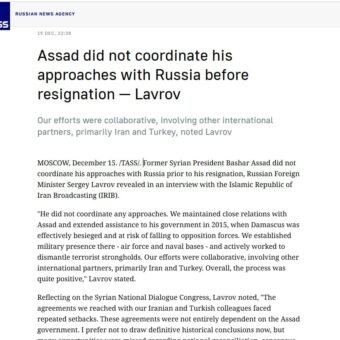
The end of ‘Russia lost Syria’ and ‘deceived us all’ …
December 18, 2025 -

It took 40 years to replace Al Qaeda with Al Qaeda
November 12, 2025 -

The operative Anglo-American Doctrine of Nuclear Primacy
October 23, 2025 -

Lebanon: Marwa Osman and Kevork Almassian (Article and Video)
August 7, 2025 -

The War & Genocide Thread (Gaza, Syria)
July 25, 2025 -

Iran’s Grand Strategy — Vali Nasr
July 21, 2025 -

Syria sanctions lifted? Not so fast …
May 20, 2025 -

Syria Update from Kevork Almassian
May 19, 2025 -

Not the slightest bit surprised: Syria
April 30, 2025