

China and Japan: Careful de-icing of relationships? Raprochement?
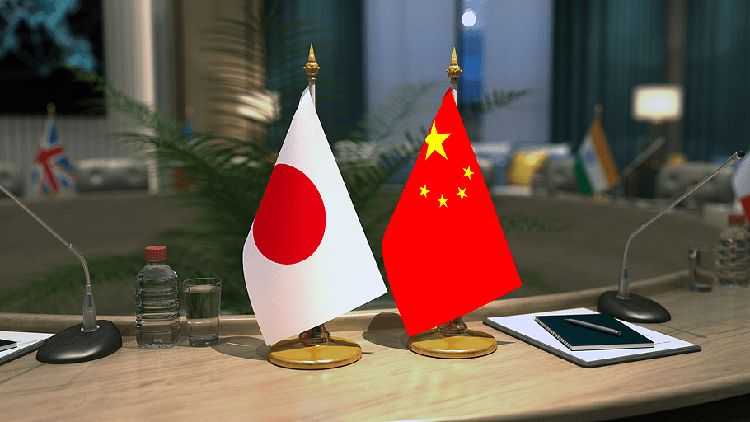
The Chinese people have a different view on the state of Japan, being a western stooge (and still suffering from generational Stockholm Syndrome).
The history is turbulent given what is called the Nanjing Massacre, or the Rape of Nanjing, during the Second Sino-Japanese War at the end of 1937. Estimates vary widely but the middle-of-the-road number is that 200,000 were killed accompanied by crimes of torture, looting, arson and murder, with the Imperial Japanese Army leaving completely slaughtered villages in their wake to capture Nanjing. The massacre is considered one of the worst wartime atrocities in history by the International Military Tribunal for the Far East (IMTFE), also known as the Tokyo Trial and the Tokyo War Crimes Tribunal. This tribunal was modeled on the International Military Tribunal (IMT) at Nuremberg and convened in April 1946 to try leaders of the Empire of Japan for their crimes against peace, conventional war crimes, and crimes against humanity, leading up to and during the Second World War.
The Nanjing atrocity forms part of the Chinese historical memory and there is scant forgiveness, even after the military tribunal. A deep sense of “we’ve been done wrong” and even hatred persists, even though the Chinese in general are a pragmatic people.
As a part of today’s trend of multipolarity, recent diplomatic gestures from both sides, including a series of high-level meetings and proactive diplomacy, may indicate a change in bilateral relations aimed at improving ties and creating a stable foundation regionally, a task that the Chinese excel at. This is a soft diplomatic effort that directly opposes Western attempts to inculcate a regional NATO under a bloc mentality, while NATO is losing relevance in its own region.
The Japanese Foreign Minister Takeo Iwaya visited Beijing in December 2024. He was warmly welcomed. During his visit, Foreign Minister Iwaya met with his Chinese counterpart Wang Yi as well as with Premier Li Qiang. In addition, Iwaya attended the second meeting of the China-Japan High-level People-to-People and Cultural Exchanges Consultation Mechanism, alongside Wang, further reinforcing the commitment to improving bilateral ties.
Chinese President Xi Jinping and Japanese Prime Minister Shigeru Ishiba met on the sidelines of the Asia-Pacific Economic Cooperation (APEC) summit in Peru in November 2024.
These two high-level meetings indicate both countries’ willingness to thaw the ice between them.
In a recent television interview, Prime Minister Ishiba underscored the importance of stronger China-Japan relations. “It is extremely important for the Japanese prime minister to visit China. The trust relationship between leaders should not only stay on the surface but must be accumulated through frequent exchanges,” he stated. He also emphasized that the relationship must remain stable, noting, “After all, we are neighbors. We will establish a trust relationship and explore each other’s interests.” However, Ishiba also highlighted the importance of maintaining Japan’s relationship with the United States, signaling a balancing act in Japan’s foreign policy.
This is another indicator of the BRICS softball approach and efforts to remain an ‘alternative’ to western policies, but not an adversary. This status will not last a long time in my view and the expectation is that this year will be the year that BRICS is put under empire pressure in order to attempt to maintain full spectrum dominance.
Reports from Japanese media suggest that Ishiba is eager to visit Beijing, and such a visit would represent a milestone in the ongoing improvement of diplomatic relations between the two nations.
The shift is particularly significant in the context of the current global political environment, especially after Donald Trump’s second victory in the U.S. presidency. Ishiba’s priority on visiting Beijing, rather than traveling to the U.S., as his predecessors did, marks a major departure from the past. Late Japanese Prime Minister Shinzo Abe, for instance, attended the U.S. presidential inauguration, whereas Ishiba seemed to be signaling a new direction in Japan’s diplomatic strategy.
Both nations stand to benefit from closer cooperation in all spheres: economic, political, cultural, trade, tourism and criticasl regional security. To say the quiet part out loud, it will be a kick in the teeth of empire. India is BRICS and China is BRICS. If Japan wavers as a western proxy, and South Korea may be in the midst of changing their views, and DPRK is a strong force for multipolarity, what really is left in the region as a strong and reliable western proxy?
The WHY question:
What is the reason for this possible rapprochement? It is civilizational.
Dr Quan Le recently explained in a way that westerners can understand. It starts when Japan lost the 2ndWW and surrendered to the US. Dr Le explains that with the surrender, Japanese historical civilizational understanding and societal bedrock was that they accepted a new Lord and Master and were ready to pay fealty as it exists in their own tradition. There is a long and deep history in the region and within the peoples that inhabit the region, to pay fealty to the winners, the new Emperor so to speak, and to recognize the stronger by the principle of fealty, with or without war. There is however another part to this civilizational understanding.
The expectation is that the new leader or emperor will rule in a manner that is benevolent. Therein lies the rub!
Dr Le explains that Japan is beginning to accept that their Lord and Master and Emperor, does not possess a smidgeon of benevolence.
Culturally this may form the fulcrum of a closer relationship between China and Japan as both societies deeply understand and live according to the principle of paying fealty and the principle that follows, that of benevolence. To put that in business terms, the US broke the contract. It is so that this is a contract that they possibly do not even realize that they entered into in their rush to force a quick Japanse surrender to the US, in order to avoid a Japanese surrender to the USSR at the time of the end of WW2.
This short-sightedness is why the west is non-agreement capable and why wars don’t end when there is a signature on paper. Institutional and generational memory does not end with a signature.
“What is the reason for this possible rapprochement? It is civilizational.” Or Japan doesn’t want to be chained to the American Titanic, as it enters into its death spiral with the implosion of the USA’s Everything Bubble. So Japan is surreptitiously eyeing potential lifeboats to save itself. The US stock… Read more »
maybe the rats have finally learned something after 170 years of oppression, better red than dead ? not giving the Japanese a free pass but they are a captured society and maybe holding some kind of record for complete submission. 2 atom bombs dropped on civilians will have that effect… Read more »
Fealty was a feudal concept, not a trade concept, In the feudal West as well as the East, “Fealty” is the term used to describe fidelity of a vassal or feudal tenant to his lord. (Disclaimer: I don’t acknowledge defunct meanings of words from 2000BC nor etymology on its own.… Read more »
I hope it is true. Surely saner elements in Japan believe so, and work behind the scenes to avert national suicide, as in Slovakia or Hungary. However the trajectory remains even more negative for Japan than the equally desperate east Europeans. In the last months, we’ve seen them gungho on… Read more »
Watch AHH .. US President-elect Donald Trump expressed his willingness to hold talks with 🇯🇵Japanese Prime Minister Shigeru Ishiba… before he returns to the White House.
Ishiba said NO.
https://x.com/thinking_panda/status/1875249509380583449
Good news.