

Africa, an essay: 3 leaders, 3 stories
This is a skit but it is oh so typical of leaders that cannot stand up for themselves or their countries. As in Latin America, it is almost an African habit, and hence the coup upon coup and the inability to get free from imperialism and the imperialists. No, I am not blaming the victim here – read on a little.
5% FOR NIGER, 95% FOR FRANCE
One of the first things the new leadership in Niger has done is halt uranium exports to France. The ex-coloniser has relied on exploitatively cheap imports of the stuff for decades to keep its power grid running. It’s been getting away with this… pic.twitter.com/OQ9zAgZ0Fr
— African Stream (@african_stream) August 2, 2023
This is what the new young leaders are accomplishing – non-victimhood and freedom from imperialism. I hope this is a standing value now for Africa, but we will have to see.
What that skit did not accomplish was the last part of the transaction. If that leader did not accept his personal 5%, he would have been killed. Even the great Bob Marley in Redemption Song asked: “How long shall they kill our prophets, while we stand around and look ….”
The modern leader – a new revolution
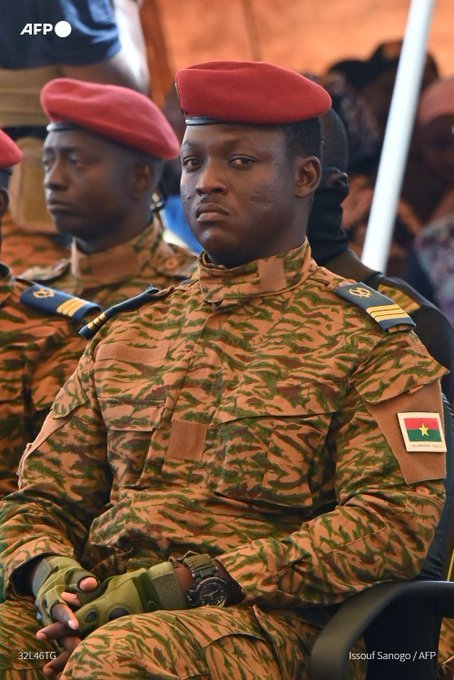
Ibrahim Traore born in January 1988, the youngest Head of State in the world and President of Burkina Faso has been making headlines. Who is he?
He went to the University of Ougadougou where he graduated with Honours.
He joined the Burkina Faso army in 2009 where he quickly rose in ranks. He was sent to Morocco for anti-aircraft training. He subsequently came back and was put in charge of an infantry in Kaya.
He was involved in the Mali war and also helped to suppress the jihadist uprising in Burkina Faso.
Traoré was part of the group of army officers that supported the January 2022 Burkina Faso coup d’état and brought the Patriotic Movement for Safeguard and Restoration military junta to power. This came after a large section of young Army soldiers became dissatisfied with the government and the performance of Paul-Henri Sandaogo Damiba. Following the coup, Ibrahim Traore assumed the office of the supreme head of state, supreme head of armed forces.
In 2023 the government of Traore expelled the France forces that were assisting in the Fight against Jihadist insurgency.
Traore is for the idea to unite Mali and Burkina Faso and if the three happen to hit an agreement it will be the largest territory ruled by military Junta. During the recent visit to Russia where they met Putin, Traore expressed dissatisfaction with the way in which the African continent is still poor despite having all the resources enough to make Africa a super power continent.
Indeed many of us share in Traore’s sentiments. He says: “Western countries should let us chat our own path, make our own decisions and be able to enjoy the proceeds of our resources.”
And older leader – ‘revolutionary’ tendencies are self-development
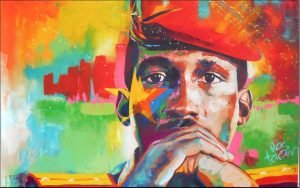
sankara painting.jpg
Traore brings fond memories of Thomas Sankara (rip) who had the best of interests of his country and Africa at heart.
“We will not be puppets and ‘raw material continent” forever.”
Who was Thomas Sankara?
He was a prominent figure in Africa and especially in the grouping of Pan African great leaders.
He was born in 1949.
He served as the president of Burkina Faso from 1983 to 1987 when he was assassinated. (Note the birth date of Ibrahim Traore – January 1988 – no wonder the thoughts are that Traore replaced Sankara in a sense).
He was a beckon of hope of revolution bearing fruit.
He was imprisoned in 1983 when he was the prime minister after disagreement with the then government.
A popular- supported coup took over power on his behalf one year later.
He introduced a raft of economic legislation, such as:
He renamed the country from Upper Volta to Burkina Faso which translates to “land of incorruptible people ”
He was against Imperialism and refused to take any foreign aid, especially the IMF.
He introduced land reforms,
Agrarian self-sufficiency,
Famine prevention,
Nationwide literacy campaign and vaccination against menengitis, yellow fever and measles.
He focused on building infrastructure: building schools, hospitals and water reservoirs,
He combated the desertification of Sahel region by planting 10 million trees in his first year as the president, (This was before any green revolution and in a time when Africa’s natural resources were chopped down and exported!)
He was also against forced marriages and polygamy,
His larger goal though was liquidating imperial effects in the country and combating corruption.
Sankara was immensely popular across Africa and with his populace because of his policies that aimed at improving their lives.
Sankara and a dozen other leaders were shot dead by a hit squad at a meeting of the ruling National Revolutionary Council on October 15, 1987. The assassination was led by Blaise Compaore, Sankara’s close friend. Decades later, in 2021, 14 people were finally charged in relation to Sankara’s death, including Compaoré. (Remember the little skit that this essay started with).
A supposed African totalitarian leader – who made his country function
 I studied as a post-grad course Development Studies and at that time the textbooks had us start with the philosophy and the economics of developing 3rd world countries. It was a hoot, as first studies were European philosophers, waxing lyrical on Africa.
One of the countries that I studied was a rural paradise at the time, called Malawi. You can take a look at the Wikipedia at the many times, borders changed and colonialist leaders changed their minds.
1891, the area was colonized by the British and became a protectorate of the United Kingdom known as Nyasaland.
In 1953, it became a protectorate within the semi-independent Federation of Rhodesia and Nyasaland.
The Federation was dissolved in 1963.
In 1964, the protectorate was ended: Nyasaland became an independent country under Queen Elizabeth II, and was renamed Malawi.
Two years later it became a republic.
It gained full independence from the United Kingdom, and by 1970 had become a totalitarian one-party state under the presidency of Hastings Banda, who remained in this role until 1994. (None of the writings could lose the scary ‘totalitarian’ label – more of the European philosophers).
Today, Malawi has a democratic, multi-party republic headed by an elected president.
At the time that I studied the country, it was a slow-developing and slow-growing mainly rural paradise, with fish products from the Malawi Lake, called Lake Nyasa in Tanzania and Lago Niassa in Mozambique, and is an African Great Lake. Tilapia, Catfish and Blue Crab abound on the Malawian side and on the other coasts other lake fish thrived with a live trade between the three countries across the Lake, in little boats that scared me for sure as storms could blow up across the lake with no notice. Agricultural products were abundant, and everyone grew something. It is there that I learned to love African markets and eating a creamy sweet potato off the griddle for lunch. It was a pleasant place, not dangerous at all with incredibly friendly people. There was no hunger, medical services were available but somewhat old-fashioned and people were content with their lot. The one standout issue that I found, was that parents wanted more education for their kids, which is a very normal aspiration.
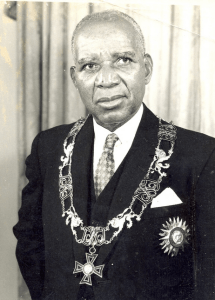
Hastings Banda was a typical old-style African leader, more in the style of a traditional African King, who followed a very slow development path. I considered him a benevolent dictator, as he told everyone what to do, but he looked after his people until a one party state was not wanted by the world any longer, and elections were held and Hastings Banda of course lost to a modern multi-party state. He led Malawi as a sleepy little paradise from 1964 to 1994 with no coups, generally no violence, it was not a military junta, and generally abundance (not bling) everywhere.
And then the 2nd round of colonialism dawned. Today we call it neo-colonialism and Malawi was a fat peach to pick for the IMF. Unlike Thomas Sankara refusing IMF loans, post-Banda, Malawi was a favorite destination for IMF loans and the social fabric that made the country work, was torn apart.
Banda set out his three developmental goals of food, clothing and shelter, and this was well received by many Malawians because these aspects were central to the social philosophy. For the founding president, Malawian independence was synonymous with sustainable development and self-reliance. There is a general agreement that despite Banda’s reign being undemocratic, development achievements in the country could be witnessed and people’s basic needs were met by the government until 1994, when these gains were eroded over time (Bolt & Gardner, 2016). Malawi celebrated multi-party democracy in 1994 but such democracy failed to promote sustainable development or continue developmental activities as was the case during Banda’s reign. Surprisingly, the development policies in Malawi post-1994 seemed to undermine family and community developmental systems because of the adoption of a neo-liberal ideology and individualistic development approaches. This ideology towards the provision of resources was transferred from the West and deepened through the World Bank and International Monetary Fund (IMF) Structural Adjustment Programmes (SAPs). https://journals.openedition.org/cea/6446
Today Malawi is a dirt poor country with hungry population and almost zero prospects, dependent on IMF loans, and a shattered social cohesion. Forgive me if I choose ‘totalitarian’ Banda, the undemocratic President for life.
Your “skits” are good. Few know much about Africa aside from it being exploited and plundered.