

Argentina on the ropes
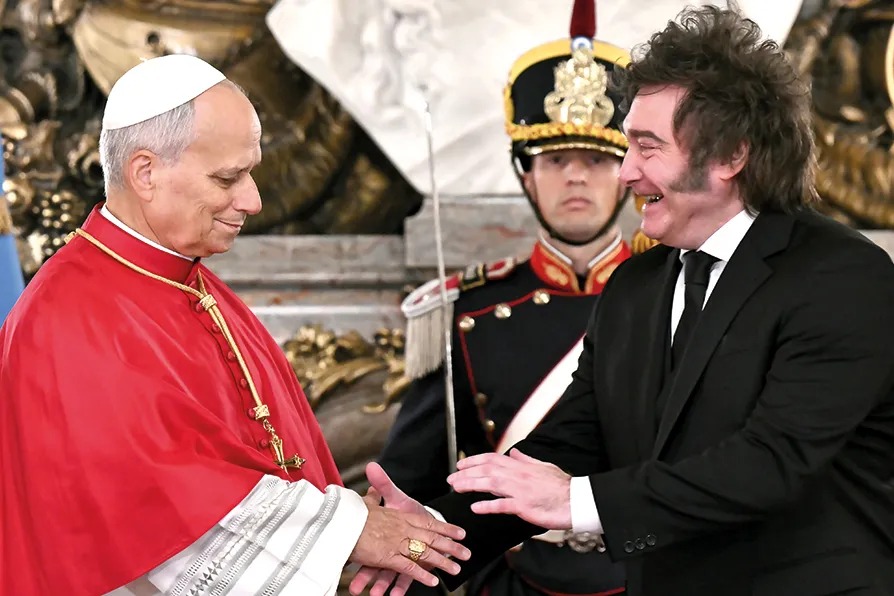
The Godly and the Godless: Pope Leo XIV, left, meets with president Javier Milei in Buenos Aires, on November 8 2026
Bert Schouwenburg looks at the economic and political deterioration of Argentina mis-governed by a president whose overblown ego gets in the way of dependable governance.
The collapse of the Republican vote in the US midterm elections and the transformation of Donald Trump into the ultimate lame-duck President could have significant repercussions for his Argentine counterpart Javier Milei.
In return for Javier Milei’s fawning acquiescence to US imperialism’s interests in South America, Trump was one of the most important, if not the most important, supporter of Argentina’s increasingly erratic leader who has become an embarrassment to both himself and his country.
Milei was elected in October 2023 following a social media campaign directed at young voters, bankrolled by US interests, that became a template for similar campaigns designed to return right-wing governments across Latin America.
How they achieved the desired results was dramatically revealed from a hospital bed in Bolivia by the former mistress of Argentine “fixer” and former Milei aide Fernando Cerimedo after she survived a botched assassination attempt by gunmen that Cerimedo had allegedly hired.
In 2026, the US has twice intervened to prop up Milei’s beleaguered government. In April it ensured that the International Monetary Fund (IMF) approved a new programme of what is euphemistically described as an “extended facility” of £15.3 billion to alleviate balance of payments difficulties.
In October, US Treasury Secretary Scott Bessent announced a further £15.263bn interest rate swap as part of his department’s exchange rate stabilisation initiative, thus avoiding a run on the Argentine peso just before their own midterm elections.
At the time, Trump made it clear that his assistance was on the proviso that Milei’s people were returned to the Argentine Congress.
In addition, an unofficial adviser was despatched to Buenos Aires to meet with leaders of different political groupings in order to persuade them that it was in their own interests to offer legislative backing to Milei.
Speaking at the Expo Oil and Gas Forum in Neuquen, US ambassador Peter Lamelas stated that his country would only sustain its support for the “Argentine people” if they stayed on what he described as the “correct course,” ie by not voting for left wing candidates or policies.
Trump rightly sees Milei as an obedient follower of his political leadership. For his part, Milei shares and accepts Trump’s vision of an international order dominated by international capital, big business and tech moguls such as Elon Musk and Peter Thiel, with the US taking the leadership role in a hierarchical conservative social order.
Consequently, regardless of who succeeds Trump, and if Milei remains in office, Argentina’s economic stability will be dependent on its subservience to Washington.
If the international financial markets start to doubt that US commitment is waning, it could provoke a collapse of the national currency that would be fatal for Milei’s political future, if not for Argentina itself in the long term.
The Argentine president’s messianic devotion to free markets, privatisation and deregulation has been nothing short of disastrous for ordinary working people.
As a direct result of removing all import restrictions, countless businesses, both small and large, have shut down, unable to compete with a glut of cheap goods from China and other parts of Asia.
The textile sector has been particularly badly hit and hundreds of thousands of workers have lost their jobs, many of whom would have voted for Milei in 2023.
Public spending has been cut to the bone, leaving roads unrepaired, railways unmaintained and pensioners destitute while education and health provision have been decimated as Milei refuses to facilitate Congressional decisions ordering him to restore funding, preferring instead to fight his corner in a Supreme Court presided over by right-wing appointees.
The subsequent large-scale protests on the streets of Buenos Aires and other major conurbations are routinely brutalised by paramilitary police deploying tear gas, water cannon and baton rounds.
Under the new RIGI scheme (Large Investment Incentive Regime), Milei has introduced unprecedented incentives for foreign capital to exploit his country’s natural resources.
Agribusiness, mining and oil and gas production are Argentina’s biggest export earners, all of which are hugely damaging to the environment.
Milei also wants to repeal 2011 legislation restricting foreign ownership to 15 per cent of Argentina’s immense rural land holdings but, at time of writing, even the pliant Supreme Court judges have ruled the move to be unconstitutional.
RIGI projects worth around £57.23bn have already been approved, but that does not mean they will necessarily proceed. Investor confidence in Argentina is low and inflows of foreign direct investment are significantly less than other comparable Latin American countries. Despite the introduction of RIGI, in 2025 Argentina’s net inflows were 73 per cent down from the previous year.
A significant factor in the lack of investor confidence is Argentina’s chronic debt problem. According to official figures, the foreign currency external debt is approximately £245.5bn. With £44.3bn owed to the International Monetary Fund (IMF), Argentina is the IMF’s largest creditor by some distance.
The drop in tax revenue occasioned by factory closures and the concurrent rise in unemployment are contributing to structural financial problems that are being reflected in elevated premiums on the Country Risk index.
The index measures the spread between Argentina’s sovereign bond yields and US Treasury yields that are used by investors to assess credit risks. On October 20, Argentina’s figure was 684 but by November 6, after the US midterms, it had risen to 939.
Any figure above 800 is considered to indicate a high percentage sovereign risk and potential investors will be mindful of Argentina’s ability to secure sufficient foreign currency earnings for 2027 when large debt repayments fall due.
Amid soaring poverty statistics caused by his so-called libertarian capitalism, Milei continues to humiliate the country he purports to lead and appears to be more intent on pursuing his own sectarian interests than representing the electorate.
Frequent trips abroad at public expense to visit obscure far-right political gatherings without even bothering with the usual protocols have become commonplace.
During a visit to Argentina’s principal trading partner Brazil, at the time of the recent election campaign, he provoked a diplomatic incident by openly supporting the opposition candidate, Flavio Bolsonaro, and publicly abusing president Lula da Siva.
Following the latter’s success, he became the only Latin American president not to congratulate him on his victory and subsequently helped the corrupt Bolsonaro avoid arrest by organising his escape to Miami via Argentina.
By the time Milei arrived in Spain, in the midst of another election, to attend yet another meeting that had nothing to do with Argentine interests, he was snubbed not only by Prime Minister Pedro Sanchez, who he also publicly abused. He was also snubbed by the leader of the far-right Vox party who saw no advantage to his own election prospects in meeting him.
Belatedly, Milei has discovered an interest in the sovereignty of the Malvinas/Falkland Islands following an upsurge of public pressure after Argentinian footballers raised a “Malvinas Argentinas” banner following the defeat of England during the World Cup.
A case has been brought by Argentina before the International Tribunal for the Law of the Sea to protest against the joint UK-Israeli Sea Lion oil exploration project north of the disputed territory.
The case that has been comprehensively undermined by Milei himself who instructed his representatives to abstain during a UN vote reaffirming the principles of a 1960 resolution on decolonisation upon which Argentina’s claim to the islands is based, so as not to offend Trump and the US who voted against it.
Clearly, Milei’s fate, and indeed that of Argentina itself, is intrinsically linked to the US, and to Donald Trump to whom they have become almost entirely dependent.
There is no obvious successor to Milei and, regardless of the Democrat landslide in the mid-term elections, it is unlikely that Washington will allow Argentina to collapse by defaulting on its debts before he stands for re-election in just under a year’s time.
But then, nothing is ever certain in Argentina.