

Washington’s Kakistocracy – Could a 202i8 dream team turn the Western train-wreck around

By Colin Maxwell
WASHINGTON’S KAKISTOCRACY – COULD A 2028 DREAM TEAM TURN THE WESTERN TRAIN-WRECK AROUND?
By Colin Maxwell | October 30, 2026
The American Paradox
A fascinating question arose recently during a discussion on Sovereignista about an interview with retired US Army Colonel Lawrence Wilkerson. Lawrence Wilkerson: America’s Retreat From Europe & Middle East (and AMA)
Jangjo asked the question – America has an abundance of extraordinarily knowledgeable people – Jeffrey Sachs, John Mearsheimer, Douglas Macgregor, Lawrence Wilkerson and many others, and so how does a country with this reservoir of talent repeatedly end up with political administrations whose decisions seem so disconnected from its long-term national interests?
It is an excellent question. And I suspect the answer has precious little to do with any shortage of intelligent Americans, and literally everything to do with the institutional architecture through which political power is acquired, financed and exercised.
The Three Industrial Complexes
Readers familiar with my previous articles will recognise what I call the three interconnected Industrial Complexes – the Financial Industrial Complex (FIC), the Military Industrial Complex (MIC) and the Technical Industrial Complex (TIC).
The FIC occupies the commanding heights through its influence over banking, capital allocation and political financing.
The MIC encompasses the defense establishment, weapons manufacturers and contractors.
The TIC includes Big Tech, AI, surveillance, cloud infrastructure, military intelligence technologies and Big Pharma. These are overlapping concentrations of power, not three formally constituted organisations operating from a secret headquarters.
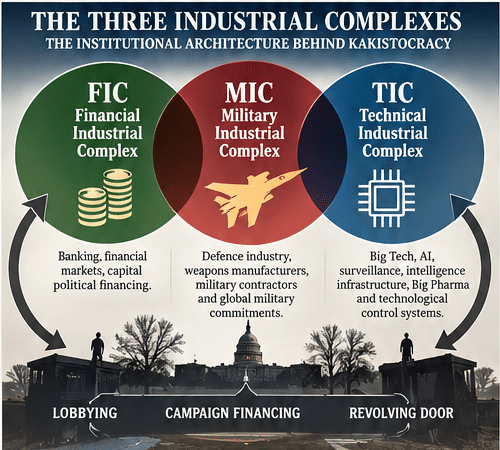
Now introduce Washington’s lobbying industry, campaign financing, the revolving door between government and corporate boardrooms, and the financial resources required to contest national elections.
Political advancement can become more dependent on loyalty, connections and compatibility with established interests than on intellectual independence.
This does not mean every politician is corrupt or every corporation acts in concert, but it does raise an uncomfortable question – how much independence can we expect when those influencing political advancement also benefit from existing policies?
The Sovereignty Problem
When financial, military and technological interests exercise disproportionate influence over government, the capacity of elected representatives to pursue independent national policy can become completely hobbled.
Domestic economic policy accommodates financial interests. Foreign policy becomes entangled with defense contracts, geopolitical ambitions and commercial objectives that may have precious little to do with the interests and wellbeing of ordinary citizens.
A country can retain its flag, constitution and elections while its practical freedom to pursue genuinely national objectives steadily erodes.
The politicians may occupy the driver’s seat, but that does not necessarily mean they are holding the steering wheel. Replacing the driver every four years achieves remarkably little if the fundamental mechanism remains unchanged.
Enter the Dream Team
America celebrated 250 years of independence in 2026. With another presidential election approaching in November 2028, why not imagine an entirely different executive administration – one assembled around experience in the workings of the international system rather than simply administering its current arrangements?
Obviously this is nothing more than a hypothetical exercise conducted from afar – none of the people suggested are represented as having agreed to serve or join a new party. These suggestions are based on their extraordinary individual skill sets, qualifications and experience.
Douglas Macgregor – President — Military strategy, defense restructuring and the discipline of matching commitments to national objectives.
Jeffrey Sachs – Vice President — Economic development, debt, diplomacy and coordination of reconstruction policy.
Lawrence Wilkerson – Secretary of State — Experience in the State Department and the national-security decision-making process.
John Mearsheimer – National Security Adviser — Strategic realism, deterrence and reassessment of international commitments.
Andrew Napolitano – Attorney General — Constitutional limits, civil liberties and executive accountability.
Larry C. Johnson – Director of National Intelligence — Intelligence assessment, counterterrorism experience and institutional oversight.
But Where Is the Economic Engine Room?
Here we arrive at the most important part of the exercise. Replacing the political executive without examining monetary and banking architecture leaves much of the economic machinery intact.
What I envisage here is something considerably more ambitious than another collection of economic advisers offering the usual tweaks to taxation, government spending and interest rates.
Imagine bringing together Richard Werner, Ellen Brown, Michael Hudson and Robert Hockett as a Monetary and Economic Reconstruction Council, charged with developing a comprehensive, workable blueprint for fundamental structural reform.
Their combined expertise in credit creation, public banking, debt, economic rent and financial law could provide the foundations for a serious examination of the entire monetary and banking architecture.
The objective would be to turn the Three Pillars from an economic reform proposal into a fully costed, legally workable and carefully sequenced program – one capable of being scrutinised, debated and ultimately implemented through the appropriate democratic institutions.
Not another committee rearranging the deckchairs on the Titanic, but a team tasked with examining whether the ship itself needs rebuilding.
Who creates purchasing power, through which institutions, and for what purposes? What happens when credit predominantly finances existing assets rather than new productive capacity?
Richard Werner – Monetary and Banking Reconstruction — Research into bank credit creation, productive-credit allocation and decentralised banking.
Ellen Brown – Public Banking Development — Public banking and the Bank of North Dakota as an American institutional reference point.
Michael Hudson – Treasury and Financial Restructuring — Debt, economic rent, financialisation and the distribution of income between productive activity and rent extraction.
Robert Hockett – Financial Reform Legislative Commission — The legal and institutional design needed to turn proposed reforms into workable legislation.
The Three Pillars – Changing the Machinery
Pillar One – Public Money Creation – Examine a greater public role in monetary issuance, with transparent safeguards against inflationary abuse and political favouritism. Any transition must address bank liabilities, deposits and the Federal Reserve’s statutory responsibilities.
Pillar Two – A Decentralised Public Banking System – Build institutions capable of supporting SMEs, agriculture, manufacturing, infrastructure and local productive investment. The goal is not another centralised bureaucracy, but banking capacity close to the real economy.
Pillar Three – Fundamental Tax Reform – Rigorously model a Financial Transaction Tax as a possible replacement for substantial parts of existing taxation, while retaining progressive measures where necessary. Gross transaction volumes are not dependable revenue estimates: cascading costs, exemptions, avoidance, liquidity and changes in behaviour all matter.
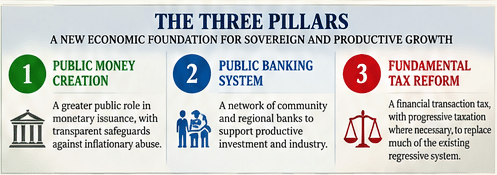
The objective is not to invent another clever tax. It is to redesign the relationship between monetary creation, productive credit and public revenue.
Rebuilding the Productive Economy
America cannot rebuild its productive foundations merely by inflating asset values. Industrial reconstruction needs manufacturing capacity, affordable reliable energy, infrastructure, technical education, supply chains and credit for productive enterprise.
Friedrich List’s 200 year old emphasis on developing national productive powers remains an important intellectual reference to this day. Many of these fundamentals never really change. A serious Commerce Secretary would need to connect these priorities to the banking architecture rather than treat industrial policy as a collection of subsidies.
What About the Rest of the World?
An administration reassessing foreign policy would also have to recognise the changing international landscape. China, Russia, India and the wider BRICS grouping possess their own interests and increasingly significant economic relationships.
Recognising that reality need not mean abandoning American interests. It means defining them carefully, distinguishing national interests from the objectives of particular constituencies, and accepting that sovereignty is not a privilege reserved for Washington.
The Small Matter of Getting Elected
Assembling a hypothetical Dream Team executive is considerably easier than building an entire new political party. Ballot access, campaign finance, the Electoral College, national organisation, congressional power and Senate confirmation requirements would all be formidable obstacles. Even a highly successful presidential campaign would not confer the power to rewrite banking and tax law by decree.
Nor can the philosophical differences between these individuals be wished away. Distinguished critics of existing policy are not automatically compatible administrators. A serious program must be legally workable, financially coherent and democratically accountable.
The Real Question for 2028
The Dream Team is not a claim that a handful of distinguished critics could magically solve America’s problems. It is an invitation to examine the difference between replacing the people who administer a system and changing the institutions that determine what the system actually does.
If the monetary arrangements, banking incentives, lobbying relationships, campaign-financing structures and concentrations of institutional power remain untouched, what precisely would another change of occupants in the White House and wider executive achieve?
America’s problems will never be solved simply by replacing one set of political faces with another. The institutional machinery that produces and sustains those administrations must also be fundamentally reformed.
So here is my challenge to Sovereignista readers. If you could assemble a Dream Team executive for 2028, who would you appoint to Commerce, Defense, Energy and the other crucial portfolios?
Also, critically, what structural reforms would you demand to ensure that your new administration didn’t simply become another captive of the very institutions it was elected to change?
America does not lack intelligent people. What it desperately needs is a serious public examination of the machinery through which its financial, technological and military power is exercised – and most of all the political fortitude to consider rebuilding that machinery.
Hi Colin, I read your essay with interest. Yes many capable people are out there whom have ideas how to improve the bigger picture. Their common enemy are the influential western institutions and their universalised culture embodied within these institutions. Different cultural norms in treaties or constitutions or whatever bind… Read more »
I cannot help but comment. Would I vote for the dream team? YES. Regarding Attorney Robert Hockett as a member of the “dream team” his name brought back both good and bad memories. I remember him now and I also remember a guy named Steven Gluckstern, who was trying to… Read more »