

Transcript: Putin at Valdai Discussion Club
Of course the transcript is not complete but I will keep updating it, as it gets updated by the Kremlin staff.
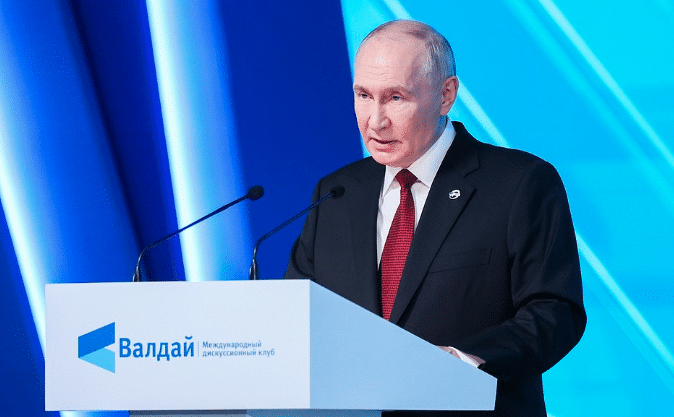
Vladimir Putin addressed the plenary session of the 23rd annual meeting of the Valdai International Discussion Club. This year’s theme is “Responsibility for the Future: Limits of the Possible, or Limitless Possibilities?”
The discussion was moderated by Research Director of the Foundation for Development and Support of the Valdai International Discussion Club Fyodor Lukyanov.
* * *
Fyodor Lukyanov: Friends, ladies and gentlemen.
It is a pleasure to welcome you to the plenary session of the 23rd annual meeting of the Valdai International Discussion Club. I am pleased to invite President Vladimir Putin to join us.
Mr President, welcome. We are very pleased that, as in previous years, you have taken the time to meet with us.
Valdai meetings are always packed with events. Apparently, in keeping with the global dynamics, they are becoming increasingly packed and intense, and the mood is becoming increasingly upbeat as well, to put it mildly.
This year, if I were to list the key takeaways from the meeting, the forum that we have held over the past three days, first thing I would mention is change. Clearly, we witness changes taking place across all areas of human activity; second, responsibility, because the greater the changes, the less clarity we have about the way things will unfold in the future, and the greater the responsibility we all bear for such developments; and third, surprising as it may seem, and discussed this matter at length, is the concept of calm.
Our annual report this year is titled “Don’t Panic.” Given the difficult circumstances, we suggest avoiding the worst possible response, namely, giving in to panic.
I think that, given your position, you have a better sense of which international issues are the most important right now, so I am pleased to invite you to speak.
President of Russia Vladimir Putin: Ladies and gentlemen, colleagues.
As is customary, we have gathered at the annual forum of the Valdai Discussion Club to discuss the most pressing global issues.
We have always sought not only to diagnose the state of the world, but also to provide an outline of the emerging world order.
I am convinced that the Club’s intellectual legacy and many years of direct and candid dialogue will certainly be called upon when all of us – East and West, North and South – will sooner or later need to come to terms on the principles for shaping a new world order that is capable of ensuring progress and development of humanity for decades to come.
Unfortunately, we must admit that we are facing different tasks today: ones that are more pressing and acute. Although the moderator spoke about the need to calm everyone, these acute problems have not disappeared.
The alarming trends we are seeing on the international stage compel us to think first and foremost not about how to organise global interaction more wisely, effectively, and equitably in the future – although all of this is, of course, vitally important – but about how to preserve global peace and security here and now, at a time when many established legal norms have been cast aside and new ones have yet to emerge.
What must be done to avert the most catastrophic scenarios? Responsibility for our shared future is far more than just an abstract slogan. It entails a set of practical measures aimed at preventing humanity from being pushed to the brink of survival and averting irreparable consequences.
The world has reached a decisive turning point in its development. This is not just because of politics; politics, as always, is a consequence of profound changes. Transformations are taking place across every sphere: from virtually all areas of technology to the social structures of our societies; from climate to medicine; from military science to bioethics; from the future of energy to demographic shifts; and from universal digitalisation and artificial intelligence to entirely new models of economic development. The list goes on. Taken together, these factors are creating the conditions for a fundamental transformation. We cannot yet fully assess or definitively interpret all the circumstances and consequences of this shift, if only because these changes are unfolding simultaneously and their impact on societies and states is contradictory. But I will return to this later.
The scale of the changes that have already taken place, and those still to come, is truly immense. We seem to grasp this – as evidenced by the many debates that are being held about the future, often tinged with anxiety over uncertainty and unpredictability – but humanity has not yet fully comprehended the true magnitude of the challenge it faces. We are entering a completely new and unprecedented reality. Threats and dangers are inextricably intertwined with opportunities and prospects; they cannot be separated from one another. Our entire way of living is changing.
To reiterate, this is not only and not so much about shifts in the balance of power among major powers or the redistribution of economic and technological influence. All of that is, of course, important and is effectively taking place. What matters most, though, is that these changes affect the biological and moral nature of human beings, go to our core, and impact our way of life and the foundations of our worldview. Technology is opening up, quite literally, fantastic prospects for extending lifespans and improving the quality of life. However, it is also taking the possibilities for the destruction of all humanity to a whole new level, be it as a result of military conflicts, rapid degradation of the environment, or loss of control over technological processes that have been set in motion.
Clearly, an atmosphere like that cannot but exacerbate anxiety among people and societies, and cause an increase in internal tensions stemming from uncertainty and a lack of understanding of what tomorrow will bring us. One consequence includes domestic political “fever” in many countries, all the more so because traditional party systems are increasingly failing to reflect rapidly changing social structures. For any state, regardless of how well it is organised or what cultural and historical traditions it relies on, internal stability – I think you will agree – is always more important than anything else. To preserve it, governments may take a wide range of actions, including actions that affect the situation beyond their borders in neighbouring countries, regions, and, indeed, the world at large. In other words, they may, unfortunately, export instability which only exacerbates and heightens tensions and – if I may put it that way – further increases the overall strain in the international environment.
Whatever scenario unfolds in the world in the years ahead, the international conflicts, unfortunately, are likely to continue. This is due in part to the fact that the profound shifts now under way, and the opportunities they create, fuel and encourage ambitions and a willingness to take risks for what may appear to be a major payoff. I wish I were wrong in this assessment, but the sustainable trends we are witnessing, unfortunately, suggest otherwise.
We remain confident, though, that, in the long term, as the world moves away from Western hegemony, the international situation will gradually improve leading to a more stable, democratic, and free multipolar international order. It is equally clear, however, that on the path towards such a world order, states, communities and every individual will face various risks. This is inevitable in times of profound change. That is why minimising risks at every level from global to personal is the key task today for policymakers, business leaders, and top figures in science and life in general. Much depends on these people. Responsibility also means helping people understand these risks and be prepared for them, so that individuals and families are not left one-on-one with problems in the area of security, changing labour market, or the digital environment, to name a few.
What has more importance these days: caution and good judgement for avoiding being swept by an avalanche of uncontrolled change, or sticking to an assertive approach for overcoming unfavourable scenarios or using the existing circumstances to serve our own needs? There is no clear-cut answer to this question since each particular case requires its own line of rational conduct.
Of course, decision-makers seek to adapt to what is going on around us. However, considering , as they call it, the polycrisis, all-encompassing and ubiquitous, these decision-makers struggle to look beyond their everyday administrative travails and deadlines and adopt a more forward-looking perspective, beyond the polycrisis. The weight of responsibility is immense, and mistakes will come at a dire cost, including for the future. Immediate goals tend to relegate strategic objectives to the background. While this is obviously understandable, it is also extremely dangerous. Responding to many of the existing challenges would be impossible without taking into account how our current actions are going to affect our future. As one well-known classic of Russian political thought said, you must be able to see the wood for the trees.
So what is the overall situation? It is obvious that the mechanisms for striking a balance between state interests and actions as they evolved over the preceding years are unable to fully and effectively fulfil their regulating function. Not because they are no good but because the conditions in which they were created in their day – these conditions have changed. Of course, the new emerging reality will help develop new instruments but this will be a lengthy process. Let us be honest – today, certain international organisations often fail to mitigate risks and sometimes even create and provoke them by serving the interests of a single country or a group of nations. However, these structures were designed to serve a different purpose.
There have been critical voices targeting also the United Nations, a fundamental structure. According to its Charter, it must operate as a central coordinating mechanism in international affairs. This criticism is not always objective, of course, but well-grounded objections do exist. To an extent, they stem from the fact that the United Nations, even if it is the most representative international organisation, falls short of the collective and democratic principles in the way it is being managed compared to its original design. A narrow grouping of Western countries wields an unproportionally large influence. It constitutes a global minority by all accounts while seeking to appropriate administrative functions. And since these countries’ are seeing their influence diminish as it is taken over by a more and more independent and confident global majority, the lack of balance within the UN system is becoming increasingly obvious. This is a system-wide issue that cannot be resolved in an instant.
Russia still continues to support the idea of fair reform of the United Nations, yet such reform is impossible without internal consensus that is difficult to achieve today. Let me reiterate that we consistently advocate a UN structure that fully reflects the diversity of the world, with countries from Asia, Africa, Latin America, and the Middle East playing a far more significant role in the Organisation. Meanwhile, it is crucial to recognise that reforming the UN entails far more than simply expanding the Security Council or adopting other measures to achieve more balanced geographical representation in international governing bodies. It also involves redefining the Organisation’s substance, its priorities, including future ones – particularly given that global changes are creating a list of new dilemmas that simply did not exist before.
The most obvious example is artificial intelligence – something we must all learn to live and work with. How will its rapid development affect humanity’s intellectual capacity, or spiritual and cultural heritage? It is no coincidence that the concept of “mindful digitalisation” is being discussed. This means refusing to allow the uncontrolled integration of such technologies into areas that have always been vital and sensitive to human moral development. Indeed, the social and humanitarian implications of the spread of artificial intelligence are currently being examined even more closely and thoroughly than its technical or economic aspects. Experts are increasingly voicing concern that the proliferation of artificial intelligence could represent yet another attempt to reduce everyone to a common denominator, stripping away individuality – this time through algorithms configured by others. Such digital totalitarianism would be just as much of a dead end, and just as bleak and inhumane, as the totalitarian societies of the past which we are all familiar with.
There is another significant issue, one that is already relevant today and will become even more acute in the near future: how can states undergoing increasingly extensive digitalisation ensure their sovereignty in this sphere? In other words, how can they safeguard their security and distinct identity without isolating themselves from global progress or falling behind in technological development?
Another area in which science and technology are radically changing the world is the ability of humans to intrude deeply into what was previously seen as the Creator’s domain: genetic changes to the body, the shaping of personality, the programming of human behaviour and even of thought itself. It is essential to combine the efforts of countries and communities to work together on mutually acceptable solutions to these extremely delicate, defining, truly existential questions.
It would be logical to do this work within existing international frameworks. Yet, many of these organisations, as I have already noted, are under excessive influence of Western countries, which are not interested in universal progress – only in maintaining their own power. The institutions that worked well after World War II no longer reflect the reality in the second quarter of this century. Is it possible to reform them successfully so that they conform to modern realities? The question remains open.
New international communities are also emerging, generated by the current international situation. Of course, they have great prospects, whether they are regional associations or global structures such as BRICS. However, it must be admitted that all of them have a great deal of work to do to define their functionality, the optimal areas for its application, and the limits of their own capabilities. Of course, organisations that are relatively new can hardly be expected to quickly reshape the world order and build a multipolar architecture; this is a long and thorny path with many unknowns, but it will undoubtedly lead to results.
Does this mean that we are now doomed to chaos? No, it is certainly premature to make such a judgement. In general, a world regulated by clearly defined norms and the institutions that uphold them – a world that is orderly, so to speak – is a recent invention, one that emerged only in the last century. All previous centuries managed without it. As we know, the results were mixed, to put it mildly: arrog
President of Russia Vladimir Putin: Ladies and gentlemen, colleagues.
As is customary, we have gathered at the annual forum of the Valdai International Discussion Club to discuss the most pressing global issues.
We have always sought not only to diagnose the state of the world, but also to provide an outline of the emerging world order.
I am convinced that the Club’s intellectual legacy and many years of direct and candid dialogue will certainly be called upon when all of us – East and West, North and South – will sooner or later need to come to terms on the principles for shaping a new world order that is capable of ensuring progress and development of humanity for decades to come.
Unfortunately, we must admit that we are facing different tasks today: ones that are more pressing and acute. Although the moderator spoke about the need to calm everyone, these acute problems have not disappeared.
The alarming trends we are seeing on the international stage compel us to think first and foremost not about how to organise global interaction more wisely, effectively, and equitably in the future – although all of this is, of course, vitally important – but about how to preserve global peace and security here and now, at a time when many established legal norms have been cast aside and new ones have yet to emerge.
What must be done to avert the most catastrophic scenarios? Responsibility for our shared future is far more than just an abstract slogan. It entails a set of practical measures aimed at preventing humanity from being pushed to the brink of survival and averting irreparable consequences.
The world has reached a decisive turning point in its development. This is not just because of politics; politics, as always, is a consequence of profound changes. Transformations are taking place across every sphere: from virtually all areas of technology to the social structures of our societies; from climate to medicine; from military science to bioethics; from the future of energy to demographic shifts; and from universal digitalisation and artificial intelligence to entirely new models of economic development. The list goes on. Taken together, these factors are creating the conditions for a fundamental transformation.
We cannot yet fully assess or definitively interpret all the circumstances and consequences of this shift, if only because these changes are unfolding simultaneously and their impact on societies and states is contradictory. But I will return to this later.
The scale of the changes that have already taken place, and those still to come, is truly immense. We seem to grasp this – as evidenced by the many debates that are being held about the future, often tinged with anxiety over uncertainty and unpredictability –
… but humanity has not yet fully comprehended the true magnitude of the challenge it faces.
We are entering a completely new and unprecedented reality. Threats and dangers are inextricably intertwined with opportunities and prospects; they cannot be separated from one another. Our entire way of living is changing.
To reiterate, this is not only and not so much about shifts in the balance of power among major powers or the redistribution of economic and technological influence. All of that is, of course, important and is effectively taking place. What matters most, though, is that these changes affect the biological and moral nature of human beings, go to our core, and impact our way of life and the foundations of our worldview. Technology is opening up, quite literally, fantastic prospects for extending lifespans and improving the quality of life. However, it is also taking the possibilities for the destruction of all humanity to a whole new level, be it as a result of military conflicts, rapid degradation of the environment, or loss of control over technological processes that have been set in motion.
Clearly, an atmosphere like that cannot but exacerbate anxiety among people and societies, and cause an increase in internal tensions stemming from uncertainty and a lack of understanding of what tomorrow will bring us. One consequence includes domestic political “fever” in many countries, all the more so because traditional party systems are increasingly failing to reflect rapidly changing social structures. For any state, regardless of how well it is organised or what cultural and historical traditions it relies on, internal stability – I think you will agree – is always more important than anything else. To preserve it, governments may take a wide range of actions, including actions that affect the situation beyond their borders in neighbouring countries, regions, and, indeed, the world at large. In other words, they may, unfortunately, export instability which only exacerbates and heightens tensions and – if I may put it that way – further increases the overall strain in the international environment.
Whatever scenario unfolds in the world in the years ahead, the international conflicts, unfortunately, are likely to continue. This is due in part to the fact that the profound shifts now under way, and the opportunities they create, fuel and encourage ambitions and a willingness to take risks for what may appear to be a major payoff. I wish I were wrong in this assessment, but the sustainable trends we are witnessing, unfortunately, suggest otherwise.
We remain confident, though, that, in the long term, as the world moves away from Western hegemony, the international situation will gradually improve leading to a more stable, democratic, and free multipolar international order. It is equally clear, however, that on the path towards such a world order, states, communities and every individual will face various risks. This is inevitable in times of profound change. That is why minimising risks at every level from global to personal is the key task today for policymakers, business leaders, and top figures in science and life in general. Much depends on these people. Responsibility also means helping people understand these risks and be prepared for them, so that individuals and families are not left one-on-one with problems in the area of security, changing labour market, or the digital environment, to name a few.
To be continued.
ance, envy, and greed have always plagued world politics, and they still occur today.
Nevertheless, responsible powers have always competed with each other in one way or another, but they have also worked together, collaborated to build frameworks for relations among themselves and with smaller states, and in general, as a rule, still sought to maintain stability.
Amid the ongoing crisis of institutions and the erosion of international law, the major powers bear an enormous responsibility that matches their immense capabilities. Such states have the potential to take actions that can reverse global trends towards achieving greater predictability and security or, conversely, towards exacerbating all existing problems. This potential gets multiplied by the innovative technologies I have mentioned before. Clearly, the future of the world and every individual depends on how effectively risks are managed during the period of abrupt changes.
The absence of universally recognised rules and a shared understanding of the principle of equal and indivisible security – or cancelling that principle altogether – often encourages selfish behaviour. In some cases, it turns into aggressive attempts to secure unilateral advantages, aggravate the confusion and exploit it to promote one’s own interests. International politics provides examples of this almost every day. Every conceivable and inconceivable taboo is being violated. I will not go over them now. I think everyone in this room understands perfectly well what I am talking about. I am deeply convinced that something as complex as international relations nevertheless requires prudence and adherence not only to established laws but also, as lawyers say, customary law, meaning not only the letter but also the spirit of the law, as well as established and universally recognised practice.
Moral and ethical constraints and basic standards of decency still matter, because respecting them creates at least a possibility to maintain some kind of dialogue. Conversely, the systematic failure to honour commitments, deception, turning communication into a farce and any substantive discussion into a propaganda exercise, and the blatant mockery and distortion of facts for the sake of fleeting gains destroy the very foundation of international coexistence.
Such, if you will, approach to conducting international affairs is short-sighted and dangerous. A temporary gain achieved in this manner can turn into long-term setbacks, and, most importantly, make the situation worse for everyone, because the interconnectedness of the world is here and is not going away. The might makes right principle sometimes appears to guide certain international actors who are convinced of their own military-political, economic and, as they think, moral exceptionalism. We know perfectly well from history that this never ends well.
To be continued.