

The Sahel States : A grab bag
It is a grab bag because there is too much to report. Enjoy a good success story!
It is no secret that my opinion strongly is that the Sahel States are so far the only African Countries that are doing a complete and correct break with their colonial past, and they are doing it right. Economically they finance themselves with grit and a combination of gold and uranium revenue that they wrestled back from France. (See later on the speech of Niger for a list of commodities). France has not given up on its colonial ambitions, the these three states are still at war and Russia’s African Corps supports, trains and beats away insurgents.
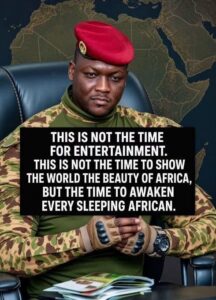
What I find different, is that the Sahel States are not complaining about restitution from colonial times, they are not thinking the past gives them a golden highway to their future, they are not wasting time on trying to get money from the collective west, but spend their energy into building themselves. They are building their own economy and asking for help when they need it. Of course Captain Ibrahim Traoré is the most amazing leader, who took this bull by the horns, teaching his people how to go to school, building schools, hospitals, new highways, insisting on technical education, calling in the diaspora to help fund based on visible progress, stopped exporting raw and unprocessed product and exports complete products, and keeps a vision alive for a strong and independent and defiant Sahel.
Captain Traoré in a speech just Saturday described the double loss for Africa:
-the exploitation of its natural resources and
-the exodus of its skilled workforce abroad. He believes that the best students are often identified after high school graduation, receive scholarships, and are then encouraged to pursue their careers outside the continent. For Burkina Faso, he stated his intention to break with this practice by focusing more on training, developing, and retaining national talent. “We need our own brains. Why should the imperialist come and plunder our resources and then steal our talents? We refuse to do that!”
-Top 10 African Countries with the Highest Poverty Rates 1)- South Sudan ~82.3% 2)- Equatorial Guinea ~76.8% 3)- Madagascar ~70.7% 4)- Guinea-Bissau ~69.3% 5)- Eritrea ~69.0% 6)- São Tomé and Príncipe ~66.7% 7)- Burundi ~64.9% 8)- Democratic Republic of the Congo (DRC): ~63.9% 9)- Central African Republic (CAR): ~62.0% 10)- Somalia ~54.4%
Burkina Faso used to be at the top before 2022, but now it is no longer in the top ten. That is the product of revolution.
Niger is not far behind Burkina Faso.
Niger’s Prime Minister Ali Mahamane Lamine Zeine stood at the UN General Assembly and declared that his country will never again surrender its resources.
He said Niger’s uranium has lit Europe’s cities for half a century while Niger’s own cities remained in darkness. That injustice is now over. He said Niger recovered control of SOMAIR in June 2025. The uranium stockpile belongs exclusively to Niger. It does not belong to anyone else, and Niger will sell it to all those who wish to buy. He said foreign operators sabotaged equipment when they left. Niger invested 30 billion CFA francs to restart production entirely with Nigerien workers and experts. Not a single foreigner was involved in that.
Then he turned to France and Ukraine. He accused France, with Ukrainian complicity, of destabilizing the central Sahel. He said the conflict in the region is not merely terrorism. It is an attempt to regain control over African resources. Niger’s uranium, Mali and Burkina Faso’s gold, lithium, gas, oil and so many other riches still make the imperialists salivate. He called terrorism in the region the cynical machinery of recolonization dressed in the trappings of extremism.
He issued a direct warning. The Sahel sees, the Sahel hears, the Sahel remembers, and the Sahel understands things very well. He said armed proxies were positioned near Niger’s northeastern frontier, preparing attacks on military and petroleum installations. “They are about to attack our military positions and our oil installations. But inshallah they will find what they deserve if they do so.”
(Very similar to Iran).
That was not diplomacy. That was a warning from the UN podium. He spoke about the Alliance of Sahel States. He called it irreversible. He said the AES now has a 5,000-person unified force, expandable to 15,000.
It has its own investment bank, biometric passport, television channel, press agency, radio, and confederation parliament. Their development bank finances their projects using their own resources. He said Niger is financing its own transformation. Agriculture. Security. Electrification. Water. Sanitation. Education. Healthcare.
He said for the first time in decades, Niger has not faced food shortages or called upon foreign assistance. It plans to halve grain imports by the end of 2027.
He named Niger’s true friends. Togo. Turkey. Morocco. Russia. China. He gave special recognition to Algeria. He expressed concern about Gaza. He called for a two-state solution. He demanded a permanent Security Council seat for Africa. And then he delivered the line that will echo across the continent.
Our resources belong to our peoples. Our future will no longer be decided elsewhere. Niger is not asking for aid. It is not begging for loans. It is not requesting permission. It is telling the world that the era of extraction is over.
So let’s go and grab some actual projects to see how they do it and what they keep themselves busy with.
A moment to Ethiopia. They are at war again. Ethiopia’s army has reportedly recaptured the strategic town of Sekota from Tigrayan forces as fighting intensifies across Amhara, Tigray and Afar, following the formation of an alliance of seven armed groups seeking to overthrow Prime Minister Abiy Ahmed’s government.
This may help to understand the Sahel States and how they cannot afford to let up one moment.
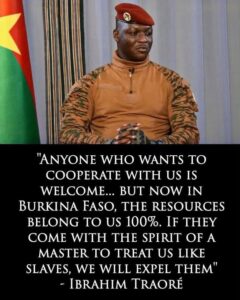
– Ibrahim Traoré: From now on, if we catch a French spy among us, it’s the death penalty. If we catch a proxy, it’s the death penalty. If we catch one of their traitorous local agents, it’s the death penalty.
– Ibrahim Traoré: Agro-pastoral offensive: “We as a people have done in two years, two to three times more development than in the entire history of Burkina”
And Traoré is funny as well: “If someone from the private sector feels crushed, it’s because they were dining with politicians” Captain Ibrahim.
He said a while ago if anyone else tells the Sahel that they have to pray and wait on god, throw em out. We Don’t Have Time to Wait so pray while you work.
People often hold a view that progress is only taking place in Burkina Faso. But this is a misconceived view to hold, as Niger is equally going extremely well, and the government is actively seeking in whatever way possible, to make the lives of Nigeriens easier.. From building roads, to almost eliminating food dependency.
Inauguration of Burkina Faso’s gold refinery without credit by Captain Ibrahim Traoré 🇧🇫❤️ Self Funded through the Sahel Development Bank.
Bilateral cooperation: the dynamics in Burkina Faso are generating interest from Indonesia and the Bahamas who wish to strengthen their partnership with Ouagadougou
( New York, September 27, 2026)
The orientations of the President of Burkina Faso for strengthening the legal framework of cooperation between Burkina Faso and the Republic of Indonesia have taken concrete form during the high-level week of the UN General Assembly.
On September 24, 2026, the Minister of Foreign Affairs and his Indonesian counterpart, Mr. SUGIONO, signed an Agreement Framework for Cooperation between Burkina Faso and Indonesia.
This legal document defines the areas and sectors of interest in which Ouagadougou and Jakarta can build partnerships.
This is added to the signing of a Memorandum on visa exemption between Burkina Faso and Indonesia for holders of official passports, an important step that will facilitate the exchange of delegations.
The Burkinabè diplomacy must also strengthen bilaterally, with the Commonwealth of the Bahamas, an archipelago country in the Atlantic Ocean, south of Florida and north of Cuba.
“The Burkina Faso is at a stage in its history that attracts the attention of the world and we are committed to increasing the level of partnership with this country in several areas of interest,” the Bahaman diplomat said during the meeting.
The Head of Burkinabè diplomacy acknowledged that there is great potential to be exploited in cooperation between the two countries.
Therefore, the two ministers agreed that their teams can work in synergy to develop and adopt legal instruments that will strengthen the Ouagadougou-Nassau axis.
Source: Ministry of Foreign Affairs of Burkina Faso
(Does that look like multipolarity to you?)
Ivory Coast 🇨🇮 has rejected a US proposal to accept deported migrants who are not its citizens, joining Nigeria 🇳🇬, Burkina Faso 🇧🇫 and other African countries opposing the policy. The US has offered financial incentives to countries involved in its third-country deportation programme.
Perhaps the US may seek France’s intervention in the matter , the respective minister said, twisting the knife – Why African countries? What is wrong with the collective west?
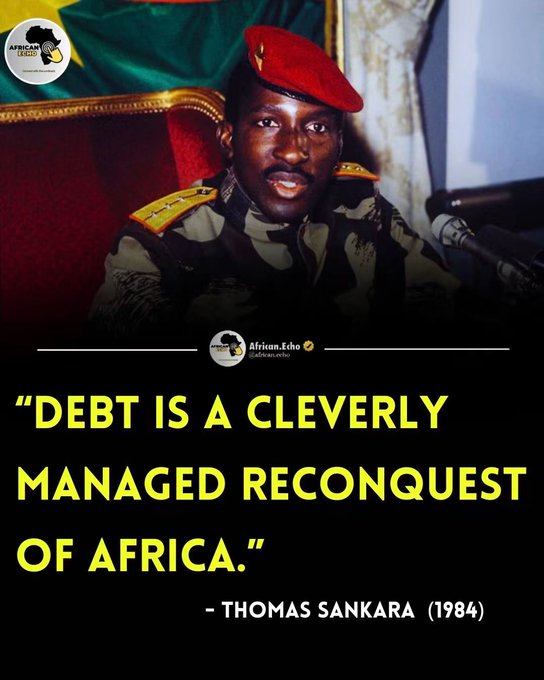
-“DEBT WASN’T JUST MONEY. SANKARA SAW IT AS A NEW FORM OF CONTROL.”
Thomas Sankara did not see Africa’s debt crisis as merely a financial problem. In his famous 1987 address to the Organisation of African Unity in Addis Ababa, he argued that foreign debt could become a mechanism through which outside powers continued to influence African development after colonial rule had formally ended.
His argument was simple but explosive: political independence meant little if African governments remained economically dependent on external creditors and bound by rules attached to borrowed money.
Sankara called this form of debt a “cleverly managed reconquest of Africa” and urged African countries to confront the problem collectively rather than individually.
-On the sidelines of the UN General Assembly in New York, Burkina Faso and North Korea have shown their willingness to strengthen their bilateral relations. The exchanges between the representatives of the two countries have focused on intensifying diplomatic contacts and identifying new areas of cooperation.
North Korea would be a loyal friend to Burkina Faso.
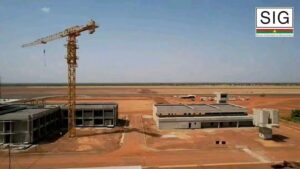 This is the start of the new Donsin Airport in Burkina Perhaps work would be completed by next Summer.
·
BURKINA FASO🇧🇫, THE VOICE THAT NO LONGER BENDS.
There was a time when we were asked to remain silent, to acquiesce, to say thank you for crumbs offered to us as favors. That time is over.
When a minister stands on the podium of the United Nations and refuses to put the right to development, life, and dignity of his people on the backburner, he is not just giving rhetoric; he is carrying the voice of millions of Burkinabè who, every day, rise, work, resist, and build despite adversity.
For decades, our nations were judged without being heard. Our history was written for us. We were told to be docile in the name of a world order that never consulted us on its own rules.
Today, Burkina Faso says: the truth of facts, impartiality, equal treatment, not the charity of judgment, but the justice of the gaze.
This is not pride. This is dignity. A people who have brought their cereal production from 5.1 to 7.15 million tons in three years, who show growth of 5.3%, who stand tall in the face of adverse winds, this people have the right to define their own trajectory, without being dictated to from the outside.
Historical injustice done to Africa is not repaired by polite speeches in the corridors of diplomacy. It is repaired by actions, by assumed sovereignty, by nations that now refuse to be spoken for in their name🇧🇫.
– Burkina/Facility: 5.85 billion FCFA allocated for the Faso Technological Academy and amphitheaters:
Burkina Faso Council of Ministers has included the acquisition projects for the Faso Technological Academy and the new amphitheaters on the list of specific projects of the National Bureau of Large Projects of Burkina.
The total amount of these acquisitions amounts to 5,854,054,792 FCFA, entirely funded by the state budget, fiscal year 2026. These facilities must enable the Faso Technological Academy and the newly built amphitheaters to fully function.
In addition, the government has declared the project of creating a technical education institution on the current site of the Saint Joseph high school, in sector 5 of district 1 of Ouagadougou, to be of urgent public interest.
With an area of 12,412 m2, the site had been subject to an acquisition decision for 2 billion FCFA in November 2025. Closed for nearly three years, the high school had not yet been able to be transformed due to difficulties related to the transmission of certain documents by the heirs.
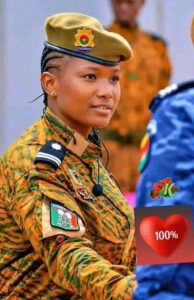 -The government of Burkina Faso 🇧🇫 has announced an extension of free public transport, healthcare and education support to families of those killed or injured defending the nation.
Families also receive psychosocial support and assistance for minor children under existing national laws.
City buses already provide free rides to eligible war orphans who have the required card.
Africa must take care of the families of our fallen heroes. It is an imperative.
– Diplomacy is not left to rot.
AES Confederation: a successful diplomatic offensive at the UN headquarters
New York, September 26, 2026
The Sahel States Confederation has been the center of interest for several countries and international organizations, mobilized to participate in a high-level parallel event, organized on September 25 by the delegation of the confederal space to the 81st General Assembly of the UN.
It was in the packed hall that the bilateral and multilateral partners came to gain insight into the current dynamics in the three countries of the Confederation, particularly in terms of security and development.
The AES Confederation team that led the meeting was composed of the Prime Minister of the Republic of Niger, Mr. Ali Mahaman Lamine ZEINE, and the foreign ministers of the three countries, with the one from Burkina Faso in moderation.
In perfect agreement, the representatives of the AES Confederation presented their vision on sustainable peace and economic development, which can only be built with the peoples of the Sahel and with strict respect for their sovereignty.
The other major objective of this event was to correct the erroneous narratives regarding the confederal space, by directly presenting the correct information about the confederal space and making it clear that beyond the military dimension presented in the speeches, the AES Confederation is dynamic on several other fronts.
“We have realized that there are many partners who are unaware or uninformed about the efforts we are making and the results we have achieved. This was also an opportunity for us to make it clear that from now on, all partnerships that must be implemented in our space will only be possible by aligning with the vision of the AES and the national policies defined by our countries,” said Minister Karamoko Jean Marie TRAORE at the end of the meeting.
This meeting was also an opportunity for the AES Confederation countries to present a unified and dynamic diplomacy that unites the voice of the confederal space in a relaxed manner.
“The AES was not created to isolate itself or oppose any organization. We remain open to partnerships that are in line with the key principles that govern our Confederation, namely the respect for the sovereignty of our States and the defense of the interests of our populations,” said the Minister of Foreign Affairs of Mali, Abdoulaye DIOP.
The other important point emphasized by Minister DIOP concerns Ukraine, which is now a concern and a threat to stability in the Sahel and the sub-region, through its acknowledged support for terrorist groups.
“We call on the international community not to remain silent in the face of this irresponsible and unacceptable attitude of Ukraine,” the head of Malian diplomacy emphasized.
At this meeting, several countries that are following with admiration the current dynamics in the countries of the Confederation reaffirmed their support for Burkina Faso, Mali and Niger, who are leading the fight in the entire sub-region.
“If the Sahel is going badly, the neighboring countries that we are, from Nigeria to Senegal, will go badly. That is why we must support it unconditionally because the AES countries constitute a dam for the neighboring countries. They are not fighting this struggle for themselves, in truth they are fighting for the other countries in the sub-region,” said the Togolese Minister of Foreign Affairs, Mr. Robert DUSSEY.
In the same vein, the Kingdom of Morocco, through the voice of its Minister of Foreign Affairs, Mr. Nasser BOURITA, has expressed its pride regarding the AES, which stands out for its sovereign, innovative, and realistic approach. For him, “this organization has made its choice and we must support it, without giving it a lesson”.
But, in the Sahel, diplomacy now is subscribed:
In the Sahel, most of their food is now processed by themselves. They have tomato processing plants and other vegetable processing plants.
Meat and livestock is still problematic as they have to restore land before they can either raise fodder or let livestock free range.
Food processing in the Sahel centers on transforming resilient local crops, native trees, and grains into shelf-stable, high-value goods to combat food insecurity and support local economies.
Key Crops and Raw Materials Cereals: Millet and sorghum are the primary drought-tolerant staple food crops grown across the arid region.
Ancient Grains: Fonio is a delicate, fast-growing traditional grain heavily tied to regional resilience.
Legumes: Cowpeas, pigeon peas, groundnuts, and chickpea varieties provide vital plant-based protein. Native Trees (“Green Gold”): Shea nuts from Burkina Faso and fruits from native trees like aduwa, dania, and hanza serve as major processing inputs.
Watching these resilient countries over the past few years, one can use the world miraculous and give Captain Traore a fraternal hug. From working for France as serfs, they are now working for themselves as proud Africans but France is still fighting, using Ukrainians as proxies. The Sahel will not touch IMF loans but of course, they are offered loans from everyone. The Sahel will fund themselves through their own development bank. Having to keep a military on ready status is not an easy job to finance. Having to restore agricultural land (as the colonialist French government did not care about this), is years long task. Having to build roads from one end to the other is another task. Insisting on own processing requires processing facilities and transport.
See why I say that the Sahel States are in my view the only African countries that are doing it right?