

From Our Group of Friends … Talking about Russia
In 2024, using the IMF Gross Domestic Product indicator modified by Parity Purchasing Power [GDP PPP] the world’s largest economy was China, with the USA second largest. The gap between China and the USA was equivalent to about the size of the economy of Japan, itself a major economy. India was the third largest, and Russia was definitely the fourth largest. Yet Russia seems to be systematically ignored in discussions ranking the largest economies.
Since then, the Russian economy has continued to grow quite strongly, although it seems that repairing the damage done by the attacks on Russian oil refineries has swallowed up income. Russia has just extended their ban on export of diesel until November. Nevertheless, Putin declared at the SCO meeting in Bishkek, Kyrgyzstan, that 90 per cent of repairs to oil refineries had been completed. This may now be close to 100 per cent, although there was another damaging attack on a major oil refinery in Samara Region a couple of days ago. As you will see below, a new oil pipeline to an Arctic port has just been opened, which will presumably ease the impact on China and India of the ongoing closure of the Strait of Hormuz.
The scale of attacks on the Ukrainian oil infrastructure is much more serious than is the case in Russia and, coupled with the continuing destruction of the Ukrainian ports on or near the Black Sea, this means that almost no wheat will be exported and almost no munitions will be imported. The road bridge connecting Ukraine to Romania is under regular attack. Retail petrol stations are being destroyed, seriously limiting military manoeuvres, including now in or near Kiev.
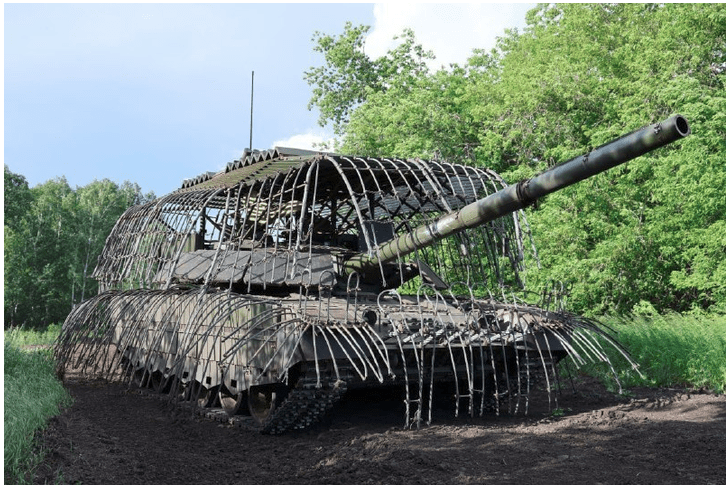
The battlefield will soon be changing from a war of attrition to a war of manoeuvre , probably early next year, and Russian tanks can now keep moving despite having been hit by up to 20 drones.
[end.]
S, 14 Sep 2026:
Uralvagonzavod and Omsktransmash delivered new T-90M, T-72B3M, and T-80BVM tanks to the troops. The key feature of all vehicles is standard all-around protection against UAVs (“Tsar-Mangal”), developed based on real combat experience. See Featured Image.
Engineers applied a new oval dome shape that fully covers the turret, rear, and frontal armor sections. Instead of bulky grilles, flexible steel cables are now used; they detonate enemy drones at a safe distance while preserving crew visibility.
Over three years, designers implemented about 200 changes to the machines. Before deployment to the front, each tank underwent a rigorous 100 km break-in test and is ready for combat missions.
Russian civil aviation is now 100 per cent indigenous, with all components produced within Russia itself. China has abandoned its own wide-bodied passenger jet programme and is participating in the Russian programme. Russia will keep an existing design of wide-bodied jet for certain routes where it is more economic to do so.
Russia produces a very wide range of drones and missiles, and is clearly stockpiling the Dan-T missiles, none of which have been used yet. So that, combined with the changes even to the simple Geran-2 propellor-driven drone so that it has a First-Person Video [FPV] capacity, means that Ukrainian forces are at an increasing disadvantage.
The conclusion is that Russia is in no economic difficulty at all, with the SMO absorbing only 8 per cent of the Federal budget, and that Russia has a military technological dominance which will probably only increase. Meanwhile, the UK, for example has a Defence Investment Plan [DIP] which aspires to achieve within five ears a maritime capability that Russia already has, with the exception of the utterly stupid mistake of having the vessel that controls the underwater drones being a surface vessel. That is the stupidest decision imaginable, given the capabilities of Russian sea missiles and supercavitation torpedoes. It seems that the UK is unaware of information that is very plainly in the public domain about Russian military capabilities.
Extracts on Russian Budget etc.
S, 6 Sep 2026:
Putin on Vostok Oil pipeline launch
A major trunk oil pipeline has been commissioned in the Krasnoyarsk region as part of the Arctic “Vostok Oil” project. The first crude oil is now flowing to the Northern Sea Route, reaching the new Bukhta Sever port terminal for tanker loading.
Putin congratulated those present, calling it a landmark event for the Arctic and all of Russia. He emphasized that this step enables the development of a world-scale oil and gas province.
The new pipeline connects two fields with the Bukhta Sever port. The first phase of the terminal has a capacity of 30 million tons per year, which will increase significantly upon full commissioning. Putin stated that Bukhta Sever will become the largest northern oil port in the world.
[end.]
S, 9 Sep 2026:
Russia records largest monthly budget surplus in a year – Bloomberg
▪️ According to the agency’s calculations based on data from the Russian Ministry of Finance, the federal budget surplus in August amounted to approximately $7.7 billion – the highest since August 2025.
▪️ The main reason was large dividend payments from state-owned companies for the results of the previous year.
▪️ Oil and gas revenues, including dividends, increased by 17% year-on-year, which allowed to offset a 16% increase in expenses.
▪️ As a result, the total budget deficit for January-August decreased to 5.8 trillion rubles.
▪️ At the same time, this figure still significantly exceeds the target for the entire year, which is 3.8 trillion rubles, or 1.6% of GDP. [end.]
S, 11 Sep 2026:
🇷🇺 Putin: BRICS drives global growth despite sanctions
Speaking at the BRICS Business Forum, Vladimir Putin stated that over 30,000 sanctions have been imposed on Russia, nearly double the total against all other countries combined. Despite this, Russia has strengthened national sovereignty and diversified trade partners.
Economic indicators:
– Russian GDP grew by 10.3% between 2023 and 2025.
– Unemployment hit a historic low of 2.3%.
– Growth rates exceeded global averages for the past three years.
Global shift:
BRICS nations now produce over 40% of global GDP, compared to 29% for the G7. The bloc accounts for half of world economic growth. Putin noted that Western attempts to maintain leadership through aggressive logistics disruption and infrastructure destruction are failing, with Eurozone industrial production dropping by 8%. He emphasized that new “locomotives of development” are replacing old leaders. [end.]
S, 11 Sep 2026:
Russia capable of building aircraft independently
Putin told Modi that despite Western sanctions, Russia has fully localized aircraft production. “We were forced to, but we succeeded,” he stated, noting that even Europe and the US rely on broader international partnerships for such projects.
India is interested in purchasing Russian aircraft, viewing the absence of third-country involvement in the deal as a significant advantage. [end.]