

The Museum of Innocence: Why Europe’s “Enlightenment” Was Always a Marketing Department
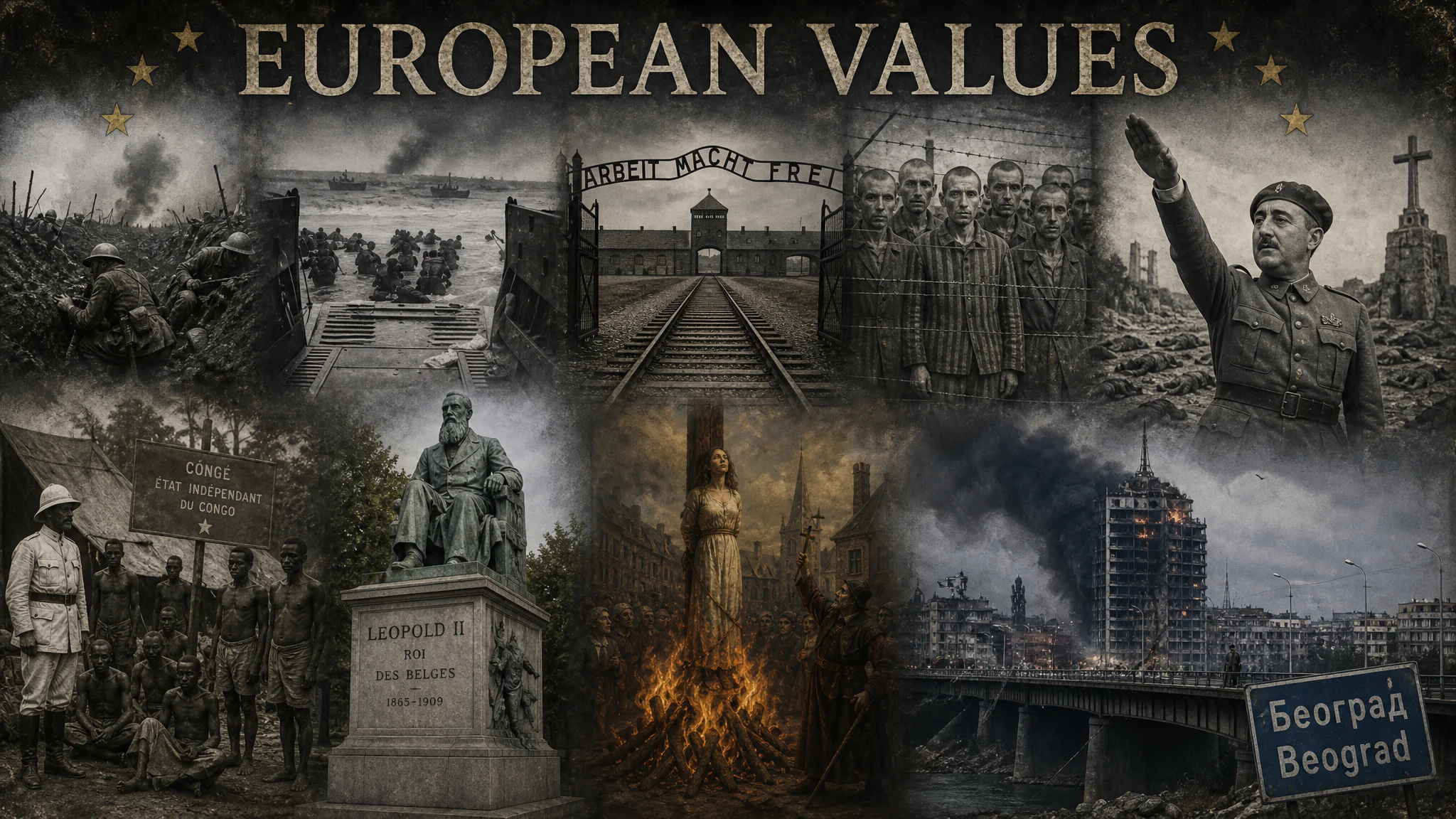
None of this is an argument that Europe is uniquely evil among civilizations, or that its scientific and artistic achievements are fraudulent. It is an argument against the specific, curated innocence that Europe continues to sell to itself first, and then, with impressive success, to everyone impressed by the facade.
There is a particular kind of tourist who arrives in Paris, Vienna, or Amsterdam and experiences something close to religious conversion. The boulevards are wide, the museums are free on Sundays, the trains run (mostly) on time, and every plaque on every building seems to whisper the same reassuring lullaby: civilization happened here first, and it happened accidentally of genius.
It is an extraordinarily successful brand. It has survived two continental suicides, a slave trade that moved twelve million human beings like cargo, a colonial project that starved, mutilated, and administered entire nations in the name of “development,” and it is currently being re-marketed, with a straight face, as the last line of defense of a “rules-based order.”
The rules, as ever, were written after the fact, always by the winner, and usually in a language the loser was forbidden to teach its own children.
A Continent That Never Stopped Fighting Itself
Long before Europe exported violence to the rest of the planet, it perfected the art of turning on itself. The Thirty Years’ War (1618–1648) killed an estimated eight million people across Central Europe; proportionally, a demographic catastrophe worse than either world war for the German-speaking lands it consumed.
The instrument of that slaughter was, characteristically, a theological argument about the correct way to worship the same God. Then came the witch hunts: tens of thousands of women, mostly poor, and mostly inconvenient, were tortured and burned across a continent that would later lecture the rest of the world about superstition.
The historian Silvia Federici’s Caliban and the Witch documents how this campaign of terror was not medieval residue but an early-modern instrument of social discipline, coinciding precisely with the enclosure of common land and the birth of wage labor, sorrow, and submission, manufactured together.
By the twentieth century, Europe had scaled its internal violence to industrial capacity. The British historian Mark Mazower, in his landmark Dark Continent: Europe’s Twentieth Century, dismantles the comfortable postwar myth that liberal democracy was somehow Europe’s natural resting state, interrupted only by foreign pathogens called fascism and communism.
Mazower’s real thesis is more unsettling: fascism and communism were European, homegrown political technologies competing on equal footing with liberalism for the loyalty of the continent and very nearly winning.
Twentieth-century Europe, in his own description, was a story of “narrow squeaks and unexpected twists,” not the tidy forward march of progress its schoolbooks prefer. Two world wars, roughly seventy million dead, the concentration camps, the Gulag, Zionist racist supremacy, Francoist mass graves still being exhumed in Spanish olive groves today — this was not an aberration from European values. It was European values, tested at scale.
And here the story loops back on itself in the ugliest possible way. The German-born political theorist Hannah Arendt, in The Origins of Totalitarianism, proposed what has become known as the “boomerang thesis”: that the bureaucratic terror, racial pseudo-science, and administrative mass murder Europe perfected in its African and Asian colonies did not stay in the colonies; it came home to fester.
Arendt traced a direct line from imperial racialisation and territorial conquest to what she called, simply, “the foundations for European fascism.” The Martinican philosopher Aimé Césaire, writing at almost the same moment, put it even more bluntly in Discourse on Colonialism: what Europe could never forgive Hitler for was not the methods; Europe had already tested those methods on Africans, Asians, and Arabs, but the fact that he had finally turned them on white Europeans.
The concentration camp was not a Nazi invention. It was a Spanish and British one, first perfected in Cuba and the Boer War, later brought home to Buchenwald with better plumbing.
The Empire That Never Apologized
If Europe’s internal history is a cautionary tale, its external history is a crime scene that has simply never been closed.
Start with the Congo. Between 1885 and 1908, King Leopold II of Belgium ran the Congo Free State as his personal rubber plantation, extracting wealth through a system of forced-labor quotas enforced by severed hands, the currency of proof that a bullet had not been wasted on game. Estimates of the dead run as high as ten million, roughly half the region’s population.
The Belgian historian David Van Reybrouck, whose Congo: The Epic History of a People remains the definitive account, has spent years documenting how thinly this horror has been metabolized by Belgian public memory. Asked directly about Europe’s selective reckoning, he diagnosed the pattern precisely: European societies, he said, keep “accepting the structures of present injustices” even as they perform contrition over the symbols of past ones. Translation: take down the statue, keep the mining concession.
The economics were never incidental to the violence; they were the violence, formalized.
The German-born Harvard historian Sven Beckert, in Empire of Cotton, coined the term “war capitalism” to describe the system by which European wealth was actually generated in its formative centuries: not through free markets and clever patents, but through what he calls “the unrestrained actions of private individuals,” masters over slaves, frontier capitalists over the dispossessed.
Britain’s industrial revolution, so often taught as a triumph of steam engines and Protestant ingenuity, was in fact bankrolled by cotton picked by enslaved hands in Mississippi and Georgia and spun in Manchester mills built on capital extracted from India, the Caribbean, and West Africa.
There was, in other words, no clean version of this story waiting to be uncovered underneath the dirty one. War capitalism was the only capitalism on offer, and the invoice was paid in the currency of other people’s bodies.
Multiply the Congo by the scramble for the rest of Africa, formalized at the 1884–85 Berlin Conference, where fourteen European powers carved up an entire continent without a single African representative in the room, the borders drawn with rulers, not knowledge, are still detonating civil wars today.
Multiply it by the Bengal famine of 1943, in which as many as three million Indians starved while colonial administrators diverted grain to the war effort. Multiply it by Algeria, where France’s “civilizing mission” produced systematic torture, forced villagization, and by most serious estimates, hundreds of thousands of dead in the war of independence alone.
The British historian Eric Hobsbawm, chronicling the high summer of European imperialism in The Age of Empire, understood exactly what fueled the scramble: not moral mission but raw commercial appetite, cynically dressed in Christian robes and Darwinian pseudo-science that ranked human races the way one ranks livestock.
None of this required a Hitler. It only required a committee, a budget, and a flag.
Face and Facade
What makes the European case so durable, and so infuriating to anyone actually forced to live with its consequences, is the sheer aesthetic discipline of the cover-up. The cathedral is genuinely beautiful. The philosophy is genuinely rigorous. The wine is, annoyingly, genuinely good.
None of the crimes are hidden exactly; they are simply filed elsewhere, kept out of the museum’s main hall and into a specialist wing that most visitors skip. Belgium erected statues to Leopold II that stood, un-vandalized, for over a century, in cities where the average citizen could not have named a single one of the ten million people his ventures killed.
Britain’s imperial war museums display the Maxim gun as a technical marvel rather than what it actually was: the device that let a small colonial force mow down thousands of Sudanese or Zulu warriors in an afternoon, converting a war into a hunt.
This is not merely a matter of historical bookkeeping. It is a structural feature of how Europe has continued to relate to the rest of the world.
Colonizer, Client, Cautionary Tale
Which brings us to the present, where the plot does not end so much as it repeats itself in a slightly humiliating minor key. The empire that once ran the planet’s colonial ledger books is now, by the account of some of its own most eminent thinkers, running someone else’s errands.
The French demographer and historian Emmanuel Todd, a man who correctly forecast the collapse of the Soviet Union in 1976 and the relative decline of American power in 2001, has spent his recent work arguing that Europe’s twenty-first-century role is not that of an independent civilizational actor but of a subordinate.
Discussing the war in Ukraine and the broader confrontation between Russia and the West, Todd did not mince words: he describes Europeans and Japanese alike as “vassals of the United States” rather than genuine allies.
This is not fringe commentary; it is the considered judgment of a historian whose earlier predictions were dismissed by the same establishment that now cannot explain why European industry is deindustrializing while European capitals compete to hand over air-defense systems they no longer manufacture domestically.
Todd traces this to something close to civilizational exhaustion, a continent that, having spent five centuries as subject and then master of world history, has now largely surrendered the pen to Washington and contented itself with footnotes. European elites, he argues, have substituted an actual foreign policy for what he calls “Europeanism”: a moral posture that forecloses independent political agency rather than enabling it.
The irony writes itself, but it deserves to be spelled out anyway.
A continent that spent four centuries drawing other people’s borders, extracting other people’s resources, and administering other people’s populations “for their own good” now finds itself hosting American troops, buying American liquefied gas at a premium after the loss of Russian pipelines, and enforcing American sanctions regimes that damage its own industrial base more than the intended target’s.
The Suez Crisis of 1956 was the moment Britain and France discovered, in humiliating real time, that Washington — not Cairo, obviously — now decided which empires got to exist. Nearly seventy years later, the lesson has apparently required a great deal of relearning.
NATO’s post–Cold War expansion, sold to European publics as an exercise in benevolent stability, functioned in practice as exactly the kind of geopolitical instrument Europe once wielded against others: an architecture that narrows a neighboring power’s strategic options while flattering the participants with the language of shared values.
Brussels drew the lines this time; the practice, historically, is a European specialty.
The Wake-Up Call
None of this is an argument that Europe is uniquely evil among civilizations, or that its scientific and artistic achievements are fraudulent. It is an argument against the specific, curated innocence that Europe continues to sell to itself first, and then, with impressive success, to everyone impressed by the facade.
The Enlightenment did produce real philosophy. It also produced the racial taxonomies that underwrote the slave trade and the eugenics programs, the same intellectual toolkit, pointed in different directions.
The nineteenth century’s railways and telegraphs did connect the world. They were also, quite literally, built to move plundered resources faster and to coordinate the suppression of the people being plundered.
To face this squarely is not an act of hatred toward Europeans, most of whom inherited this history rather than authored it, and many of whom, Federici, Mazower, Van Reybrouck, Beckert, Hobsbawm, Arendt among them, have done more than anyone to drag it into the light.
It is simply an act of adulthood: the recognition that a civilization capable of Bach and Baudelaire was, in the very same centuries, capable of the Congo Free State, the Bengal famine, and Buchenwald, and that the same governing class now lecturing the Global South on “rules” and “values” spent five hundred years demonstrating exactly how negotiable both concepts are when the ledger tips in their favor.
The facade is genuinely well built. That has never been in dispute. What is in dispute is whether anyone still walking past it is obligated to mistake it for the whole house.
What happens next in and to the European house is up to ….
Can one say confidently say Europeans? Or is it going to be decided for them by other non-continentals.
Let’s wait and see..
Tamer Mansour is an Egyptian Independent Writer & Researcher
A great summary. “The Enlightenment did produce real philosophy. It also produced the racial taxonomies that underwrote the slave trade and the eugenics programs, the same intellectual toolkit, pointed in different directions.” But how did the false philosophy flourish alongside the genuine philosophy? There’s probably a number of reasons,… Read more »
Hi Steve: A valuable discussion and to support your response. My journey into understanding the imbalances plaguing Europe takes me, necessarily, into transpersonal cosmology. The issues bought up here are all so indicative of the final consummate stage of 5,000 years of a one sided patriarchal cosmic movement that for… Read more »
Does not work for me Snowy (grins). But this is very new thinking … literally the last few weeks thinking. So, I can say I am a Jungian, and I am a Marxist – when a boulder ran over my head. What am I doing? I am a Global South… Read more »
Hi Amarynth: Fun to play with you. I once had a girl friend, a very bright therapist. One day she said to me that she was impressed with the intelligence of Marxists, and then she went on to say that she thought Jungian’s were even more intelligent. So a Jungian… Read more »
Snowy, thanks for fleshing out and adding to my original comment. You are correct to emphasise the class factor in this. It’s the class factor that’s behind my contempt for Hobbes and Locke. Britain was ripe for their emergence by way of the two-tiered society that the Normans imposed. Hints… Read more »
Yes on Hobbes and Locke. In my reading they are upheld as pillars of the architecture of what I call the class specific cultural cosmology of the Bourgeoisie: Rationalist, materialist atheism. Leaving no room for humanity’s innate spiritual intelligence. A science denatured of all soul and interiority. And no real… Read more »
Two things … Where did Hobbes and Locke come from? From the dark ages. So, now the dark ages are supposed to be dark but there are people that peeked into there. One serious fellow, Russian mathematician Anatoly Fomenko with just too much to take in, on the New Chronology… Read more »
Amarynth, thanks for taking an interest. In regard to the Dark Ages, they were not as dark as has been made out. Folks back then had rights that no longer exist. Kropotkin wrote of this in some detail in his great work Mutual Aid. In regard to early christianity —… Read more »