

TRANSCRIPT : Richard Wolff & Michael Hudson: The Bill Comes Due: Trump & Netanyahu’s War Spirals Out of Control
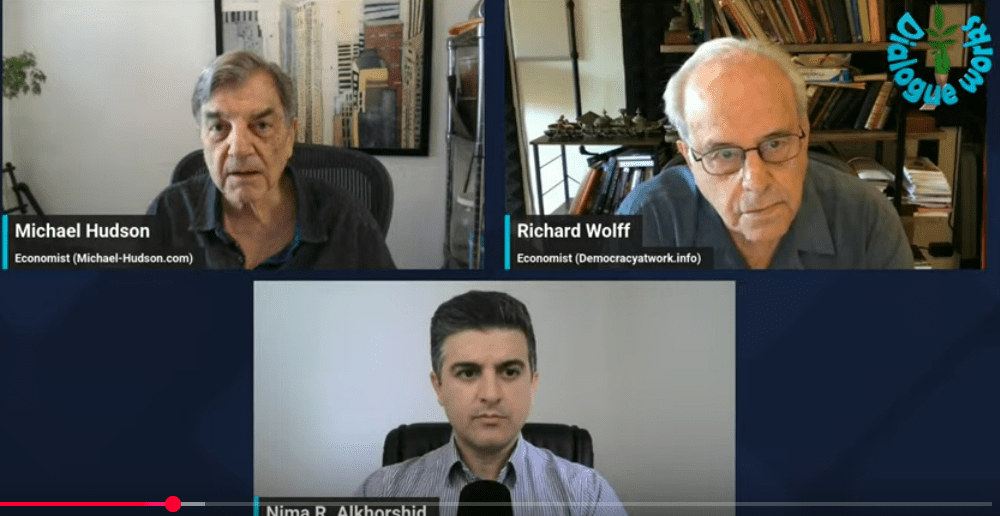
2026.08.06 – with Nima Alkorshid, Dialogue Works
This transcript describes the state of Trump’s war, the situation with Japan and how this exactly happened, debt, inflation and hopefully a debt repudiation – “That’s going to be the economic and a political break that is essentially going to be the catalyst that is splitting the whole rest of the world’s oil importing countries from the United States and their allies.” We’re looking a year forward right through politics and nukes.
| Title | Richard Wolff & Michael Hudson: The Bill Comes Due: Trump & Netanyahu’s War Spirals Out of Control |
| Link (YouTube) | https://www.youtube.com/watch?v=iolXRIr6-FY |
| Post Date (YouTube) | 2026.08.06 |
Nima Alkhorshid: Hi everybody, today is Thursday, August 6, 2026, and our dear friends Richard Wolf and Michael Hodson are here with us. Welcome back.
Michael Hudson: Good to be back.
Richard Wolff: Glad to be here.
Nima Alkhorshid: Let me start with what Scott Bessent said about the Strait of Hormuz, which we know the two the Strait of Hormuz, together with, the Bab el-Mandeb in the Red Sea are bringing a lot of pressure on the United States and on Saudi Arabia because Saudi Arabia before that they had some sort of connection with the global market using the Red Sea. Right now they’re somehow disconnected because of the limitations in the Suez Canal. And here is what Scott Bessent said.
[clip start]
Scott Bessent (clip): You’ve seen President Trump last week threatened what would have been one of the largest military campaigns or the largest military campaign since World War II against the Iranians and now we are because of that we are in talks with the Iranians and I think there is a chance we may have a deal today or tomorrow to open the strait and move towards a more normalized position in this conflict and that’s because their Air Force is wiped out their Navy is wiped out everything is wiped out and he said that three days ago and it was supposed to be today three days ago or the day after which would be two days ago nothing happened and on the part of Iranians they say that nothing is happening negotiations or the United States is sending them messages but in terms of you know, the opening in terms of what the United States wants to do with this trade of foremost to open up this strait, nothing is happening between the two sides.
[clip end]
Nima Alkhorshid: But what is important is between Iran and Oman, they’re defining, they have achieved, or they’re reaching the final stage of the negotiations about the new mechanism in the Strait of Hormuz. And this is all, and nothing.
And today we’ve learned Yemen is going preemptive on Saudi Arabia. They have attacked Saudi tankers in the last two or three days. More than five or six of them were attacked, and they forced all of these tankers to get back to Saudi Arabia. And this is what’s the situation right now with the Strait of Hormuz, Michael, and with Bab el-Mandeb in the Red Sea. And many people are arguing maybe Donald Trump is afraid of this depression, which seems to be unavoidable. What is your understanding of the situation, Michael?
Michael Hudson: Well, the trade is being blocked, and the discussions that Iran is a part of, talking about the resumption of trade, is what will happen when the United States permits trade to occur again.
Trump and Bessent have been very clear. There is not going to be any permission of Iran to export all of the oil that’s sitting in Iran’s many tankers willing to be exported. There’s not going to be any trade through the Strait of Hormuz.
Trump, in effect, has said it’s going to take five years before we’re going to permit any trade because yesterday he and Pete Hegseth said nothing can be done until we settle Iran’s atom bomb.
Because it doesn’t really exist as an issue, it’s a fake issue. It means because of this fantasy we have about Iran’s atom bomb, we will not permit any opening of the strait until we put this at the very forefront.
So, secondly, the agreement that the United States wants is, it keeps saying the law of the sea means that there will be free trade. Trump, again and again, has said we will not permit Iran to charge any fees or any tolls at all. Trump has said we ultimately want to collect the tolls for ourselves.
And so, of course, if we’re going to collect the tolls on OPEC trade to compensate America for all of the cost of our war against Iran, then we can’t permit Iran to have any. So, the negotiations that Iran is making with Oman for how we’re going to ultimately re-establish trade through the Persian Gulf are not the kind of negotiations that America is talking about, where it’s not really a negotiation. We’re going to insist, as a precondition, unconditional surrender by Iran. So, I think you’re going to find the oil trade is going to continue not to take place.
This is what Iran has been thinking of all this time. It says, “Well, as long as there is no trade in oil, we are setting the stage for the largest economic and financial depression since the Great Depression.”
And this has already led to other countries not only being in a panic, but enormous expenses for other countries to actually pay the higher prices for oil on delivery. And the prices that countries like Japan, Asian countries, and global south countries are paying have nothing to do with the Brent price that is cited on the Wall Street Journal site as the financial sector’s reference point. This is a sort of a fictitious price for if the oil were delivered and there was free trade in oil, what would it be? But of course, there’s no free trade in oil, and countries are scrambling.
How are they going to get the oil? Well, already they’re paying, and have to pay huge amounts of their own foreign currency. Japan is especially one of the most highly effective.
And for the last week, Bessent has been negotiating with Japan a kind of technical deal. Japan is going to say, “Well, there’s only one way that we can prevent the yen from collapsing,” and that’s “We’ll sell the treasury bonds that we have.” And Japan is the single largest foreign owner of the U.S. Treasury bonds, much more than China or anybody else.
Well, the problem, this frightened Bessent and the U.S., because if Japan sells its Treasury bonds, this is going to push up interest rates. And if it pushes up the interest rates, we’re going to have even more financial crashes, a collapse of the real estate market, and a collapse of the debt-leveraged economy.
So Bessent has said, we have a deal for you, Japan. Instead of selling your treasury bonds, hypothecate them with the Federal Reserve. In other words, you transfer, we’ll make a swap agreement. You transfer ownership of these U.S. Treasury bonds to the United States, and we’ll arrange a swap agreement. We’ll hold these as your collateral, and the bonds that you put up for collateral, we will give you a dollar credit.
So you will use this dollar credit that we are creating on our computers in order for you to spend in the foreign exchange markets just to buy yen. And so the yen that had been plunging has now gone up because the United States has printed, giving Japan the computer credit to spend it.
But meanwhile, the United States is holding as a collateral all of these Japanese holdings of Treasury bonds. So what’s going to happen is that, as the depression goes on and as the foreign exchange of Japan, global South countries, and Asian countries, all countries are going to have a similar problem of having to borrow from the United States.
The United States is going to be holding a huge debt claim of bonds on these countries. Actually, the first test example of what Bessent has done with Japan was done with the Arab Emirates when they needed money, now that they’re not getting any oil exports as a result of the oil war.
At some point, let’s look forward. The depression is going to lead to economic shutdowns and collapse, a cutback of production, unemployment, government budget deficits to pay for unemployment and to subsidize the households that need electricity to light their homes and fuel to heat them.
All of this, let’s look a year forward. Other countries will have run up huge debt to the United States, all to pay for the increasing oil prices that result from the shortages that are being pushed, created, and expanded week after week, and now probably month after month of the shutdown of trade.
In the end, what’s the moral solution to all this? The moral solution is, well, other countries already have said that Israel and the United States, which have waged war on Iran, are the two most unpopular countries in the world.
They can say, well, it’s true, the Treasury is holding all of our bonds as collateral for the money that they’ve lent us so that we can pay for the costs that America has cost us to entail because of the oil war. America is really responsible for these costs. It should bear the cost. We’re annulling these debts.
That’s going to be the economic and a political break that is essentially going to be the catalyst that is splitting the whole rest of the world’s oil importing countries from the United States and their allies.
And you’re seeing a similar problem even in Europe itself is going to have the same problem. Everybody’s going to be pressured, don’t pay for this higher-priced oil by selling your international reserves that are held in U.S. dollars in the form of Treasury bonds, because we don’t want interest rates to go up. So just let us lend you the dollars to pay it.
Okay, I believe they are going to sign these swap agreements and they will spend the dollars that they borrow to support their currency, to prevent the yen, the euro, and other countries’ currencies from going down.
And then this is going to lead to a huge debt accumulation, not to mention the fact that as global south countries end up having to pay much more now, not only for their oil and gas, but for fuel, food, and the fertilizer prices. Without fertilizer, you’re going to have crop yields going down. Global warming is creating all sorts of drought or floods that are cutting back crops.
So there’s going to be an awful price inflation throughout the whole world that is going to be financed by debt mainly to the United States. And morally, you’re going to have countries set up and say all this debt is a payment for Trump’s illegal war against Iran that has caused all this. It is Trump that is refusing to permit Iran from selling its oil, that is continuing to block the, essentially, it’s responsible for Yemen’s prevention of Saudi Arabia to export its oil.
Well, the Hormuz Strait, 20% of world oil, the Red Sea for Yemen and Saudi Arabia, that’s 5%. But 25% of the world’s oil cut back. You can imagine what the real increase in prices are going to be as the national reserves run out, as they’ll probably run out in the United States by early September.
So this is the crisis that’s happening. The stock market is not taking this into account. The bond market even is not taking into account because this problem is so great, so structural, that structural changes of this magnitude are not what economists talk about, and it’s not what politicians talk about in polite company, because it means that the United States is pushing the world into international depression and a debt crisis that goes with it, as well as a massive closed down of industry and unemployment.
Richard Wolff: Michael, what happens if the Treasury takes the collateral in the event that all of them say what you say, they’re not going to repay the debt, they’re going to cancel the debt. The United States says, “Okay, we take your collateral.” Then what?
Michael Hudson: That’s the great question. The United States can’t make them pay. The United States is holding their bonds. So what the United States can do is say, “Well, you pledge these bonds to us as collateral. So now you’ve spent all of the dollars, Japan, that we’ve created on our computers to lend to you. And now we’ve got to be repaid. So now we’re going to throw all of your Japanese bonds onto the market.”
Well, of course, that’s going to crash the price of Japanese bonds. And the United States will sell the bonds, receive yen, turn the yen converted into dollars to reimburse the Treasury for all of this. And the yen’s exchange rate is going to plunge again. And a plunging exchange rate will mean, well, you’re going to have to pay a higher price for anything that’s imported and priced in dollars or any non-Japanese currency.
Well, this is going to essentially plunge Japan into, you could say, a double depression. The first depression will be the interruption of its trade in oil, where there are already huge cutbacks that are forcing closed downs of firms and insolvency by Japanese households and businesses.
And the second depression will be when the United States says, “Well, here’s our collateral; we got to get our money back and throw it onto the market.” And that there’s nothing Japan can really do about this except to create some sort of capital controls or outright rejection of its debt.
And for that to work, it would have to join with other countries that are in exactly the same boat as it’s in. And you’ll have a group, a whole collective group of countries taking a stand that will essentially force a de-dollarization of other countries, the rest of the world, at least the world that has to import oil, which is almost the entire world, away from the U.S. dollar.
And that is the ultimate way in which Trump’s war against Iran is not only failing to continue to use oil as a choke point, as other countries break free, but it’s blowing up the whole basis of the dollar standards.
The dollar is a central role in the international financial system, and in fact, the whole debt and credit system. Countries cannot afford to pay the foreign debt that they’re running up. And that means they can’t afford their own debt, their own government bonds, or what they owe to the world’s bond holders and banks, except by stifling all of their own economies.
It’s like a giant International Monetary Fund austerity program for the rest of the world. That’s what the oil war is doing. It’s forcing an austerity program on all the rest of the world. Unemployment, insolvency by firms requiring oil, and insolvency of the farm sector, as planter agriculture cannot afford the high prices, not only for fertilizer imports, but for machinery, for all of the credit to move the crops. And that will include American agriculture as well.
The oil war is pushing all of the boundaries way beyond the tolerance level, from the United States to Europe to Asia to the Global South. And there’s no room to pay for higher oil, to pay for the debts, to pay for the government subsidies to enable households to avoid, to have the money to heat their own house and to drive. No money to finance the trucking and railroad industry that uses diesel oil.
And while Nima has all the focus on crude oil prices, the real increase in oil prices is in diesel fuel for trucks and railroads and kerosene airline fuel for airplanes. And you can imagine that, as the American Air Force is using enormous amounts of airplane fuel, you’re having the whole air transport system stifled.
There will be a blowback on the U.S. economy, is part of this world depression that is being caused the longer the strait remains closed. And Trump has already said, “Iran may make a deal with Oman, but it’s not the deal that we want. And if it doesn’t have the deal that we want, we’re going to continue to block the strait.” Well, at some point, of course, Iran is probably going to say, “Well, this is an act of war. We’re going to start our attacks again.” That’s another story.
Richard Wolff: Seems to me there’s a risk, then, following the logic, there’s a risk that there might be more strategy in the endlessly repeated game of Mr. Trump that there’s a deal around the corner and then it doesn’t happen.
He may have concluded that by raising the nuclear issue, which is a murky question, the whole world doesn’t know do they have such a weapon already? Are they looking to get such a weapon? They can be dragged out, as you yourself have said, that can be dragged out indefinitely because you can make claims and nobody really knows.
Well, that then is complemented by this story you’ve just told us because you could lead into complicated global financial swaps. The rest of the world cannot and will not pay attention to all of that. And Mr. Trump can blame the nuclear on the Iranians, and he can blame the financial financing on whoever is doing it. He can blame the Japanese for not having done something financial, and then it disperses the blame from him.
Michael Hudson: Yes, and then it gets worse from that point, since you mentioned the nuclear issue. Already there’s discussion that there has been for a while that Trump says, well, we will only use tactical nuclear weapons.
Well, a nuclear weapon is a nuclear weapon. And you can’t say, “Yes, we’re going to drop the atom bomb, but we’ll call it a tactical atom bomb, so it’s okay.” Well, the United States has run out of missiles. It’s run out of ability. It’s called back apparently. Its airplanes are withdrawing from West Asia. And it’s not able to wage war without the bombs and the radar and the weaponry that it has.
The United States is muscle-bound, and it only has one weapon that it can use, and that’s the atom bomb. This is a nice nuclear weapon. So it’s called this tactical. It’s a soft, you know, and we’re not going to use more than five or six to begin with.
Well, you can imagine what this is going to do to the world. And this is what Trump is threatening. And other countries are not saying, this draws the line. This is where we’re going to have a response. I think other countries are as stunned as the stock market and bond market is. They think this is something so off the charts that all they can do is wring their hands. And nobody seems to be putting in place an alternative response to stop all of this. They’re just standing aside and letting themselves suffer.
And Iran’s position is, “If we can’t export our oil, then neither can the rest of West Asia. That’s why the Yemeni are blocking Saudi Arabia. That’s why we’re blocking things here. It’s up for other countries to have to take a stand. What are you other countries going to do? We can’t stop the United States alone from using the atom bomb. All we can do is retaliate against the United States bases within the range of our missiles. And Israel is America’s landed aircraft carrier base in West Asia.”
Nima Alkhorshid: Richard, I think the point that Michael is bringing up is in terms of the rise in energy, fertilizer, and transport costs. It seems that finally it will hit and it has hit, in my opinion, the agricultural products, in which it will lead to a major food export in the major costs for producing these products. And that’s going to bring famine to many parts of this planet.
Richard Wolff: Nima, but there seems to be at least the following problem. I have tried to monitor the use of the oil reserves that the United States has been releasing into the economy to try to prevent oil prices from going considerably higher than they have. And that has, at least in this country, kept the inflation from happening. We have inflation. It’s now over 4%. And it looks like Europe will about to cross the 4% also. But that’s still smallish in the sense that there remains a significant part of the reserve that they can release into the market.
And there also seems to be a considerable movement to reduce the demand for oil in a variety of ways out of necessity, so that the whole rebalancing of global oil and demand, supply and demand may prevent inflation from getting as bad as you’ve just suggested. I agree with you that if it did, and we have an acceleration of inflation, that alone will produce internal difficulties all over the West and in Japan that are very serious.
I mean, just take a look at the price of beef or the price of many things here in the United States that are showing already signs of much worse inflation than 4%. But if they can hold down to that for another little while, it buys them some time.
Michael Hudson: Well, there’s a problem with that. You talk about cutting back demand for oil. That’s happening in the United States. And what’s taking its place? Coal.
There’s a resurgence now of electric utilities using coal all throughout the world. Countries do have coal as an alternative. And of course, the more coal you burn, the more global warming there’s going to do. So you’re increasing global warming, the drought and the hurricanes and the floods that occur as a result of extreme weather.
And all of that is going to wreak as much damage as the oil shortage. So that’s the parallel disaster the world’s suffering. Well, Spain has just come out and said NATO is insisting that we spend 2% of our budget on the military for defense.
But I think our defense expenditures should include our environmental expenses because we’re defending ourselves against global warming. And global warming is being caused largely by the oil war.
And the irony, of course, is that you have the pro-war parties; the most vicious pro-war parties in Europe are Germany’s Green Party, the solvent. And how can you be a Green Party and the environment if you’re for the war that is responsible for most of this and the byproduct of war, which is oil, the paralysis of the oil trade, leading countries to turn to coal?
There are very few ways in which you can cut back demand for oil. And by the way, if you cut back demand for oil, then what’s going to happen to the whole artificial intelligence plan? The entire U.S. stock market has been going way up on the belief that the magnificent seven artificial intelligence information technology companies are going to have this huge expansion in computer chip systems that can process all of this.
All of these expansion plans are based on enormous electricity demand. So if you have the demand cutbacks on electricity produced by oil or coal or gas, then that means forgetting the U.S. plans at least and the European plans to expand their artificial intelligence plans that were supposed to be America’s ability to create a choke point in information technology, just as serious a choke point as control of the oil trade and control of the sea trade.
Richard Wolff: It’s a problem, but given that Mr. Trump cares nothing about global warming and has specialized in diminishing that, and given that he has likewise specialized in following Netanyahu to accuse the Iranians for many years now of building nuclear weapons, he has these two claims: the denigration of climate and the hyping of nuclear weapons, and he can hide another little period of time in the oil game around those two false issues or fake news, if I can steal his language from it. I think we have underestimated the usefulness of those things so far.
Michael Hudson: Well, you’ve described insanity, and you’d think that’s what it is, and the world is standing by. What are we going to do about it?
Richard Wolff: Thanks. Well, I think you’re seeing a shift in opinion, public opinion, that is working hard against what he’s trying to do. I mean, the election in Michigan the other night is an important index. You know, some cataclysmic number, like $60 million of billionaire money, coupled with the official endorsement of both Chuck Schumer on the Senate side and Hakeem Jeffries on the House side, the entire Democratic establishment is pushing for that woman.
And the only two issues that really exist are the Palestine-Israel issue, and because I don’t think that was enough, and the fact that Michigan is a state that thinks of itself as the working class, and they really now have understood that Mr. Trump and the billionaires are not their friends.
And they’re not, enough of them are beginning to understand it. And if you then look at the speed with which Mr. Starmer was kicked out of his job in Britain, if you look at the polling numbers of Macron, which are flirting with single digits, you know, that’s how low it is. And if you follow German politics a little bit, as I do, and you’ll know that there’s now a governmental crisis with a significant number of German leaders calling for the resignation of Mr. Mertz, well, you can see there’s a growing shift.
The polls now indicate that a clear majority of Americans have changed their mind about the Israel-Palestine issue and no longer support Israel and are to varying degrees critical of Israel and supportive of the Palestinians.
That took a long time to develop. And I think you’re seeing enormous change. And it’s not even clear that Mr. Netanyahu can survive the bombing that is happening to Israel and that will continue to happen given what the Iranians have shown they can do and are ready to do again. So it may be that popular opinion is going to enter this story and have some impact here too.
Michael Hudson: Well, you’re right, Richard, that this is a long-term development. And already a year ago, the majority of American opinion and European opinion were against the war. This is the most unpopular, even more unpopular war than the Vietnam War was when we were younger.
And yet, this has not affected the political parties at all. The Democrats today have come out again and said, “We would rather, remember what they said in 2016, we would rather lose with Hillary than win with Bernie, because our enemy is the working class. Our sponsors are Wall Street, and Wall Street believes that it can make money primarily by shifting the taxes onto the labor force off themselves, shifting them off to taxpayers, which is not the 1% exactly.”
So there was already what you’ve described, this buildup of opposition against the war. And what has happened now is that the opposition to the war in Iran has turned into an opposition for support for Israel.
And the symbol of all of this, of course, is AIPAC (American Israel Public Affairs Committee). And the elections that occurred yesterday, and there will be new elections in other states next Tuesday, basically are that “I do not accept any money from AIPAC. Vote for me, not for my opponent.” If a politician accepts money from AIPAC, then that is turning out to be the death knell for that politician.
And yet these are the Democratic Party politicians and the Republicans, because here’s how it works. America gives enormous military and other grants to Israel. Israel receives the grants and then it recycles billions of dollars of these grants back into lobbying and the campaign contributions to the senators and the representatives who support Israel. And the vehicle for this recycling of American aid to Israel back to financing the congressmen and the senators has been AIPAC.
Well, this is the American public is now onto this recycling. And they said, “Well, as long as you’ve made politics up for whoever gives you the most money for your campaign and for your personal spending and all the other ways in which we can transfer money to you, then we’ve got to get rid of them.”
Now, I’m glad you mentioned the $60 million that the Democrats put into supporting the pro-war Democratic Party candidate, who’s also very anti-Semitic. Either way, I’ll get into that. Compare that with hardly any money that goes into Abdul El Sayed’s victory. And what he was able to say was, “Look, my advantage is that I don’t have the money that’s going into the television attack campaigns on me.”
And then let’s look at the attack campaigns. Again and again, the Democratic candidate said, “El Sayed is anti-Semitic because he’s against genocide. If you don’t support genocide, you’re anti-Semitic. If you’re not in favor of genocide, you hate Jews.” Well, if you say that again and again and again, there’s no other way of being more anti-Semitic to say that Jews support genocide as the foundation of their religion.
Well, I think a lot, most of the assimilated Jewish voters voted against AIPAC as well. The victims of all this are the secular Jews in the United States and in Germany, where you have similar rules.
What are you going to do if you’re Jewish and you’re told that if you are against the attacks on Gaza, the genocide that’s occurring, that you’re anti-Semitic? And what if you’re told, well, isn’t Judaism the doctrine of genocide, to exterminate the people that are not Jewish, who have land or property that you want?
I mean, this was Adolf Hitler’s Nazi statement, blaming everything on the Jewish bankers. This is a resurgence of everything that was anti-Semitic when we were young.
Richard Wolff: Well, I think if you ever study the history of Judaism in the last two or three centuries, the rising of the whole Zionist movement split the Jewish community from the earliest days that there were people who were either on religious grounds or on secular grounds were against the notion of a homeland for the Jewish people or against using that idea as a way to proceed with a colonialism two centuries after colonialism was out of the question.
I mean, that’s why, when I talk about it, I try to make the point that the reason you have genocide has nothing to do with Judaism. The reason you have genocide is that you have a non-West Asian program of taking West Asian property and land and giving it to mostly European colonial.
This is an exercise in settler colonialism, which you could do in the 17th and 18th centuries. You could do that in the United States, you could do it in South Africa, you could do it in Australia and New Zealand, but you can’t, two centuries or three centuries later, do it in the Middle East.
That doesn’t work. And the attempt to go against the whole historical period we are in, which is anti-colonial. I mean, the whole notion, the global south, that’s a very language is about the rejection of colonialism.
If you then make the effort to do a settler colonialism in that moment, you appear to be at best ridiculous and at worst genocidal because you can’t do it. And you see it not just in what the Israelis are doing, but in the resistance of the Gazan people.
Look at the resistance they have maintained. That’s because you think history is on your side. And you’re right, it is. And you will eventually prevail here. And that gives you a little bit of extra strength, given the destructiveness of what the Israeli military did to all of that.
That’s why it’s kind of hopeless. And to give you an example of what it’s ridiculous, the ridiculous is listening to Mr. Trump explain why he has to have Greenland. That’s the same, that’s another settler colonialism at the wrong time in the wrong place by the wrong person.
And so it doesn’t go anywhere, you know, unless he becomes, you know, genocidal in another way on a smaller scale with the poor folks that live in Greenland. Didn’t work too well to call Canada the 51st state either.
Michael Hudson: I agree with you. And so what you’ve just said is indeed the course. It’s settler colonialism. Then how did all of this turn out to be conflated with anti-Semitism in a way that is destined to increase anti-Semitism if Netanyahu was right and if Trump is right and to say if you’re against Israel, you’re against Jews. The implication is that, well, all Jews are for Israel, which, of course, is not the case at all, as you’ve correctly pointed out.
I’m glad you want to say something about Greenland also, because the reason that Trump wants Greenland is to weaponize the law of the sea.
All of the arguments that are holding up the Iranian, the Persian Gulf trade right now concern the law of the sea. And the United States is saying, “Well, the law of the sea that countries have signed, Iran never signed it, America never signed it, but this law of the sea says that you can’t charge tolls unless we’ve already given you permission at the point that you subscribed and signed the UNCLOS for it. And you didn’t do it, so you lose out.” Well, all of this is overcome by, number one, the laws of war.
And number two, the United States is the largest violator of the law of the sea. As you and I have been discussing on Nima for over half a year now with America’s shooting down of the fishermen in Venezuela, shooting down of the boats in the Strait of Hormuz, the NATO attacking and confiscating Russia’s oil tankers in the Baltic, Ukraine’s a few days ago attacking a Russian ship in the Caspian. All of these are supposed to be subject to the law of the sea.
There is no law of the sea anymore. Because the United States has said it’s whoever can take piracy can do it. The law of the sea is now back to piracy, and it has to be that way until the law of the sea and the United Nations that supports it has an enforcement capability to protect countries from what Trump is trying to do in taking over Greenland, extending a block from Greenland to Iceland, and then from Iceland to Britain, and to prevent any access of the rest of the world via the Atlantic into the Arctic oil route to circumvent it so that you don’t have to go around South America, the tip of South America or the tip of Africa.
You can go to the oil route. America is trying to monopolize all of the choke points in international transport of the sea so that it can prevent the oil trade from developing in hands other than those that are controlled by the United States.
So this is what the real fight is about in the Strait of Hormuz. This fake issue of the law of the sea, as if somehow Iran cannot say there’s a war on. Of course we have a right given the war to prevent warships going right through the waters right near us, not our territorial waters, but our neighboring waters right here. Of course we have the right because there’s a war on. That takes precedence over all of this. Well, that’s what the United States is trying to point to, a no longer enforced, dead law.
I think there are still laws in the books of some Western states that if you shoot an Indian, you get a $50 compensation for that. That’s an unenforced law. That’s about the position that the law of the sea is in right now. So that’s as much of a fake issue as the fake atom-bomb weapons of mass destruction issue that America is bringing against Iran. That’s all part of the mess that we’re describing.
Richard Wolff: And I would like to add that it’s evidence for the decline of the American empire that we talk about a great deal. Because the sign of an empire that’s in secure, good shape is that it has laws of the sea and behavior, that there’s a rule, what did they used to call it, rules-based international order, so that they don’t have to enforce it.
It’s like a police department that understands that the community is best, that doesn’t need us, that observes the rules of collective behavior without a police department. The more you need a police department, the more you are in trouble.
Well, empires, when they decline, when they can’t get their needs met with the rules, abandon the rules. That’s your sign that the empire is in trouble. Until recently, if there was a boat that you suspected of carrying drugs, we had a mechanism.
Either the Navy or the Coast Guard would approach the ship, board the ship, inspect the ship, and if it was found to be carrying illegal drugs or any other contraband, there would be a procedure, paw it to court. They would get lawyers, they would have a trial, they would confront the evidence.
And even if they were found guilty, they were given prison sentences. Drug traffic is not a capital crime in the United States. And the President and the War Secretary Hegseth simply ignore all of that and say, as if it were sufficient, that these people in these boats, people who are now dead, and whose boats are at the bottom of the ocean, so there is no evidence, there is no demonstration that they did what they are charged with. We just summarily and extrajudicially killed them.
Well, that’s there it is. It’s an admission that you can’t rely. And I understand it in a way because Michael and I grew up for our entire lives hearing about the so-called war on drugs. And I can tell you, and Michael knows it too, that I can go out on the street here in New York City and I can get every drug there is. I could now. I could do it five years ago. I could do it 10, 15, 20. The war on drugs has been a colossal failure. Killing people in boats is an absurd response to that failure.
Michael Hudson: Well, Richard, one of the distinctive features of American literature and Hollywood movies are all about corrupt police departments. I mean, just think of all the great American novels and the movies that are made out of them about corrupt policemen.
Well, you can say this is a model of U.S. policy on a great international scale. We’re the corrupt policemen, we’re the duplicitous parties that are the cover story for the fact that we’re complicit in crime.
And if Trump has been a major supporter of the drug trade and the drug dealers, he’s gone to the drug dealers, or he’s had his secretaries go to them and say, if you give a campaign contribution to the Trump campaigns, we will give an amnesty and a pardon to you for your drug dealing. I think he did that to one of the big Honduran drug dealers. I forget the names of them all, but he’s selling get out of jail cards to the drug dealers.
So the idea is: if you don’t pay the police for permission to do the drugs, then we’re going to arrest you. So it all becomes a police payoff system. Think of all the movies and the novels that have all been about that. Well, that’s what’s occurring on an international scale. And Trump’s genius has been to raise it to the highest political level of the presidency, no longer just the New York Police Department.
Nima Alkhorshid: Since Richard mentioned the war on drugs, I would mention the war on terror as well, because that was one of the other wars.
Richard Wolff: And you have to, as a final comment, you have to give a certain kind of credit. One of the rationales for the war against Iran is that Iran has been sponsoring terror around the world.
The United States, after 30 years of a war in Afghanistan and a war in Vietnam, and a war in Iraq, and God knows how many, the activities in Libya and the activities in Syria, are accusing another country of sponsoring terrorism. It shows you that the level of self-delusion that these people can articulate is amazing and is, for me, another sign of a declining empire.
Michael Hudson: Well, I think an Iranian made that very point a few days ago when Trump was saying we’re negotiating with the Iranians. The Iranians can say, “Well, we don’t have any negotiators. We’re willing to negotiate but you kill the negotiators. You started in your first term by killing Qasem Soleimani. Then you killed our leaders there. Whom are you going to negotiate with if you’re killing all of us who are in a position of authority to do the negotiation? I mean, you can’t be more terrorist than that.”
Richard Wolff: And Trump used that word the other day, “decapitation,” one more time. You know that comes more from the Israeli side. But he used it too. I hadn’t heard him do that before, but it’s as if he decided he could threaten that too, and he would like to join in this behavior, which, by the way, for large numbers of people around the world, is a kind of mystery.
They don’t understand the American tendency, which comes out of our origins as a colony, to view the political conflict in these God versus the devil overstatements. This is built into American culture in extraordinary ways.
It shows up. Our enemy can’t be Saddam Hussein. It has to be another Hitler. Mr. Putin can’t be an enemy or an adversary. He is another Stalin.
What is this? What is it you get by this demonization of your adversary? It’s either very childish or really stupid.
Michael Hudson: Or it’s a euphemism. It’s not terrorism. It’s decapitation. We’re not attacking them. We’re protecting Earth from the devil.
Richard Wolff: And remember, during the war on terror, nothing was given more play than the fact that some people in Afghanistan cut off the head of somebody. This was the kind of confirmation that we good people are in a struggle with these lunatics who look at what they do. Now it becomes decapitation, and it’s a clever strategy rather than a moral horror.
Michael Hudson: Well, it’s not even clever if you don’t have anyone to negotiate or surrender it. And beyond that, instead of demoralizing the Iranian population or any population, when you attack them with terrorism, you mobilize the whole population to support the government defense against you.
Nima Alkhorshid: Thank you so much, Richard and Michael. Great pleasure, as always.
Richard Wolff: Okay, till next week.
Nima Alkhorshid: See you next week. Bye-bye.
